Skip to main content Skip to footer
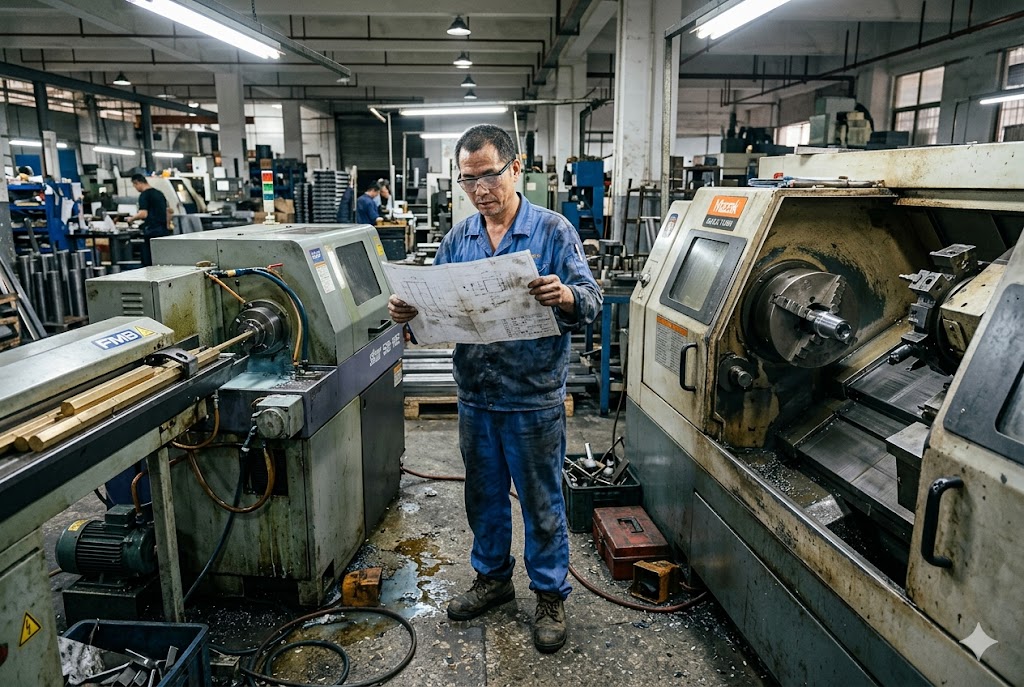
Every week, customers send us drawings of small, slender precision parts and ask why their current supplier keeps missing tolerances. After years of sourcing and managing production of custom mechanical parts across China and Vietnam, I've seen this problem traced back to the same root cause: the wrong machine for the job.
Swiss-type CNC lathes use a sliding headstock that pushes bar stock axially through a fixed guide bushing, while conventional CNC lathes hold the workpiece in a stationary chuck and move the cutting tool. This fundamental kinematic difference makes Swiss-type machines far superior for long, slender, small-diameter precision parts.
Understanding which lathe type fits your part is not a minor detail. It directly affects your tolerances, your cycle time, and your cost per piece. Let's break it down section by section.
Why Are Swiss-Type Lathes Superior for Long, Slender, Small-Diameter Precision Parts?
Customers often come to us frustrated. Their parts look simple on paper, but the supplier keeps delivering out-of-tolerance shafts or pins. When I look at the drawings, the answer is usually clear: the parts are long, thin, and tight on tolerance — and they were made on the wrong machine.
Swiss-type lathes are superior for long, slender, small-diameter parts because the guide bushing supports the workpiece directly at the cutting zone, preventing deflection. This allows consistent tolerances across the full length of parts with high length-to-diameter ratios, which conventional chuck-based lathes cannot reliably achieve.
The Physics Behind the Problem
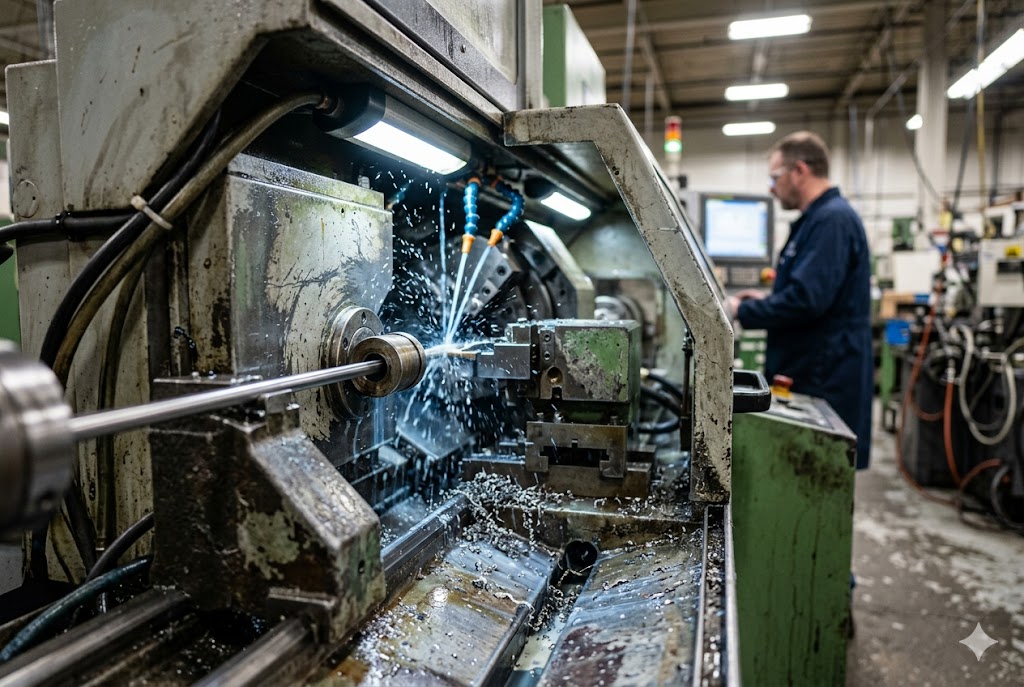
When you machine a long, thin bar on a conventional lathe, the cutting force pushes the workpiece sideways. The further the tool is from the chuck, the more the bar bends. This bending is called deflection [1]. Even a small amount of deflection causes dimensional error. On a part that is 100mm long and only 4mm in diameter, deflection can easily push you outside your tolerance band.
Swiss-type machines solve this at the mechanical level. The bar stock feeds through a guide bushing. The bushing sits right next to the cutting tool. The workpiece is supported exactly where the cut happens. There is almost no unsupported length. Deflection is effectively eliminated.
Length-to-Diameter Ratio: The Key Metric
Machinists use the length-to-diameter (L/D) ratio to judge how difficult a part is to hold in tolerance. Here is a simple reference:
| L/D Ratio | Difficulty on Conventional Lathe | Recommended Machine |
|---|---|---|
| Under 3:1 | Low — chuck provides enough rigidity | Conventional CNC lathe |
| 3:1 to 6:1 | Medium — steady rest may be needed | Either, with support tooling |
| 6:1 to 20:1 | High — deflection is a serious risk | Swiss-type lathe preferred |
| Over 20:1 | Very high — conventional lathe not suitable | Swiss-type lathe required |
Most Swiss-type machines [2] handle bar stock up to 32mm or 38mm in diameter. Within that size range, they can machine parts with L/D ratios that would be impossible to hold on a conventional lathe without multiple setups and support tools.
High-Volume Efficiency for Small Parts
Swiss-type machines are also built for continuous production. Bar stock feeds automatically from a bar feeder through the headstock. The machine runs part after part without stopping to reload. This makes them ideal for high-volume runs of small precision components. Lights-out production [3] — running overnight without an operator — is common on Swiss-type machines.
Conventional lathes require the operator to load each workpiece individually. For small, high-volume parts, this adds significant labor cost and slows throughput.
Integrated Multi-Operation Capability
Most Swiss-type machines include a sub-spindle and live tooling. This means the machine can turn, drill, mill, thread, and part off — all in one cycle. The finished part drops into a collection bin complete. No secondary operations. No re-fixturing. This single-setup capability is a major advantage for complex small parts that would otherwise require two or three machines on a conventional line.
What Part Geometries Are Best Suited to Swiss-Type Machining Versus Standard CNC Turning?
One of the most common questions I get from purchasing managers is: "Can this part be made on a Swiss machine?" The answer depends on geometry, not just size. Choosing the right process starts with understanding what each machine type handles well.
Swiss-type machining is best suited for parts under 32mm in diameter with high length-to-diameter ratios, complex features across the full length, or tight tolerances on small features. Standard CNC turning is better for shorter, larger-diameter parts where the chuck provides sufficient rigidity and the geometry does not demand continuous workpiece support.
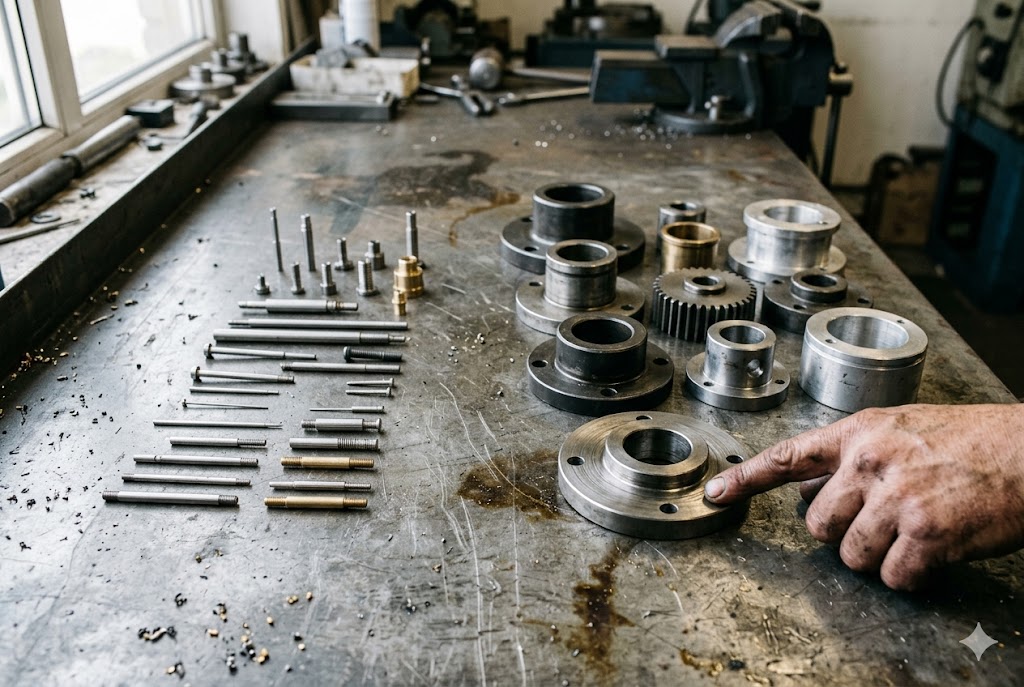
Swiss-Type: Ideal Part Characteristics
Swiss-type machines excel when the part has one or more of the following characteristics: - Diameter under 32mm (some machines go to 38mm) - Long relative to its diameter (L/D ratio above 6:1) - Multiple features along the full length (grooves, threads, undercuts, cross-holes) - Tight dimensional tolerances (±0.005mm or tighter) - High surface finish requirements - High production volume
Typical Swiss-type parts include medical bone screws [4], dental implant components [5], watch movement shafts [6], hydraulic valve spools [7], fuel injector pins [8], and miniature connector pins.
Standard CNC Turning: Ideal Part Characteristics
Conventional CNC lathes are the right choice when: - The part diameter is larger than 32–38mm - The part is short relative to its diameter (L/D under 3:1) - The geometry is simple — basic OD turning, facing, boring - Tolerances are moderate (±0.02mm or looser) - The production volume is low to medium
Typical conventional lathe parts include flanges, hubs, bushings, short shafts, and large-diameter fittings.
Side-by-Side Geometry Comparison
| Feature | Swiss-Type Lathe | Conventional CNC Lathe |
|---|---|---|
| Max bar diameter | Up to 32mm or 38mm | 50mm to 500mm+ |
| Best L/D ratio | 6:1 and above | Under 6:1 |
| Complex multi-feature parts | Excellent — one setup | Often requires multiple setups |
| Large diameter parts | Not suitable | Excellent |
| Tight tolerances on small parts | Excellent | Moderate |
| Short, stubby parts | Less efficient | Efficient |
| High-volume small parts | Highly efficient | Less efficient |
Where Geometry Creates Problems
Some geometries cause trouble on Swiss-type machines. Very short parts — shorter than the guide bushing length — cannot be properly supported and fed. Parts with large flanges or heads that exceed the bar stock diameter cannot pass through the guide bushing at all. In these cases, a conventional lathe or a guide-bushing-less Swiss machine may be the better option.
Guide-bushing-less Swiss machines are a newer hybrid. They remove the guide bushing to reduce bar remnant waste and allow shorter workpieces. They sacrifice some deflection control but offer more flexibility for certain geometries. They are worth considering when your part is borderline in length and you want to minimize material waste.
Tolerances and Surface Finish
Swiss-type machines routinely hold tolerances of ±0.005mm on small diameters. Some high-end machines reach ±0.002mm. Conventional lathes typically hold ±0.01mm to ±0.02mm under normal production conditions. If your drawing calls for tight tolerances on a small-diameter part, Swiss-type machining is almost always the correct process.
How Does the Guide Bushing in a Swiss-Type Lathe Improve Rigidity and Reduce Deflection?
When I explain Swiss-type machining to customers who are new to the process, the guide bushing is always the part that surprises them most. It looks like a simple sleeve. But it is the single most important element that separates Swiss-type performance from everything else.
The guide bushing in a Swiss-type lathe supports the bar stock immediately at the point of cutting. This eliminates the unsupported overhang that causes deflection on conventional lathes. The result is dramatically improved rigidity, tighter tolerances, and better surface finish on long, slender workpieces.
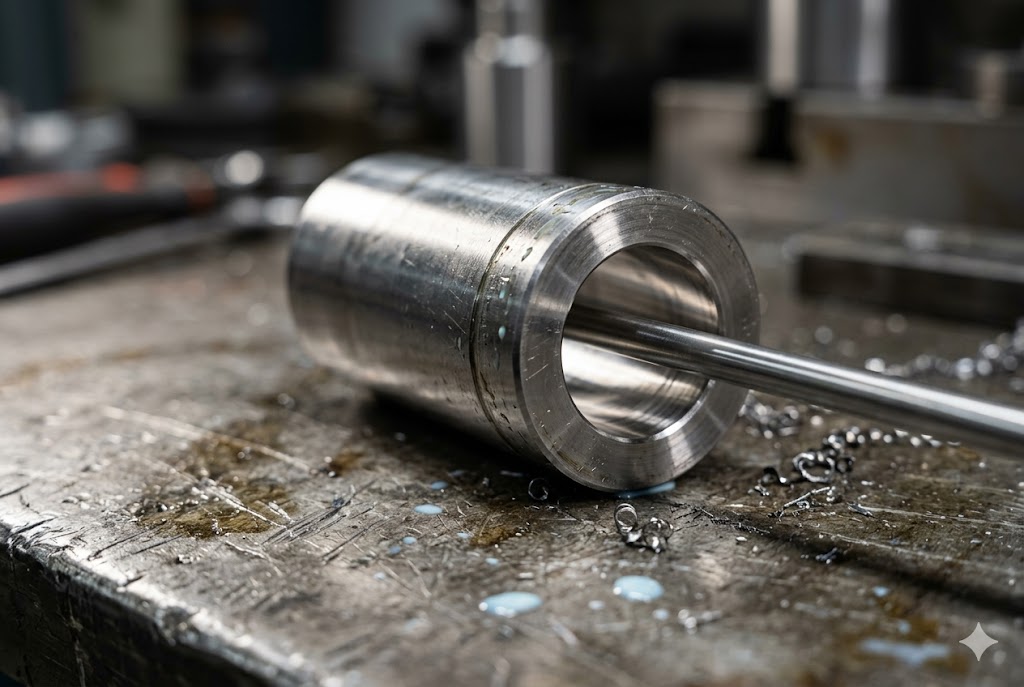
What the Guide Bushing Actually Does
The guide bushing is a precision-bored sleeve mounted in a fixed position on the machine. The bar stock passes through the headstock, through the guide bushing, and into the cutting zone. The cutting tools are positioned just in front of the bushing — sometimes within 1–2mm of it.
Because the bushing grips the bar stock right at the cutting point, the workpiece has almost no free length to bend. The cutting force is absorbed by the bushing, not by the bar stock itself. This is fundamentally different from a conventional lathe, where the workpiece is only held at one end (the chuck) and the tool applies force at a distance.
Deflection: A Quantitative Perspective
Deflection in a cantilevered bar [9] follows basic beam mechanics. The deflection increases with the cube of the unsupported length. Double the unsupported length, and deflection increases eightfold. This is why even a modest increase in part length causes dramatic accuracy problems on a conventional lathe.
On a Swiss-type machine, the unsupported length between the bushing and the cutting tool is typically 1–3mm. On a conventional lathe machining a 100mm part, the unsupported length could be 80–100mm. The difference in deflection is enormous.
Guide Bushing Clearance: A Critical Variable
The guide bushing must be matched precisely to the bar stock diameter. If the clearance is too large, the bar can vibrate inside the bushing. This vibration introduces error and poor surface finish. If the clearance is too tight, the bar binds and feeding becomes inconsistent.
This is why Swiss-type machining has a material quality dependency that conventional lathes do not. The bar stock must be ground or precision-drawn to a consistent diameter. Standard hot-rolled or rough-turned bar stock is not acceptable. Out-of-tolerance bar stock will cause problems even on a perfectly set-up Swiss machine.
| Bar Stock Condition | Effect on Swiss-Type Machining |
|---|---|
| Precision-ground, consistent diameter | Optimal — bushing fits correctly, no vibration |
| Cold-drawn, moderate tolerance [10] | Acceptable for most applications |
| Hot-rolled, rough surface | Not suitable — causes vibration and error |
| Out-of-tolerance diameter variation | Introduces chatter, poor finish, dimensional error |
Thermal and Chip Management Near the Bushing
The guide bushing creates a very confined cutting zone. Chips and heat are generated in a small space. If chips are not cleared quickly, they can be re-cut by the tool. Re-cutting chips damages the surface finish and can cause tool breakage.
Coolant delivery must be carefully engineered on Swiss-type machines. High-pressure coolant directed precisely at the cutting zone is standard practice. Some machines use through-tool coolant to flush chips away from the bushing immediately. Thermal growth is also a concern. The bushing and the bar stock expand at different rates as temperature rises. On micro-precision parts, even a few microns of thermal growth can push a part out of tolerance. Good Swiss-type machining requires stable coolant temperature and warm-up cycles before production begins.
Guide-Bushing-Less Machines: The Trade-Off
Some modern Swiss-type machines can run without a guide bushing. This reduces bar remnant waste — the short piece of bar stock left over at the end of each bar that cannot be fed through the bushing. It also allows shorter parts to be machined. However, removing the guide bushing reduces rigidity. The machine behaves more like a conventional lathe for short parts. For long, slender parts, the guide bushing is still essential.
When Is a Conventional CNC Lathe Actually a Better Choice Than a Swiss-Type Lathe for My Part?
I want to be honest with customers: Swiss-type machines are not always the answer. I've seen projects where someone specified Swiss machining because it sounded more precise, but the part geometry made it the wrong choice. The result was higher cost and no improvement in quality.
A conventional CNC lathe is a better choice when the part diameter exceeds 32–38mm, the length-to-diameter ratio is low, the geometry is simple, tolerances are moderate, or production volume is low. Swiss-type machines add cost and complexity that is only justified when the part genuinely requires their specific capabilities.
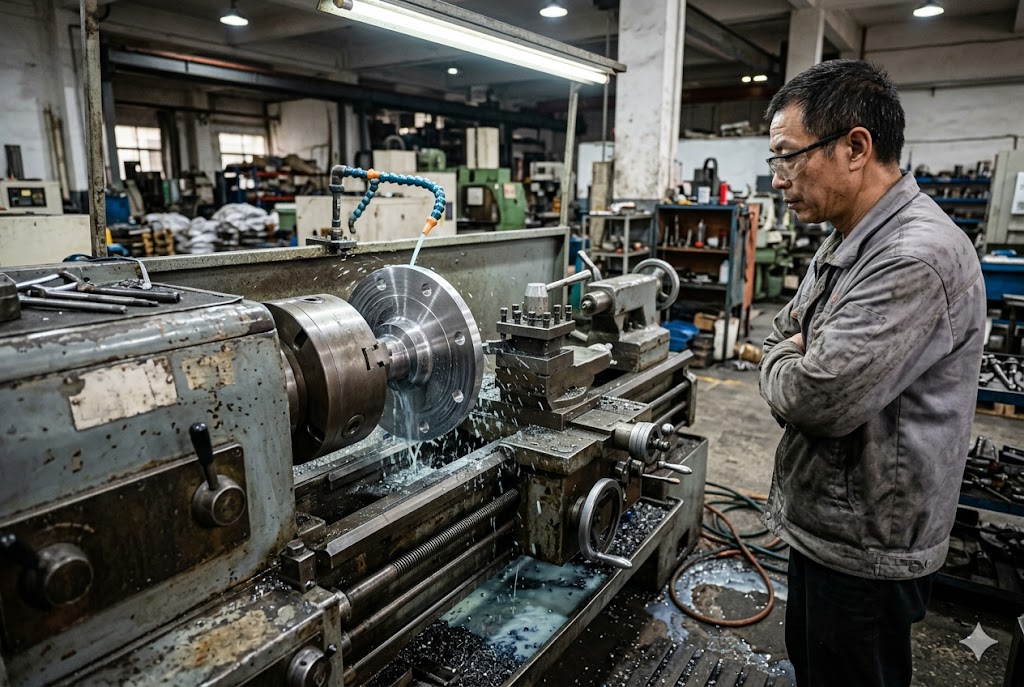
When Conventional Lathes Win
Here are the clearest situations where a conventional CNC lathe is the right machine:
Large diameter parts. If your part is 50mm, 80mm, or 200mm in diameter, a Swiss-type machine cannot help you. The guide bushing and headstock bore have a hard size limit. Conventional lathes handle large diameters easily.
Short, stubby parts. A part that is 20mm long and 15mm in diameter has an L/D ratio of about 1.3:1. The chuck on a conventional lathe provides more than enough rigidity. There is no deflection problem to solve. Running this part on a Swiss machine wastes machine time and adds unnecessary cost.
Low production volume. Swiss-type machines require careful setup, bar feeder loading, and guide bushing selection. For a run of 50 pieces, the setup time may exceed the actual machining time. A conventional lathe with a skilled operator is faster and cheaper for small batches.
Simple geometry. If the part only needs OD turning, facing, and a single bore, a conventional lathe completes it efficiently. The multi-axis capability of a Swiss machine is not needed and not worth paying for.
Non-ground bar stock. If your material specification does not include precision-ground bar stock, and switching to ground bar adds significant cost, a conventional lathe avoids this dependency entirely.
Decision Framework
Use this table to guide your machine selection:
| Decision Factor | Choose Swiss-Type | Choose Conventional Lathe |
|---|---|---|
| Part diameter | Under 32mm | Over 38mm |
| L/D ratio | Above 6:1 | Under 3:1 |
| Tolerance requirement | ±0.005mm or tighter | ±0.02mm or looser |
| Production volume | High (thousands of pieces) | Low to medium |
| Part complexity | Multiple features along full length | Simple turning and boring |
| Bar stock type | Precision-ground available | Standard bar stock acceptable |
| Budget for setup | Higher setup cost acceptable | Lower setup cost preferred |
The Cost Reality
Swiss-type machines are expensive to buy and to run. Machine hourly rates for Swiss-type CNC are typically higher than for conventional CNC lathes. If your part does not need the capabilities of a Swiss machine, you are paying a premium for nothing. A good purchasing manager asks the supplier to justify the machine choice, not just accept it.
At our company, when we source parts for clients, we always review the drawing before recommending a process. We ask: What is the diameter? What is the L/D ratio? What are the tolerance requirements? What is the volume? The answers determine the machine. We do not default to Swiss machining because it sounds impressive. We choose it when the part demands it.
When to Question Your Supplier
If a supplier quotes a Swiss-type machine for a part that is 60mm in diameter and 40mm long, ask why. If a supplier quotes a conventional lathe for a 3mm diameter shaft that is 80mm long with ±0.005mm tolerances, push back. Machine selection should be driven by part requirements, not by what equipment the supplier happens to have available.
Conclusion
Choosing between a Swiss-type lathe and a conventional CNC lathe comes down to your part geometry. Match the machine to the part — not the other way around — and your tolerances, cost, and delivery will all improve.
Footnotes
1. Engineering explanation of deflection and its effect on machined workpiece accuracy. ↩
2. Overview of Swiss-type screw machines, their history, design, and capabilities. ↩
3. Wikipedia article on lights-out manufacturing — fully automated, unattended production. ↩
4. Detailed reference on bone screws, their types, and orthopedic surgical applications. ↩
5. Overview of dental implants, their components, and precision manufacturing requirements. ↩
6. Reference on watch movements and the precision mechanical components they contain. ↩
7. Explanation of spool valves, their construction, and use in hydraulic systems. ↩
8. Overview of fuel injectors, their function, and precision component tolerances. ↩
9. Structural explanation of cantilever beams and how unsupported length affects deflection. ↩
10. Reference on the cold drawing process and the dimensional accuracy it produces in bar stock. ↩