Skip to main content Skip to footer

We have shipped thousands of custom CNC machined part orders to buyers in the US and Canada. We know the moment a buyer discovers a batch of out-of-tolerance parts, the first question becomes: who pays, and how much?
Quality compensation for imported custom CNC parts should be defined before production starts, not after a defect is found. A clear contract must specify what counts as a defect, how damages are calculated, which remedies apply in what order, and how long the buyer has to file a claim. Without these terms, enforcement is nearly impossible.
Most disputes are not about whether a defect exists. They are about what the contract says. Get the wording right upfront, and you hold real leverage.
What Quality Failures Should Trigger Supplier Compensation?
Every week, our team reviews inspection reports from our supplier factories. Vague defect definitions cause more disputes than any other issue. Buyers and suppliers argue over whether a deviation is "significant" instead of simply checking a number.
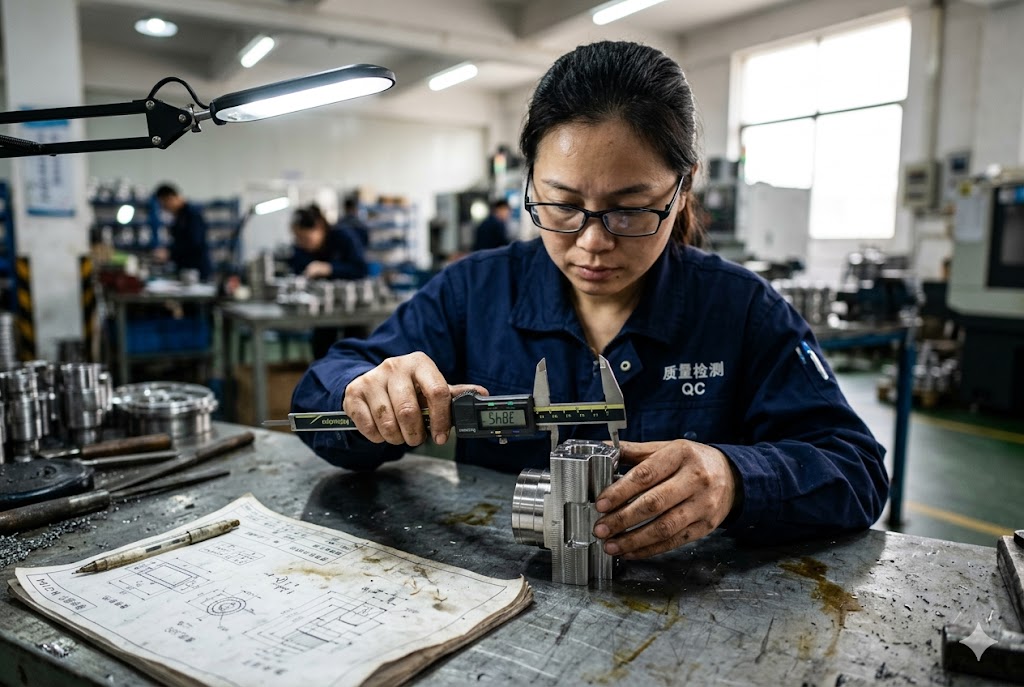
A quality failure that triggers supplier compensation must be defined using measurable criteria linked directly to your technical drawings. This includes dimensional deviations beyond your stated GD&T tolerances, surface finish values outside the agreed Ra range, wrong material grade, and any non-conformance to referenced industry standards.
Tie Every Defect to a Number
Subjective language fails in disputes. Words like "poor quality" or "not acceptable" give the supplier room to argue. Instead, define defects using exact values from your drawings.
Here are the common defect types and how to define them contractually:
| Defect Type | Vague Definition (Avoid) | Measurable Definition (Use This) |
|---|---|---|
| Dimensional deviation | "Out of tolerance" | Deviation exceeds ±0.05 mm per drawing callout on any critical dimension |
| Surface finish | "Rough surface" | Ra value exceeds 1.6 µm where Ra 0.8 µm is specified |
| Wrong material | "Incorrect grade" | Material cert does not confirm 6061-T6 aluminium or equivalent per PO |
| Visual defects | "Bad appearance" | Scratches deeper than 0.1 mm or burrs above 0.2 mm on any mating surface |
| Plating failure | "Coating looks wrong" | Coating thickness below 12 µm per agreed specification sheet |
What Standards Should You Reference?
Reference specific standards by name and number in the contract. For CNC machined parts, common references include:
- ISO 2768 1 for general dimensional tolerances
- ASME Y14.5 for GD&T interpretation
- ISO 1302 for surface texture callouts
- ASTM or EN material standards for alloy grades
When both parties know which standard applies, there is no room for interpretation.
Do Not Forget Non-Dimensional Failures
Dimensional tolerance failures get most of the attention. But these failures also trigger legitimate claims:
- Missing features (holes not drilled, threads not cut)
- Wrong thread pitch or depth
- Incorrect heat treatment or hardness
- Contamination or embedded debris
- Parts mixed between different revision levels
List these explicitly in your quality clause. Silence means no remedy.
How Can I Calculate Compensation for Scrap, Rework, or Customer Claims?
Our team has worked through dozens of compensation disputes between buyers and Chinese manufacturers. The biggest mistake buyers make is expecting a factory to volunteer a fair number. Compensation must be calculated by the buyer and documented before the negotiation starts.
Compensation for CNC part defects should be calculated as a tiered amount covering direct costs first: scrap value, rework labor, return freight, and re-inspection fees. Where downstream customer claims are involved, document those separately with receipts. The total claim must reflect real, provable losses tied to the supplier's specific failure.
Use a Tiered Remedy Structure
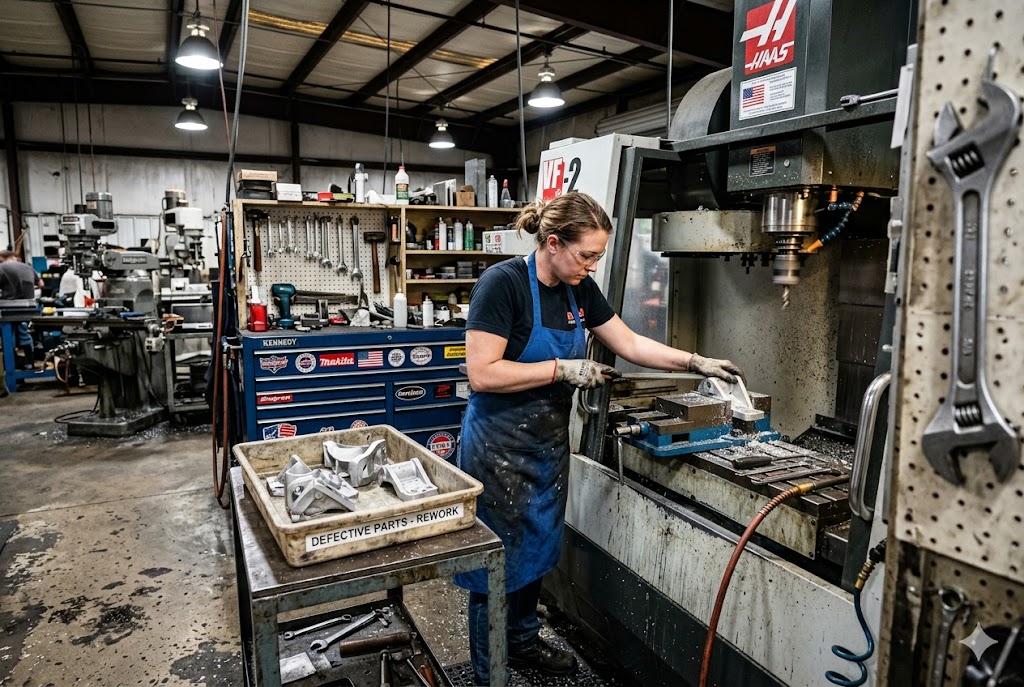
Do not leave the choice of remedy to the supplier. Structure your contract so remedies follow a fixed priority, and the buyer — not the factory — selects which remedy applies.
| Remedy Tier | Description | Who Chooses |
|---|---|---|
| Tier 1 — Rework or Replacement | Supplier funds full rework or ships replacement parts at no cost, including return freight | Buyer |
| Tier 2 — Invoice Credit | A price credit is applied against the current or next invoice | Buyer |
| Tier 3 — Cash Refund | Full or partial refund for the defective quantity | Buyer |
This order matters. Suppliers almost always prefer Tier 2 because a future credit costs them less in cash flow. Without the buyer controlling the choice, the factory defaults to whichever option suits them.
How to Calculate Scrap Costs
When parts are scrapped, your claim should include:
- Unit cost × defective quantity — the base refund amount
- Return freight — cost to send parts back to the supplier, if required
- Third-party inspection fee — if you hired an inspector to confirm the defect rate
- Re-inspection cost — time and cost to check the rest of the batch
How to Calculate Rework Costs
If you rework parts locally rather than returning them, document every cost:
- Labor hours × hourly shop rate
- Materials consumed (tooling, coatings, consumables)
- Machine time
- Quality re-check time
Provide these as a written breakdown with supporting invoices. A lump-sum claim without documentation will be challenged.
Epidemic Failure Clauses
When a systemic defect affects a defined percentage of a batch, standard per-unit remedies are not enough. Include an epidemic failure clause. A typical threshold is 3–5% of the batch quantity. The Acceptance Quality Limit (AQL) 2 framework from ISO 2859-1 provides the statistical basis for setting and defending these defect thresholds contractually. When the defect rate crosses this threshold, escalated remedies apply:
- Full batch rejection right
- 100% re-inspection at supplier cost
- Right to source replacement parts from an alternative supplier and back-charge the cost differential to the original supplier
This clause changes the conversation from individual defective parts to systemic production failure — which is what a high defect rate actually represents.
Should I Define Credit, Replacement, or Refund Terms in Advance?
We have seen buyers lose disputes simply because their contract said nothing about which remedy applies. The factory offered a 5% discount on the next order. The buyer expected a full replacement. Neither position was defined in writing.
Yes, you must define credit, replacement, and refund terms before you place the order. The contract should state the priority order of remedies, who selects the remedy, the timeframe for the supplier to deliver on the chosen remedy, and what happens if the supplier fails to perform the remedy within that timeframe.

Payment Withholding Is Your Strongest Tool
The most effective leverage you have with a Chinese manufacturer is unpaid money. Once a factory has been paid in full, their financial incentive to resolve a quality dispute drops sharply. Structure your payment terms to withhold a final balance until after inspection is complete.
A common and effective structure:
| Payment Stage | Percentage | Trigger |
|---|---|---|
| Deposit | 30% | Purchase order confirmed |
| Milestone payment | 50% | Parts ready for pre-shipment inspection |
| Final balance | 20% | Post-receipt inspection passed and parts formally accepted |
The 20% final balance is your leverage. It is not punishment — it is the financial mechanism that keeps the supplier engaged until you have confirmed the parts meet your specifications.
Conducting a thorough pre-shipment inspection in China 3 before releasing this final payment is the most practical way to verify conformance before you lose financial control over the outcome.
Require a Defined Remedy Timeline
Stating the remedy is not enough. Define how long the supplier has to execute it. If no timeline is written, disputes about "reasonable time" replace disputes about the defect itself.
A practical remedy timeline framework:
- Supplier acknowledgment of claim: within 3 business days of submission
- Replacement parts shipped: within 15–25 business days depending on part complexity
- Rework completed and re-shipped: within 10–20 business days
- Credit applied to invoice: within 5 business days of agreement
If the supplier misses these timelines, define the escalation: the buyer's right to source from a third party and back-charge the difference.
Exclude Buyer-Caused Defects
Define what is not the supplier's liability. Without this, factories blame every quality issue on the buyer's CAD files or specifications. Your contract should explicitly state that defects caused by the following are excluded from supplier compensation:
- Design errors in buyer-provided drawings
- Incomplete or contradictory specifications
- Post-delivery mishandling or improper storage by the buyer
This boundary protects both parties. It keeps legitimate supplier liability clear and prevents endless disputes about who caused the problem.
What Wording Makes Quality Liability Easier to Enforce?
Our contract team reviews supplier agreements every quarter. We have learned that well-meaning clauses become unenforceable the moment they use vague language, inconsistent terminology, or terms that do not map to how Chinese courts and arbitration bodies actually assess claims.
Enforceable quality liability wording must use precise, measurable language; define a formal claim window of 7–15 days from confirmed delivery; require written notice with photographic evidence and batch numbers; reference the governing law and dispute resolution body; and include liquidated damages calibrated to approximately 130% of demonstrable actual losses.

The Claim Window Must Be Written Down
A claim window is the period after delivery during which the buyer must submit a formal defect notice. Outside this window, the supplier's compensation obligation expires.
Recommended claim window by inspection type:
- Visual and dimensional inspection with calipers: 7 days from confirmed delivery
- CMM or coordinate measurement inspection 4: 15 days from confirmed delivery
- Functional testing under load or pressure: 20 days from confirmed delivery
- Regulated industries (aerospace, medical, automotive): negotiate 30 days minimum
Make the window long enough for your actual inspection process. If your team needs CMM time and that takes a week to schedule, a 7-day window leaves you exposed.
What a Formal Claim Must Include
Define exactly what the buyer must submit to activate the compensation clause. Without this, suppliers dispute whether a claim was properly filed.
A complete claim submission should include:
- Written notice (email is sufficient if confirmed received)
- Purchase order number and invoice reference
- Batch or lot number of affected parts
- Photographic evidence of each defect type
- Inspection report, CMM report, or equivalent measurement data
- Quantity confirmed defective and method used to determine defect rate
Liquidated Damages: Set the Right Amount
Chinese courts will uphold liquidated damages clauses 5 — but only if the amount approximates actual loss. Penalty-style amounts that vastly exceed provable harm are routinely reduced by arbitrators. A calibration of approximately 130% of your demonstrable actual loss is the practical ceiling that Chinese judicial bodies consistently uphold.
This means: calculate your real direct losses first. Then write your liquidated damages clause at 1.3× that amount. Do not write a punitive number hoping it creates deterrence — it will be reduced, and the reduction weakens your overall claim.
Downstream Liability for Regulated Industries
If your CNC parts go into aerospace, medical devices, or automotive assemblies, add a downstream liability indemnification clause. This requires the supplier to cover your direct costs — recall logistics, re-inspection, and customer chargebacks — when their manufacturing defect reaches end use.
Chinese courts cap such awards in practice. But the clause creates a documented contractual basis for negotiated settlement and removes the supplier's ability to dispute liability origin entirely. When a claim reaches negotiation, having this clause is the difference between a productive conversation and a dead end.
Governing Law and Dispute Resolution
Specify where disputes are resolved. Common options for China-sourced parts:
- CIETAC arbitration 6 (China International Economic and Trade Arbitration Commission) — recognized in China, enforceable against Chinese suppliers
- HKIAC arbitration 7 (Hong Kong International Arbitration Centre) — neutral venue, English-language proceedings, internationally recognized
- ICC arbitration — international recognition but higher cost
Chinese courts will enforce CIETAC and HKIAC awards against domestic manufacturers. For most B2B import contracts under USD 500,000, CIETAC is the most practical choice.
The enforceability of CIETAC and HKIAC clauses against Chinese suppliers depends critically on how the arbitration clause is worded in the original contract 8 — vague or inconsistent dispute resolution language is one of the most common reasons enforcement fails.
Conclusion
Define defects with numbers. Structure remedies with buyer's choice. Withhold final payment until inspection passes. Set a real claim window. Write damages at 130% of actual loss. These five steps give you enforceable quality compensation terms before the first part ships.
When referencing dimensional standards in your contracts, ASME Y14.5 9 governs how GD&T callouts on your drawings are interpreted, and ISO 1302 10 establishes the symbols and rules for surface finish requirements — both are essential references to name explicitly in any quality compensation clause tied to drawing specifications.
Footnotes
1. ISO 2768 defines general dimensional tolerances for machined parts across four classes. ↩︎
2. QIMA's AQL guide explains defect thresholds and batch acceptance sampling per ISO 2859-1. ↩︎
3. Insight Quality Services outlines best practices for pre-shipment inspection in China. ↩︎
4. Creaform explains how CMMs work and why they are used for tight-tolerance part verification. ↩︎
5. China Business Law Journal compares liquidated damages enforceability under mainland and Hong Kong law. ↩︎
6. CIETAC is China's primary permanent arbitration body for resolving international commercial disputes. ↩︎
7. HKIAC provides neutral, internationally recognized arbitration services for cross-border trade disputes. ↩︎
8. Harris Bricken explains how contract wording determines whether China arbitration clauses can be enforced. ↩︎
9. ASME Y14.5 is the authoritative standard for geometric dimensioning and tolerancing on engineering drawings. ↩︎
10. ISO 1302 specifies graphical symbols and rules for indicating surface texture requirements in technical documentation. ↩︎