Skip to main content Skip to footer
Every week, our team reviews drawings sent by clients who have already had a bad experience — parts rejected, lead times blown, or quotes that doubled after production started. Most of those problems trace back to one skipped step: nobody checked whether the factory could actually run the job before placing the order.
To evaluate whether a China sheet metal factory can handle your part size and material thickness, you must request three specific numbers before anything else: the press brake's rated tonnage and bed length, the laser cutter's maximum thickness by material type, and the cutting bed dimensions — then cross-check all three against your flat blank size and bend requirements, not your finished part dimensions.
Once you know what to ask for, the evaluation takes less than one conversation. The sections below walk you through each check, in order.
What Factory Limits Should I Check Before I Send Large Sheet Metal Drawings to China?
Our sourcing team has reviewed hundreds of factory capability sheets over the years, and the same pattern repeats: factories list headline numbers that sound impressive but leave out the variables that actually determine whether they can run your specific job. Sending drawings before doing this check wastes everyone's time.
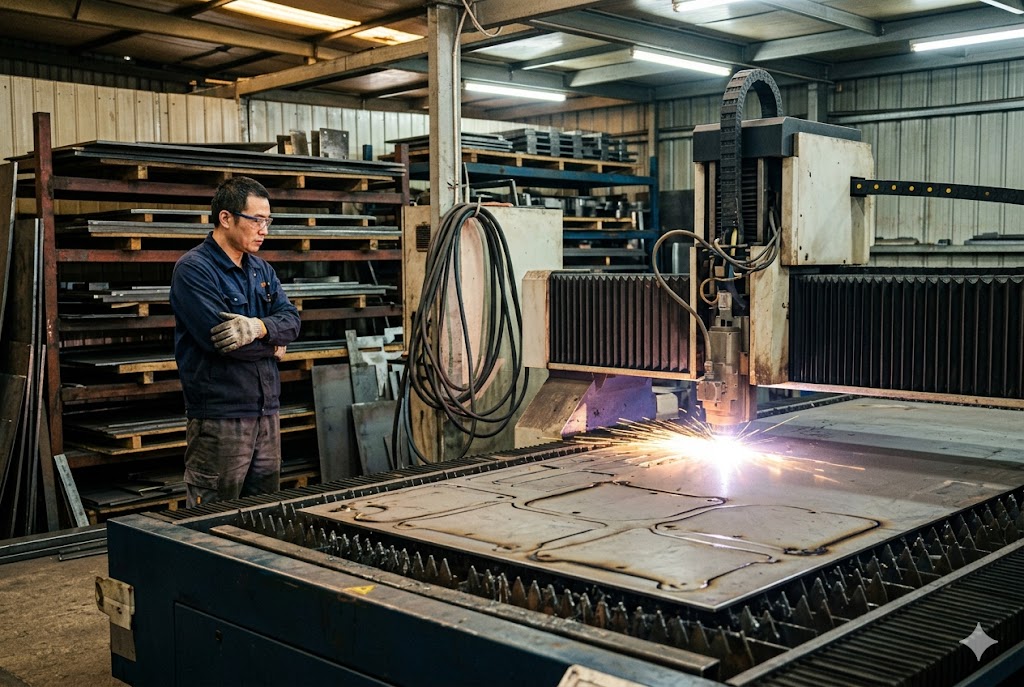
Before sending any large sheet metal drawing to a factory in China, you must verify four limits in this order: press brake bed length versus your flat blank length, press brake rated tonnage versus your required bending force, laser cutting bed size versus your blank dimensions, and laser maximum thickness by your specific material grade — not a single generic maximum.
The Four Numbers You Need First
Most purchasing managers ask for a "capability overview" and get a PDF full of machine brand names. That document tells you almost nothing. Ask for specific numbers instead.
| Capability to Check | What to Ask For | Why It Matters |
|---|---|---|
| Press brake bed length | Maximum working table length in mm | Your flat blank must fit in a single hit |
| Press brake rated tonnage | Total tonnage at full bed length | Insufficient tonnage causes angular error |
| Laser cutting bed size | Sheet capacity in mm × mm | Determines maximum blank size without repositioning |
| Laser thickness by material | Max thickness per material type (mild steel / stainless / aluminum) | A single "max 25mm" number hides real gaps |
Why Flat Blank Size Is the Right Measurement
This is the most common mistake we see. A client sends a drawing of a finished part that is 800mm long and assumes any factory with an 800mm press brake can handle it. That assumption is wrong.
When you bend sheet metal, the flat blank size is always larger than the finished part 1 due to bend allowance calculations. A part with two 90-degree flanges of 50mm each on a 700mm base requires a flat blank of roughly 900mm or more, depending on material thickness and bend radius. A factory with a 900mm press brake bed can run it. A factory with an 800mm bed cannot — not in a single hit.
Forcing two hits on a part that requires one creates a seam, a precision risk, and usually an extra cost that nobody quoted you upfront.
Tonnage Is Not Optional to Verify
Bending stainless steel requires approximately 15 tons per meter of bend length for 3mm material 2. For a 1,000mm bend on 3mm stainless, you need at least 15 tons. A press brake rated at 100 tons sounds like more than enough — but rated tonnage at full bed length is often lower than the machine's peak rating. Ask for the tonnage rating at the specific working length your part needs.
A factory that overloads its press brake to hit your bend angle will either damage the tooling, spring the frame, or ship you parts with angular error that compounds across the production run.
Laser Thickness by Material Type
A fiber laser rated to cut 25mm mild steel may only cut 8mm to 10mm stainless steel reliably at the same power level 3 — and 6mm aluminum at best. Factories that give you a single maximum thickness number without specifying material are not being transparent about a real capability gap. Ask for a table. If they cannot produce one, that tells you something.
How Do I Confirm Whether My Sheet Thickness Is Within a Supplier's Real Production Range?
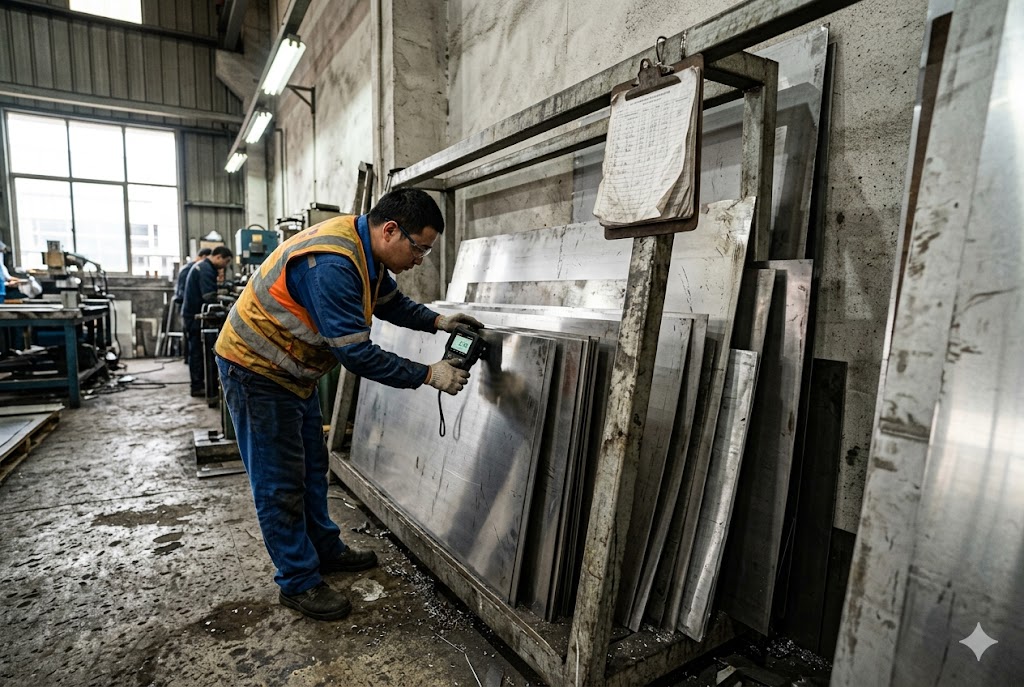
When we calibrate production runs for clients, we do not rely on what the factory tells us their machines can do. We ask what they do regularly — those are two different answers. A factory may technically own equipment rated for 12mm stainless, but if their standard work is 2mm mild steel, their tooling, programs, and operator habits are all calibrated for light gauge. Your heavy-gauge job will be an experiment on your dime.
To confirm a supplier's real production range for your sheet thickness, request their most recent jobs by material and thickness, ask for the specific bend allowance tables they use for your material grade, and request a first-article sample using your exact material — not a similar one — before committing to a production order.
Ask About Regular Work, Not Maximum Capability
There is a simple question that filters out factories fast: "What is the thickest stainless steel job you ran in the last 90 days, and what was the part?" A factory regularly processing 6mm stainless will answer immediately. A factory that rarely touches it will hesitate or give you a vague answer.
Regular work means calibrated tonnage data, accurate bend allowance tables 4, and tooling that is already conditioned for that material's springback behavior.
Springback Is Material-Specific
Stainless steel has a springback coefficient roughly 30% to 60% greater than that of carbon steel 5. A factory experienced only in mild steel will quote your stainless job with confidence and ship you parts with angular error — because springback compensation requires material-specific tooling adjustments and programming corrections that they have not yet calibrated for your alloy.
This is not incompetence. It is experience gap. A factory that processes stainless daily has already built those corrections into their CNC programs. One that rarely touches it has not.
The First-Article Sample Rule
| Validation Method | What It Confirms | What It Misses |
|---|---|---|
| Factory capability sheet | Machine specifications on paper | Real operator experience with your material |
| Similar material sample | General process capability | Springback, tonnage, and tooling gaps specific to your grade |
| Exact material first article | True capability on your specific job | Nothing — this is the correct method |
The only reliable validation is a first-article sample using your exact material grade and thickness. 304 stainless and 316 stainless behave differently under bending 6. 5052 aluminum and 6061 aluminum have different springback characteristics. Do not accept a sample in "a similar material." That sample is not your part.
Incoming Material Inspection Matters
Chinese mill tolerances on sheet metal can vary by ±0.1mm to ±0.15mm from nominal thickness. A factory that does not perform incoming material inspection transfers that variance directly into your finished part's bend radius and overall dimensional accuracy. Ask whether they measure incoming sheet thickness and what their acceptance criteria are. A factory with no answer to that question is running your job on unverified raw material.
Alloy-Specific Experience
Ask whether the factory stocks your required material grade or sources it per order. A factory that does not regularly process your specific alloy — for example, 316L stainless versus standard 304, or 6061-T6 versus 5052-H32 aluminum — may lack the calibrated data to hold tight tolerances reliably across a full production run, even if their equipment is technically capable.
Why Does Maximum Processing Size Affect My Cost and Lead Time?
Our project managers track this across every order we manage, and the pattern is consistent: parts that exceed a factory's standard processing size do not just cost more — they take longer, require more touchpoints, and generate more dimensional variation. The cost impact is rarely quoted upfront. It surfaces after the order is placed.
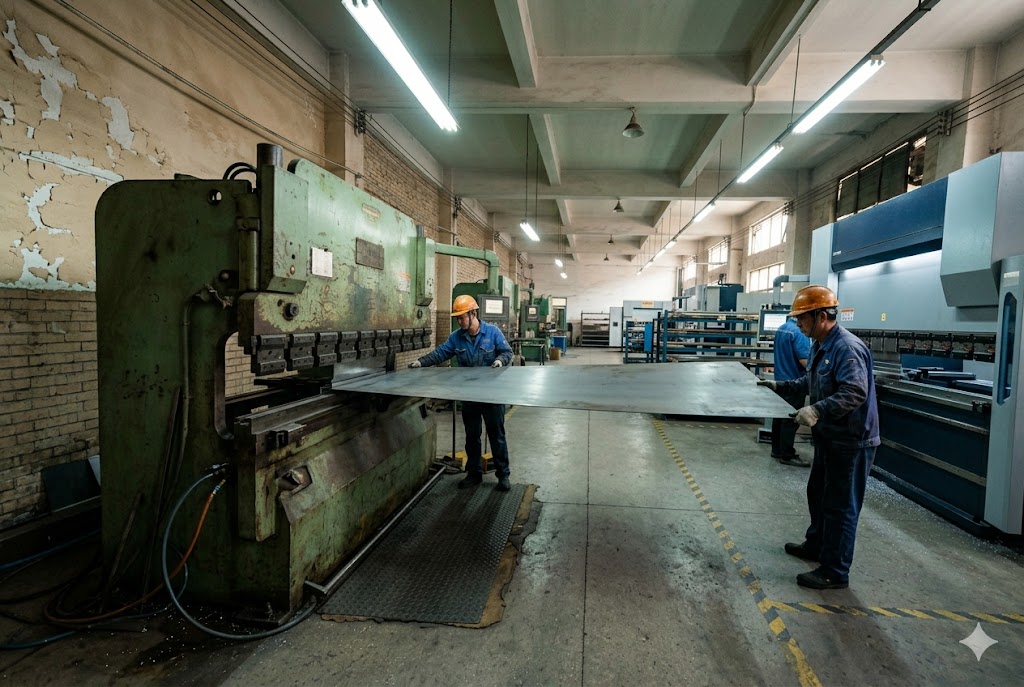
Maximum processing size affects cost and lead time because parts that exceed a factory's standard equipment capacity require secondary operations — additional bends, seam welds, repositioning setups, or subcontracting — each of which adds labor hours, introduces a new tolerance risk, and extends the production schedule in ways that are difficult to predict before the job starts.
How Size Overruns Generate Hidden Costs
When a part is too large for a factory's standard equipment, they have options — none of them free.
| Workaround | Added Cost | Added Risk |
|---|---|---|
| Split the blank into two pieces and seam weld | Welding labor + weld inspection | Weld distortion, dimensional drift at seam |
| Run two bending hits with repositioning | Setup time per hit | Angular error accumulates across hits |
| Subcontract to a larger factory | Markup + transport | Loss of quality oversight |
| Buy time on a larger machine at another facility | Machine rental or queue wait | Lead time uncertainty |
None of these workarounds appear in a standard quote. They appear in change orders after production starts — or worse, in a shipment that does not meet your drawing.
The Crowning System Factor
For parts longer than 1,000mm in material above 3mm thickness, ask specifically whether the factory's press brake has an automatic crowning system 7. Without crowning compensation, the press brake bed deflects under load and produces a bowed bend angle across the length of the part. No amount of operator skill corrects for bed deflection. It is a mechanical problem that requires a mechanical solution.
A factory without a crowning system on a long-bed press brake is structurally unable to hold consistent bend angles on large, thick parts — and the error is not visible until you measure the part.
CNC Punch Press Versus Laser for High-Volume Holes
If your part has a dense hole pattern — many holes of similar size across a large sheet — the choice of cutting method has a direct cost and lead-time impact. Laser cutting each hole individually is slower and more expensive at volume than CNC punch pressing 8. A factory that routes all such work through laser cutting will be structurally more expensive for repeat orders, regardless of their quoted price.
Ask whether the factory has a CNC punch press in addition to laser cutting. If they do not, factor the cost premium into your total landed cost calculation before comparing quotes.
What Should I Ask If My Sheet Metal Part Is Too Large for Standard Equipment?
When a client brings us a drawing that pushes beyond standard equipment limits, we do not stop at "the factory can't do it." We work through a structured set of questions to find out whether the job is still viable, at what cost, and with which factory configuration. Most large-part problems are solvable — but only if you ask the right questions before the order is placed.
If your sheet metal part is too large for a factory's standard equipment, ask these four questions in sequence: Can the part be split and joined with a structural weld that meets your drawing's requirements? Does the factory have a larger machine in-house or a reliable subcontractor with documented quality oversight? What is the realistic lead time impact of the secondary operation? And what dimensional tolerance can the factory guarantee on the finished assembly — not just the individual pieces?
Question One: Is a Structural Weld Acceptable on This Part?
The first question is not about the factory. It is about your drawing. Some parts can be split at a logical seam and welded without compromising function, appearance, or structural integrity. Others cannot. If your drawing specifies a single-piece blank, a weld is a nonconformance — full stop. If it does not, a weld may be a valid option, but it needs to be specified in the drawing with weld symbol, inspection criteria, and surface finish requirement before anyone quotes it.
Do not leave this decision to the factory. Make it yourself, with your engineering team, before you ask for a quote on the workaround.
Question Two: Material Handling Infrastructure
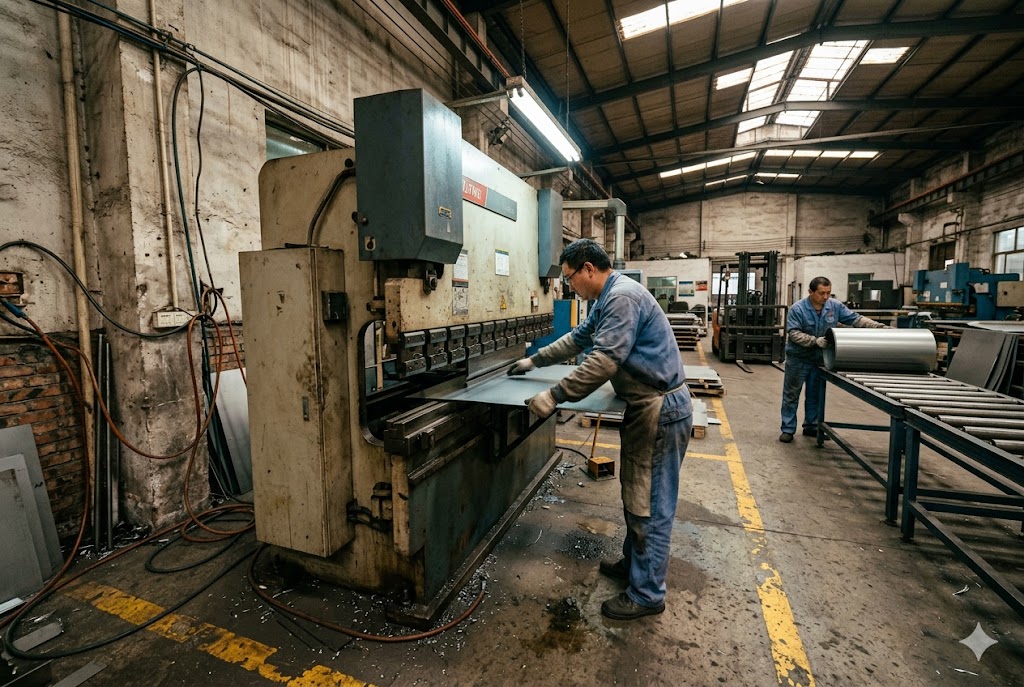
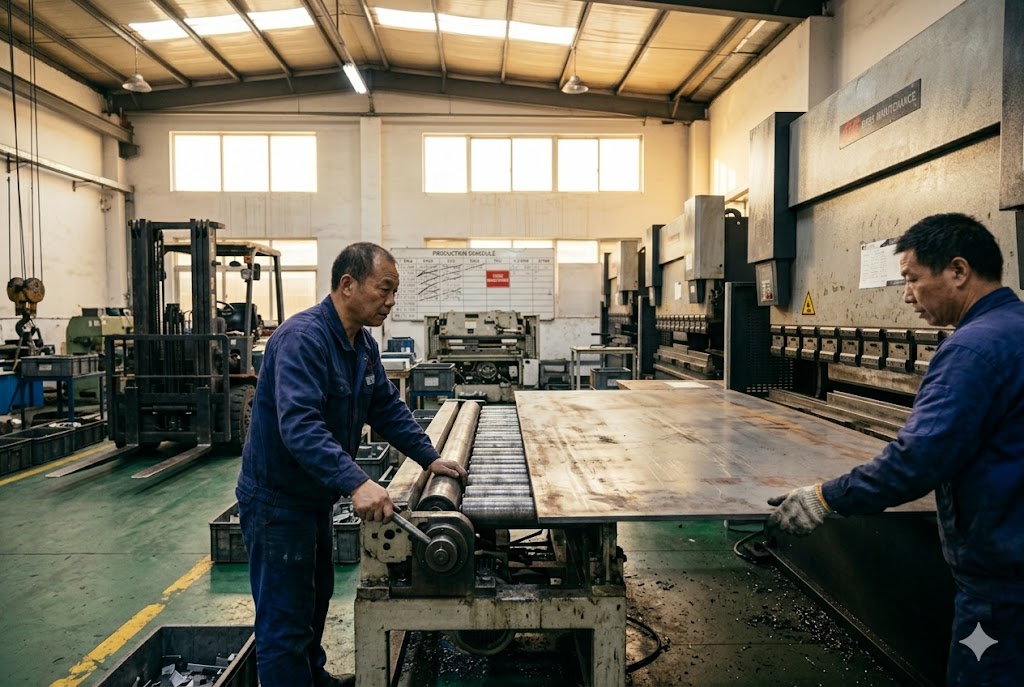
Large, heavy sheet metal blanks introduce a physical variable that most buyers do not consider: how does the factory move them? A 1,500mm × 3,000mm sheet of 6mm steel weighs over 200kg. Loading and positioning that blank on a press brake without powered material handling — roller tables, lifting aids, or manipulators — introduces operator fatigue and positional inconsistency into every bend hit.
That inconsistency is invisible in a first-article sample. It surfaces as batch-level dimensional variation once production volume increases. Ask specifically what material handling equipment the factory uses for blanks of your size and weight. Press brake manufacturers consistently note that supporting heavy material during the bend is essential to consistent angle results 9.
Question Three: CNC Controller Capability for Complex Bend Sequences
Multi-bend parts with tight interior flanges require the CNC back-gauge to reposition precisely between every hit. Factories running older NC controllers without multi-axis back-gauge automation 10 either produce angular drift across the sequence or require manual repositioning — both of which degrade part-to-part repeatability on complex geometry.
Ask what CNC controller brand the factory uses on their press brake. DELEM, Cybelec, and modern Estun controllers support programmable multi-axis back-gauge repositioning. Older NC controllers do not. For complex parts, this is not a minor detail.
Question Four: Subcontractor Transparency
If the factory needs to subcontract any part of your job to a larger facility, ask for that facility's name, location, and any audit documentation. You placed the order with one factory's quality system — you need visibility into any secondary facility that touches your parts. A factory that cannot or will not name their subcontractor for large-format work is asking you to accept a quality blind spot in your supply chain.
Conclusion
Evaluating a China sheet metal factory for your part size and thickness is not complicated — but it requires asking the right specific questions before you send drawings, not after you receive parts. Check bed length against flat blank size, verify tonnage and laser capacity by material type, confirm real production experience with your exact grade, and get transparent answers on any secondary operations or subcontracting. Those steps take one conversation and save months of rework.
Footnotes
1. Explains how K-factor and bend allowance determine accurate flat blank length before bending. ↩︎
2. Covers how to calculate required press brake tonnage based on material type and bend length. ↩︎
3. Details fiber laser cutting capacity limits by material type at different power levels. ↩︎
4. Explains K-factor values and how bend allowance tables are built for different materials. ↩︎
5. Compares springback behavior across material types and explains compensation methods. ↩︎
6. Details how stainless steel grades differ in springback and bending force requirements. ↩︎
7. Explains how automatic crowning systems compensate for press brake bed deflection on long parts. ↩︎
8. Compares cost and throughput of CNC punching versus laser cutting for high-volume hole patterns. ↩︎
9. Guides press brake tonnage limit calculation including material handling considerations. ↩︎
10. Covers multi-axis back-gauge features on modern CNC press brakes and their effect on repeatability. ↩︎