Skip to main content Skip to footer

We audit factories every month, and the single biggest gap we find between a good quote and a good part is always the same thing: equipment. Buyers send the same drawing to five suppliers and get five wildly different prices — and later, five different quality outcomes. That gap starts on the factory floor, not in the sales office.
A factory's equipment list directly determines what tolerances it can hold, how fast it can run your job, and what it must charge. Fiber laser cutters, CNC press brakes, in-house punch presses, and calibrated metrology tools together define the true precision ceiling and cost floor available to you on any given order.
Once you understand what each machine does to your part — and your price — you stop comparing quotes blindly and start asking the right questions before you commit.
What Machines Should I Look for Before I Trust a China Sheet Metal Supplier?
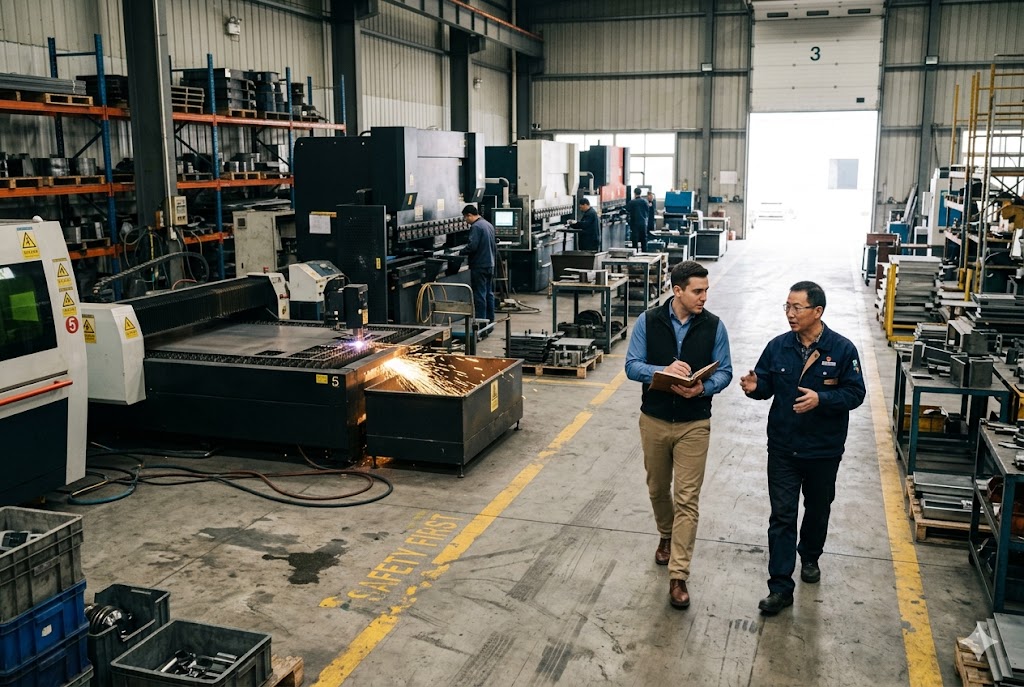
Every time we visit a factory on behalf of a client, the first walk we take is through the production floor, not the conference room. The machines we see — and the ones we don't — tell us more than any capability brochure ever will.
Before trusting a China sheet metal supplier, look for fiber laser cutters, CNC press brakes with back-gauging, CNC punch presses, in-house welding and finishing, and a metrology room with CMMs or vision systems. A factory missing any of these must outsource that step, which adds cost, delay, and quality risk to your order.
The Core Machines That Matter
Not every part needs every machine. But a factory's lineup tells you which jobs it can own from start to finish, and which ones it will quietly hand off to a subcontractor.
Here is a practical breakdown of what to look for and why each machine matters to your order:
| Machine | What It Does for Your Part | Red Flag If Missing |
|---|---|---|
| Fiber Laser Cutter | Cuts profiles to ±0.1 mm or tighter | Factory uses plasma or CO2 only |
| CNC Press Brake (with back-gauge) | Bends to ±0.5° consistently | Manual press brakes only |
| CNC Punch Press | Fast, repeatable holes and features at volume | All hole work routed through laser |
| Spot / MIG / TIG Welding | In-house joining without subcontracting | No welding capacity listed |
| CMM / Vision System | Verifies tolerances were actually held | Only manual calipers in the QC room |
| Hardware Insertion Press | PEM nuts, standoffs set in-house | Hardware sourced and inserted elsewhere |
Why Outsourcing a Process Step Hurts You
When a factory sends your part to a subcontractor for bending, finishing, or welding, three things happen. First, the price goes up because the subcontractor charges a margin. Second, the lead time grows because transport and scheduling add days. Third, the quality risk increases because the part gets re-fixtured on a different machine, and re-fixturing introduces positional error.
We have seen parts arrive with weld spatter and dimensional shift specifically because a factory outsourced one step without telling the buyer. The factory was not dishonest — they simply did not consider it important to disclose. You need to ask directly: "Is your full process in-house, or do any steps go outside your facility?"
What to Ask During a Factory Audit
Visiting in person is ideal. When that is not possible, a video audit or third-party inspection visit 1 works. Either way, ask these specific questions:
- How old is your fiber laser, and when was it last serviced?
- Do you own your own bend tooling, or do you order tooling per job?
- What is your CMM brand and what is its measurement range?
- Can you show me your last equipment calibration certificate?
Factories that answer these questions confidently, with documentation, are worth your trust. Factories that deflect or provide vague answers are telling you something important.
The CAD/CAM Pipeline Question
One detail most buyers overlook is how the factory converts your DXF or STEP file into machine code. Factories with direct CAM software integration — where your file feeds straight into the cutting and bending program — make fewer re-entry errors and can quote faster. Factories that manually re-program each file from scratch introduce human error at the very first step. For design iterations or frequent updates, this difference compounds quickly.
How Do Laser Cutters and Press Brakes Affect My Part Accuracy?
When our engineers review a client's rejected batch, the two machines responsible for the most dimensional failures are always the laser cutter and the press brake. These two operations define the shape of your part. If either machine is out of spec, every downstream step inherits that error.
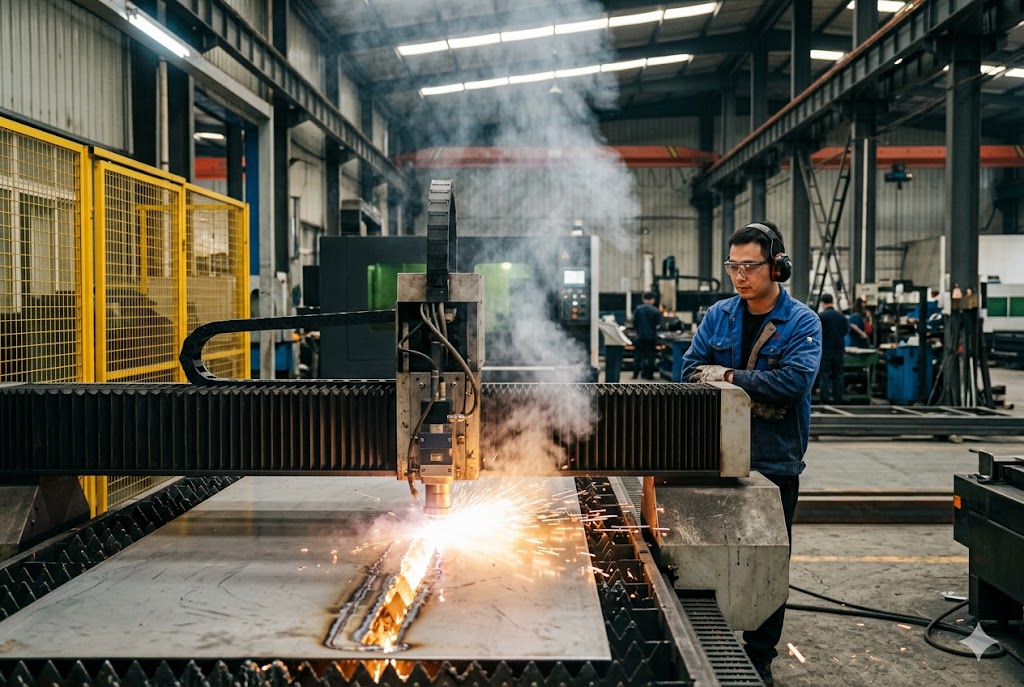
Fiber laser cutters hold profile tolerances to ±0.1 mm or tighter and cut copper, brass, and thin stainless cleanly; CO2 and plasma machines cannot match this on reflective metals. CNC press brakes with automatic back-gauging hold bend angles to ±0.5°; manual press brakes introduce operator-dependent error that compounds across every additional bend in the part.
Laser Cutter Types and What They Mean for Your Drawing
Not all laser cutters are equal. The technology inside the machine determines which materials it can handle and how tight a tolerance it can reliably hold across a full production run — not just on a sample. Fiber lasers consistently deliver tight tolerances ranging from ±0.001 to ±0.003 inches 2 — a level of precision that CO2 and plasma systems cannot match for precision sheet metal work.
| Laser Type | Typical Profile Tolerance | Material Range | Best For |
|---|---|---|---|
| Fiber Laser | ±0.05–0.1 mm | Steel, SS, aluminum, copper, brass | Precision parts, reflective metals |
| CO2 Laser | ±0.1–0.2 mm | Steel, SS, acrylic, wood | General fabrication, non-reflective |
| Plasma Cutter | ±0.5–1.5 mm | Thick steel, structural plate | Heavy structural work only |
If your drawing has tight hole positions, close-tolerance slots, or features in copper or brass, you need a factory with a fiber laser. Full stop. A factory offering plasma cutting for precision sheet metal parts 3 is not the right fit, regardless of price — plasma tolerances run to millimetres versus the hundredths of a millimetre that fiber lasers achieve.
How Press Brake Technology Affects Multi-Bend Parts
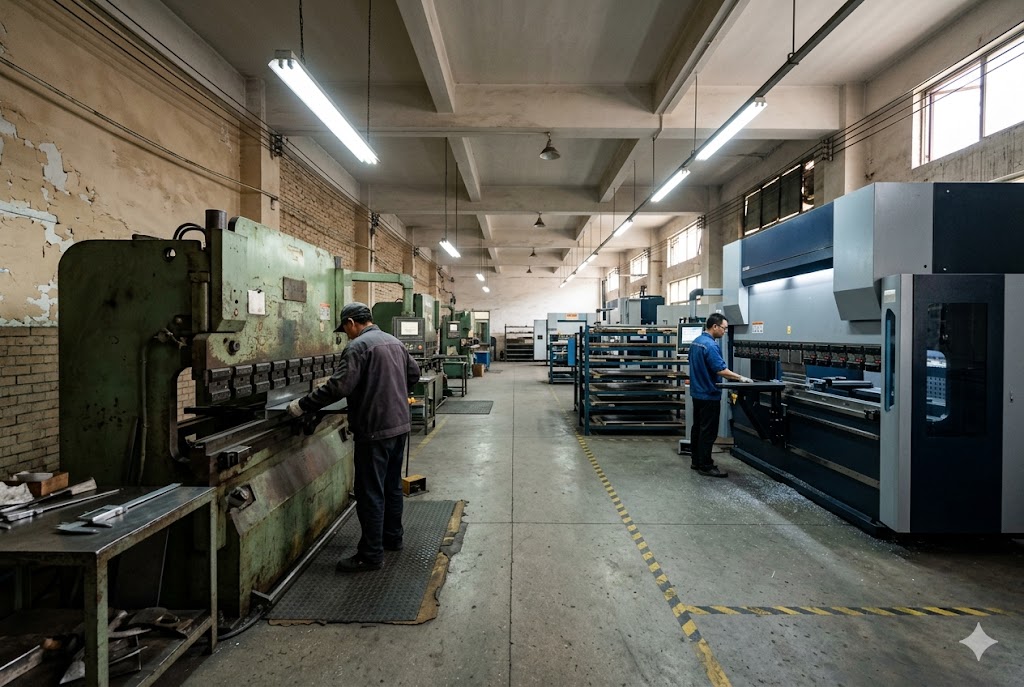
A part with one bend is forgiving. A part with four or five bends is not. Each bend introduces a small angular error. On a CNC press brake with automatic back-gauging 4, that error is held to ±0.5° per bend. On a manual press brake, it depends on the operator's skill and fatigue level — and it varies from part to part within the same batch.
The Cumulative Error Problem
Here is the math that buyers rarely see. If a manual press brake holds ±1° per bend, and your part has five bends, the worst-case cumulative error at the final flange is ±5°. That is the difference between a part that fits your assembly and one that does not. CNC back-gauging eliminates this drift by repositioning the sheet automatically and consistently on every stroke.
This is why identical drawings sent to two factories can produce parts that look similar but behave very differently in assembly. The machine, not the drawing, determines the outcome.
Equipment Age and Positioning Drift
Older press brakes and laser cutters develop mechanical wear over time. Ball screws wear. Servo systems degrade. The result is positioning drift — where the machine moves to a slightly different position than commanded. This drift is often invisible to the factory unless they actively measure and compensate for it. A factory without a calibration schedule may not even know their machine is drifting. You find out at incoming inspection.
Ask directly: "When was your press brake last calibrated, and can you show me the calibration log?" A well-run factory will have this document ready. One that cannot produce it is a risk.
Why Can Two China Suppliers Quote Very Different Prices for the Same Sheet Metal Drawing?
We place orders with dozens of factories every year. We send the same drawing to multiple suppliers as a standard practice. The price spread we see — sometimes 40% to 60% between the lowest and highest quote — surprises most of our clients. It should not. The gap is explainable, and understanding it protects you from both ends of the range.
Two China suppliers quote different prices for the same drawing because their equipment, process capability, tooling ownership, volume efficiency, and overhead costs differ fundamentally. A lower quote often reflects a factory routing your job through slower or less capable machines, outsourcing steps, or omitting costs like custom tooling — not superior efficiency.
The Seven Drivers of Quote Variation
Price differences between suppliers are not random. They trace back to specific, identifiable factors. Here is how each one affects your quote:
| Cost Driver | Low-Price Factory | Higher-Price Factory |
|---|---|---|
| Cutting Method | Plasma or CO2 laser | Fiber laser |
| Bending | Manual press brake | CNC press brake |
| Hole Features | Laser cut at volume | CNC punch press |
| Process Chain | Partial outsourcing | Fully in-house |
| Tooling | Borrows or buys per job | Owns standard library |
| QC | Manual calipers only | CMM or vision system |
| Overhead | Lower (less equipment) | Higher (more capability) |
Tooling Costs and How They Hide in Quotes
One of the most common surprises buyers face is a tooling charge that appears after the initial quote. If your part requires a non-standard punch shape, a special die set, or a custom forming tool, that tooling must be made or purchased before the first part runs. Factories that own a full standard tooling library quote faster and absorb more of these costs internally. Factories that must source custom tooling per order pass that cost to you — sometimes as a separate line item, sometimes bundled in unit price, sometimes disclosed only after order confirmation.
Always ask: "Does my drawing require any non-standard tooling? If so, what is the tooling cost and who owns the tooling after this order?"
Volume and Machine Efficiency
A CNC punch press runs hole patterns, louvers, and embossed features 5 far faster than a laser cutter at production volumes, with punching speeds exceeding 400 holes per minute versus laser cutting's linear process. A factory with a punch press will quote significantly lower unit prices for high-volume parts with repeated features. A factory without one routes the same work through laser cutting, which costs more per hole at volume. The machine mix a factory owns directly determines where it is cost-competitive and where it is not.
Why the Lowest Quote Is Not Always the Cheapest Order
We tell every client the same thing: evaluate total landed cost, not unit price. A lower unit price from a factory with manual bending and outsourced welding can easily cost more in rework, re-inspection, and shipping of replacement parts than a higher unit price from a factory that gets it right the first time. The equipment a factory owns is the most reliable predictor of first-pass yield. Self-clinching hardware such as PEM nuts and standoffs 6 is one example of a process step that, when done in-house, eliminates a secondary sourcing margin and keeps the assembly under one quality inspection cycle.
How Can I Tell If a Factory's Equipment Really Matches My Tolerance Requirements?
We get this question from nearly every new client. They have the factory's capability statement. They have the ISO certificate. They want to know if the real-world output will actually match what the certificate claims. The answer requires more than reading a document.
To verify that a factory's equipment matches your tolerance requirements, request calibration certificates for cutting and bending machines, ask for metrology equipment specifications and recent inspection reports, check whether ISO 9001 certification includes documented maintenance schedules, and review first-article inspection results from a comparable part before committing to full production.
The Metrology Gap Most Buyers Miss
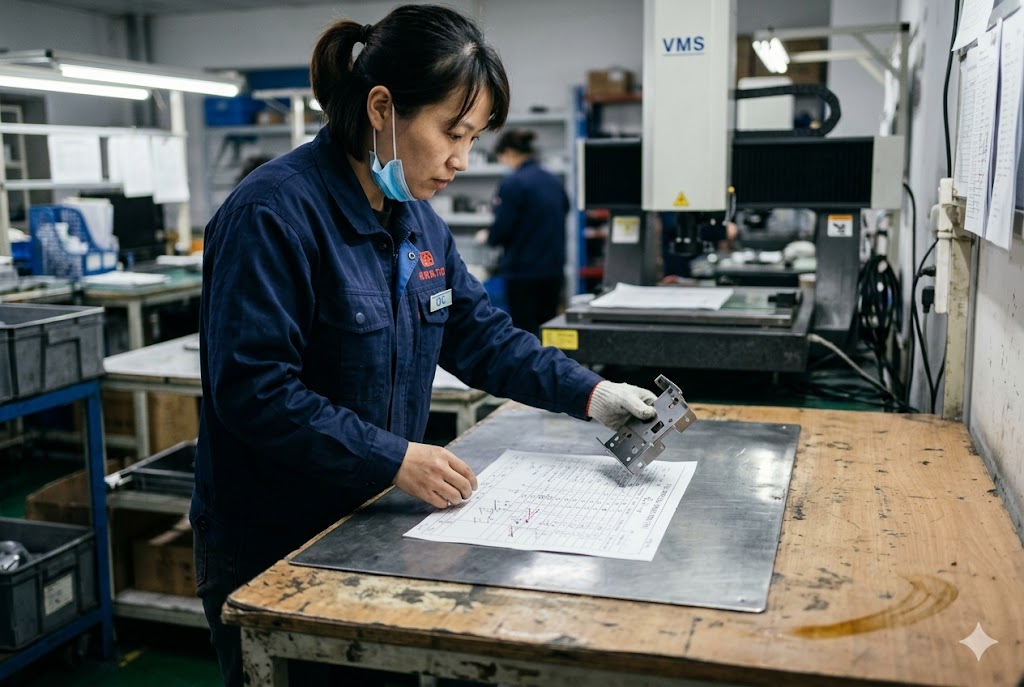
A factory can own the most advanced fiber laser and CNC press brake in its region and still ship out-of-tolerance parts — if it lacks the inspection equipment to catch the problem. Production equipment and inspection equipment are two separate capability layers. Both must be in place.
Here is what to look for in the metrology room:
| Inspection Tool | What It Verifies | Limitation If Absent |
|---|---|---|
| CMM (Coordinate Measuring Machine) | 3D dimensional accuracy across all features | Cannot verify complex geometry without it |
| Optical Comparator | Profile and edge geometry | Manual calipers miss subtle profile errors |
| Vision Measurement System | Hole position, slot width, feature spacing | Slow manual checking misses batch variation |
| Surface Roughness Tester | Ra finish values after machining or grinding | Finish spec cannot be confirmed |
| Manual Calipers / Micrometers | Basic thickness and simple dimensions | Insufficient alone for tight-tolerance work |
Coordinate measuring machines 7 are available in bridge, gantry, and horizontal-arm configurations — the horizontal-arm type being particularly well-suited to inspecting large sheet metal parts. Their ability to measure 3D features and record data for every part inspected makes batch-level verification objective and traceable, which manual instruments cannot replicate.
Reading ISO 9001 Certificates the Right Way
ISO 9001 certification 8 is worth something — but only if the scope covers the right processes and the certificate is current. Check the certificate issue date and the certifying body. A well-known certification body (TÜV, Bureau Veritas, SGS, DNV) carries more weight than an obscure local registrar. More importantly, ask whether the quality management system includes documented equipment calibration schedules. ISO 9001 requires this, but not all factories implement it with the same rigor.
First-Article Inspection as a Confidence Test
Before you commit to a production order, request a first-article inspection 9 (FAI) on a small sample run. The FAI report should include measured values against each drawing dimension, not just a pass/fail stamp. If the factory's CMM report shows measured values clustered close to nominal with low variation, the process is under control. If values are spread widely — even if technically within tolerance — that spread will likely worsen at full production volume.
The Age and Calibration Question for Production Equipment
Equipment age alone is not disqualifying. Equipment with no calibration history is. Ball screws wear. Servo drives drift. Optical lenses accumulate contamination. A factory that tracks these variables with a documented maintenance and calibration schedule — and can show you the records — is managing its process. One that cannot produce those records is guessing.
We always ask factories to show calibration logs dated within the last 12 months for their primary cutting and bending equipment. Referring to the back-gauge calibration requirements 10 for CNC press brakes helps frame exactly what those records should contain: axis positioning accuracy, servo system performance, and last-verified repeatability figures. Factories that maintain these records as a routine matter of business are the ones we recommend to our clients. The document itself takes five minutes to produce. The discipline behind it takes years to build.
Conclusion
Equipment is not a background detail. It is the direct cause of what you receive. Know the machines, verify the metrology, ask for the calibration records, and compare quotes at the process level — not just the price level.
Footnotes
1. How third-party inspection services conduct supplier and factory audits in China. ↩︎
2. Detailed breakdown of fiber laser cutting tolerances by material type and thickness. ↩︎
3. Side-by-side comparison of laser and plasma cutting accuracy, kerf width, and edge quality. ↩︎
4. How CNC backgauge systems improve press brake accuracy and bending repeatability. ↩︎
5. Cost and speed comparison of laser cutting versus CNC punch press at production volumes. ↩︎
6. Guide to PEM self-clinching fasteners, nuts, and standoffs for sheet metal assemblies. ↩︎
7. Overview of CMM types — bridge, gantry, and horizontal-arm — and their inspection applications. ↩︎
8. Official ISO 9001:2015 quality management system standard and certification requirements. ↩︎
9. Wikipedia entry defining first article inspection and its role in production validation. ↩︎
10. Complete guide to CNC press brake back-gauge calibration and servo positioning accuracy. ↩︎