Skip to main content Skip to footer

Every year, we coordinate hundreds of CNC machining orders between our clients and factories across China and Vietnam. One question comes up on almost every first order: do I really need someone on the factory floor, or can I just inspect the parts when they land?
You do not need on-site QC for every CNC import order — but three risk factors make it necessary: order value above $5,000–$10,000, tight dimensional tolerances, and an unproven supplier. If all three are present, on-site inspection is not optional. If even one applies, skipping it is a gamble with your production schedule.
Most buyers skip on-site QC to save a few hundred dollars. Then one bad batch costs them ten times more. Here is how to make the decision correctly.
When Is On-Site QC More Effective Than Third-Party Final Inspection?
Experienced sourcing teams know that a pre-shipment inspection is not the same as quality control. We have seen this play out repeatedly — a buyer receives a passed PSI report, then opens the crates and finds problems the inspector never caught.
On-site QC during production is more effective than a final third-party inspection whenever the failure mode is progressive — meaning defects build up gradually across a run. For CNC parts, tool wear drift, fixture slippage, and thermal offset are all progressive. A mid-production visit catches these; a final inspection finds them after the damage is done to the entire batch.
Three Inspection Stages — and Why They Are Not Interchangeable
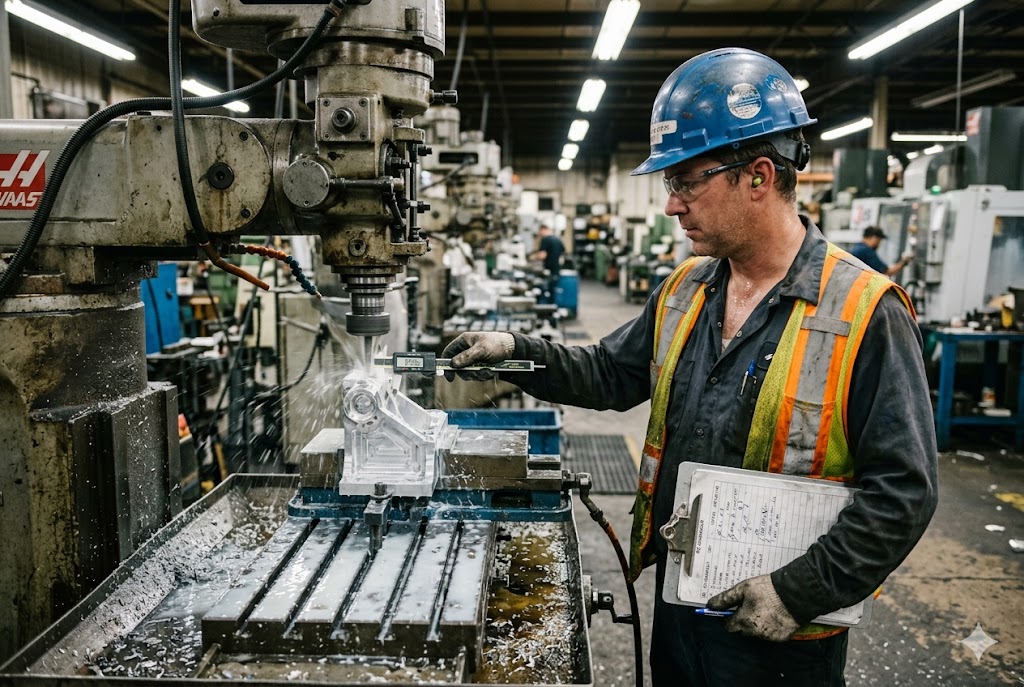
There are three distinct on-site inspection stages for CNC orders. Each one catches different failure modes.
| Inspection Stage | Timing | What It Catches |
|---|---|---|
| Pre-Production Inspection (PPI) | Before machining begins | Wrong raw material, incorrect setup, wrong tooling |
| During Production Inspection (DUPRO) | When 20–40% of batch is complete | Tool wear drift, fixture slippage, operator errors |
| Pre-Shipment Inspection (PSI) | After production, before shipping | Final dimensional check, surface finish, packaging |
A PSI alone is the most common setup — and the weakest one. By the time a PSI inspector arrives, all parts are machined. If there is a process problem, it has already affected the entire quantity. You can reject the shipment, but you cannot recover the time or the rework cost.
A DUPRO changes your leverage completely. If an inspector visits at 20–30% completion and finds tool wear causing dimension drift, the factory can correct the setup immediately. Only a fraction of the batch is affected. The rest of the run is protected.
What "Third-Party Final Inspection" Actually Covers
Many buyers assume a third-party inspection firm will measure everything on the drawing. That is not how it works. A standard consumer goods inspection agency will do visual checks, count quantities, and spot-check a few basic dimensions. They are not equipped for tight-tolerance CNC parts.
For CNC machining QC to be meaningful, the inspection checklist must specify exact dimensions to measure referenced to the drawing, instruments to use (micrometer, coordinate measuring machine (CMM) 1, pin gauges, surface roughness tester), sample size per AQL level 2, and accept/reject criteria for each feature.
Without a detailed checklist, you are paying for an inspector to look at parts and report "no obvious defects." That is not quality control.
The Statistics Buyers Ignore
Industry data consistently shows approximately 30% of pre-shipment inspections in China result in a failed AQL check. If you have had three clean orders in a row, that does not mean your supplier has solved their process problems. It means your next order is statistically overdue for a failure.
On-site QC during production is the only mechanism that addresses process risk, not just outcome risk. A PSI tells you what happened. A DUPRO gives you the chance to change what is happening.
What Should My On-Site QC Team Focus on During Production?
When our team conducts a DUPRO at a CNC factory, we follow a structured checklist. Most buyers who send their own QC staff — or hire a generalist inspector — focus on the wrong things and miss the defects that actually ruin batches.
During a CNC production inspection, your on-site QC team should focus on four areas: raw material verification against the mill certificate, first-article measurement of the opening batch against all critical dimensions on the drawing, in-process monitoring of tool condition and fixturing, and operator setup records. These four checks address the failure modes most likely to cause a full-batch rejection.
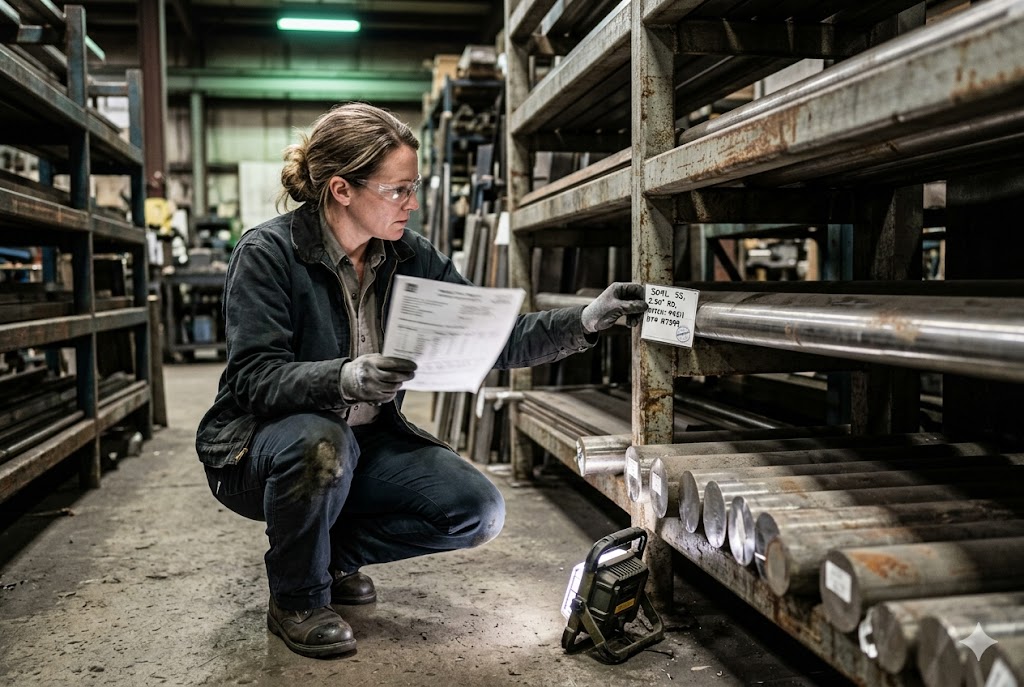
Raw Material Verification
This step happens before any machining. The inspector checks that the material on the floor matches the grade specified in the drawing and the purchase order. This means requesting the mill certificate (also called a material test report or MTR) 3 and comparing the heat number, chemical composition, and mechanical properties.
This is not a theoretical risk. Material substitution — intentional or accidental — is one of the most common causes of first-run failure on CNC parts. A bar of 303 stainless looks identical to 304 on the shelf. The difference only shows up in corrosion performance or machinability downstream.
First-Article Measurement
The factory should produce a small number of first-off parts before running the full batch. Your inspector measures these parts against every critical dimension on the drawing. This is not a statistical sample — it is a 100% check of the first pieces off the machine.
| Feature to Check | Instrument | Why It Matters |
|---|---|---|
| Bore diameter | Bore gauge or CMM | Fit and assembly function |
| Outer diameter | Micrometer | Mating part clearance |
| True position of holes | CMM with GD&T analysis | Assembly alignment |
| Surface roughness (Ra) | Surface roughness tester | Seal and friction performance |
| Thread form and pitch | Thread gauges (go/no-go) | Fastener engagement |
The true position of holes and other GD&T (Geometric Dimensioning and Tolerancing) 4 features require CMM verification rather than manual gauging. If first-article parts pass, the factory can proceed with the run. If they fail, setup is corrected before any further machining.
In-Process Monitoring: Tool Wear and Fixturing
This is the area most generalist inspectors skip — and it is where the most damaging CNC defects originate.
CNC cutting tools wear gradually. A dimension that measures on-target at the start of a run can drift out of tolerance by part 50 or part 100, depending on tool life, material hardness, and cutting parameters. An on-site inspector should check that the factory is recording in-process measurements 5 at defined intervals, verify that tooling is being changed at the correct frequency, inspect fixture clamps and locating pins for wear or movement, and review the machine's thermal compensation settings for long runs.
An inspector who only measures finished parts after the run is complete will find the drift — but the parts are already made.
Operator Setup Records
Ask to see the setup sheet for the job. A professional CNC shop will have a documented setup record that lists tool numbers, offsets, speeds, feeds, and the dimensions measured at first-article inspection 6. If the factory cannot produce this document, that alone is a quality signal worth reporting.
How Can On-Site QC Reduce Delay and Rework Risk?
Delivery delays are the pain point that costs our clients the most money. A batch that fails final inspection and requires rework in China before shipping adds weeks to the lead time. If you are supplying a US manufacturer running a lean production schedule 7, those weeks have a dollar value attached to them.
On-site QC reduces delay and rework risk by catching process failures at the point where correction is cheapest and fastest. A DUPRO finding that triggers corrective action at 20% completion costs a fraction of reworking a completed batch and avoids the schedule impact of a failed pre-shipment inspection.

The Cost Comparison: Early Detection vs. Late Detection
The timing of a defect discovery determines its total cost. Here is how the numbers typically play out on a mid-size CNC order.
| Discovery Point | Typical Additional Cost | Schedule Impact |
|---|---|---|
| During DUPRO (20–40% complete) | Low — process correction, scrap on early pieces only | Minimal — run continues with corrected setup |
| At PSI (100% complete, pre-ship) | Medium-high — full rework or re-run, re-inspection fee | 2–4 week delay |
| After arrival in the US | Very high — return freight, re-run, expedited air freight | 4–8 week delay, possible line stoppage |
The inspection fee for a DUPRO is typically $250–$350 per inspector-day in China. That is a fixed, predictable cost. The cost of a failed shipment that reaches your customer — including return freight, re-run costs, expedited delivery, and customer compensation — can be 10 to 50 times higher.
How a DUPRO Protects Your Delivery Schedule
Here is the practical sequence. A DUPRO inspector visits the factory when 25% of the batch is complete. They find that hole position on a machined flange is drifting due to a loose fixture. The factory re-clamps and re-machines the affected pieces — a half-day correction. The remaining 75% of the batch runs correctly.
Without the DUPRO, the full batch ships. The error is discovered at PSI or, worse, at your customer's incoming inspection in the US. The entire batch needs rework. The factory quotes 15–20 working days. Your customer's production line is waiting on these parts.
That sequence is avoidable. The DUPRO visit that prevented it cost less than $350.
Drawing Revisions Reset the Clock
One trigger for on-site QC that buyers consistently overlook is an engineering change order (ECO). Any revision to a drawing — a tighter tolerance, a material grade change, a new surface finish specification — resets the supplier's process back to an unvalidated state.
It does not matter if the supplier has produced ten clean batches of the previous revision. The changed drawing is effectively a new part from a process control standpoint. The first production run after any drawing change requires on-site inspection at the same level as a brand-new part, including first-article inspection.
How Do I Decide Whether On-Site QC Is Worth the Extra Cost?
This is the question we get most often from purchasing managers who are managing tight budgets. The answer is not "always inspect everything" — but it is also not "inspect when it feels risky." There is a structured way to make this decision.
On-site QC is worth the cost when any one of three conditions is present: the order value exceeds $5,000–$10,000, the parts have tight tolerances or critical assembly functions, or the supplier has fewer than five consecutive clean inspection batches on record. When all three conditions apply, on-site QC is non-negotiable.

The Risk-Factor Decision Framework
Use this framework to decide the right inspection level for each order.
| Risk Factor | Low Risk | Medium Risk | High Risk |
|---|---|---|---|
| Order value | Under $3,000 | $3,000–$10,000 | Over $10,000 |
| Tolerance level | ±0.5 mm or looser | ±0.1–0.5 mm | Tighter than ±0.1 mm |
| Supplier track record | 5+ clean batches | 2–4 clean batches | New supplier or first run |
| Drawing status | Unchanged | Minor revision | New or significantly revised |
If all four factors are Low, a remote documentation protocol (photos, video, CMM data) may be sufficient. If any factor is High, on-site inspection is justified. If two or more factors are Medium or High, combine DUPRO and PSI.
When Remote Inspection Is a Viable Substitute
For small, low-value orders from proven suppliers, a remote inspection protocol is a practical alternative. Require the supplier to photograph each part next to a calibrated steel rule, record a video of the CMM measurement sequence for the three most critical dimensions, and send the raw CMM data file before payment is released.
This is not equivalent to physical inspection. It does not catch everything. But it creates documentation accountability. Suppliers are less likely to take shortcuts when they know measurements will be recorded and reviewed.
Reducing Frequency on Proven Suppliers — Without Eliminating Oversight
For repeat orders from a supplier with a clean record across at least five consecutive batches, you can responsibly reduce on-site QC frequency. A reasonable approach:
- Every first order: DUPRO + PSI
- Orders 2–5 (clean record): PSI only
- Orders 6+: Rotate — DUPRO + PSI every third or fourth order, PSI only on others
Never eliminate on-site inspection entirely on any supplier. Without periodic on-site oversight, quality fade occurs — gradual process degradation that goes undetected until a significant batch failure forces the issue. The cost of one batch failure on a supplier you stopped monitoring will exceed the cumulative cost of years of PSI fees.
The Right Inspector for CNC Parts
Not all inspection firms are equal. General consumer goods inspection agencies are not adequate for tight-tolerance CNC machining. When hiring a third-party inspector for CNC parts, look for ISO/IEC 17025-accredited 8 measurement capability, inspectors with experience reading GD&T drawings 9 and operating CMM equipment, and willingness to follow your specific inspection checklist rather than a generic template.
Provide the checklist in advance. Specify every dimension to measure, the instrument to use, the sample size, and the accept/reject criteria. If you leave the scope open, the inspector will default to whatever their standard template covers — and it will not be enough for precision CNC parts.
When measuring sample sizes, use a statistically sound acceptance sampling plan 10 indexed to your AQL level. Randomly chosen samples that are too small will miss process drift; samples that are too large add cost without proportional benefit.
Conclusion
On-site QC is not a luxury for cautious buyers. It is a cost-control tool. The decision comes down to order value, tolerance criticality, and supplier track record. Get the timing right — especially the DUPRO — and you protect your schedule, your margin, and your customer relationships.
Footnotes
1. Overview of coordinate measuring machines (CMMs) and their role in dimensional quality control. ↩︎
2. ASQ guide to AQL-based acceptance sampling standards (ANSI/ASQ Z1.4 and Z1.9). ↩︎
3. Wikipedia entry explaining mill test reports and how they certify metal material properties. ↩︎
4. Wikipedia overview of Geometric Dimensioning and Tolerancing (GD&T) principles and symbols. ↩︎
5. ASQ resource on statistical process control for monitoring and controlling production quality. ↩︎
6. Guide to AS9102 first-article inspection requirements and documentation process. ↩︎
7. ASCM overview of lean manufacturing principles and their impact on production schedules. ↩︎
8. ISO page on ISO/IEC 17025 accreditation for testing and calibration laboratories. ↩︎
9. ASME page for the Y14.5 Dimensioning and Tolerancing (GD&T) standard. ↩︎
10. Wikipedia article on acceptance sampling methodology and statistical lot-inspection principles. ↩︎