Skip to main content Skip to footer

We have seen it happen dozens of times: a buyer receives a competitive quote, places an order, and then — weeks into production — gets an email asking for more money. It is frustrating. It feels unfair. And it almost always could have been prevented.
The most reliable way to avoid unexpected price increases after a CNC machining quote from China is to remove ambiguity before you place an order. Suppliers revise prices when drawings are incomplete, quotes are lump-sum, and purchase orders lack a fixed price clause. Fix those three things, and most mid-order surprises disappear.
The sections below go through the specific steps. Each one is practical and actionable.
What Terms Should I Confirm to Prevent Later Price Changes?
When we process orders for clients sourcing custom mechanical parts, the first thing we do is check whether the commercial terms on the quote match the purchase order. Most buyers skip this step. That gap is where price revisions enter.
The key terms to confirm before placing a purchase order are: unit price tied to a specific drawing revision, quantity, agreed Incoterms, delivery date, payment terms, and quote validity period. Every one of these must appear on both the supplier's quote and your signed purchase order, with no daylight between them.

Why Commercial Terms Are the First Line of Defence
A quote is a supplier's offer. A purchase order is your acceptance. Under China's Civil Code 1, once a supplier accepts a purchase order in writing, the price stated on that PO is binding — provided the price is clearly defined and no price adjustment clause has been included.
That is the key phrase: clearly defined. A PO that says "per quote" without attaching the quote document, or that references a drawing number without specifying the revision, is not clearly defined. It leaves room for interpretation, and interpretation is where disputes begin.
The Six Terms You Must Lock Down
| Term | What to Confirm | Why It Matters |
|---|---|---|
| Unit price | Exact figure, per piece | Prevents "market adjustment" claims |
| Drawing revision | Revision number and date | Ties price to a specific scope |
| Quantity | Total order quantity and release schedule | Affects setup amortisation |
| Incoterms 2 | DDP, FOB, or EXW — specified clearly | Controls who absorbs freight and duty changes |
| Quote validity | Date range the price is valid | Limits exposure to market movement |
| Payment terms | Net 30, 50% deposit / 50% balance, etc. | Reduces supplier's cash flow pressure to reprice |
What "Accepted in Writing" Actually Means
An email chain is not always enough. A supplier sales representative acknowledging your PO by email is useful evidence, but a signed order confirmation on the supplier's letterhead — or a counter-signed copy of your PO — is stronger. When we manage orders for clients, we request a written order acknowledgement before releasing any deposit. This document becomes the reference point for every conversation that follows.
Price Validity for Blanket Orders
If you run blanket purchase orders 3 with multiple delivery releases across a year, you need a price validity clause on the supply agreement — not just on the first PO. Without it, the supplier is commercially entitled to requote each release at current material prices. For most standard materials, six to twelve months of price validity is achievable. Negotiate it into the supply agreement before you confirm the first release, not after.
How Can I Identify Vague Quotes That May Lead to Add-On Charges?
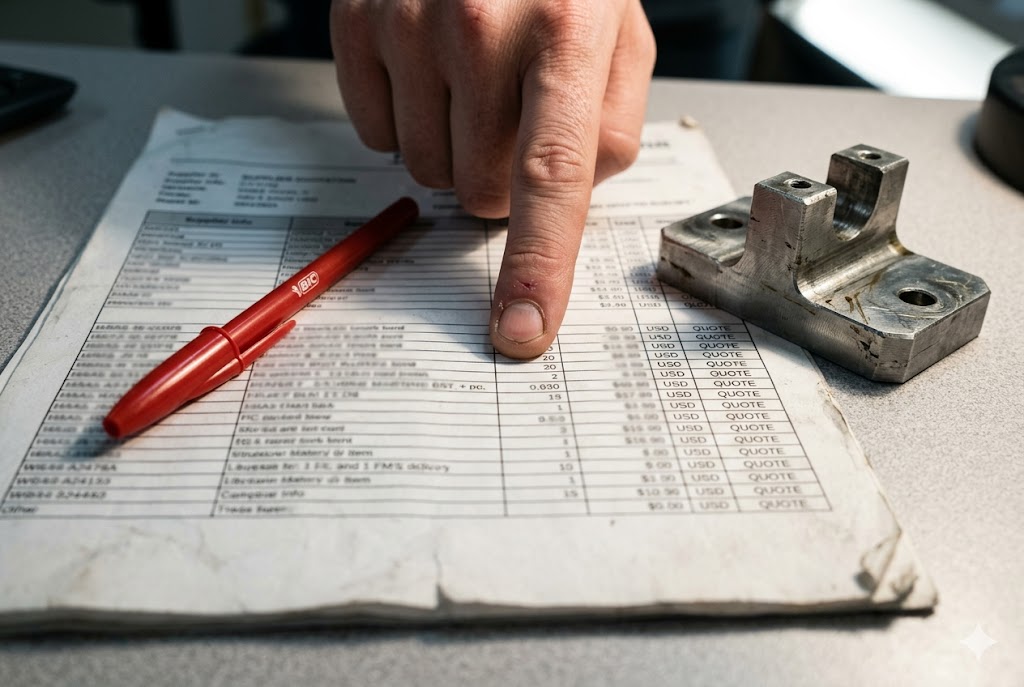
Our sourcing team reviews hundreds of supplier quotes each year. We can usually tell within two minutes whether a quote carries a high risk of revision. The signal is almost always the same: a single lump-sum number with no breakdown.
A vague quote is any quote that gives you one total price without separating material, machining, finishing, inspection, packaging, and freight costs. When you cannot see each cost driver, you cannot know what was included — and neither can the supplier's production team, which is exactly when add-on charges appear.
The Anatomy of a High-Risk Quote
A lump-sum quote conceals assumptions. When a supplier's estimator builds a quote, they make decisions about what is included and what is not. If those decisions are not documented, the production team — who did not make the quote — may discover gaps that the estimator never priced. That discovery becomes a revision request.
Here are the most common items left out of lump-sum quotes:
| Frequently Omitted Item | Common Cause | Typical Impact |
|---|---|---|
| Hard anodise vs. Type II anodise 4 | Drawing says only "anodise" | 15–30% finishing cost increase |
| Material certification (MTR) | Not explicitly requested | $50–$200 per batch |
| Masking for anodise or plating | Not shown on drawing | Additional setup charge |
| Thread gauging inspection | No drawing callout | Per-piece inspection fee |
| Custom packaging or labelling | Not discussed pre-quote | Added at shipping stage |
| Export documentation (CO, FORM E) | Assumed not needed | Charged at final invoice |
How to Request an Itemised Quote
Ask for the quote to be broken down into the following line items at minimum:
- Raw material (grade, form, quantity including waste factor)
- CNC setup and programming
- Machining time (per piece)
- Secondary operations (deburring, heat treatment, surface finish)
- Inspection (dimensional, surface, material verification)
- Packaging
- Freight to named Incoterm point
When a supplier refuses to provide this breakdown, that itself is a signal. Established manufacturers can itemise. Suppliers who cannot may be working from rough estimates, which carry a higher revision risk.
Read the Exclusions Section — If There Is One
Some suppliers include an exclusions section at the bottom of their quote. Read it carefully. Statements like "tooling not included," "surface finish TBD," or "freight quoted separately" are direct signals of future charges. If there is no exclusions section, add one yourself by asking the supplier to confirm in writing that the quoted price includes all costs to deliver finished, inspected parts to the agreed Incoterm point.
Should I Ask Suppliers to List All Excluded Costs in Writing?
Yes — and this is one of the simplest, most effective steps any buyer can take. When we onboard a new supplier for a client, we send a standard pre-order checklist that includes a written confirmation of exclusions. It takes the supplier ten minutes to complete and has saved clients from significant disputes.
Yes, you should always ask suppliers to confirm in writing what is not included in their quote. A written exclusions list converts the supplier's silent assumptions into visible gaps that you can address before placing an order, not after goods have shipped.

Why Suppliers Do Not Volunteer Exclusions
Suppliers who quote competitively have an incentive to keep the headline number low. Listing exclusions makes the quote look less complete. So most suppliers omit the list and hope the buyer does not ask. This is not dishonesty — it is commercial behaviour. The solution is simply to ask.
A Practical Exclusions Confirmation Template
Send the supplier a short written question alongside your RFQ review:
"Please confirm in writing that the quoted price includes all of the following, or identify any item below that is not included: raw material to specification, all machining operations, surface finishing as per drawing, dimensional inspection, packaging for export, and freight to [Incoterm point]. If any item is excluded, please state the reason and estimated cost."
This question does three things. It tells the supplier you are an informed buyer. It gives them a structured way to answer. And it creates a written record you can reference if a charge appears later.
Drawing Revision Control Prevents Scope Creep Charges
One of the least understood sources of mid-order price revision is a drawing change during production. Even a minor tolerance relaxation — the kind a buyer considers a favour to the supplier — gives the supplier grounds to reprice, because the engineering scope has changed. The protection is simple: freeze your drawing to a named revision before quoting, reference that revision number on the PO, and include a clause stating that any change requires a mutual written change order 5 before it affects pricing.
| Risk Scenario | Without Exclusions Confirmation | With Exclusions Confirmation |
|---|---|---|
| Surface finish not specified | Supplier charges for upgrade at shipping | Buyer confirms finish type pre-order |
| Material cert 6 required by end customer | Added to final invoice | Priced into PO from the start |
| Drawing revision during production | Supplier reprices affected features | Change order required before price changes |
| Tooling needed for new feature | Surprise tooling invoice | Disclosed at RFQ stage |
What Contract Language Can Protect Me From Post-Quote Increases?
Our team has helped buyers draft and negotiate supply agreements with Chinese manufacturers for years. The clauses that provide the most protection against post-quote price increases are not complicated. They are short, specific, and written in plain language that both sides can read and understand.
The most effective contract clauses for preventing post-quote price increases are: a fixed unit price clause tied to a drawing revision, a price validity period for blanket orders, a change order requirement for any scope modification, and a material escalation cap with a verifiable benchmark index.

Four Clauses That Do the Work
Fixed Price Clause
State the agreed unit price explicitly on the PO or supply agreement, and include the words "fixed and not subject to adjustment." Reference the drawing revision number 7 and specification. This prevents the supplier from citing general market conditions as justification for a revision.
Change Order Clause
Include a sentence stating that any change to the drawing, specification, or quantity requires a written change order signed by both parties before it takes effect, and that no price change is valid without a signed change order. This clause alone eliminates the majority of revision attempts, because most suppliers will not pursue a formal change order process for a minor margin recovery.
Price Validity Clause for Blanket Orders
For multi-release agreements, specify the period during which the agreed unit prices remain fixed — minimum six months, ideally twelve. State the date from which validity runs and the process for reviewing prices at expiry. This protects your budget forecast and gives you a defined point at which a price discussion is commercially appropriate.
Material Escalation Cap
If a supplier requests protection against large material price movements, agree a cap: for example, prices may be reviewed if the relevant SMM or LME benchmark index moves by more than a stated percentage (typically 10–15%) from the date of the PO. Include a reference to the specific public index. This gives the supplier a legitimate mechanism for large movements while preventing small fluctuations from being used as a pretext for revision.
Verifying Material Price Claims
Before accepting any material surcharge, cross-check the supplier's claim against a public benchmark. China's Shanghai Metals Market (SMM) 8 publishes daily aluminium prices. The London Metal Exchange (LME) 9 covers copper and other non-ferrous metals. If a supplier claims a 15% aluminium price increase but the SMM benchmark shows 4% movement over the same period, the claim does not support the requested surcharge. Challenge it with the data, not just with a refusal.
The Backup Supplier Principle
Contract language is your legal protection. A qualified backup supplier is your commercial leverage. A supplier who knows you can transfer an order to a qualified alternative within one production cycle has a strong incentive to honour agreed terms. A supplier who knows you have no alternative and face months of requalification if you walk away has the opposite incentive. Maintaining at least one pre-qualified backup supplier 10 for any critical component is the most durable long-term protection against opportunistic price revision.
Conclusion
Most mid-order price surprises from Chinese CNC suppliers are preventable. Complete drawings, itemised quotes, signed purchase orders, and clear contract clauses remove the ambiguity that makes revisions possible. Start with those four, and your price stability will improve significantly.
Footnotes
1. How China's Civil Code governs supplier price changes and buyer protections. ↩︎
2. Official U.S. government guide explaining DDP, FOB, EXW and all Incoterms 2020 rules. ↩︎
3. How blanket purchase orders establish pre-negotiated pricing across multi-release agreements. ↩︎
4. Key differences between Type II and Type III (hard) anodizing, including cost and hardness. ↩︎
5. Complete guide to engineering change orders: lifecycle, re-quoting triggers, and FAI requirements. ↩︎
6. What a Mill Test Report (MTR) is and why it documents material compliance for metal parts. ↩︎
7. Why drawing revision control is critical to traceability and pricing accuracy in manufacturing. ↩︎
8. Shanghai Metals Market daily aluminium price data, used as China's primary commodity benchmark. ↩︎
9. London Metal Exchange non-ferrous metals page covering copper, aluminium, and global pricing. ↩︎
10. How pre-qualifying backup suppliers strengthens pricing leverage and supply continuity. ↩︎