Skip to main content Skip to footer

We see this catch buyers off guard more often than it should. A quote looks solid, the project is approved, and then weeks later the final invoice is higher than expected — and the reason traces back to a metal price shift nobody tracked.
Yes, material price fluctuations can and do affect your order cost when importing custom CNC machining parts from China. Material typically represents 30–50% of total unit price. A 20% rise in raw metal prices can push your final part cost up by 6–10%, even when nothing else in the supplier's pricing changes.
Understanding how this works — and how to manage it — puts you in control before you sign anything.
Which Raw Materials Are Most Likely to Change My Quote?
When we process orders for aluminium, copper, and stainless steel parts, we track spot prices daily. Even a few weeks between quote and production can open a meaningful gap in the material line.
Aluminium, copper, stainless steel, and specialty alloys like titanium Ti-6Al-4V and Inconel 718 are the materials most likely to shift your quote. Aluminium prices alone can move 15–40% within a single calendar year, making it the most common source of quote revisions for CNC machined parts.
Why Aluminium Tops the List
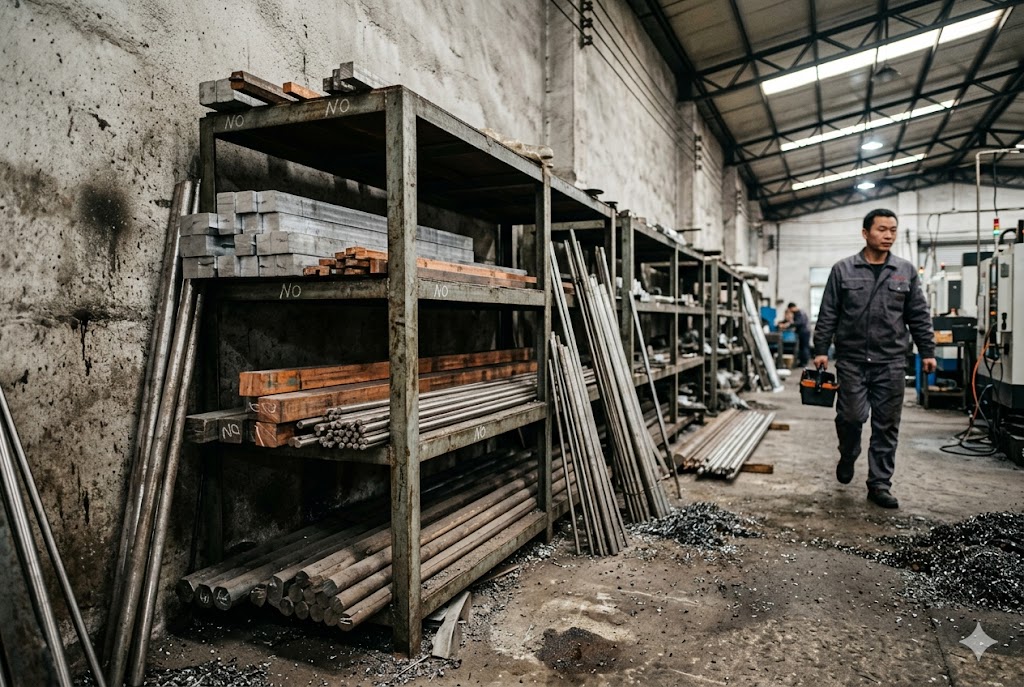
Aluminium is the single most widely used CNC machining material, and it is also one of the most price-volatile base metals in commodity markets. Chinese domestic aluminium prices are benchmarked against the Shanghai Futures Exchange (SHFE) 1 and reported daily by the Shanghai Metals Market (SMM) 2. These prices can diverge from LME Aluminium 3 prices by $500–$1,000 per tonne or more at times.
This is important: if your procurement team is watching LME aluminium to estimate costs, but your Chinese supplier is buying at SHFE-based domestic pricing, you are tracking two different numbers. Both indices matter. Tracking only one gives you an incomplete picture.
The Buy-to-Fly Problem
There is a detail most importers miss. The material line in your quote is not simply finished part weight multiplied by price per kilogram. Your supplier purchases a rectangular billet large enough to enclose your part geometry, plus clamping stock. They charge you for the full billet weight, not the finished part weight.
A finished part weighing 200 grams may require a 900-gram billet. When metal prices rise, you absorb the price increase across the full 900 grams — not 200 grams. This amplifies the cost impact of any market move by the buy-to-fly ratio 4 of your specific geometry.
Material Volatility by Category
| Material | Typical Price Volatility | Primary Benchmark | Notes |
|---|---|---|---|
| Aluminium (6061, 7075) | High (15–40% per year) | SHFE / SMM | Most common CNC material; wide swarf loss |
| Copper / Brass | High | LME / SMM | Dense material; moderate buy-to-fly ratio |
| Stainless Steel (304, 316) | Moderate | Domestic mill pricing | Nickel content drives variance |
| Mild Steel | Low to Moderate | Domestic mill pricing | Most stable commodity metal |
| Titanium Ti-6Al-4V | Very High | Spot / distributor | Specialist sourcing; limited stock |
| Inconel 718 | Very High | Spot / distributor | Long procurement lead time |
Specialty and Exotic Alloys
Titanium, Inconel 718 5, tool steels, and oxygen-free copper carry more severe and less predictable price swings than commodity metals. Chinese suppliers sourcing these materials often rely on specialist distributors. They cannot pre-purchase stock without a confirmed purchase order, and they may not have fixed-price supply agreements in place.
This means a material price spike in these categories can arrive in a quote revision without advance warning. For any order involving non-commodity alloys, always confirm current material availability and price before finalising your order quantity. This is not a formality — it is standard risk control.
How Part Complexity Affects Exposure
| Part Geometry Type | Typical Buy-to-Fly Ratio | Material Cost as % of Unit Price | Risk Level |
|---|---|---|---|
| Simple turned part | 1.2–1.5× | 25–35% | Low |
| Milled block with moderate pockets | 2–3× | 35–45% | Moderate |
| Thin-wall or complex 5-axis part | 3–6× | 45–60% | High |
| Aluminium structural bracket | 3–5× | 40–55% | High |
How Long Is a Material-Based Quote Usually Valid?
Our team sets validity windows for every quote we send. This is not a sales tactic. It is a direct reflection of how exposed a supplier becomes the moment metal prices move.
Most CNC machining quotes from Chinese suppliers carry a validity period of 7 to 30 days. This window exists because suppliers buy raw stock at spot prices at the time of production, not at the time of quoting. Once the window closes, the supplier has no obligation to honour the original price.

Why the Clock Starts the Moment You Receive the Quote
Chinese CNC machining suppliers do not hedge commodity exposure the way large manufacturers do. They buy raw stock on the spot market — at current SHFE or Changjiang benchmark prices — at the time your order enters production. The material line in your quote reflects the price on the day the quote was prepared. That price can shift meaningfully by the time the supplier actually purchases your billet.
This matters most for volatile metals. If your quote is for an aluminium part and SHFE aluminium moves 8% between quote date and production date, your supplier faces a real cost increase. Suppliers who absorb that variance without adjustment do so at a loss. Most will requote. A few will absorb it once and build a larger contingency into future quotes to compensate.
What Happens When a Quote Expires
| Scenario | Likely Outcome | Risk to Buyer |
|---|---|---|
| PO placed within validity window | Original unit price honoured | Low |
| PO placed 1–2 weeks after expiry, stable market | Supplier may honour original price | Low to moderate |
| PO placed after expiry, rising metal prices | Supplier requotes at higher price | High |
| PO placed after expiry, falling metal prices | You may not automatically receive a lower price | Moderate |
What "Valid for 15 Days" Actually Means
When a supplier states "quote valid for 15 days," the primary driver is material price exposure. The supplier is committing to absorb any market movement within that window if you place your order. After 15 days, they are pricing at current market conditions.
Placing your purchase order within the stated validity window transfers the material procurement risk to the supplier. That is a concrete commercial advantage. Allowing the quote to expire and reordering later at a time of higher metal prices typically results in a requote with no obligation to honour the original figure.
Practical Advice for Procurement Managers
If your internal approval cycle routinely takes longer than 30 days, communicate this to your supplier early. Ask whether they can extend the validity period in exchange for a formal letter of intent or a partial deposit. Some suppliers will accommodate this, particularly for repeat customers. Others cannot, because their own raw material costs are moving. Knowing your supplier's position before the quote expires prevents last-minute surprises during budget finalisation.
Can I Ask Suppliers to Lock Material Pricing for My Order?
We get this question regularly from buyers managing multi-release blanket purchase orders 6. The short answer is yes — and there are specific mechanisms to make it work cleanly.
You can ask a Chinese CNC machining supplier to lock material pricing for your order. Options include a fixed unit price, a price adjustment clause tied to a named index, or a deposit arrangement that triggers early material procurement. Each approach carries different risk distribution between buyer and supplier.

Three Ways Professional Suppliers Handle Material Pricing on Blanket Orders
For blanket purchase orders covering quarterly or annual delivery schedules, the material price at order placement is rarely the material price at production time for later releases. Professional Chinese suppliers handle this in one of three ways.
Option 1: Fixed Unit Price
The supplier commits to a single unit price for the entire blanket order, regardless of material movements. In exchange, they typically build a material price buffer into the quote — usually 5–15% above current spot price depending on order duration and volatility of the metal. You get cost certainty. They carry the risk.
Option 2: Material Escalation Clause
The contract specifies a named benchmark index (e.g., SHFE aluminium, LME copper 7), a base price at order placement, a price band within which no adjustment applies (typically ±5–10%), and a defined calculation method for adjustments outside that band. This approach is fair to both parties. If prices rise sharply, your cost adjusts upward by a formula. If prices fall, your cost adjusts downward.
Option 3: Release-by-Release Requoting
Each delivery release is priced individually based on current spot prices at the time of scheduling. This gives you access to falling prices but exposes you to rising prices. It also makes cost forecasting difficult for multi-release projects.
Which Option Is Right for Your Situation?
| Buyer Situation | Recommended Approach | Reason |
|---|---|---|
| One-time order, short production window | Fixed price within quote validity | Simple; supplier absorbs variance |
| Blanket order, stable commodity (mild steel) | Fixed unit price | Low volatility makes this viable |
| Blanket order, volatile commodity (aluminium) | Material escalation clause | Shares risk fairly; avoids large buffer in price |
| Blanket order, specialty alloy (titanium) | Release-by-release requoting | Market too unpredictable for fixed commitments |
| Long internal approval cycle | Deposit to trigger early material purchase | Locks in current spot price before PO is finalised |
Is a Price Adjustment Clause Normal in Chinese Manufacturing Contracts?
Yes. A contractual price adjustment clause 8 — specifying a named benchmark, a neutral band, and a defined calculation — is a legitimate and widely accepted commercial term in Chinese manufacturing contracts. It is explicitly permitted under PRC civil law. Requesting this clause for blanket orders is standard practice among experienced importers.
Absent this clause, the default position is that the quoted price is fixed and the supplier bears all material variance. This incentivises suppliers to build a large contingency into the original quote, which costs you more upfront even when prices stay stable.
How Should I Manage Material Price Risk in Long-Term Projects?
Our experience working with buyers on multi-year supply programs has shown one consistent pattern: the buyers with the fewest cost surprises are the ones who built material risk management into the contract terms before the first purchase order was signed.
To manage material price risk in long-term CNC machining projects, combine three tools: a contractual price adjustment clause tied to a published index, larger batch orders to dilute setup cost and reduce per-unit material exposure, and dual-index tracking of both SHFE and LME prices when sourcing aluminium or copper parts from China.

Start With the Contract, Not the Spot Price
The most common mistake in long-term sourcing programs is treating price management as a conversation topic rather than a contract term. By the time metal prices spike and a supplier requests a price revision, your leverage is limited. The time to define the rules of adjustment is before you place your first order.
A well-structured supply agreement for a long-term CNC machining program should include: the baseline material price at contract start, the named index to track (SHFE aluminium A00, LME copper grade A, etc.), the adjustment band within which no change applies, the review period (monthly, quarterly), and the calculation method for any adjustment outside the neutral band.
Use Batch Size as a Natural Hedge
Ordering in larger batch sizes provides a partial natural hedge against material price volatility. Here is why: the material for a batch is typically purchased in a single transaction at the time production begins. The setup and programming cost per part — which is completely unaffected by commodity markets — represents a higher share of total cost in small batches and a lower share in large batches.
As batch size grows, the material line approaches its theoretical commodity-price floor with no setup cost overhead. This makes the cost base both lower and more transparently linked to trackable market indices. It also reduces the number of individual material procurement events, reducing your exposure to short-term price spikes.
Track Both SHFE and LME
Your procurement team may be watching LME metal prices as a proxy for what your Chinese supplier is paying. This is a useful starting point, but it is not the same number your supplier uses. SHFE aluminium prices and LME aluminium prices diverge regularly due to Chinese tariff policy, domestic demand cycles, and currency movements. The gap between the two indices has historically reached $500–$1,000 per tonne or more during periods of trade tension.
Tracking both gives you a more accurate forecast of likely material cost movements in your supplier's quotes.
The Section 232 Multiplier Effect
There is a structural pricing risk that many importers overlook entirely. US import duties on CNC parts from China are calculated on the full declared customs value of the shipment, which includes material cost as a component. The Section 232 tariff on aluminium 9 applies to the raw metal value of aluminium and steel derivative articles — at a rate of 50% on aluminium as of mid-2025.
When aluminium prices rise, the metal value embedded in your declared customs value rises proportionally. The absolute dollar amount of Section 232 duty you pay at the port of entry rises in lockstep. A commodity price spike therefore generates a double cost impact: higher part cost from your supplier and higher import duty at the US border. Importers who model only the supplier-side cost increase are consistently surprised by the customs bill.
For a full legislative background on these duties, the US Bureau of Industry and Security maintains an authoritative overview of Section 232 steel and aluminium investigations 10.
Summary: Material Risk Management Checklist
| Action | When to Do It | Impact |
|---|---|---|
| Include price adjustment clause in contract | Before first PO | Defines rules before prices move |
| Confirm quote validity window before approval cycle begins | At quote receipt | Prevents requote surprises |
| Track SHFE and LME prices monthly | Ongoing | Gives early warning of supplier cost pressure |
| Order in larger batches where inventory allows | At order planning stage | Dilutes setup cost; reduces procurement events |
| Confirm material availability for specialty alloys before finalising quantity | Before finalising order | Avoids supply delays and emergency pricing |
| Model Section 232 duty on declared customs value | At cost modelling stage | Captures full landed cost impact of material movements |
Conclusion
Material price risk is real, measurable, and manageable. Know which metals drive your part cost, respect quote validity windows, build adjustment clauses into blanket orders, and track both SHFE and LME prices. Do this before the first PO, not after the first surprise invoice.
Footnotes
1. Official exchange for Chinese aluminium and copper futures; the primary domestic benchmark for CNC material pricing. ↩︎
2. China's leading independent metals price reporting agency, publishing daily spot prices used by Chinese CNC suppliers. ↩︎
3. Global benchmark for aluminium prices; diverges from SHFE by $500–$1,000/tonne during trade tension periods. ↩︎
4. Peer-reviewed academic explanation of buy-to-fly ratio and its impact on material cost in subtractive manufacturing. ↩︎
5. Current market pricing, grade specifications, and procurement guidance for Inconel 718 superalloy. ↩︎
6. Comprehensive guide to blanket purchase orders: structure, benefits, and best practices for recurring procurement. ↩︎
7. LME Copper contract page; the global reference price for copper used in supply contract indexation. ↩︎
8. Guidance on structuring blanket supply agreements, including price adjustment clauses and escalation mechanisms. ↩︎
9. Official US CBP FAQ on Section 232 aluminium and steel tariffs, including duty calculation on full customs value. ↩︎
10. US Bureau of Industry and Security overview of the Section 232 investigations and legislative background for steel and aluminium duties. ↩︎