Skip to main content Skip to footer
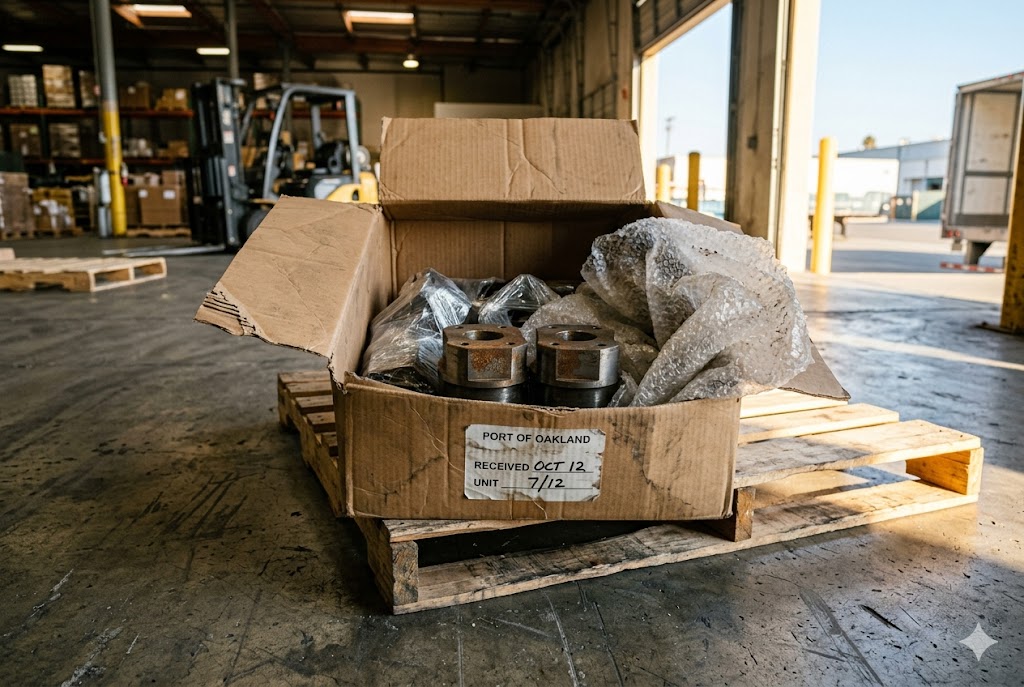
Every year, our team visits dozens of factories across China and Vietnam to audit how suppliers pack finished parts. What we see is often the same story: bare metal in a standard PE bag, dropped into a carton with a handful of bubble wrap, loaded onto a pallet with no moisture protection. By the time that shipment reaches a dock in California or Toronto, the damage is already done.
The most effective way to prevent shipping damage when importing custom CNC parts from China is to specify packaging requirements in writing on every purchase order. Require VCI inner bags, desiccant packets, foam cushioning, and ISPM 15-compliant wooden crates for sea freight. Never rely on verbal instructions alone.
Most suppliers will use the minimum packaging they can get away with unless you tell them exactly what you need. The sections below explain how to do that, step by step.
What Packaging Standards Should I Require for Precision CNC Parts?
When our team places orders with factories on behalf of clients, the packaging specification is always an attachment to the purchase order — never a phone call, never a WeChat message. The difference in outcomes is night and day.
You should require a written packaging specification that defines, for each part type: inner wrapping material, cushioning type and minimum thickness, carton weight limit (maximum 15 kg), pallet construction standard, and crate requirements for heavy or high-value shipments. Attach this document to every purchase order.
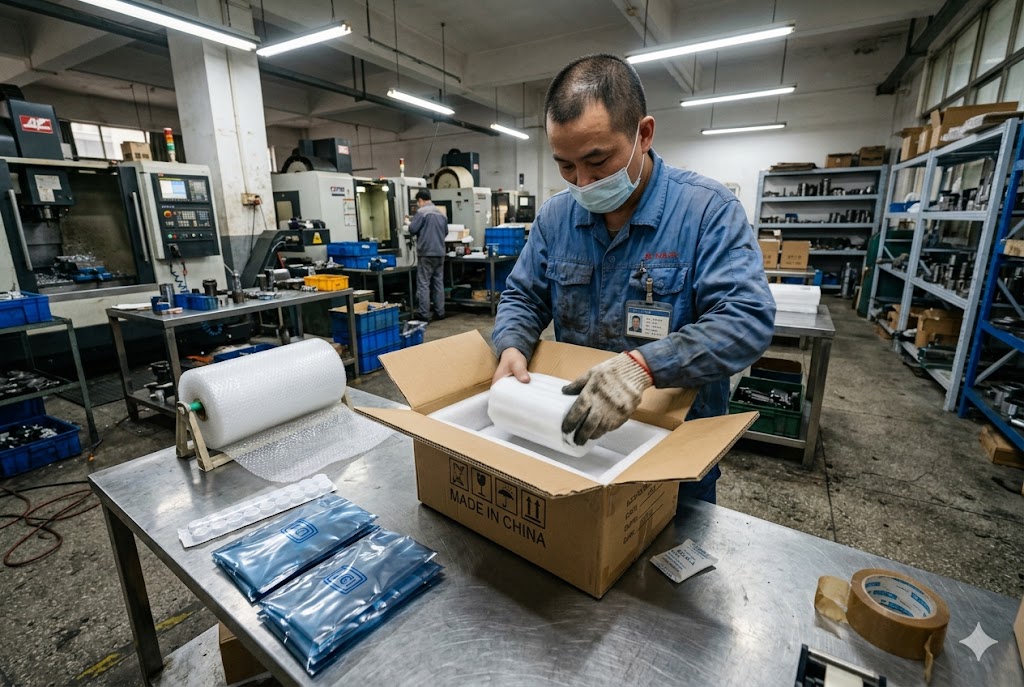
A verbal instruction means different things to different people on a factory floor. A written spec gives every worker the same reference point and creates accountability when something goes wrong.
Why Written Specifications Change Supplier Behavior
Suppliers who receive a written spec produce consistent results. Suppliers who receive no spec optimize for their own workflow — which typically means the least packaging that passes their internal inspection. That standard is not designed to survive 30 days in a shipping container.
A well-written packaging specification should cover the following elements:
| Specification Item | What to Define |
|---|---|
| Inner wrapping material | VCI bag (heat-sealed), tissue paper for soft metals |
| Cushioning type | EPE foam 1, bubble wrap (small-cell for air freight) |
| Minimum cushioning thickness | 25 mm on all faces as a standard starting point |
| Carton weight limit | 15 kg maximum per carton |
| Carton wall rating | Double-wall corrugated 2 for heavy parts |
| Pallet type | Export pallet, heat-treated (ISPM 15) |
| Crate requirement | Export wooden crate for parts over 50 kg or high value |
Part Geometry Determines Individual Wrapping Method
Not every CNC machined part 3 wraps the same way. A blanket instruction like "wrap in bubble wrap" will cause problems. Here is why:
Sharp edges cut through standard bubble wrap in transit and can damage adjacent parts. Threads and precision bores need physical protection before any soft wrap goes on. Ground surfaces and polished finishes on aluminum parts will show texture marks if bubble wrap contacts them directly.
The correct wrapping sequence for most CNC machined metal parts:
- Apply plastic thread caps or plugs to all threaded features.
- Wrap sharp-edged parts in tissue paper first.
- Apply EPE foam or bubble wrap over the tissue layer.
- Add edge protectors at any contact point with carton walls.
- Place desiccant packet between the inner wrap and the sealed outer VCI bag — not touching the metal directly.
Carton-Within-Crate Structure for Sea Freight
For medium to large batches going by ocean, the right structure is parts individually wrapped, placed in foam-padded inner cartons, and those cartons secured inside an export-grade wooden crate with blocking and bracing.
The critical detail: fill every void inside the crate. Cartons that can shift absorb impact forces that exceed what a carton wall can handle. A full, braced crate transfers load evenly.
| Shipment Type | Recommended Structure | Key Risk to Prevent |
|---|---|---|
| Small batch, air | Reinforced carton, small-cell bubble wrap | Bag expansion from pressure change |
| Medium batch, sea | Carton with foam padding inside wooden crate | Shifting, impact, moisture |
| Large batch, sea | Palletized crates, stretch-wrapped, corner-braced | Forklift damage, stack collapse |
| High-value parts | Custom foam-insert tray inside crate | Surface contact and vibration damage |
How Can I Protect Finished Surfaces During Transit?
We have seen beautiful precision parts arrive with surface rust, thread damage, and pressure marks — not because the factory did poor work, but because nobody specified how to protect the finish after machining. Our quality control team now checks packaging compliance on every pre-shipment inspection we conduct.
To protect finished CNC surfaces during transit, use a two-layer system: a heat-sealed VCI (Volatile Corrosion Inhibitor) 4 inner bag that deposits a nanometer-thin protective layer directly on the metal surface, and a sealed outer layer with desiccant packets placed between the two layers — never in direct contact with the metal.
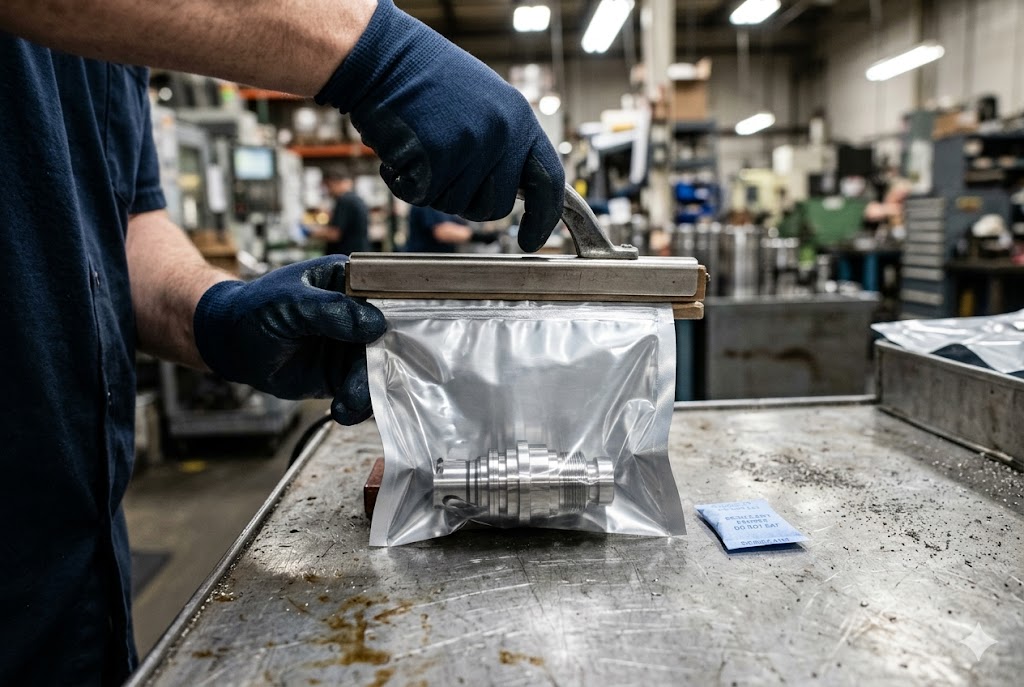
Corrosion is the most common and most preventable form of shipping damage for CNC machined metal parts on ocean freight. The fix is simple if you specify it clearly before production ends.
Understanding the VCI Protection System
VCI stands for Volatile Corrosion Inhibitor. VCI film or bags release molecules that form a nanometer-thin protective layer on metal surfaces inside the sealed package. This layer blocks the electrochemical reaction that causes rust and oxidation.
The system only works when sealed. A VCI bag that is left open, torn, or loosely folded provides little to no protection. Heat-sealed closure is the correct standard.
| Metal Type | VCI Protection Needed? | Notes |
|---|---|---|
| Carbon steel | Yes — critical | Rusts rapidly in humid conditions |
| Stainless steel | Yes — recommended | Corrosion-resistant but not corrosion-proof |
| Aluminum | Yes — recommended | Oxidizes and pits; soft surface scratches easily |
| Brass / bronze | Yes — recommended | Tarnishes and develops patina in moisture |
| Titanium | Lower priority | Naturally corrosion-resistant |
Humidity Indicator Cards: Simple, Objective Evidence
Humidity indicator cards 5 placed inside sealed VCI packages give you an objective record of whether the moisture barrier held during transit. These cards change color when relative humidity inside the package exceeds a threshold — typically 50% RH for metal parts.
When your receiving team opens the package, the card gives an immediate visual answer: did the protection work or not? If it shows a breach, you can assess moisture damage risk before parts enter your production line. You also have fresh, timestamped evidence to support an insurance or warranty claim.
This is a low-cost step — cards cost cents each — that can save thousands of dollars in dispute resolution.
Photographic Documentation at Origin
Ask your supplier or third-party inspection agent to photograph each stage of the packaging process before shipment. The photos should cover:
- Cleaned and inspected parts before wrapping
- Individual part wrapping with VCI bag visible
- Carton packing with foam layers visible
- Sealed cartons before crating
- Completed pallet or crate before loading
These photos serve three purposes. First, they confirm the specified packaging was actually applied. Second, they establish the condition of goods at origin for insurance claims. Third, they create direct accountability — suppliers who know they will be photographed take the process more seriously.
Should I Approve Packaging Before Mass Shipment?
When a new supplier asks us if packaging approval is really necessary, our answer is always yes — and we have the damage reports to explain why. Approving packaging before full production runs is one of the highest-return steps a buyer can take.
Yes. You should require the supplier to submit a pre-shipment packaging sample or conduct a third-party pre-shipment inspection 6 that includes packaging verification before mass shipment is released. This confirms your written specification was followed, not just acknowledged.
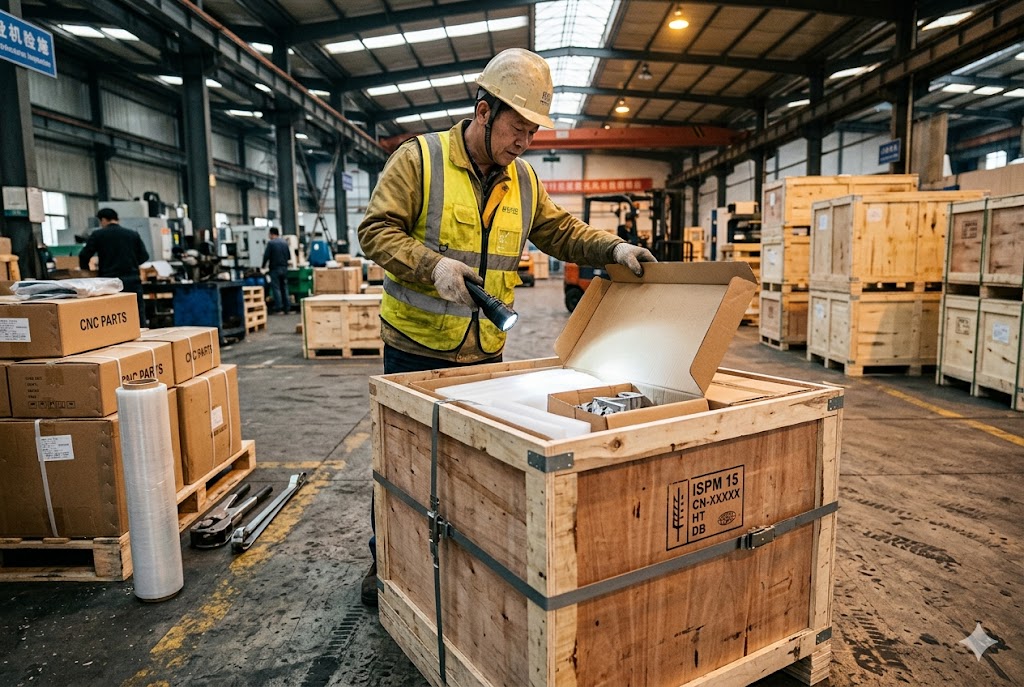
Most problems we see with shipped CNC parts trace back to a disconnect between what was written in the purchase order and what was actually done on the factory floor. A packaging approval step closes that gap.
What a Packaging Approval Should Confirm
A packaging approval — whether done by your own team, your sourcing agent, or a third-party inspection company — should verify the following:
- Correct VCI bag type and heat-sealed closure
- Desiccant packets 7 present and correctly positioned
- Correct foam cushioning type and thickness on all faces
- Thread caps and edge protectors applied where specified
- Carton weight within the 15 kg limit
- Carton labeling correct: "This Side Up," "Fragile," "Do Not Stack," max stack height, printed in both English and Chinese
- ISPM 15 mark present on any wooden crate or pallet
Outer Carton and Crate Labeling
LCL ocean freight consolidation involves multiple handling events: origin CFS, transshipment port, destination CFS, and your delivery truck. Warehouse workers at each point handle cartons based on visual cues. A clearly labeled carton significantly reduces the chance of crushing from improper stacking.
Labels should use both text and pictogram symbols and appear on at least two faces of the carton. For wooden crates, labels should be printed on a weatherproof tag attached to the crate frame.
ISPM 15 Compliance for US-Bound Wooden Packaging
This point is non-negotiable for US-bound shipments. Any wooden packaging material — pallets, crates, dunnage — must be ISPM 15 compliant 8. This means the wood has been heat-treated to kill pests and carries the official IPPC mark stamped directly on the wood.
Non-compliant wooden packaging is detained at US ports of entry. Detention means your shipment sits at the port, demurrage charges accumulate, and your downstream customer's production schedule is disrupted. Confirming ISPM 15 compliance during packaging approval takes one minute and prevents days of delay.
Cargo Insurance: Match Coverage to Your Risk
Before shipment is released, confirm your cargo insurance is in place and at the right level. The standard CIF insurance suppliers provide covers only ICC Clause C, which excludes rough handling, water damage, and contamination. These are exactly the scenarios most likely to affect precision CNC parts in transit.
The correct coverage for machined components is ICC Clause A (all-risks) 9, which covers all causes of physical loss or damage not explicitly excluded. For FOB shipments, you arrange this directly with your insurer. Verify the policy covers the full transit from factory door to your receiving dock — not just the ocean leg.
What Should I Inspect Immediately When the Shipment Arrives?
Our receiving process for client shipments is not informal. Before a single carton moves into storage, the condition of the packaging is recorded. This step has saved clients from losing insurance claims that would otherwise have been denied for lack of documentation.
When a shipment arrives, immediately photograph the outer packaging condition, record any visible carton or crate damage on the carrier's delivery receipt before signing, open inner packaging and photograph humidity indicator card readings, then perform a dimensional and visual check on a sample of parts before accepting the full shipment.
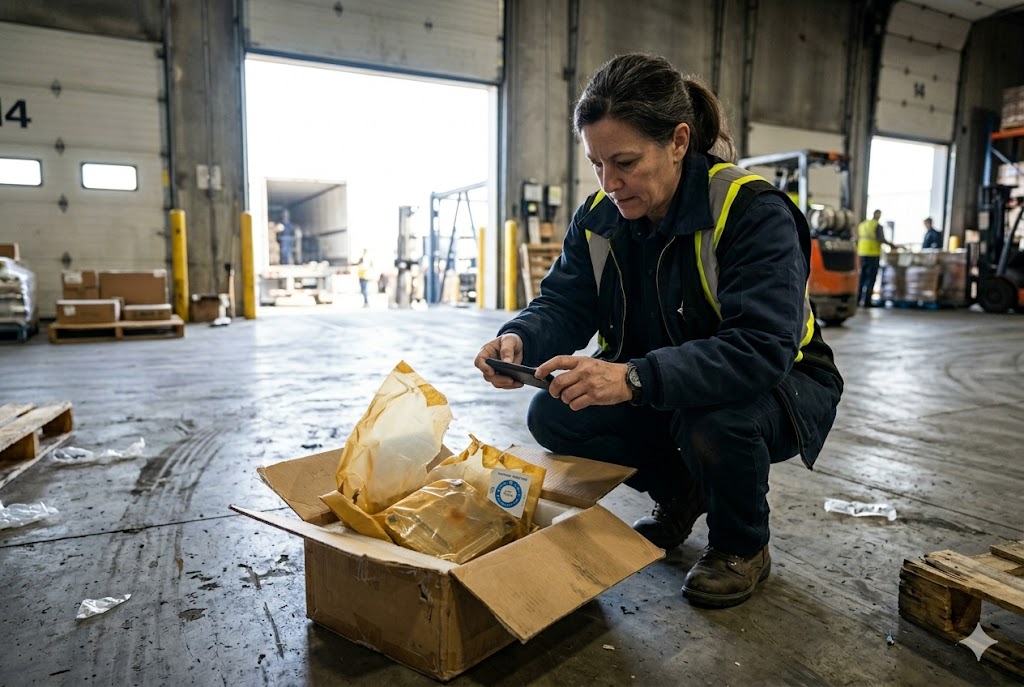
Most cargo insurance policies and purchase order terms require damage to be noted on the carrier's delivery receipt at the time of delivery. Claims submitted without contemporaneous documentation are routinely denied. The incoming inspection procedure is not optional — it is your evidence record.
Step-by-Step Incoming Inspection Procedure
Follow these steps in order, before any part moves into your stock or production area:
Step 1 — Photograph the outer packaging. Before opening anything, photograph every face of each carton or crate. Note any dents, tears, water staining, or evidence of rough handling. If a crate has been dropped, the corner bracing will often show the impact point.
Step 2 — Note damage on the carrier's delivery receipt. If you see any external damage, write it on the delivery receipt before you sign. Use clear, specific language: "Carton 3 of 12 shows crush damage on top face." Once you sign a clean receipt, the carrier's liability ends.
Step 3 — Open packaging and read humidity indicator cards. Photograph the humidity indicator card in every sealed package before removing parts. A card showing a breach (color changed) means the moisture barrier failed at some point during transit. Do not remove parts before photographing the card.
Step 4 — Inspect inner packaging condition. Check that VCI bags are still sealed, foam is intact, thread caps and edge protectors are in place. Any displacement of cushioning materials suggests the shipment experienced more movement than the packaging was designed to handle.
Step 5 — Perform a sample check on parts. Before accepting the full shipment, inspect a sample of parts for dimensional compliance and surface condition. Check critical dimensions against your drawing. Look for rust spots, pressure marks, thread damage, and surface scratches. Corrosion damage to metal surfaces is explained in detail by VCI protection science 10, which helps you distinguish packaging failure from pre-existing material issues.
Documentation Creates Accountability at Both Ends
The documentation you create at incoming inspection — photographs, written notes, carrier receipt annotations — serves two functions. It supports insurance or warranty claims if damage is found. It also creates a feedback loop with your supplier: when suppliers receive damage reports with photographic evidence, the next shipment's packaging usually improves.
If you are working with a sourcing agent, share the incoming inspection records with them. A good agent will use this data to apply pressure on the supplier and verify corrective actions before the next order ships.
Conclusion
Preventing shipping damage starts before the parts leave the factory. Write a clear packaging spec, require VCI and desiccant protection for ocean freight, approve packaging before shipment, and document everything the moment your delivery arrives. These steps protect your parts, your budget, and your supplier relationships.
Footnotes
1. EPE foam is a lightweight, semi-rigid closed-cell material widely used for protective cushioning in transit packaging. ↩︎
2. Double-wall corrugated fiberboard offers superior burst and stack strength for heavy industrial parts during ocean freight. ↩︎
3. CNC (Computer Numerical Control) machining automates cutting tools via computer to produce precision metal components. ↩︎
4. VCI (Volatile Corrosion Inhibitor) bags release protective vapors that form a molecular barrier on metal surfaces to prevent rust. ↩︎
5. Humidity indicator cards change color when relative humidity inside a sealed package exceeds a set threshold, confirming moisture barrier integrity. ↩︎
6. Pre-shipment inspection (PSI) is a quality control process verifying goods meet buyer specifications before shipment is released. ↩︎
7. Desiccant packets are hygroscopic materials that absorb moisture inside sealed packaging to protect metal parts from humidity damage. ↩︎
8. ISPM 15 is the international phytosanitary standard requiring heat treatment of wooden packaging material to prevent pest transfer in international trade. ↩︎
9. ICC Clause A provides the broadest all-risks cargo insurance coverage, protecting against all physical loss or damage not explicitly excluded. ↩︎
10. Corrosionpedia explains the electrochemical science behind VCI protection and how different metals respond to corrosion inhibitor compounds. ↩︎