Skip to main content Skip to footer

Every year, we see purchasing teams get burned by the same mistake: they approve a coating spec, the parts pass receiving inspection, and six months later the field team is calling about rust. It is not always a supplier defect. Sometimes the salt spray requirement was simply set too low for the actual environment.
The right salt spray test duration depends on where your parts will be used. Indoor protected parts typically require 96–240 hours to red rust under ASTM B117. Outdoor or partially exposed parts need 480–720 hours. Harsh marine, coastal, or road-salt environments require 1,000 hours or more. Match the requirement to the exposure, not to a generic industry default.
The four questions below walk through how to set the requirement, read the results, choose the right coating, and enforce the standard with your Chinese supplier from purchase order through final inspection.
What Salt Spray Test Standard Should I Specify for My Coated Sheet Metal Parts from China?
Most Chinese fabricators are familiar with two test standards: ASTM B117 and ISO 9227. Both use a 5% neutral sodium chloride fog at 35 °C. In practice, the two standards produce comparable results for flat coated steel panels, and a Chinese lab certified to either standard can generate results the other will recognize.
ASTM B117 is the dominant standard for US export parts. ISO 9227 is its European equivalent. Both are acceptable. For US customers, specify ASTM B117 by name in your purchase order. Add ISO 9227 as an acceptable alternative only if your supplier cannot access an ASTM-certified chamber — the results will be comparable for most coated steel applications.

ASTM B117 vs. ISO 9227: What Actually Differs
The core chemistry and temperature are nearly identical. The differences that matter in practice are procedural: how the test chamber is qualified, how fog uniformity is verified, and how results are reported. For purchasing purposes, the distinction is minor. What matters is that the test lab is accredited, the chamber is calibrated, and the test report documents the start time, end time, and inspection interval.
ASTM B117 1 defines a controlled corrosive environment for producing relative corrosion resistance information on coated and uncoated metal specimens, and it explicitly does not prescribe exposure periods for specific products. ISO 9227 2 is its international counterpart, specifying apparatus, reagents, and procedures for neutral salt spray, acetic acid salt spray, and copper-accelerated acetic acid salt spray tests.
| Parameter | ASTM B117 | ISO 9227 |
|---|---|---|
| Solution concentration | 5% NaCl | 5% NaCl |
| Chamber temperature | 35 °C | 35 °C |
| pH range | 6.5–7.2 | 6.5–7.2 |
| Common use region | North America | Europe, Asia |
| Acceptance by US customers | Standard | Acceptable alternative |
The Cyclic Corrosion Alternative
Straight salt spray runs a continuous fog. Cyclic corrosion testing (CCT) alternates between salt spray, humidity, and dry phases to simulate the real-world wet/dry cycle. Standards like SAE J2334 3, Volvo STD 423-0014, and GM 9540P use this approach.
CCT produces better correlation to outdoor atmospheric corrosion than conventional ASTM B117, particularly for galvanic and crevice corrosion on assemblies with mixed materials. If your parts will be used outdoors or in road-salt environments, consider requiring CCT in addition to, or instead of, ASTM B117. Chinese labs with automotive or heavy equipment customers typically have CCT capability.
What to Write in Your Purchase Order
Be specific. A vague note like "passes salt spray test" is unenforceable. Specify:
- The standard (e.g., ASTM B117)
- The minimum hours to first red rust (e.g., 480 hours)
- The white rust threshold for zinc-coated parts (e.g., no white rust before 72 hours)
- The test geometry (flat panel, or representative part with edges)
- The lab accreditation requirement (e.g., A2LA, CNAS, or equivalent)
Without these four elements in writing, your supplier's interpretation of "passes salt spray" may not match yours.
How Do I Translate Salt Spray Hours into Real-World Corrosion Protection Life?
This is the question every purchasing manager eventually asks — and the answer is uncomfortable. Salt spray hours do not convert to service years by a fixed multiplier. The test was designed as a process control check, not a service-life predictor.
Salt spray testing accelerates a single, continuous corrosion mechanism — constant saline fog — while real outdoor exposure involves wet/dry cycling, UV, temperature swings, rain washdown, and multi-agent atmospheric chemistry. There is no reliable universal conversion factor. Use salt spray hours to screen suppliers and detect process drift, not to calculate a service-life guarantee.
Why the Correlation Is Weak
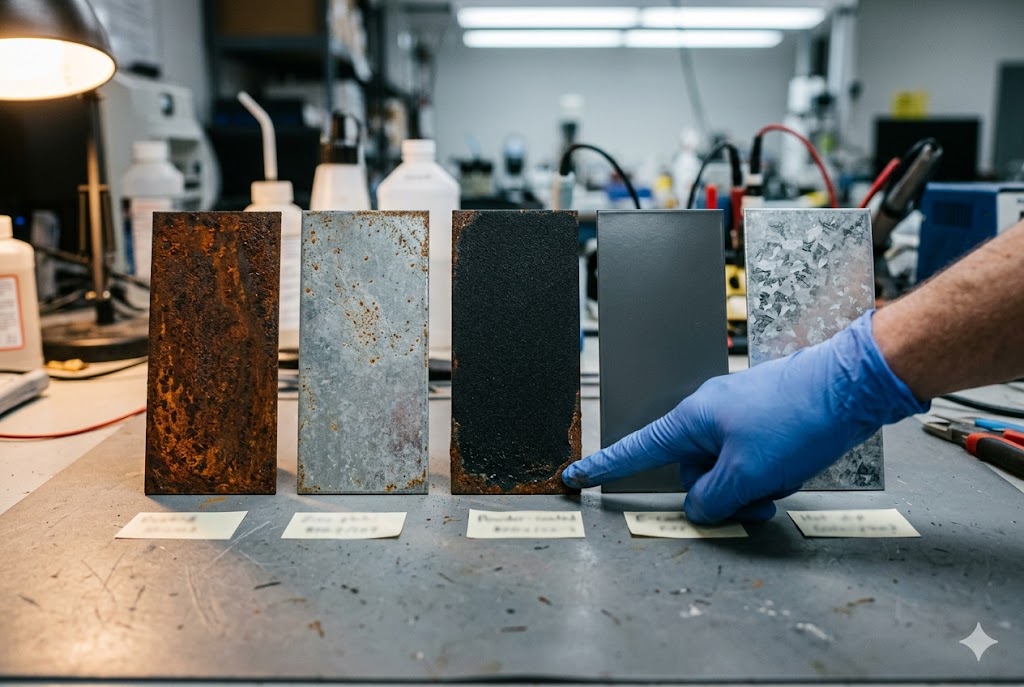
Researchers have spent 50 years trying to link ASTM B117 hours to outdoor exposure months. The relationship remains weak for most coating systems. The key reasons:
- Real outdoor air contains CO₂, SO₂, and NOₓ that alter corrosion chemistry. ASTM B117 uses only NaCl.
- Wet/dry cycling drives the formation of protective corrosion products on zinc. Continuous fog prevents this, which is why zinc-coated steel systematically underperforms its outdoor service life when rated only by ASTM B117 hours.
- UV degrades organic coatings (powder coat, liquid paint) in ways that salt fog does not replicate.
- Edge geometry, assembly gaps, and dissimilar metal contacts create galvanic and crevice corrosion that a flat coupon test does not capture.
Zinc Is the Most Misread Case
ASTM B117 is particularly misleading for hot-dip galvanized or electroplated zinc parts. Zinc's corrosion resistance in service depends on the formation of a zinc carbonate barrier layer that builds up through atmospheric exposure. Continuous salt fog prevents that layer from forming, causing the zinc to deplete far faster in the chamber than it would outdoors.
A part that fails at 96 hours in ASTM B117 may last five to ten years in a rural outdoor environment. The ISO 12944 standard 4 addresses this by recommending CCT rather than ASTM B117 for zinc coating evaluation, classifying environments by corrosivity category and recommending protective paint systems matched to each category.
| Coating System | ASTM B117 Typical Hours to Red Rust | Notes on Correlation to Service |
|---|---|---|
| Bare cold-rolled steel | <24 hours | Not applicable for exposed use |
| Zinc electroplate (8–12 µm) | 96–240 hours | SST underestimates outdoor life for zinc |
| Zinc electroplate + trivalent chromate | 240–480 hours | Better SST performance than service would predict |
| Hot-dip galvanize (85 µm) | 500–1,000+ hours | SST unreliable; use CCT or ISO 12944 C-rating |
| Powder coat over zinc phosphate | 480–720 hours | Reasonable outdoor correlation for urban environments |
| E-coat primer + powder coat topcoat | 720–1,500+ hours | Strong process control indicator |
How to Use SST Results Correctly
Use salt spray hours as a process-control floor, not as a specification ceiling. If parts from a supplier have consistently passed 480 hours for two years and a new batch fails at 80 hours, that signals a process change — a bath chemistry drift, a coating thickness drop, a passivation step omitted — that needs investigation before the batch ships.
This is where salt spray testing earns its cost: not as a service-life calculator, but as a tripwire for process drift at your supplier's surface finishing subcontractor.
Which Coating Types Perform Best in Salt Spray Tests for Industrial Sheet Metal Parts?
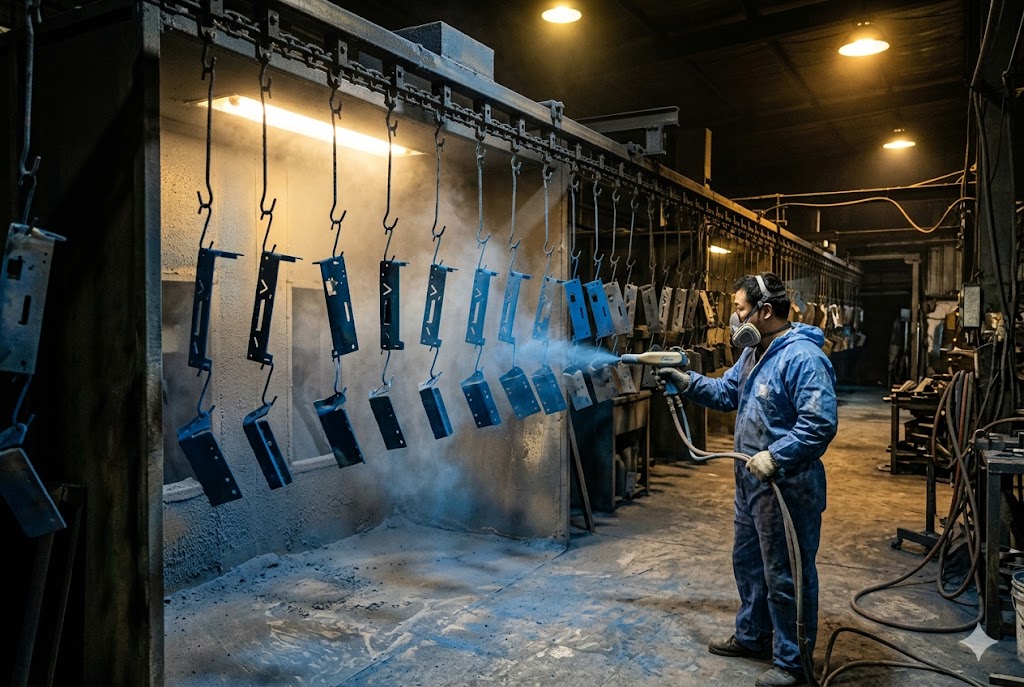
Coating selection determines your salt spray performance ceiling before any test spec is written. The coating system — not just the topcoat — drives the result. A thick powder coat over bare steel will fail much earlier than a thin powder coat over a zinc phosphate conversion layer.
For industrial sheet metal parts, the strongest salt spray performers are electrocoat (e-coat) primer plus powder coat topcoat systems, achieving 720–1,500+ hours under ASTM B117. Zinc electroplate with trivalent chromate passivation delivers 240–480 hours. Powder coat alone over zinc phosphate provides 480–720 hours. The coating system — substrate preparation, conversion coating, primer, and topcoat — matters more than any single layer.
The Role of Surface Preparation
Fabricators who cut costs on surface preparation — skipping iron phosphate wash, using inadequate blast profile, or rushing the zinc phosphate stage — will produce parts that fail salt spray testing regardless of topcoat thickness. Surface preparation is invisible at receiving inspection, which is exactly why it is the most common place for cost-cutting at tier-2 and tier-3 Chinese fabricators.
Specify surface preparation requirements explicitly in your drawing notes or supplier technical agreement:
- Blast profile: Sa 2.5 per ISO 8501-1 for e-coat or high-performance powder coat
- Zinc phosphate conversion coating: minimum 1.5 g/m² coating weight
- Iron phosphate: acceptable for indoor-use parts; not adequate for outdoor or corrosive environments
Coating System Comparison
| Coating System | Typical ASTM B117 Hours to Red Rust | Best For | Key Risk |
|---|---|---|---|
| Powder coat alone (no primer) | 200–480 hours | Indoor light-duty | Edge coverage gaps |
| Zinc phosphate + powder coat | 480–720 hours | Outdoor industrial | Phosphate bath control |
| E-coat primer + powder coat | 720–1,500+ hours | Outdoor heavy-duty | Subcontractor outsourcing |
| Zinc electroplate + trivalent chromate | 240–480 hours | Hardware, fasteners | White rust onset |
| Hot-dip galvanize | 500–1,000+ hours (CCT preferred) | Structural, outdoor | SST result unreliable |
| Liquid paint (2K epoxy) | 480–720 hours | Complex geometries | Film thickness variation |
Cut Edges: The Weak Point No Coupon Test Captures
Laser-cut kerf faces, punched hole edges, and sheared perimeters are the earliest corrosion initiation sites on sheet metal parts. Powder coat and e-coat penetrate poorly into tight-radius edges. A flat coupon test will show excellent SST hours while the actual part rusts at every hole within 90 days.
Require that your salt spray test panels include representative edge geometry — a laser-cut edge, a punched hole, and an inside bend radius — not only flat plate. This single requirement makes your SST acceptance criterion far more predictive of actual part performance.
Passivation Chemistry: Trivalent vs. Hexavalent
Hexavalent chromate passivation (Cr⁶⁺) produces better initial SST hours than trivalent (Cr³⁺). However, hexavalent chromium is restricted under RoHS and REACH 5 for most end products sold in the EU and increasingly under US state-level environmental regulations. Most Chinese electroplaters have transitioned to trivalent chromate, but some still offer hexavalent as an option.
If your customer base includes EU manufacturers or any RoHS-sensitive downstream application, specify trivalent chromate passivation explicitly and require your supplier to provide a RoHS compliance declaration alongside the SST report.
Can I Request Salt Spray Test Certificates from My Supplier Before I Accept a Batch?
Yes — and you should make it a contractual requirement, not a polite request. A salt spray test certificate is a standard quality document in Chinese manufacturing, and any supplier finishing parts with zinc plating, powder coat, e-coat, or paint has access to either an in-house chamber or a qualified third-party lab within their industrial cluster.
Yes, you can and should require salt spray test certificates before batch acceptance. Specify this in your purchase order: the test standard, minimum hours, white rust threshold, accredited lab requirement, and that the certificate must accompany each shipment. Without contractual language, many Chinese suppliers treat SST as optional documentation rather than a release gate.

What a Valid SST Certificate Must Include
Not all test reports are equal. A one-line note saying "passed 480 hours salt spray" is not a certificate. A valid SST certificate should include:
- Lab name, accreditation number, and test date
- Customer part number and batch or lot reference
- Test standard (ASTM B117 or ISO 9227)
- Start time, end time, and total test duration
- Inspection intervals and condition at each interval
- Pass/fail criteria used (e.g., no red rust at 480 hours; no white rust before 72 hours)
- Signature or stamp of the responsible lab technician
If a supplier cannot produce a certificate in this format, treat that as a quality system gap that requires correction, not a negotiation point.
Pairing SST with Coating Thickness Measurement
A salt spray hour requirement without a minimum coating thickness specification is only half a standard. A supplier can pass your SST requirement on thick sample panels prepared specifically for testing, while shipping parts with underweight coating that will fail in the field.
Always pair your SST requirement with a minimum coating thickness specification:
| Coating | Specification Reference | Minimum Thickness |
|---|---|---|
| Zinc electroplate | ASTM B633 6 | SC1: 5 µm; SC3: 12 µm; SC4: 25 µm |
| Powder coat | ASTM D7091 7 / client drawing | Typically 60–80 µm minimum |
| E-coat primer | Internal or customer spec | Typically 15–25 µm |
| Hot-dip galvanize | ASTM A123 8 | Varies by steel thickness; minimum 45–86 µm |
Both documents — SST certificate and coating thickness measurement report — should be required at shipment. Pair them contractually.
Re-qualification After Design or Supplier Changes
One of the most overlooked corrosion risks in production is an engineering change notice (ECN) or a mid-production supplier switch that alters coating chemistry without triggering a re-qualification test. A change from hexavalent to trivalent chromate passivation, a switch to a different powder coat formulation, or a shift from one plating subcontractor to another can reduce SST performance by 30–50% with no visible difference at incoming inspection.
Make re-qualification SST a contractual trigger — not optional — for:
- Any change to the coating supplier or subcontractor
- Any change to the surface preparation process
- Any change to passivation chemistry
- Any ECN affecting the substrate material or geometry
Our team includes this clause as standard language in supplier quality agreements. It costs nothing if no changes occur, and it prevents field failures when changes do happen without advance notice.
Third-Party Inspection as a Backstop
For high-volume or high-risk programs, consider requiring a third-party pre-shipment inspection that includes coating thickness measurement on production parts — not just flat coupons. Agencies like SGS metal testing 9 and Bureau Veritas 10 can perform spot-check coating thickness audits at the factory before parts are loaded. This provides an independent data point that does not rely solely on the supplier's own test report, which is particularly valuable when sourcing from tier-2 or tier-3 fabricators whose surface finishing work is subcontracted.
Conclusion
Set your salt spray requirement based on exposure severity, not habit. Pair every SST hour specification with a minimum coating thickness requirement. Require representative edge geometry in test panels. Use the results as a process-control tool — and build re-qualification triggers into your supplier agreements before you need them.
Footnotes
1. ASTM B117 defines the standard practice for operating salt spray fog apparatus. ↩︎
2. ISO 9227 specifies neutral, acetic acid, and copper-accelerated salt spray test procedures. ↩︎
3. SAE J2334 describes the automotive cyclic corrosion lab test with humidity and drying phases. ↩︎
4. ISO 12944 classifies corrosion environments and guides protective paint system selection for steel. ↩︎
5. RoHS and REACH restrict hexavalent chromium in EU-sold products; trivalent chromium is compliant. ↩︎
6. ASTM B633 specifies thickness classes and service conditions for electrodeposited zinc coatings. ↩︎
7. ASTM D7091 covers nondestructive dry film thickness measurement of nonmagnetic coatings on ferrous metals. ↩︎
8. ASTM A123 governs minimum zinc coating thickness and adherence for hot-dip galvanized steel products. ↩︎
9. SGS offers metal testing including salt spray, coating mass, and corrosion resistance analysis. ↩︎
10. Bureau Veritas provides independent testing, inspection, and certification services for manufacturers worldwide. ↩︎