Skip to main content Skip to footer

We handle coated sheet metal parts every week — powder-coated enclosures, painted brackets, e-coated frames — and coating failures are among the most expensive surprises a purchasing manager can face after parts clear customs. A flaking finish on a high-volume order means rework costs, delayed assembly lines, and a supplier dispute that neither side wants.
Yes, the cross-cut adhesion test (ISO 2409 / ASTM D3359) is a recognized industry standard for coated sheet metal and is routinely performed by Chinese fabricators and coating suppliers, particularly for powder-coated and liquid-paint-coated parts. Specifying it correctly in your purchase order is the difference between a useful data point and a meaningless result.
The four questions below cover everything you need to know: how to read a failure, how to write airtight acceptance criteria, what to include in your PSI report, and which additional defect checks you should never skip.
What Does a Failed Cross-Cut Test Tell Me About My Supplier's Coating Process?
In our experience reviewing failed batches from Chinese sheet metal suppliers, a cross-cut failure almost always points upstream — to what happened before the coating gun ever fired. The coating material itself is rarely the culprit.
A failed cross-cut test is a direct signal of inadequate surface pretreatment — insufficient degreasing, degraded phosphate or chromate conversion coating, or contamination between pretreatment and powder application. These process failures break the bond between coating and substrate before the part ever leaves the factory.
The Root Cause Is Almost Always Pretreatment
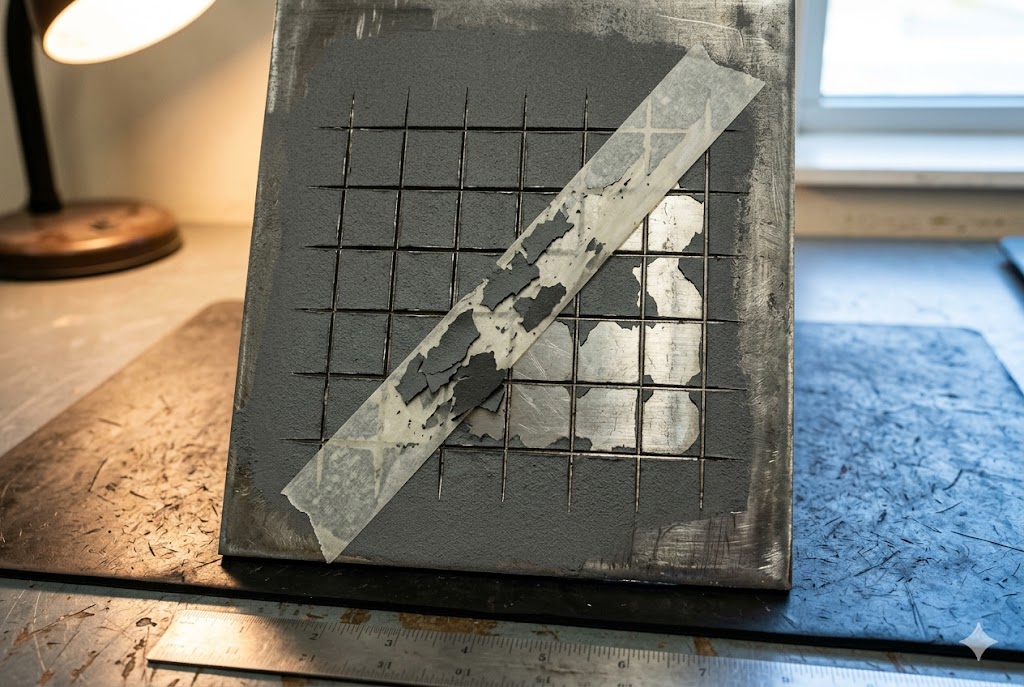
The cross-cut test 1 works by scoring a grid pattern through the coating to the substrate, then pulling adhesive tape across the grid. How much coating lifts off defines the adhesion grade. When large flakes pull free, the coating never fully bonded.
The most common pretreatment failures we see:
- Insufficient degreasing. Oil from stamping, laser cutting fluid, or handling contaminates the surface. A powder coat applied over residual oil will delaminate under tape — and later under service conditions.
- Degraded or missing conversion coating. Phosphate conversion coatings 2 create the chemical anchor between bare steel and the organic coating layer. If the bath concentration is off, the dwell time is too short, or the coating line is poorly maintained, adhesion suffers.
- Cross-contamination between stages. If parts move from pretreatment to the coating booth without adequate dry-off, or if the pretreatment rinse water is contaminated, the surface chemistry is compromised.
Reading the Failure Grade
Both ISO 2409 3 and ASTM D3359 classify adhesion, but their scales run in opposite directions:
| Standard | Best Result | Worst Result | What "Pass" Typically Means |
|---|---|---|---|
| ISO 2409 | 0 (no detachment) | 5 (>65% removed) | Grade 0 or 1 |
| ASTM D3359 Method B | 5B (no detachment) | 0B (>65% removed) | 4B or 5B |
A grade 3 under ISO 2409 means the coating is detaching in broad ribbons. That is a process alarm, not a minor cosmetic issue. It tells you the pretreatment line needs immediate corrective action — not a coating formulation change.
What a Failure Does Not Tell You
The cross-cut test detects adhesion failure at the coating-to-substrate interface. It does not detect undercure or overcure of powder coatings. A part can pass a cross-cut test and still have a powder coat that was never fully cured — making it brittle, chemically vulnerable, and likely to fail in the field. For cure verification, a separate MEK solvent rub test (ASTM D5402) is required. Specify both as a paired minimum QC requirement. One without the other leaves a gap.
How Should I Define Acceptable Adhesion Standards in My Purchase Order?
Most adhesion disputes we see between buyers and Chinese suppliers come down to the same problem: the purchase order said "good adhesion" and nothing else. That phrase means nothing in a factory context. Precise contractual language closes the gap before it becomes an argument.
To define enforceable adhesion standards, specify the test standard (ISO 2409 or ASTM D3359), the acceptance grade (e.g., ISO Grade 0–1 or ASTM 4B–5B), the tape brand and grade, sample size and frequency, and whether in-house or third-party verification is required. Ambiguity in any of these points creates a loophole.

Choose One Standard and State the Grade Explicitly
ISO 2409 and ASTM D3359 4 are not interchangeable in your documentation. They use inverse numbering. A supplier reading "Grade 3 minimum" will interpret that differently under each standard:
| Standard | Grade 3 Meaning | Acceptable for Structural Use? |
|---|---|---|
| ISO 2409 | Coating detaches in broad ribbons along cuts | No — significant adhesion failure |
| ASTM D3359 | ~15% of coating detached at intersections | Marginal — borderline for many applications |
State explicitly: "ISO 2409, maximum Grade 1" or "ASTM D3359 Method B, minimum 4B." Do not leave it open to interpretation.
Specify the Tape
This is the clause most buyers omit — and it is the easiest loophole for a supplier to exploit. ISO 2409 requires tape with a defined peel strength. Chinese suppliers using low-tack tape will record a passing result that would fail under correctly specified tape.
Your purchase order should state: "Cross-cut tape: 3M 610 or equivalent, peel adhesion ≥10 N/25mm per ISO 2409 requirements."
Define Sampling Scope
The cross-cut test is destructive. You cannot test every part. Your QC clause must define:
- Lot size and sample size. For example: 3 test specimens per production batch, drawn from the beginning, middle, and end of each coating run.
- Trigger events for mandatory retesting. Any coating material changeover, color changeover, or phosphate pretreatment 5 line maintenance should trigger a new adhesion test series.
- Who bears the cost of destroyed test parts. This should be the supplier's cost, not yours.
In-House vs. Third-Party Verification
In-house supplier test results are useful for process control. They are not independently verifiable. For first-article qualification or for high-value programs, require third-party lab verification by SGS, Bureau Veritas, or CTI. Specify that results must be documented on a supplier-issued report with lot traceability — including batch number, coating line ID, operator, and date.
| Verification Type | Traceability | Cost | Use Case |
|---|---|---|---|
| Supplier in-house | Moderate (depends on their records) | Low | Ongoing production monitoring |
| Third-party lab (SGS, BV, CTI) | High | Medium–High | First article qualification, dispute resolution |
| On-site inspector-witnessed | High | Medium | Pre-shipment inspection |
Can I Request Cross-Cut Test Results and Photos in My Pre-Shipment Inspection Report?
Yes — and you should require it, not just request it. Our inspection teams document cross-cut tests as a standard line item when buyers specify it in advance. The key word is "in advance." An inspector arriving at a factory without a defined checklist will default to visual checks only.
You can and should require cross-cut test results, grade photographs, and tape-lift photos in your pre-shipment inspection report. This must be written into your inspection brief before the inspection date, with the standard, acceptance grade, sample size, and tape specification all stated explicitly.

What to Include in Your Inspection Brief
A complete cross-cut test clause in your PSI brief should cover:
- Test standard and acceptance grade
- Tape specification (brand, grade, peel strength)
- Number of test specimens per lot
- Locations on the part to be tested (flat faces vs. near bends vs. edges)
- Required photo documentation (pre-test grid, post-tape-pull close-up, full-part context shot)
- Disposition instruction if the test fails (hold, reject, 100% re-inspection)
Photo Documentation Standards
Photos make adhesion test results auditable. Without photos, a written grade of "0" on a report is unverifiable. Require your inspection agency to capture:
- Close-up of the scored grid before tape application — confirms correct grid spacing (1mm or 2mm per coating thickness range per ISO 2409)
- Tape-pull result close-up — clearly showing the pattern and extent of any detachment
- Full-part shot with test location circled — confirms the test was performed on the actual part, not a coupon
Lot Traceability in the Report
Each test result in the PSI report should be traceable to a specific production lot. Require the inspector to record: production batch number, coating line ID if available, part number, color/finish code, and date of test. Without this, a passing result from one lot cannot be mapped to the parts in the shipping cartons.
Limitations of PSI-Stage Testing
Pre-shipment inspection 6 testing is a final confirmation check, not a substitute for in-process QC. Parts that fail at PSI stage have already consumed full production cost. The more valuable intervention is requiring the supplier to perform and document in-process adhesion tests at the coating line, with results submitted to you as production records — then using PSI as an independent verification step, not the only step.
Third-party verification agencies 7 such as Bureau Veritas offer accredited testing programs that document lot traceability, inspection methodology, and test outcomes in a format accepted by international buyers and import authorities.
What Coating Defects Should I Always Check Beyond the Cross-Cut Adhesion Test?
The cross-cut test answers one question: does the coating bond to the substrate? It does not answer questions about cure state, thickness consistency, edge coverage, or what happens after forming. Relying on cross-cut alone leaves several common failure modes completely undetected.
Beyond cross-cut adhesion, you should always verify coating cure state (MEK rub test, ASTM D5402), dry film thickness (per spec tolerance), edge and bend coverage, post-forming adhesion for bent parts, and visual surface quality against an agreed-upon limit sample. Each check targets a failure mode the cross-cut test cannot see.
Cure State: The MEK Rub Test
A powder coat that was not fully cured will be chemically weak even if it passes cross-cut. The MEK double-rub test 8 (ASTM D5402) checks cure by rubbing a MEK-saturated cloth across the surface under controlled pressure for a defined number of double strokes. A minimum of 100 double rubs without coating removal is a typical acceptance criterion for standard powder coats. Specify this alongside cross-cut — they address different failure modes and cost almost nothing to add to an inspection plan.
Dry Film Thickness
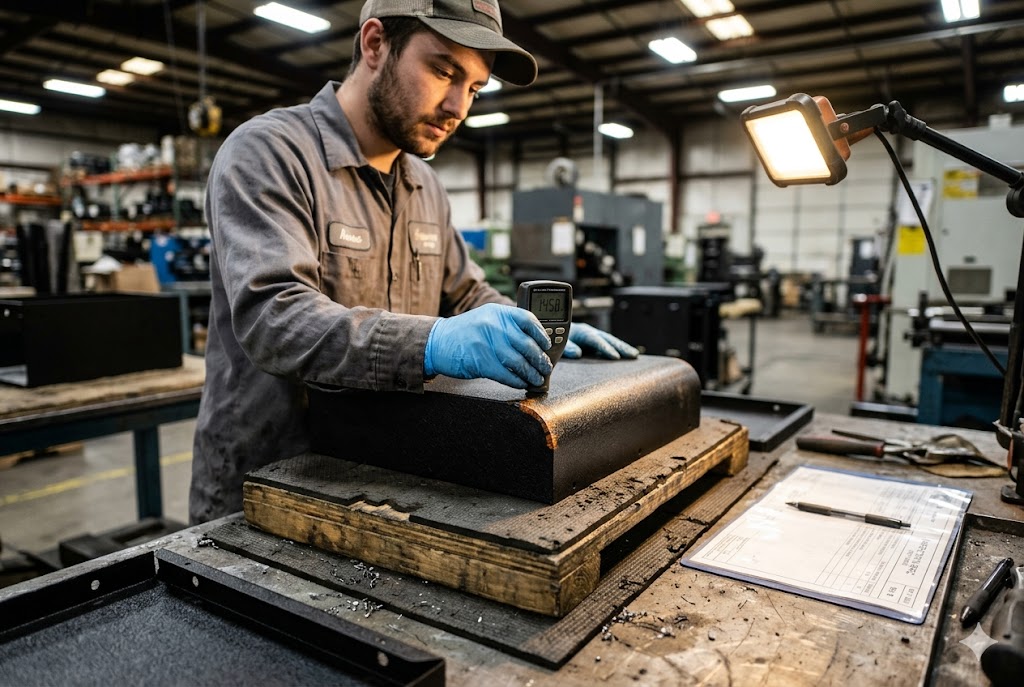
Coating thickness directly affects corrosion resistance, appearance, and — for tight-tolerance assemblies — dimensional fit. Chinese suppliers running high-volume coating lines often accumulate thickness variation across a batch. Specify dry film thickness (DFT) tolerance in your drawing or coating spec, and require DFT readings at a minimum of five measurement points per part (center, four quadrants), documented in the inspection report. A calibrated coating thickness gauge 9 is the standard instrument for this non-destructive measurement on both ferrous and non-ferrous metal substrates.
| Coating Type | Typical DFT Range | Key Risk if Too Thin | Key Risk if Too Thick |
|---|---|---|---|
| Powder coat (decorative) | 60–100 µm | Poor corrosion resistance, color inconsistency | Dimensional interference, edge sagging |
| Liquid paint (industrial) | 40–80 µm | Poor adhesion, pinholes | Runs, sags, slow cure |
| E-coat (electrocoat primer) | 15–30 µm | Insufficient corrosion protection | Cracking at bends |
Edge and Bend Coverage
Coating coverage at punched edges, laser-cut edges, and bend radii is almost always thinner than on flat surfaces — this is a physics problem, not a process failure per se. But "thinner" at an edge becomes "absent" if the supplier's pretreatment and coating parameters are not tuned for the part geometry. Require your inspector to use a thickness gauge at cut edges and inside bend radii, and set a minimum acceptable DFT for these locations separately from the flat-face tolerance.
Post-Forming Adhesion
This is the failure mode most sourcing programs completely miss. A coated flat blank that passes cross-cut may delaminate at bends after forming — especially on thin-gauge SPCC or SGCC substrates where edge deformation is severe. If your parts undergo secondary forming after coating, or if the supplier coats pre-formed parts with tight bend radii, specify a mandrel bend test or T-bend adhesion test in addition to the standard cross-cut. This is a separately contractible requirement and should be called out explicitly in your drawing notes or coating specification.
Visual Defect Limit Sample
Cross-cut and MEK tests are go/no-go functional checks. They do not govern cosmetic quality. For painted or e-coated parts 10 with appearance requirements, require the supplier to produce and hold an agreed limit sample at the start of production. Inspectors and suppliers then reference the same physical standard for orange peel, gloss level, color match, and surface texture. Without a limit sample, "acceptable appearance" is an argument waiting to happen.
Conclusion
The cross-cut adhesion test is a real and enforceable standard — but only if you specify the standard, grade, tape, sampling frequency, and documentation requirements explicitly. Pair it with MEK cure testing, DFT checks, edge coverage, and a limit sample, and you have a coating QC program that closes the gaps that most sourcing programs leave open.
Footnotes
1. Overview of paint adhesion testing methods including the cross-cut and tape-peel approaches. ↩︎
2. Wikipedia explanation of phosphate conversion coating as a steel pretreatment for paint adhesion. ↩︎
3. ISO 2409:2020 standard page for the cross-cut adhesion test for paints and varnishes. ↩︎
4. Applied Technical Services guide to ASTM D3359 cross-hatch adhesion testing on metal substrates. ↩︎
5. Best Technology guide to phosphate wash pretreatment lines for powder coat preparation. ↩︎
6. SGS pre-shipment inspection services ensuring products meet quality and contractual specifications. ↩︎
7. Bureau Veritas global testing, inspection, and certification expertise for industrial manufacturers. ↩︎
8. American Coatings Association article on ASTM D5402 MEK solvent rub test for coating cure. ↩︎
9. Elcometer guide to coating thickness gauges for dry film thickness measurement on metal. ↩︎
10. 3ERP overview of e-coating process, applications, and comparison with powder coating. ↩︎