Skip to main content Skip to footer

Every week, our team reviews incoming drawings from overseas clients, and one issue comes up more than almost any other: incomplete plating callouts. A note that says "zinc plate" tells a plater almost nothing useful. Without the right standard, thickness range, and chromate type on the drawing, every supplier fills in the blanks differently — and you end up with parts that look fine but fail corrosion testing within months.
To specify plating thickness correctly, your drawing must reference the governing standard (ASTM B633 for zinc, ASTM B733 for electroless nickel), define a service condition and thickness range, name the chromate treatment type, and add the note "DIMENSIONS APPLY AFTER PLATING." This eliminates ambiguity for every plater in your supply chain.
If any one of those elements is missing, you are leaving the decision to someone who does not know your application. Here is what a complete specification looks like — and how to verify it once the parts arrive.
What Is the Standard Plating Thickness Range for Zinc-Plated Sheet Metal Parts?
Most zinc-plated parts we process follow ASTM B633 1, but very few incoming drawings reference it correctly. The most common mistake is omitting the service condition, which is the one field that directly controls minimum thickness.
ASTM B633 defines four service conditions: SC1 (mild indoor) through SC4 (severe/corrosive outdoor). Minimum zinc thickness ranges from 5 µm (SC1) to 25 µm (SC4). A complete drawing callout must specify both the service condition and the chromate type — for example: ZINC PLATE ASTM-B633 Fe/Zn 8 TYPE III SC2 (.0003–.0005 THICK, CLEAR).

Breaking Down the ASTM B633 Callout
Let's go field by field through a correctly written zinc plating note.
The Fe/Zn designation tells the plater that the substrate is iron or steel. This is important because ASTM B633 applies to steel substrates only. The number following — in this case 8 — is the minimum thickness in micrometers. So Fe/Zn 8 means at least 8 µm of zinc on a steel base.
The Type defines the supplemental chromate conversion coating:
| Type | Chromate Treatment | Typical Appearance |
|---|---|---|
| Type I | No supplemental treatment | Bright silver |
| Type II | Colored chromate (hexavalent or trivalent) | Yellow/iridescent |
| Type III | Colorless (clear) trivalent chromate | Clear with slight blue tint |
| Type V | Black chromate | Matte black |
| Type VI | Wax or sealant topcoat | Clear/matte |
The SC (Service Condition) maps directly to a minimum coating thickness:
| Service Condition | Environment | Minimum Zinc Thickness |
|---|---|---|
| SC1 | Mild / indoor | 5 µm (0.0002 in) |
| SC2 | Moderate / occasional moisture | 8 µm (0.0003 in) |
| SC3 | Severe / outdoor exposure | 12 µm (0.0005 in) |
| SC4 | Very severe / marine or industrial | 25 µm (0.001 in) |
RoHS and Hexavalent Chromium
If your product must comply with RoHS, do not simply write "RoHS compliant" on the drawing. That phrase has no normative meaning within ASTM B633. The plating note on the drawing must explicitly prohibit hexavalent chromium in the conversion coating.
The correct approach is to add a separate note: FINISHED ARTICLE TO BE ROHS COMPLIANT. NO HEXAVALENT CHROMIUM TO BE USED IN CONVERSION COATING. Then pair this with a Type III (trivalent) chromate callout in the main plating note. The EU RoHS Directive 2 formally restricts hexavalent chromium in electrical and electronic equipment, and specifying trivalent chromate directly is the engineering-correct method — not relying on the plater to interpret a compliance label.
Zinc-Nickel Alloy Plating Is a Separate Standard
If your application requires higher corrosion resistance than pure zinc can provide, zinc-nickel alloy plating is a common upgrade. But it is governed by ASTM B841 3, not ASTM B633. These two specifications are not interchangeable. If your drawing references ASTM B633 for a zinc-nickel deposit, the callout is technically incorrect and may cause the plater to apply the wrong process or skip the alloy composition requirement entirely.
How Can I Measure Plating Thickness On Site Without Destroying My Parts?
This question comes up every time a client receives a batch and wants to verify coating thickness before the parts go into assembly. Destructive methods — like cross-sectioning and microscopy — give accurate results but ruin the part. For production inspection, you need non-destructive options.
The two primary non-destructive methods are magnetic induction gauges 4 (for zinc or nickel on steel) and eddy current gauges (for coatings on non-magnetic metals like aluminum or copper). XRF (X-ray fluorescence) per ASTM B568 is the most accurate non-destructive method and works on zinc, nickel, and zinc-nickel deposits with no sample preparation.

Magnetic Induction vs. Eddy Current: Choosing the Right Gauge
Using the wrong gauge type on the wrong substrate is one of the most common measurement errors we see in supplier audits. The physics behind each method only work correctly when matched to the base material.
| Method | Best For | How It Works | Typical Accuracy |
|---|---|---|---|
| Magnetic induction | Zinc or nickel on iron/steel | Measures change in magnetic flux through the non-magnetic coating | ±1–2 µm |
| Eddy current | Coatings on aluminum or copper | Measures change in eddy current impedance through a non-conductive coating | ±1–2 µm |
| XRF (ASTM B568) | Zinc, nickel, zinc-nickel on most substrates | Excites surface with X-rays; measures fluorescent energy by element | ±0.03 µm |
Magnetic induction gauges work because the zinc or nickel layer is non-magnetic, while the steel substrate is. The gauge measures how far the probe is from the steel through the coating. But if you use this method on aluminum (which is non-magnetic regardless), the gauge cannot distinguish between the base metal and the coating — and your readings will be meaningless.
Eddy current works by inducing an alternating current in a conductive substrate. The coating acts as a lift-off layer. This is correct for aluminum and copper parts. Do not use it on steel.
XRF: The Most Reliable Option for Final Inspection
XRF per ASTM B568 5 is the standard we specify for pre-shipment inspection on all plated parts. An X-ray beam excites the coating surface. The atoms in each element emit fluorescent energy at a characteristic wavelength. The instrument reads the intensity ratio between the coating element and the substrate element, converting it to a thickness value with resolution down to approximately one micro-inch (0.03 µm).
XRF requires no sample preparation, causes no damage, and gives results in seconds. It is effective for zinc, nickel, zinc-nickel, and many other coating types. Most third-party inspection agencies — including SGS and Bureau Veritas — use XRF as the primary method for coating thickness verification on export shipments.
Where to Measure: Significant Surfaces
Thickness readings are only meaningful if they are taken in the right places. Your drawing or purchase order should define significant surfaces — the functional areas where coating performance matters. Without this, the plater and inspector choose their own measurement locations, which may be easy-to-reach flat areas that do not represent the part's actual exposure or fitment zones.
For recessed features, sharp edges, and threaded holes, zinc deposits are typically thinner due to the geometry of the electroplating process. If those surfaces are critical, call them out explicitly.
What Inspection Tools Should My Supplier Use to Verify Plating Uniformity?
Thickness at one point on a part does not tell you whether the coating is uniform. Plating uniformity depends on rack position, bath chemistry, current density, and part geometry — all of which vary across a production batch. A single XRF reading at the center of a flat face misses everything else.
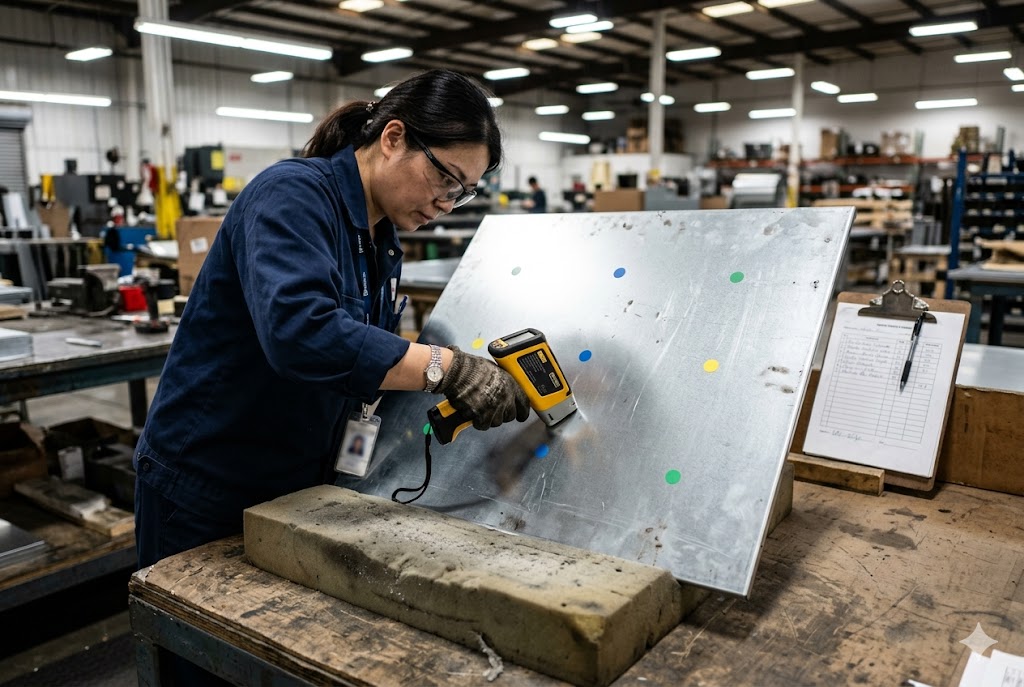
To verify plating uniformity, suppliers should use a calibrated XRF unit per ASTM B568 with readings taken at a minimum of five points per significant surface, including edges and recessed features. For safety-critical or hardened steel parts, hydrogen embrittlement relief baking and ASTM F519 6 notched-bar testing must be specified directly on the drawing.
Minimum Inspection Protocol for Zinc and Nickel Plating
Our quality team uses the following as a baseline inspection plan for all plated sheet metal orders:
| Inspection Step | Method | Standard Reference | Accept/Reject Criteria |
|---|---|---|---|
| Coating thickness | XRF | ASTM B568 | Per drawing callout (min/max µm) |
| Coating uniformity | XRF at 5+ points | ASTM B568 | All readings within spec range |
| Surface appearance | Visual / 10x loupe | Per drawing or agreed sample | No pits, blisters, or bare spots |
| Adhesion spot check | Tape test or bend test | ASTM B571 7 | No coating separation |
| H2 embrittlement bake log (if applicable) | Document review | ASTM F519 / AMS 2759/9 | Bake time and temp recorded |
Defining Contact and Jigging Zones
When parts are racked during electroplating, the rack contact points receive no coating. These are called jigging marks or contact exclusion zones. Your drawing or purchase order should specify where these marks are acceptable — typically a non-functional, hidden face of the part. If the drawing is silent on this, the plater will choose based on their own fixturing convenience, which may land on a mating surface or visible face.
Electroless Nickel: Phosphorus Content Matters
For electroless nickel plating 8, most drawings specify thickness but skip phosphorus content. This is a significant gap. Phosphorus percentage directly controls:
- Hardness — Low-phos deposits (~2–5% P) are harder after heat treatment; high-phos (~10–12% P) deposits are softer but more corrosion-resistant
- Corrosion resistance — High-phos coatings have an amorphous microstructure that resists pitting in chloride environments
- Deposit brightness — Mid-phos deposits have a semi-bright appearance; high-phos tends toward matte
ASTM B733 (the current standard for electroless nickel) does not mandate phosphorus content. If you leave this unspecified, the plater uses whatever bath they run, and you may receive a deposit that does not match your application requirements. Specify low-phos, mid-phos, or high-phos on the drawing — or give a percentage range such as "8–12% P."
Hydrogen Embrittlement Relief for Hardened Steel Parts
If your parts are made from hardened steel — generally above approximately 36 HRC — electroplating introduces hydrogen into the base metal. This hydrogen can cause delayed fracture under stress, known as hydrogen embrittlement. The standard post-plate treatment is a relief bake at 375°F (190°C) for 3–8 hours, per ASTM F519 or AMS 2759/9. The bake must begin within 4 hours of plating removal from the bath.
This step is not automatic. The plater will not perform it unless the drawing or purchase order explicitly requires it. If embrittlement testing is also required, specify ASTM F519 notched-bar specimens as part of the quality record.
Why Does Under-Plating Cause Early Corrosion Failure in My Finished Product?
Under-plating is more common than most buyers realize. A part that measures 6 µm on a flat face can have near-zero coverage at sharp inside corners. Once bare steel is exposed — even at a microscopic pinhole — corrosion accelerates far faster than on untreated steel.
Under-plating fails because zinc and nickel coatings rely on full coverage to function. Zinc provides cathodic protection 9 to steel, but this only works where the coating is intact and thick enough. A deposit below the minimum SC threshold leaves the steel underprotected, and salt spray corrosion initiates within days instead of hundreds of hours.

How Zinc Protects Steel — and Where It Fails
Zinc does not just act as a barrier. It is electrochemically active: zinc is anodic to steel, so when both are exposed to an electrolyte, the zinc corrodes preferentially and protects the steel underneath. This is called cathodic protection or sacrificial protection.
But this mechanism has limits:
- If the zinc is too thin, the deposit is consumed quickly and the steel is exposed before you expect
- If there are bare spots (pinholes, edges with zero coverage), those sites initiate rust immediately with no sacrificial layer to slow it
- If the conversion coating (chromate) is damaged or omitted, the zinc surface itself begins to oxidize faster, forming a white rust layer (zinc corrosion products) that reduces the remaining service life
For nickel plating, the failure mode is different. Nickel is actually cathodic to steel — meaning if the nickel has a pinhole, the steel underneath corrodes anodically and very rapidly. Nickel's corrosion protection is purely barrier-based. This is why minimum thickness and uniform coverage are even more critical for nickel than for zinc. The galvanic series and sacrificial protection principles 10 behind zinc coatings are well documented by the American Galvanizers Association.
The "Dimensions Apply After Plating" Note Is Not Optional
One frequently omitted note causes real production problems: DIMENSIONS APPLY AFTER PLATING (or equivalently, "ALL TOLERANCES APPLY AFTER PLATING"). Zinc deposits at SC3 thickness add approximately 12 µm per side to every surface. On a precision hole with a ±0.01 mm tolerance, that is 24 µm — more than double your tolerance — consumed by the coating.
If the drawing does not state when dimensions apply, the manufacturer may machine to final dimension before plating, and the plated part will be undersized. Or the plater will under-plate to protect fit, and you will have an SC1-grade deposit on a part designed for an SC3 environment.
Supplier-Side Root Causes of Under-Plating
From our factory visits, these are the most common reasons under-plated parts pass initial inspection and fail in the field:
- Measurement on easy surfaces only — The plater and inspector measure flat, accessible areas. Edge coverage is never checked.
- Bath chemistry drift — Zinc concentration or pH outside range reduces deposit efficiency, especially at low-current-density areas such as inside corners and recesses.
- Excessive racking density — Too many parts per rack means uneven current distribution. Parts at the outer positions receive more plating; inner parts are under-plated.
- Missing significant surface definition — Without defined measurement zones on the drawing, functional surfaces are never verified.
Calling out both a minimum and maximum thickness on the drawing — not just a minimum — protects against over-plating as well. Over-plating on tight-tolerance features causes interference fits and thread galling.
Conclusion
A complete plating callout takes less than one line on a drawing — but missing any one element causes inspection disputes, failed salt spray tests, and premature field corrosion. Specify the standard, service condition, thickness range, chromate type, and post-plate dimension rule on every drawing, and make sure your supplier's inspection protocol covers significant surfaces, not just flat faces.
Footnotes
1. ASTM B633 defines zinc electroplating requirements, service conditions, and minimum thickness classes for iron and steel. ↩︎
2. The EU RoHS Directive restricts hexavalent chromium and nine other hazardous substances in electrical and electronic equipment. ↩︎
3. ASTM B841 governs electrodeposited zinc-nickel alloy coatings, separate from pure zinc ASTM B633. ↩︎
4. DeFelsko explains magnetic induction and eddy current methods for non-destructive coating thickness measurement. ↩︎
5. ASTM B568 describes the XRF method for non-destructive metallic coating thickness measurement down to 0.01 µm. ↩︎
6. ASTM F519 specifies notched-bar sustained load testing to detect hydrogen embrittlement in plated steel parts. ↩︎
7. ASTM B571 outlines qualitative adhesion testing methods — including bend and tape tests — for metallic coatings. ↩︎
8. ASTM B733 covers electroless nickel-phosphorus coatings; phosphorus class selection controls hardness and corrosion resistance. ↩︎
9. The Galvanizers Association of Australia explains how zinc's electrochemical activity provides sacrificial cathodic protection to steel. ↩︎
10. The American Galvanizers Association describes how zinc acts as a sacrificial anode, protecting exposed steel from corrosion. ↩︎