Skip to main content Skip to footer

Every year, we see purchasing managers approve samples too quickly — and pay for it in production. A rushed T1 review feels like progress. It rarely is.
When importing custom die cast parts from China, focus your sample evaluation on ten areas: alloy chemistry verification, full CMM dimensional inspection, visual surface grading against a written standard, X-ray internal integrity checks, physical assembly fit trials, profilometer surface roughness measurement, destructive mechanical property testing, secondary operation evaluation, process parameter documentation, and formal golden sample archiving with written production release.
These ten checkpoints work as a system. Skip one and the others lose their value. Here is how to work through each one without missing what matters.
Should I Review Dimensions, Appearance, Fit, and Function Before I Approve Samples?
Our team processes hundreds of first-article submissions each year on behalf of clients sourcing in China. The most common mistake is treating sample review as a visual pass/fail — it is not.
Yes, you must review dimensions, appearance, fit, and function before approving any sample. A complete evaluation also includes alloy chemistry, internal integrity, surface roughness, mechanical properties, and secondary operation results. Approving on appearance alone is the fastest route to production failures.

Why Each Category Matters
Die casting combines metallurgy, fluid dynamics, and precision tooling. A failure in any one of those three areas produces a defective part — and the failure mode for each is different.
| Evaluation Category | What It Catches | Method |
|---|---|---|
| Alloy chemistry | Substituted or contaminated alloy | OES spectrometer certificate |
| CMM dimensional | Out-of-tolerance features | Full FAI report vs. drawing |
| Visual surface | Flash, cold shuts, porosity, sink marks | Written cosmetic acceptance standard |
| X-ray / CT | Internal voids, shrinkage, laminations | ASTM E505 or equivalent |
| Assembly fit | Stack-up interference, misaligned holes | Physical trial with mating parts |
| Surface roughness Ra | Sealing face, mating face non-conformance | Profilometer measurement |
| Mechanical properties | Alloy temper, tensile, yield, elongation | Hardness + tensile test bars |
| Secondary operations | Machining exposure, coating adhesion | Post-process evaluation on samples |
| Process parameters | Undocumented parameter drift | Signed process sheet |
| Golden sample archiving | No production reference baseline | Tagged samples + written release |
The Order of Evaluation Matters
Start with alloy chemistry. Every other check assumes the material is correct. If the alloy is wrong, a dimensionally perfect sample is still a reject — and you will not find out until the parts crack or corrode in service.
After chemistry, run the full CMM report. Only then does visual inspection have context. A scratch on a cold-shut-free, dimensionally conformant part is a cosmetic issue. A scratch on a part that already shows cold shuts is a signal of a deeper fill problem.
Assembly fit and functional checks come last. They are the integration test. They confirm that everything measured and inspected in isolation actually works together.
What Chinese Suppliers Commonly Miss
Suppliers under cost and lead-time pressure tend to submit partial CMM reports — measuring the dimensions they are confident pass and omitting the rest. They present these results without identifying them as partial. A complete first article inspection (FAI) 1 measures every dimensioned feature on your drawing. If a feature is not in the report, it has not been confirmed conformant. Require a full report and check the feature count against your drawing's dimension callout count.
Visual inspection without a pre-agreed written standard is another common gap. Without a documented cosmetic acceptance standard that classifies surfaces into zones and specifies acceptable defect types, sizes, and frequencies, inspection becomes a subjective disagreement. Write the standard before samples are produced.
What Sample Checks Can Help Me Catch Production Risks Early?
When we set up quality control plans for new China suppliers, we treat sample evaluation as the only point in the programme where we have full control before money and production cycles are committed.
The checks that catch production risks earliest are alloy OES spectrometer analysis, X-ray internal integrity inspection, and process parameter documentation. These three target the failure modes that are invisible on the surface and persist — or worsen — through the full production run.
Alloy Verification: The Invisible Risk
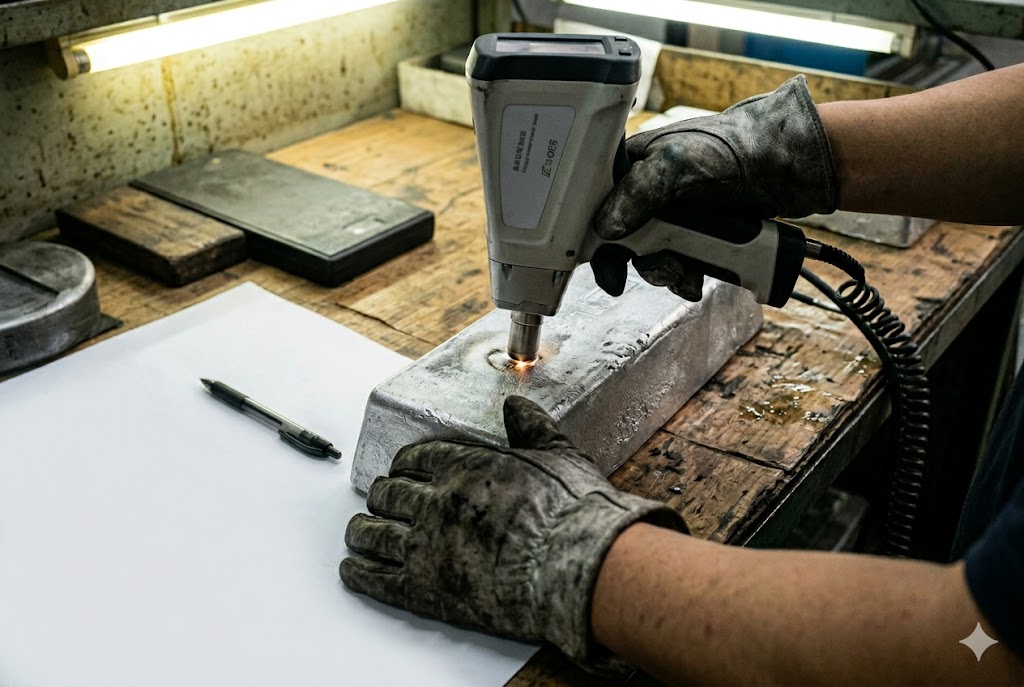
Alloy substitution in Chinese die casting happens for several reasons. Secondary alloy (remelt from mixed scrap) costs less than primary certified ingot. Lead times for specific grades can be long. And a T1 sample is often viewed by suppliers as a dimensional exercise, not a full material qualification. None of those reasons protect you.
Request the OES spectrometer certificate 2 alongside the physical samples — not after approval. For A380 aluminum 3, check iron content against the specified maximum. Iron above 1.3% indicates secondary or contaminated alloy. It will not show on the surface. It will produce brittleness and reduced elongation in production. For zinc alloys (Zamak grades) 4, check aluminum and copper content, which directly affect dimensional stability and corrosion resistance.
If the supplier cannot provide an OES certificate for the trial alloy batch, have the samples independently tested before committing to tooling approval. The test costs less than one production rejection event.
X-Ray Inspection: What You Cannot See From Outside
| Defect Type | Detection Method | Risk if Missed |
|---|---|---|
| Gas porosity | X-ray, CT scan | Structural weakness, pressure leak |
| Shrinkage voids | CT scan | Machining exposure, pressure failure |
| Cold shut laminations | X-ray (subsurface) | Fatigue crack initiation |
| Oxide inclusions | CT scan | Reduced ductility, unpredictable fracture |
Surface inspection finds surface defects. It finds nothing beneath the skin. For any part that will be machined, pressurised, or carry structural load, X-ray inspection of T1 samples is not optional. Specify acceptance criteria using ASTM E505 5 or an equivalent standard appropriate to your application before samples are submitted, so the supplier understands the acceptance threshold in advance.
Process Parameter Documentation: Locking What You Approved
The samples you evaluate were produced at a specific set of injection parameters — injection pressure, first-phase speed, second-phase velocity, switchover point, hold pressure, die temperature, metal temperature, spray volume, and cycle time. That process window is what produces the quality you are evaluating.
If those parameters are not documented and signed off by both parties before production begins, the supplier can change any of them at any time for any reason — to improve cycle time, accommodate a different die on the same machine, or respond to a material change — without violating any agreement, because no agreement specifies them.
The golden sample approval and the process parameter sign-off must happen at the same time. One without the other has no protective value.
Mechanical Properties: When Hardness Testing Is Not Enough
Brinell or Vickers hardness testing 6 is fast, non-destructive, and tells you whether the alloy achieved the expected temper. For structural brackets, load-bearing housings, or pressure-critical walls where tensile strength, yield strength, or elongation are drawing-specified, hardness is not enough. Tensile testing on separately cast test bars from the same alloy batch as the samples is the only method that confirms mechanical compliance.
This is standard practice in automotive and aerospace die casting qualification. In general commercial programmes, buyers commonly assume that an alloy specification implies mechanical property conformance. It does not. The specification defines chemistry limits; it does not guarantee the casting process produced the required microstructure and properties in the specific part geometry.
How Can I Organize My Sample Review So I Do Not Miss Critical Issues?
Our experience managing supplier programmes across China tells us the same thing: checklists fail when people treat them as boxes to tick. Structure your review so each step generates a record.
Organize your sample review using a formal First Article Inspection (FAI) sequence: chemistry first, CMM dimensional second, visual and surface third, internal integrity fourth, assembly fit fifth, and secondary operations last. Document each step with traceable records before moving to the next.

The FAI Sequence in Practice
A structured FAI keeps the review from becoming a single-day visual scan. Each step has an entry requirement, an output record, and a pass/fail gate that must be cleared before the next step begins.
| FAI Step | Entry Requirement | Output Record | Gate Criterion |
|---|---|---|---|
| 1. Chemistry | Sample received | OES spectrometer certificate | All elements within alloy grade limits |
| 2. CMM Dimensional | Chemistry passed | Full dimensional report, all drawing features | All callouts within tolerance |
| 3. Visual / Surface Ra | CMM passed | Cosmetic inspection record + profilometer data | Meets written surface acceptance standard |
| 4. X-ray / CT | Visual passed | Radiographic report, ASTM E505 grade | Below agreed porosity acceptance level |
| 5. Assembly Fit | X-ray passed | Assembly trial record or fixture check report | Assembly achieved at correct force, no interference |
| 6. Secondary Operations | Assembly passed | Post-process inspection record | Machined surfaces, threads, coatings all conformant |
Visual Inspection: Why You Need a Written Standard First
A visual inspection without a pre-agreed cosmetic standard is not inspection — it is an aesthetic opinion. Before samples are produced, classify the part's surfaces into zones:
- Class A: Cosmetic surfaces visible in service — strictest defect limits
- Class B: Functional surfaces (mating faces, sealing faces) — dimensional and Ra requirements, moderate cosmetic limits
- Class C: Hidden or non-cosmetic surfaces — flash and ejector marks permitted within specified limits
For each zone, specify acceptable defect types (flash at parting lines, ejector witness marks, surface porosity), maximum defect size, and maximum defect frequency. Die casting surface defects to evaluate against each zone include cold shuts (always reject — they indicate a fill problem), heat check patterns from the cavity (indicate tool condition), and sink marks over thick sections or ribs.
Surface Roughness Ra: More Than a Visual Check
Surface roughness Ra measurement 7 using a contact profilometer must be performed on sealing faces and mating surfaces as a separate, quantitative step. A surface that looks acceptable under inspection lighting may still exceed the Ra limit required for a reliable gasket or O-ring seat. Specify Ra limits on your drawing before samples are produced and require profilometer measurement data as part of the FAI record.
Assembly Fit: The Integration Test
Dimensional conformance to drawing tolerances and successful assembly fit are related but not identical. Tolerance stack-up across multiple mating dimensions, GD&T callouts 8 interpreted differently by your draughting team and the supplier's CMM technician, and form deviations that pass individual tolerance callouts but create interference in assembly can all produce assembly failures from dimensionally conformant samples.
The most reliable confirmation is to physically assemble the samples with real mating components or a checking fixture that replicates the mating interface. Confirm that the assembly goes together at correct force levels, all fastener holes align within positional tolerance, and mating faces seat without gaps or interference.
What Should I Confirm Before I Tell My Supplier to Move Toward Mass Production?
Before issuing any production release, we require four things to be in place without exception: approved golden samples physically archived at both facilities, a signed process parameter sheet, a written quality control plan referencing both, and a formal written production release from the client.
Before authorising mass production, confirm that golden samples are physically tagged and archived at both facilities, the production process parameters are documented and signed by both parties, all FAI steps have passed with traceable records, and a written production release has been issued by you referencing the approved sample set and process sheet.
Golden Sample Archiving: The Physical Reference Standard
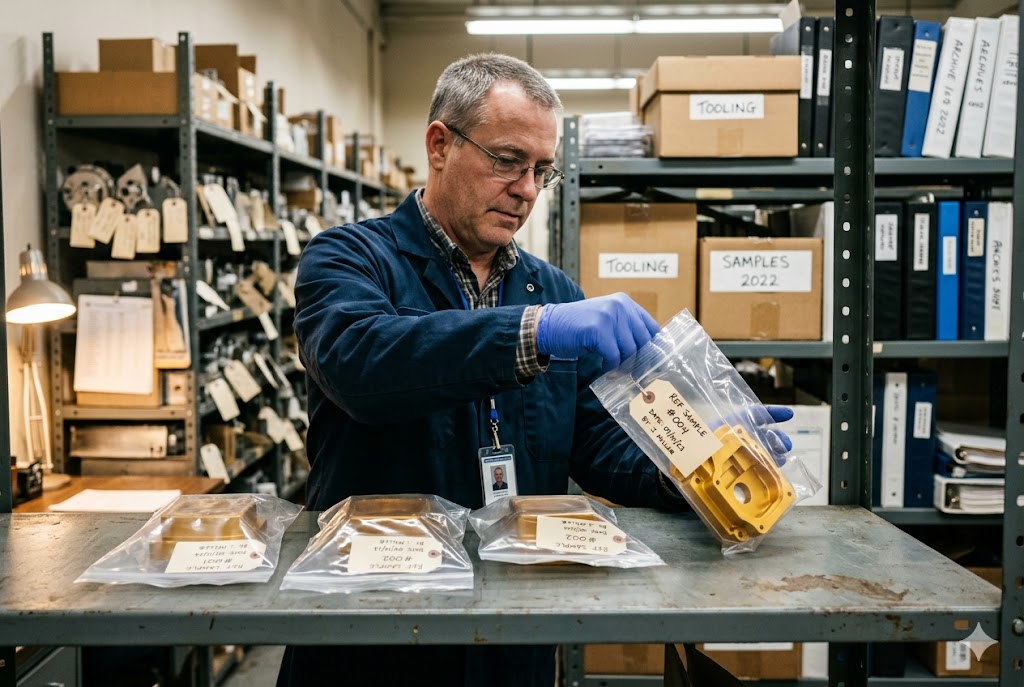
The golden sample set is the physical reference against which every subsequent production batch will be measured. Archive at least three samples at your facility and three at the supplier's facility. Each sample must be physically tagged with:
- Part number and drawing revision
- Date of approval
- Both parties' authorisation signatures
- Reference to the FAI report number
A verbal or email approval is not a golden sample programme. If the supplier's production quality later deviates from what was approved, the golden sample and the signed FAI record are your contractual evidence.
Tying Secondary Operations Into Sample Approval
If your part requires CNC machining, tapping, drilling, surface treatment (anodising, powder coating, chromate conversion) 9, or assembly inserts, evaluate these operations on the actual samples — not as a separate subsequent step after the as-cast samples are approved.
Common failures discovered only when secondary operations begin include:
- Subsurface porosity exposed by machining that was invisible on the as-cast surface
- Tapped holes that strip because cast wall thickness is marginal for the thread depth
- Anodise coating that patches unevenly over porosity-rich areas 10
- Powder coat adhesion failure over lubricant contamination on the as-cast surface
Running secondary operations on T1 samples and evaluating the results is not additional delay — it is the only way to confirm that the as-cast process window produces parts that survive the downstream process chain.
What a Proper Production Release Looks Like
A production release is a written document from you to the supplier that explicitly states:
- The part number and drawing revision being released to production
- The golden sample set reference (tag numbers, archive date)
- The process parameter sheet reference (document number, revision, date signed)
- The production quantity authorised in this release
- The quality control plan and inspection frequency that applies to production batches
- The pre-shipment inspection requirement and acceptance criteria
This sequence — evaluation, golden sample archiving, process parameter lock, written production release — creates an auditable quality record that defines the baseline for the entire production programme. It also provides unambiguous contractual evidence if production quality deviates from what was approved.
Conclusion
A thorough sample evaluation is the single highest-leverage quality event in a China die casting programme. Verify chemistry, inspect every dimension, assess surfaces against a written standard, check internal integrity, trial assembly fit, evaluate secondary operations, document the process, and archive golden samples before you authorise one production unit.
Footnotes
1. Comprehensive guide explaining what a First Article Inspection covers and why every drawing feature must be confirmed. ↩︎
2. Explains how optical emission spectrometry (OES) detects alloy composition and contamination in foundry metals. ↩︎
3. Material datasheet for A380 aluminum die casting alloy, including iron content limits and mechanical properties. ↩︎
4. Guide to Zamak zinc alloy grades, detailing how aluminum and copper content affect stability and corrosion resistance. ↩︎
5. ASTM E505 standard defining radiographic acceptance criteria for aluminum and magnesium die casting discontinuities. ↩︎
6. Overview of Brinell hardness testing, its limitations, and when tensile testing is required for structural compliance. ↩︎
7. Practical guide to Ra, Rz, and Rq surface roughness parameters and how profilometer measurement works. ↩︎
8. GD&T fundamentals guide explaining how tolerance stack-up can cause assembly failures even when individual dimensions pass. ↩︎
9. Guide to aluminum die casting surface finishes covering anodising, powder coating, and adhesion failure modes from porosity. ↩︎
10. Technical guide on anodising die cast aluminum, including how porosity and alloy impurities cause uneven coating. ↩︎