Skip to main content Skip to footer
Every year, our team reviews hundreds of customer drawings where the wrong alloy was already specified — not because the engineer lacked skill, but because the tradeoffs between aluminum, zinc, and magnesium die casting are genuinely non-obvious until you have seen them play out on a real production line.
Choosing between aluminum, zinc, and magnesium die casting depends on four hard filters: part weight, operating temperature, required surface finish, and annual production volume. Apply these filters in order. Most parts eliminate at least one alloy immediately, and the remaining choice becomes straightforward.
Once you know the right questions to ask, the decision becomes a structured process rather than a guessing game. The sections below walk through each filter in plain language.
What Material Should I Choose Based on My Part Strength and Weight Requirements?
We see this question in almost every RFQ that comes through for structural brackets, housings, and enclosures. Weight and strength pull in opposite directions, and the alloy you choose locks in both.
Magnesium at 1.74 g/cm³ is the lightest option and suits handheld or portable parts where every gram matters. Aluminum at 2.7 g/cm³ balances structural strength with reasonable mass. Zinc at roughly 5.0 g/cm³ is the densest of the three — close to steel — and delivers the highest impact resistance for small load-bearing hardware.
Density Is Not the Whole Story
Most buyers assume lighter always means weaker. That is not accurate for die castings. Zinc alloys such as Zamak 3 and Zamak 5 1 have higher yield strength and significantly better impact resistance per unit volume than aluminum alloys like A380. A zinc latch or hinge survives drop impacts that would crack an aluminum equivalent of the same geometry.
The confusion comes from comparing weight rather than geometry. If you replace an aluminum part with zinc at the same dimensions, the zinc version is heavier and stronger. If you redesign the geometry to achieve equivalent strength at lower mass, magnesium wins. These are different engineering decisions.
Strength and Weight Reference Table
| Alloy | Density (g/cm³) | Tensile Strength (MPa) | Impact Resistance | Best Fit |
|---|---|---|---|---|
| Magnesium AZ91D | 1.74 | ~230 | Low–Medium | Thin-wall panels, portable devices |
| Aluminum A380 | 2.71 | ~320 | Medium | Structural housings, heat sinks |
| Zinc Zamak 3 | 6.6 | ~285 | High | Small hardware, latches, connectors |
| Zinc Zamak 5 | 6.6 | ~330 | High | Load-bearing small parts |
When Zinc Beats Aluminum on Strength
For parts under roughly 28 grams — think door latches, connector housings, small brackets, and decorative hardware — zinc is often the structurally correct choice even though buyers default to aluminum. Zinc's higher density translates directly into better wear resistance and impact absorption at that size class. Our engineering team regularly recommends a switch from aluminum to zinc for small structural components, and the customer's end-user complaint rate typically drops after the change. Learn more on our Zinc Die Casting service page.
When Magnesium Makes Sense
Magnesium is the right answer for large, thin-walled panels where stiffness-to-weight ratio 2 is the primary requirement. Laptop lids, automotive door inners, and camera bodies are classic examples. Neither aluminum nor zinc can match the stiffness per kilogram that magnesium delivers in a large panel geometry. If your part is small and dense, magnesium gains you little. If your part is large and flat, magnesium can reduce mass by 30–40% versus aluminum at equivalent stiffness.
How Does My Part Size Affect Whether Aluminum or Zinc Is Better?
Part size is one of the most practical filters in alloy selection, and it connects directly to machine type, process cost, and factory qualification. Our sourcing team uses size and weight class as a first-pass screen before we even request quotations.
For parts under roughly 28 grams, zinc processed on hot-chamber machines is typically the lower-cost option. For medium-to-large structural parts above that threshold, aluminum on cold-chamber machines is standard — zinc's density would make the finished part unacceptably heavy and expensive to ship.
Hot-Chamber vs. Cold-Chamber Machines
The machine type is determined by the alloy, and the machine type has a direct effect on process cost and factory availability in China.
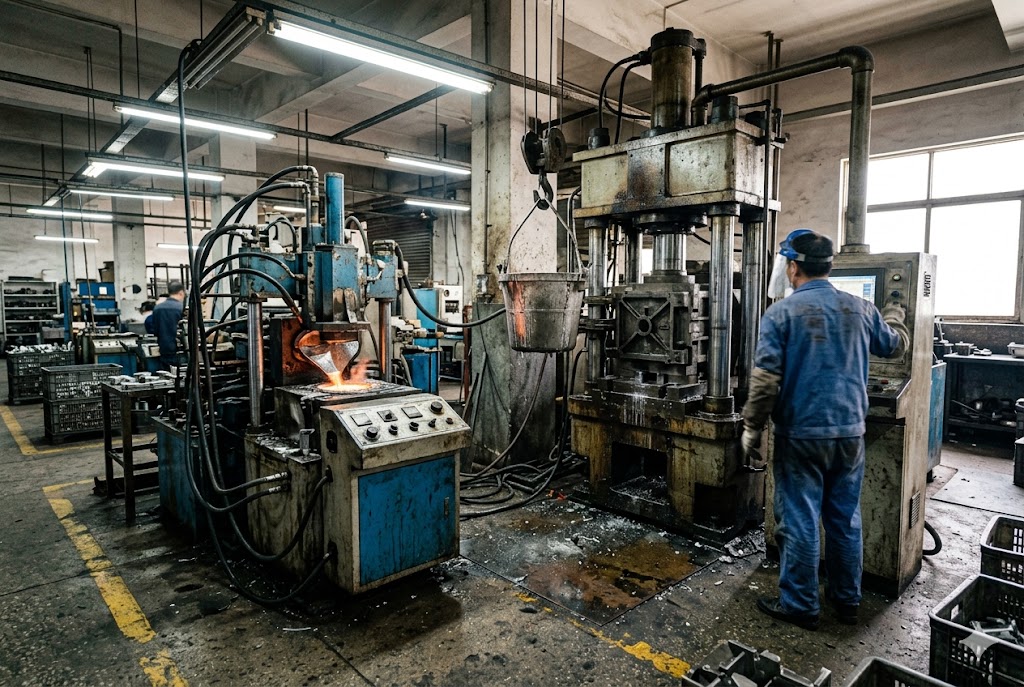
Zinc uses hot-chamber machines 3. In a hot-chamber machine, the injection mechanism sits inside the molten metal bath. Cycle times are fast — often under ten seconds for small parts — and the process is highly automated. A broader pool of Chinese suppliers operates hot-chamber lines, which increases your quoting options and applies downward pressure on price.
Aluminum and magnesium require cold-chamber machines. The molten metal is ladled into the shot sleeve separately for each cycle. Cycle times are longer, process control requirements are higher, and the supplier pool is smaller. This is not a reason to avoid aluminum — it is simply a cost factor to account for when comparing quotations.
Part Size Decision Table
| Part Weight | Recommended Alloy | Machine Type | Typical Die Life | Notes |
|---|---|---|---|---|
| Under 28 g | Zinc (Zamak) | Hot-chamber | 800,000–1,000,000+ shots | Lowest per-piece cost at high volume |
| 28 g – 500 g | Aluminum (A380 / ADC12) | Cold-chamber | 80,000–150,000 shots | Most common range for structural parts |
| 500 g – 3 kg | Aluminum | Cold-chamber | 60,000–120,000 shots | Tooling cost rises significantly |
| Large thin panels | Magnesium | Cold-chamber | 80,000–120,000 shots | Requires specialist supplier |
Why Die Life Matters for Your Total Cost
Buyers often compare alloys only on raw material price. That is incomplete. Aluminum dies wear faster than zinc dies because aluminum has a much higher melting point — roughly 660°C versus 380°C for zinc — and the thermal shock shortens die steel life. A zinc die routinely exceeds one million cycles. An aluminum die often requires rework or replacement at 80,000–150,000 shots.
For high-volume programs running over several years, the die replacement cost for aluminum can exceed the raw material cost difference between the two alloys. We calculate total program cost — not just piece price — before recommending an alloy to our clients, and this calculation sometimes reverses an initial preference for aluminum. The mechanical properties of zinc alloys across temperature and load cycles 4 are an important input to these long-term calculations. For full aluminum die casting specifications, see our Aluminum Die Casting service page.
Shipping Weight Is a Real Cost
When parts ship from China to the US, freight is calculated by actual weight or volumetric weight, whichever is higher. A zinc part that is 2.3 times denser than an aluminum equivalent costs proportionally more to ship. For large purchase volumes, this freight premium can be significant. We factor shipping weight into landed cost estimates for all alloy comparisons, not just factory price.
Should I Compare Corrosion Resistance and Finishing Before I Choose a Die Casting Alloy?
Surface finish and corrosion resistance are not afterthoughts — they determine whether your part can even use a given alloy. We have seen projects re-tooled at significant cost because the original alloy was incompatible with the required surface treatment.
Zinc offers the smoothest as-cast surface and accepts chrome, nickel, and decorative plating with minimal pre-treatment — making it the correct choice when cosmetic finish quality is critical. Aluminum provides solid corrosion resistance and works well with anodizing and powder coating. Magnesium requires a verified protective coating system for any outdoor or high-humidity application.
As-Cast Surface Quality
Zinc's superior melt fluidity allows wall thicknesses as thin as 0.3–0.5 mm and replicates fine surface detail — sharp lettering, decorative textures, fine ribs — directly from the die face. The as-cast surface is smooth enough for bright plating without heavy pre-treatment.
Aluminum A380 5 has a rougher as-cast surface. It requires more aggressive pre-treatment — typically grinding, shot blasting, or chemical etching — before plating or anodizing. Anodizing aluminum produces an excellent, durable oxide layer that is widely used for architectural and industrial parts. However, if the part requires chrome or bright nickel plating, aluminum demands more preparation labor than zinc.
Corrosion Resistance by Environment
| Environment | Best Alloy | Notes |
|---|---|---|
| Indoor, dry | Any | All three perform adequately |
| Outdoor, general | Aluminum | Anodized or powder coated |
| Marine / high humidity | Aluminum | Salt-spray test hours must be specified |
| High humidity, cosmetic | Zinc (plated) | Chrome or nickel plating needed |
| Outdoor, uncoated | Avoid magnesium | Poor bare corrosion resistance |
The Magnesium Coating Problem
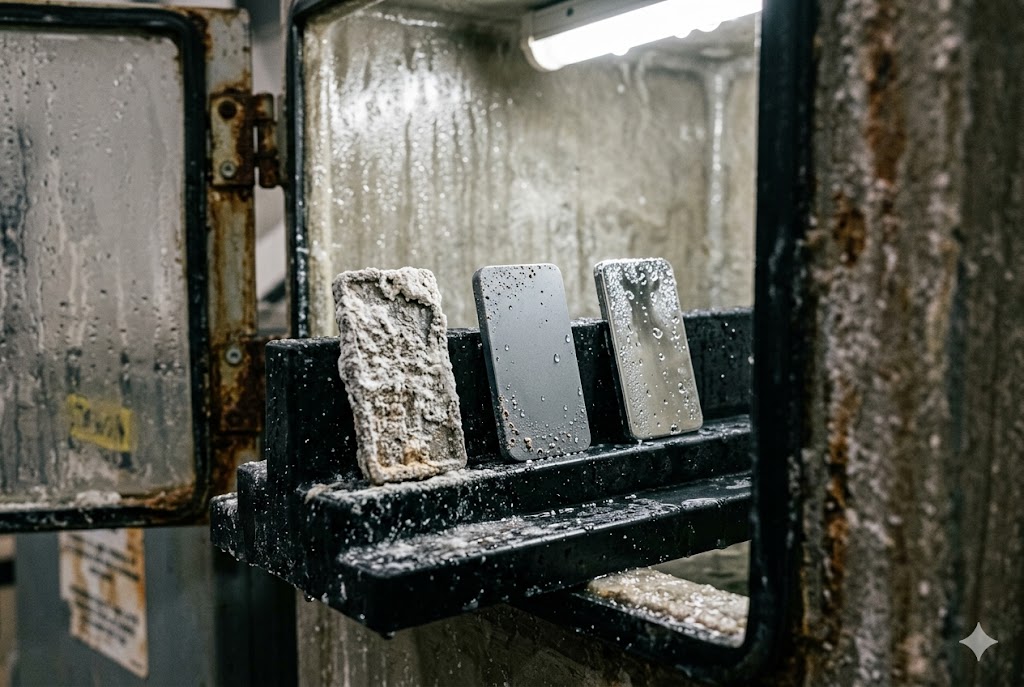
Bare magnesium corrodes faster than aluminum or zinc in salt-spray testing. In our experience reviewing supplier quality records, Chinese factories frequently apply cosmetic surface treatments to magnesium parts — treatments that look correct but provide little actual barrier protection. Unless you specify ASTM B117 salt-spray test 6 hours and rejection thresholds in your contract, and verify compliance with pre-shipment inspection, there is a real risk that field failures will appear in outdoor or marine environments.
If your part will see outdoor, marine, or sustained high-humidity conditions, aluminum with proper anodizing or powder coating is the safer default. We tell clients this directly even when they arrive with a magnesium preference, because a field corrosion failure costs far more than the weight savings justify.
Finishing Requirements and Alloy Selection
Before selecting an alloy, answer these questions: Does the part require bright plating? If yes, zinc is preferred. Does the part require anodizing 7? If yes, aluminum only — zinc and magnesium do not anodize. Does the part need no surface treatment and will see outdoor conditions? If yes, aluminum is the only practical choice of the three without a verified coating system.
Can My Supplier Explain the Tradeoffs Between Cost, Performance, and Machinability for Me?
A supplier who cannot explain these tradeoffs clearly is a supplier who will make the wrong alloy choice for you — or worse, agree with whatever you specify without flagging problems. Our team's value comes precisely from catching these issues before tooling is ordered.
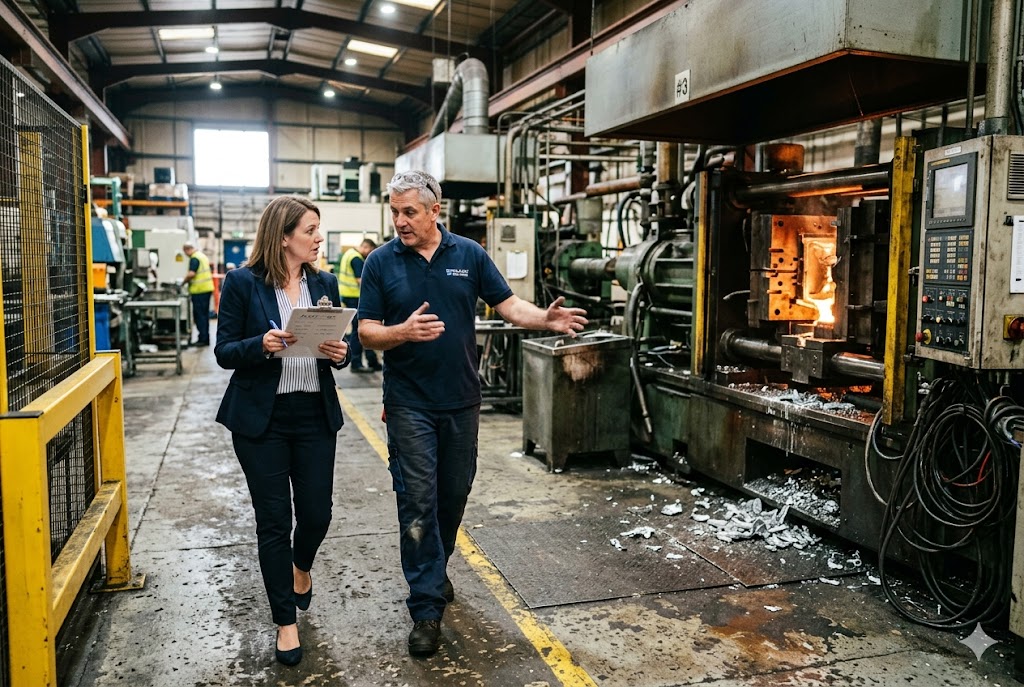
A qualified supplier should walk you through at least four factors before confirming an alloy: operating temperature, annual volume and die life calculation, secondary machining requirements, and the specific surface treatment you need. If a supplier skips any of these, treat that as a qualification red flag.
Operating Temperature Is a Hard Cutoff
Zinc fails above roughly 100°C under sustained load 8. The alloy begins to lose strength and exhibits creep — slow permanent deformation — when thermally stressed over time. Aluminum maintains its mechanical properties well above 150–200°C and is the standard choice for engine-adjacent components, LED heat sinks, motor housings, and anything near a heat source.
If your part operates above 100°C and your supplier has not raised this point, they either do not know or are not engaged enough to flag it. Either way, that is a problem worth addressing before production.
Secondary Machining Affects True Cost
Zinc and magnesium can frequently be cast to press-fit and zero-draft tolerances as-cast, which can eliminate machining operations entirely. Aluminum almost always requires post-cast CNC machining for precision bores, mating faces, and threaded features. If your drawing has many precision features, the machining cost adder can erase aluminum's apparent raw material advantage.
A supplier with genuine engineering capability will review your drawing and estimate which features require machining versus which can be achieved as-cast. This review changes the total cost comparison significantly.
Supplier Qualification by Alloy
| Alloy | Machine Required | Supplier Pool in China | Key Audit Items |
|---|---|---|---|
| Zinc | Hot-chamber | Large, broad geographic spread | Die maintenance records, Zamak alloy certification |
| Aluminum | Cold-chamber | Medium | Die temperature control logs, heat treatment process |
| Magnesium | Cold-chamber | Small, concentrated in Pearl River Delta | Fire suppression systems, melt handling protocols |
For a full overview of our equipment, tolerances, and quality standards, see our Die Casting Capabilities page.
Magnesium Supplier Audits Require Extra Steps
Molten magnesium is a combustion hazard 9. Underprepared factories have historically mishandled it with serious consequences. When we audit a magnesium die casting supplier in China, we specifically verify their fire suppression systems, melt handling protocols, and operator training records. This is not a standard item on a generic factory audit checklist. If your supplier did not mention this when quoting magnesium, that is a gap worth closing before production starts.
The Hybrid Alloy Option
Some OEMs now use hybrid assemblies — an aluminum structural shell with zinc insert-cast or overmolded detail features, or magnesium panels 10 bonded to an aluminum frame. This approach captures the weight advantage of magnesium or the precision advantage of zinc without accepting their respective weaknesses. Chinese suppliers capable of executing genuine hybrid assemblies exist, but they are concentrated in the Pearl River Delta and Yangtze River Delta clusters. Verifying that a supplier has real multi-alloy capability — rather than just quoting capability — requires a factory audit and sample validation before any production commitment.
Conclusion
Weight, temperature, finish, and production volume are the four filters that determine the right die casting alloy. Apply them in order, involve a technically capable supplier early, and calculate total program cost — not just piece price — before committing to tooling. Ready to start? Visit our Custom Die Casting Service page to request a quote.
Footnotes
1. Overview of Zamak 3 and Zamak 5 zinc alloy grades, properties, and die casting applications. ↩︎
2. How magnesium's high stiffness-to-weight ratio benefits lightweight structural die cast parts. ↩︎
3. Guide to hot-chamber die casting: process, materials, cycle times, and advantages over cold-chamber. ↩︎
4. Technical reference for zinc alloy mechanical properties including creep behavior at elevated temperatures. ↩︎
5. Properties and casting characteristics of A380 aluminum alloy for die casting applications. ↩︎
6. ASTM B117 salt spray test standard for evaluating corrosion resistance of metals and coatings. ↩︎
7. Eight common surface treatments for aluminum die castings including anodizing and powder coating. ↩︎
8. Explanation of creep failure in zinc and other metals under sustained load at elevated temperatures. ↩︎
9. Fire and explosion risks from magnesium dust and melt handling in industrial manufacturing facilities. ↩︎
10. AZ91D magnesium alloy properties, performance, and applications in automotive and electronics. ↩︎