Skip to main content Skip to footer
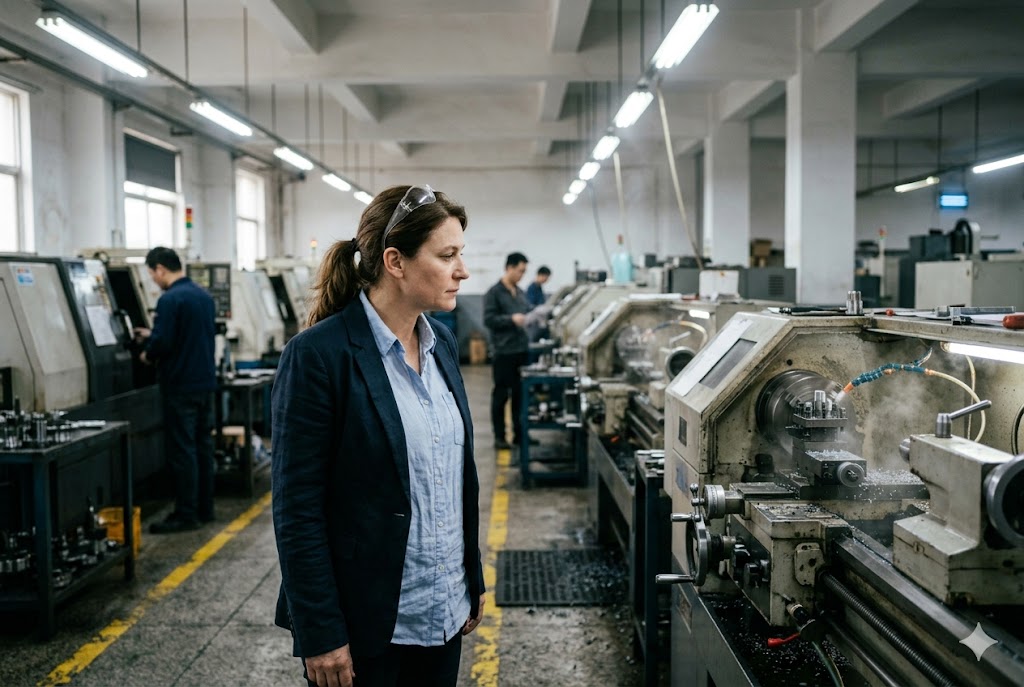
Every week, our team fields calls from purchasing managers who have been burned. A supplier promised a complex turned part — tight tolerances, cross-holes, angled features — only to deliver it late, out of spec, or with visible witness marks from re-clamping. We have seen it happen across dozens of projects.
Chinese factories running multi-axis Swiss-type lathes — from 5-axis up to 12-axis configurations — can complete complex parts in a single uninterrupted cycle. The sub-spindle takes over the workpiece after main-spindle machining to finish the back end without any manual re-clamping. This "done-in-one" capability is a standard commercial offering in China's precision machining sector, not an exception.
So the real question is not whether the capability exists. It is how to find the right factory, specify your drawing correctly, and understand what you are actually buying when a supplier says "Swiss machining."
What Part Features Can a 7-Axis Swiss-Type Lathe Produce That a 3-Axis Machine Cannot?
When we walk clients through our supplier network, one of the first things we explain is what axis count actually means — because the terminology gets misused constantly, and misunderstanding it leads to sourcing the wrong factory.
A 7-axis Swiss-type lathe can simultaneously interpolate seven independent motion vectors, enabling compound angular features, off-center holes, helical milling, and radial cross-drilling to be executed while turning continues. A 3-axis machine cannot do this — it machines one feature at a time, in sequence, with the part re-clamped between operations.
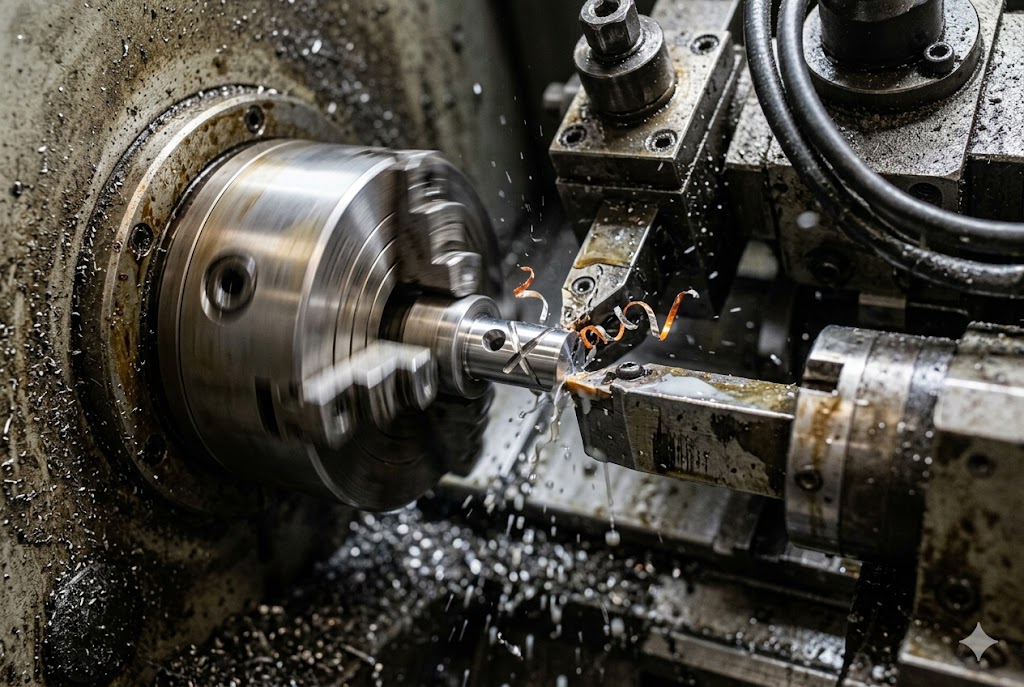
What the Axes Actually Mean
The axis count in Swiss-type lathe 1 terminology refers to synchronized linear and rotary servo-controlled axes. On a typical 7-axis machine, these are:
| Axis | Description |
|---|---|
| X1, Z1, Y1 | Main spindle side — turning, facing, and Y-axis milling |
| X2, Z2 | Sub-spindle side — back-end machining without re-clamping |
| C1, C2 | Spindle indexing on main and sub-spindle |
| B | Angular live-tool spindle — compound-angle drilling and milling |
The B-axis is the game-changer. It is a servo-driven angular live-tool spindle that can position at any compound angle and interpolate with the C-axis simultaneously. This is what enables bone screws at arbitrary helix angles, angled cross-holes in aerospace fittings, and compound-angle thread whirling on spinal implants — all without removing the part.
What a 3-Axis Machine Cannot Do
A conventional 3-axis CNC lathe machines along X, Z, and sometimes Y. It turns diameters and faces ends. It drills axial holes. But it cannot:
- Mill a flat on a compound angle while turning continues
- Cross-drill a radial hole at an offset from center
- Whirl a thread at a defined helix angle
- Machine the back end of a part without a second setup
Each of those features requires either a separate machine, a secondary fixture, or a rotary table attachment — all of which introduce re-clamping errors above 0.001mm.
Feature Comparison by Machine Type
| Feature | 3-Axis CNC Lathe | 5-Axis Swiss Lathe | 7-Axis Swiss Lathe |
|---|---|---|---|
| Straight turning & facing | ✔ | ✔ | ✔ |
| Axial drilling | ✔ | ✔ | ✔ |
| Radial cross-drilling | ✗ | ✔ | ✔ |
| Off-center milling | ✗ | Limited | ✔ |
| Compound-angle features | ✗ | ✗ | ✔ |
| Back-end machining (single setup) | ✗ | ✔ | ✔ |
| Simultaneous turn + mill | ✗ | Partial | ✔ |
This matters directly for purchasing managers. If your drawing calls for a cross-hole at 30° off-axis with a thread, a factory running 3-axis lathes will need two or three machines to make that part. Every machine transfer is a new clamping datum, a new source of error, and a longer lead time.
Typical Industries Using 7-Axis Swiss Lathes in China
Chinese factories serving medical, aerospace, and 5G electronics customers have adopted multi-axis Swiss lathes as their primary platform for complex small-diameter parts. RF coaxial connector bodies, waveguide components, antenna pin contacts, bone screws, and hydraulic valve spools all share one characteristic: multiple precision features packed into a very small diameter. Single-setup machining is the only practical way to hold concentricity and angular position across all of them simultaneously.
How Does Single-Setup Machining on a Multi-Axis Swiss Lathe Reduce My Per-Part Cost and Lead Time?
When we build cost comparisons for clients considering a China-sourced Swiss-machined part versus a domestically machined equivalent, the numbers are consistently surprising — not because Chinese labor is cheap, but because single-setup machining changes the entire production economics.
Single-setup machining on a multi-axis Swiss lathe reduces per-part cost by eliminating inter-machine transfers, re-clamping labor, and queue time between operations. One operator can supervise up to 10 machines simultaneously. Machining time drops to roughly 60% of that required by a conventional CNC lathe for equivalent complex parts.
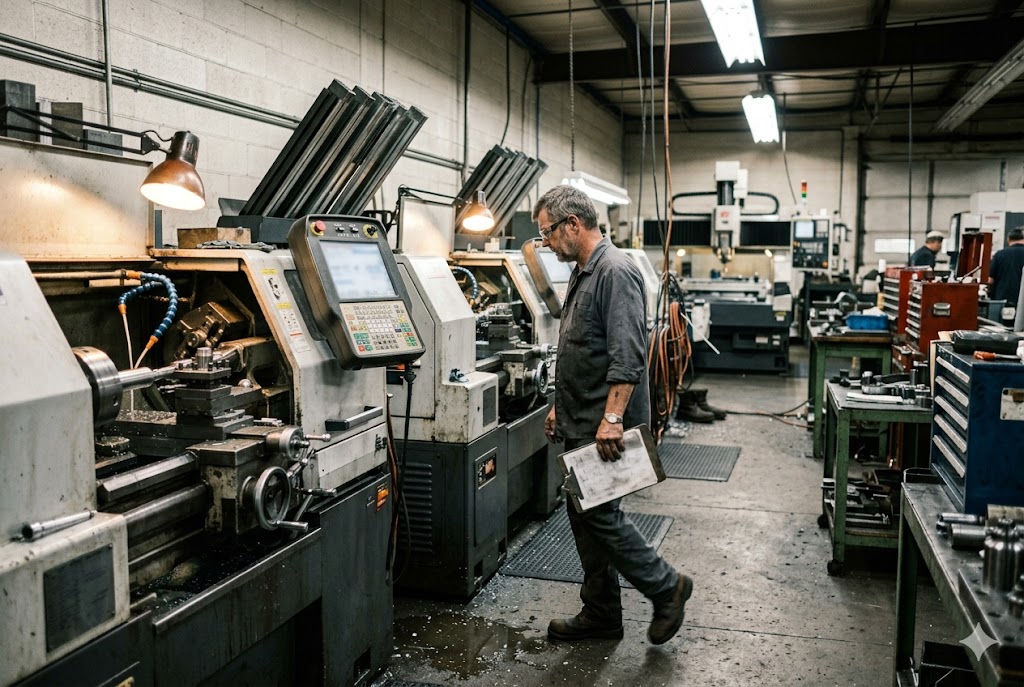
The Three Cost Drivers That Single-Setup Removes
1. Re-clamping labor and fixture cost
Every time a part moves from one machine to another, someone picks it up, loads it into a new fixture, and clocks it in. For complex parts requiring three or four operations on separate machines, this labor adds up fast. It also requires fixtures — and fixtures cost money to design, make, and maintain.
2. Queue time between machines
In a conventional multi-machine workflow, parts sit in a queue between operations. A batch of 500 parts waiting for the second machine while the first machine runs another job can add days to the effective lead time. Single-setup machining eliminates all inter-machine queue time.
3. Re-clamping positional error and scrap
Every re-clamping introduces a positional error. In a multi-machine workflow, these errors stack. A part that holds ±0.01mm on the first machine may fail the final drawing tolerance after three re-clampings because the accumulated error exceeds the total tolerance band. Scrap and rework cost money and time.
Operator-to-Machine Ratio
This is a point that purchasing managers sometimes overlook when comparing unit prices. On a conventional CNC lathe, one operator typically runs one or two machines. On a Swiss lathe running a proven program with automatic bar feed, one operator can supervise eight to ten machines. The labor cost per part drops dramatically — and this effect is multiplied in China's precision machining clusters where Swiss lathe cells of 20 or 30 machines share a small team.
Lead Time Impact
| Workflow | Machines Required | Inter-Machine Queue | Total Cycle Time (Typical) |
|---|---|---|---|
| Conventional multi-machine | 3–4 | Yes (hours to days per batch) | Long |
| Single-setup Swiss lathe | 1 | None | Short |
| Swiss lathe + secondary op | 2 | Minimal | Medium |
For high-volume runs of 5,000–50,000 pieces — the kind of volumes that characterize Chinese contract machining — the lead time compression from eliminating inter-machine queues is often measured in weeks, not hours.
The Real Constraint: CAM Programming Depth
The quantitative benefits above assume the factory can actually use all of its machine's axes. This is where a critical distinction emerges in China's Swiss machining sector.
Fully utilizing 9- or 12-axis simultaneous interpolation requires advanced CAM post-processors specific to each machine model, collision simulation across all tool zones, and experienced programmers who understand Swiss-specific sequencing logic. These skills are concentrated in China's Yangtze River Delta 2 and Pearl River Delta 3 precision machining clusters. Interior-province factories that have acquired advanced equipment without the corresponding human capital cannot deliver the same economics — and their quoted lead times will reflect this.
When we audit a supplier for a client, one of our standard checks is reviewing the CAM software license, the programmer's certification, and the machine utilization data. A factory with a 12-axis Swiss lathe running it at 5-axis capability is not delivering the efficiency it is selling.
Which Chinese Factories Have 5-Axis or 7-Axis Swiss-Type Lathes Capable of Medical-Grade Complexity?
This is the question we get most often from purchasing managers sourcing precision turned parts for regulated industries. The answer has two layers: what equipment exists, and which factories have the quality system to back it up.
Chinese factories operating medical-grade Swiss machining — including Falcon CNC, SPI China, AT-Machining, and WMTCNC — run Tsugami, Citizen, and Tornos machines rated at 9 to 12 axes, holding tolerances of ±0.005mm on complex geometry. ISO 13485 certification validates the single-setup process chain under a documented quality management system.
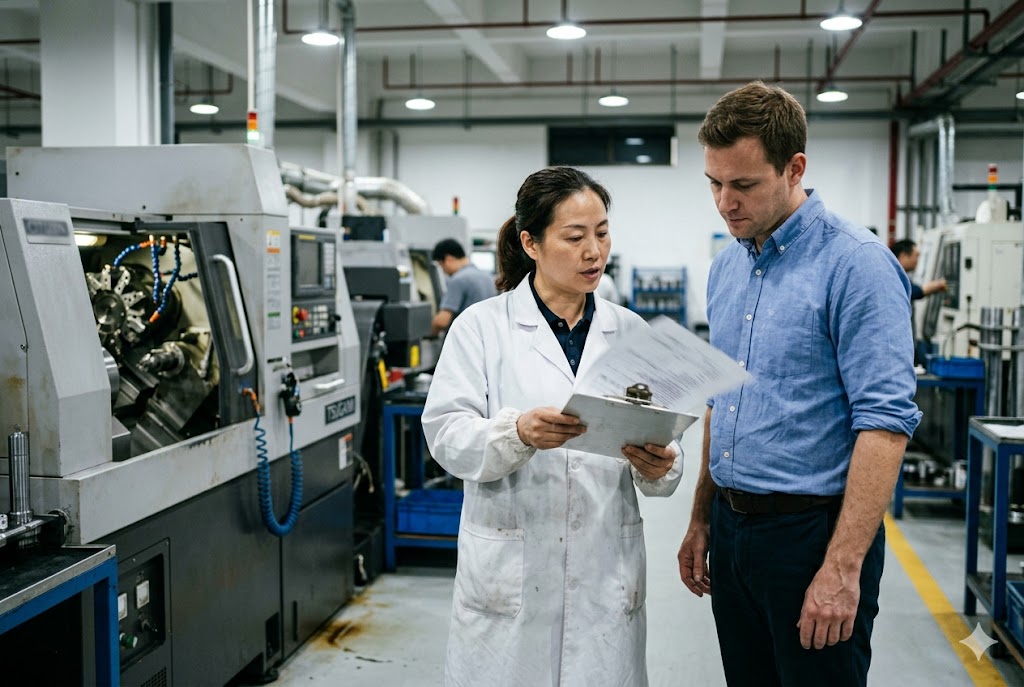
Two Tiers of Swiss Machining in China
Understanding the factory landscape requires separating two distinct tiers.
Tier 1 — Imported machines, certified quality systems
These factories run Japanese and European Swiss lathes (Tsugami, Citizen, Star, Tornos, Willemin-Macodel) rated at 9 to 12 axes. They hold ISO 9001 4 as a baseline, IATF 16949 5 for automotive, and ISO 13485 6 for medical devices. They have invested in the regulatory infrastructure alongside the equipment — process validation studies, capability indices (Cpk), first-article inspection records, and documented control plans.
Falcon CNC, SPI China, AT-Machining, and WMTCNC are publicly cited examples of this tier.
Tier 2 — Domestic machines, general commercial quality
Chinese domestic Swiss lathe manufacturers — brands like TAIKE, JSWAY, Sowin, and HS — have reached 5- and 6-axis configurations as their practical production ceiling. These are capable machines for commercial-tolerance parts on 20mm and 32mm platforms. But they stop short of the 7-to-12-axis simultaneous interpolation available on Japanese and European machines. The most complex single-setup work in China is still performed on imported equipment.
Certification Matrix
| Certification | What It Validates | Required For |
|---|---|---|
| ISO 9001 | General quality management system | Broad commercial use |
| IATF 16949 | Automotive process control | Automotive OEM supply |
| ISO 13485 | Medical device QMS | Medical OEM supply |
| AS9100D | Aerospace quality management | Aerospace OEM supply |
For international aerospace and medical OEMs, the certification is not a marketing checkbox — it is a documented process validation requirement. AS9100D 7 and ISO 13485 require capability studies for each production step, meaning the single-setup Swiss cycle must be formally validated with capability indices (Cpk) 8 data, not just demonstrated once on a sample run.
How We Evaluate Factories for Our Clients
Our supplier audit process for Swiss machining jobs includes the following checks:
- Machine brand, model, and axis count verification (we physically inspect the machine tag and controller screen)
- CAM software license and programmer certification review
- Machine utilization data and OEE (Overall Equipment Effectiveness) records
- Quality system certification (scope, last audit date, audit body)
- First-article inspection capability (coordinate-measuring machine (CMM) 9 make, model, and calibration records)
- Reference parts produced for comparable industries
This process filters out factories that have the equipment on paper but not the process discipline behind it.
How Do I Specify on My Drawing That a Part Requires Multi-Axis Swiss Machining?
One of the most common mistakes we see from purchasing managers is sending a drawing that fully defines the geometry but says nothing about the process. Then they are surprised when a factory chooses the cheapest process — which may produce a technically compliant part with poor concentricity or surface finish from multiple setups.
To specify multi-axis Swiss machining on a drawing, add a general note stating "All turned features to be completed in a single setup using Swiss-type CNC lathe with live tooling and sub-spindle." Reference key geometric tolerances using GD&T datum schemes tied to the part's primary axis to enforce the single-datum machining intent.
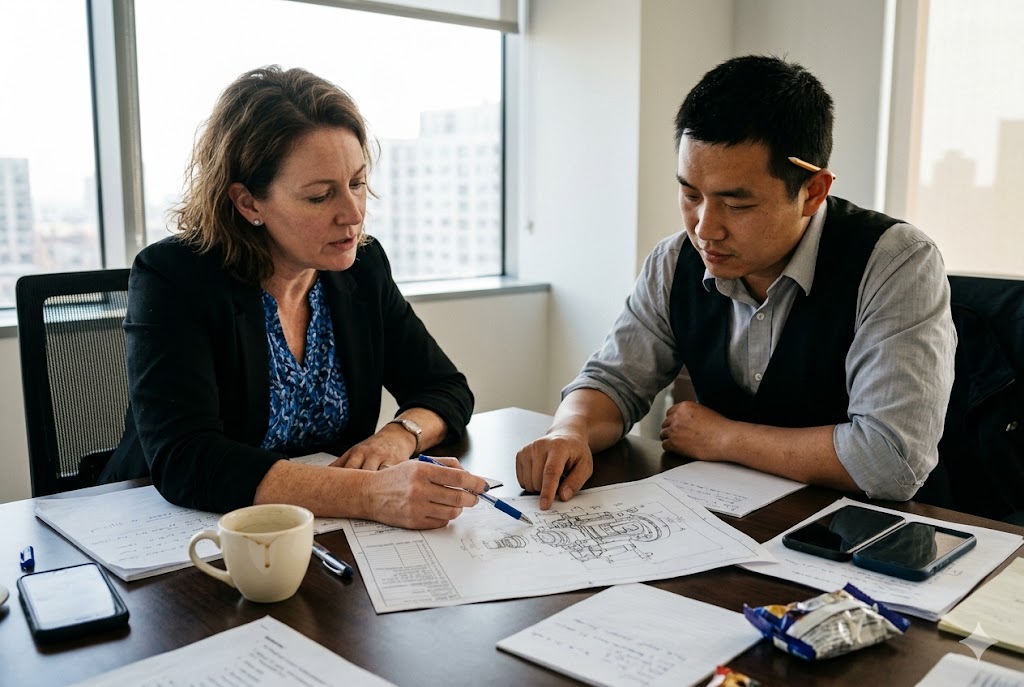
Why Drawing Notes Matter for Process Control
A drawing that specifies only the end geometry gives the manufacturer freedom to choose any process that produces that geometry. If your part has a concentricity callout of ⌀0.01mm between the front OD and the back OD, a factory can attempt to hold that tolerance across two setups — and may succeed on a sample run but fail in production. Specifying single-setup machining explicitly removes that ambiguity.
Recommended Drawing Notes
Add the following to the general notes block of your drawing:
- Process note: "All diameters, cross-holes, and axial features to be machined in one setup. No re-clamping permitted between turning and milling operations."
- Equipment note: "Part requires Swiss-type CNC lathe with live tooling, Y-axis, and sub-spindle capability. Minimum 5-axis configuration."
- GD&T datum structure: Establish Datum A as the primary bore or primary OD. Reference all concentricity, runout, and positional tolerances back to Datum A. This enforces a single datum scheme that is only achievable in one setup.
GD&T Callouts That Imply Swiss Machining
Some geometric dimensioning and tolerancing (GD&T) 10 callouts are practically impossible to hold across multiple setups without implying single-setup machining:
| GD&T Callout | Tolerance Value | Practical Implication |
|---|---|---|
| Concentricity ⌀ | ≤ 0.01mm | Requires single datum — single setup |
| Total runout | ≤ 0.01mm | Same as above |
| True position of cross-hole | ≤ 0.05mm | Requires live tooling in same setup |
| Angularity of cross-hole | ≤ 0.5° | Requires B-axis — 7-axis minimum |
| Surface finish Ra | ≤ 0.4μm | Requires stable single-setup vibration environment |
The Guide Bushing Constraint: Know Your Part Length
One structural limitation of Swiss machining that applies regardless of axis count is the guide bushing's constraint on part length. In guide bushing mode, the maximum machining length per bar-feed advance is typically 200–320mm depending on the machine model. Parts requiring features distributed across a longer total length must be machined in sequential segments or transferred to a different machine. If your part is longer than 300mm, note this on the drawing and confirm the factory's process plan before ordering.
Our team reviews drawings before placing orders with any supplier. If we see a geometric tolerance stack that implies single-setup machining without a process note, we flag it and ask the client to add the note — or we negotiate it into the supplier's quality plan. Either way, the intent gets documented before production starts.
Conclusion
Multi-axis Swiss machining in China is real, capable, and commercially accessible — but only from the right factories. Know your axis requirements, specify your drawing correctly, and audit the supplier's process, not just its equipment list.
Footnotes
1. Overview of Swiss-type lathe design, guide bushing function, and multi-spindle configurations. ↩︎
2. The Yangtze River Delta as China's primary hub for advanced manufacturing and precision machining. ↩︎
3. The Pearl River Delta Economic Zone and its role in China's precision manufacturing sector. ↩︎
4. ISO 9001 quality management system requirements and global certification overview. ↩︎
5. IATF 16949 automotive quality management standard for process control and defect prevention. ↩︎
6. ISO 13485 medical device quality management system requirements for regulatory compliance. ↩︎
7. AS9100D aerospace quality management standard and its role in supplier qualification. ↩︎
8. Process capability index (Cpk) as a statistical measure of manufacturing process performance. ↩︎
9. Coordinate-measuring machine (CMM) principles, probe types, and dimensional accuracy. ↩︎
10. Geometric dimensioning and tolerancing (GD&T) symbolic language for engineering drawings. ↩︎