Skip to main content Skip to footer

We get this question a lot — and honestly, it used to slow down deals. Customers send us drawings with long axial bores, and their first fear is: can any factory in China actually hit these specs? The concern is real, and it costs time.
Yes, Chinese Swiss CNC factories can and routinely do perform deep hole drilling on small-diameter parts. They use three main methods: coolant-through twist drilling for depth-to-diameter (L/D) ratios up to 20:1, gun drilling for L/D ratios up to 100:1, and peck drilling for intermediate depths when high-pressure coolant is unavailable.
The right method depends on your hole diameter, required L/D ratio, material, and the factory's coolant pressure capability. If you know what to look for, you can qualify the right shop fast.
What Is the Maximum Depth-to-Diameter Ratio a Chinese Swiss CNC Factory Can Reliably Drill?
When we visit supplier factories for our clients, L/D ratio is one of the first capability questions we ask. It separates general-purpose shops from precision specialists immediately.
A qualified Chinese Swiss CNC factory can reliably achieve L/D ratios of 20:1 with standard coolant-through twist drills, up to 78:1 or beyond with gun drilling on machines equipped with 2,000–3,500 PSI coolant systems, and theoretically over 100:1 on dedicated setups with the right tooling and material conditions.
Why the Guide Bushing Changes Everything
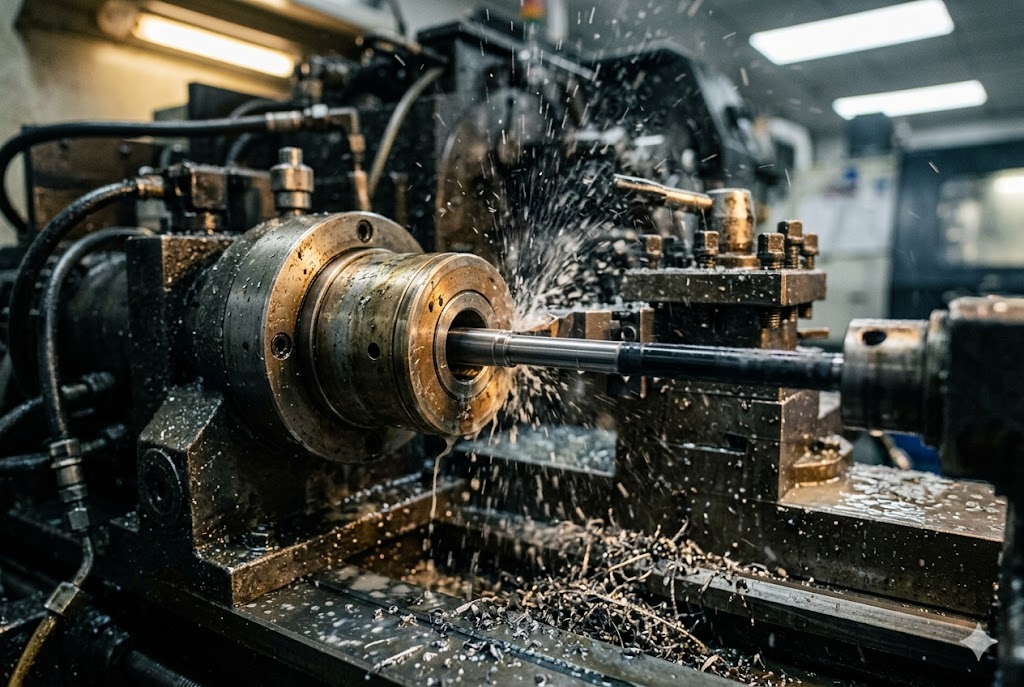
A Swiss-type lathe 1 supports the workpiece inside a guide bushing — just millimeters from the cutting zone. This is a structural advantage no conventional lathe can replicate. The drill enters a rigidly supported face, not a flexing overhang. That rigid support establishes a straight pilot path from first contact. It is the reason Swiss-type machines can handle deep holes that would cause runout or deflection on a standard turning center.
In our experience auditing factories for clients, this architecture is what separates a Swiss shop from a regular CNC lathe shop when evaluating deep-hole capability. Do not conflate the two.
L/D Ratio Capability by Method
| Method | Typical L/D Range | Coolant Pressure Required | Best For |
|---|---|---|---|
| Peck drilling | Up to 10:1 | Standard (< 500 PSI) | Low-volume, large diameters |
| Coolant-through twist drill | Up to 20:1 | 500–1,500 PSI | General precision parts |
| Gun drilling | 20:1 to 100:1+ | 2,000–3,500 PSI | Medical, aerospace, hydraulic |
What to Ask the Factory
Ask for their coolant system pressure spec. Ask if they have gun drilling 2 capability on-machine or only as a secondary operation. Ask for a sample part or inspection report with a cannulated bore at your target L/D ratio and diameter. A factory that can answer all three confidently and show documentation is likely the real deal.
Most factories in China that run Citizen, Star, or Tsugami Swiss lathes with high-pressure coolant options can reach 40:1 to 78:1 reliably. Ratios above 80:1 require dedicated setup, attended operation, and significant process control — fewer shops offer this, but they exist.
Diameter Matters Too
L/D ratio alone does not tell the full story. A 10mm bore at 30:1 is far easier than a 1mm bore at 30:1. As diameter drops below 4mm, coolant delivery becomes the limiting factor, not the machine's structural rigidity. Below 1mm, shops need spindle speeds of 15,000 RPM or more and careful piloting with a spot drill before the main drill engages.
Top-Tier vs. Standard Chinese Swiss Shops
| Capability | Standard Swiss Shop | Top-Tier Swiss Shop |
|---|---|---|
| Coolant pressure | 500–1,500 PSI | 2,000–3,500 PSI |
| Gun drilling | Secondary operation | In-cycle, same setup |
| Minimum drill diameter | ~0.5mm | 0.1mm (Tungaloy GigaMiniDrill) |
| Max reliable L/D | ~20:1 | 78:1 or beyond |
| Lights-out monitoring | Basic alarms | Spindle load torque sensing |
How Does Deep Hole Drilling Affect Cycle Time and Scrap Rate on Precision Turned Parts?
Every client we work with wants to know: will this feature kill my unit price and my lead time? Our engineers track cycle time and scrap data across the factories we manage orders with, so the answer is not a guess.
Deep hole drilling increases cycle time significantly compared to standard drilling — peck drilling can add 30–60 seconds per hole at moderate L/D ratios, while gun drilling with high-pressure coolant reduces this to 5–15 seconds per hole. Scrap rate depends almost entirely on whether the factory uses spindle load monitoring during unmanned operation.
Peck Drilling vs. Continuous Feed: The Time Cost
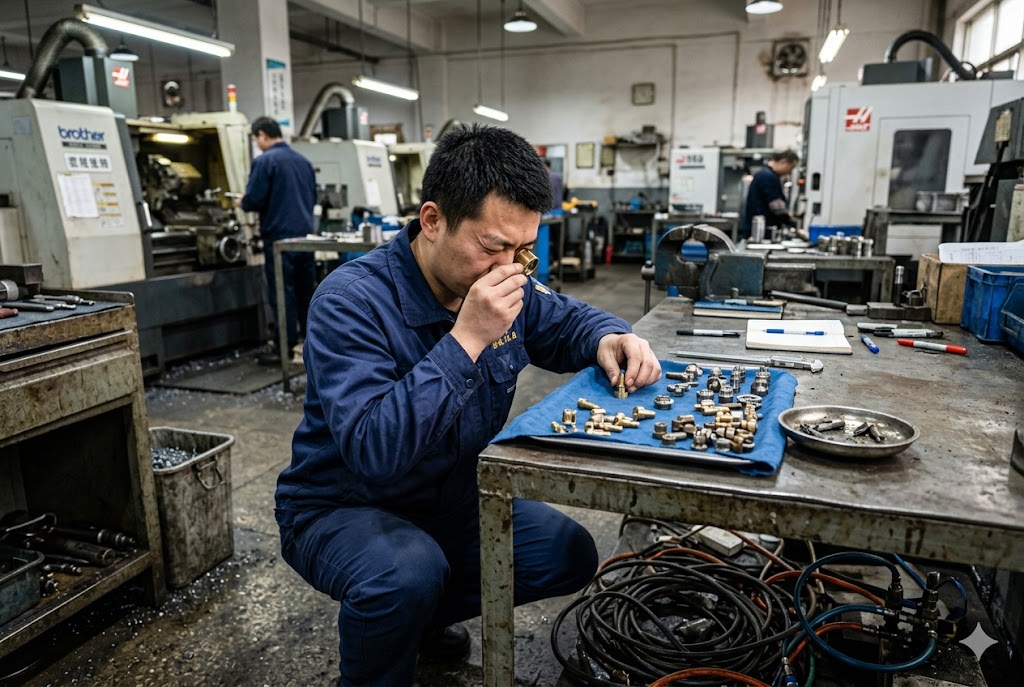
Peck drilling 3 is the fallback method when high-pressure coolant is not available. The drill advances a short distance, retracts to clear chips, advances again, and repeats. At a 15:1 L/D ratio on a 3mm bore, peck drilling might take 45 seconds. A high-pressure coolant-enabled continuous gun drilling cycle at the same geometry takes 8–12 seconds. That difference is real money on a part with a 10-second turning cycle.
This is why coolant pressure matters so much when quoting a deep-hole part. Two shops can quote identical capability on paper, but the one with 3,000 PSI coolant will quote half the cycle time — and the lower price reflects real capability, not a race to the bottom.
The Scrap Risk: Drill Breakage
The most dangerous failure mode in deep hole drilling on Swiss lathes is drill breakage during lights-out unmanned production. A broken gun drill at 60:1 depth can jam the headstock Z-axis, destroy the guide bushing, and scrap the entire remaining bar in the feeder. One event can cost an hour of production and several dozen scrapped parts.
Experienced Chinese Swiss shops mitigate this in three ways:
- Spindle load monitoring 4 — torque-sensing controls halt the machine when cutting load spikes above a set threshold.
- Adaptive feed rate reduction — the program automatically slows feed when load climbs, buying time before breakage.
- Attended shift scheduling — high-risk deep-hole operations run during staffed hours, not overnight.
If you are sourcing parts with L/D ratios above 30:1, ask the factory directly: how do you protect against drill breakage in unattended production? A shop that cannot answer this question is a scrap risk.
Cycle Time Reference by Method and L/D
| L/D Ratio | Method | Approx. Cycle Time per Hole | Scrap Risk Level |
|---|---|---|---|
| Up to 10:1 | Peck drill | 15–30 sec | Low |
| 10:1 to 20:1 | Coolant-through twist drill | 10–20 sec | Low–Medium |
| 20:1 to 60:1 | Gun drill, 2,000 PSI | 5–15 sec | Medium (without monitoring) |
| 60:1 to 100:1 | Gun drill, 3,000+ PSI | 8–20 sec | High without load monitoring |
Material Matters
Titanium and 316L stainless steel — the standard materials in medical cannulated screws 5 — are significantly more demanding than aluminum or mild steel. Tool wear accelerates, chip control is harder, and coolant chemistry becomes a factor. Factories that drill Ti-6Al-4V 6 at 40:1 L/D as routine work represent a benchmark level of Swiss deep-hole capability. When we audit factories for medical device clients, this single data point tells us more than almost anything else on the shop floor.
What Tooling Do Chinese Factories Use for Deep Hole Drilling on Swiss-Type Lathes?
When our team visits factories, we check the tooling cabinet. The tools a shop stocks tell you immediately what work they have actually done, not what they claim they can do.
Chinese Swiss CNC factories use coolant-through carbide twist drills for moderate depths, Tungaloy GigaMiniDrills for micro-holes from 0.1mm to 3mm at depths up to 15x diameter, and single-flute gun drills for high L/D ratios — all mounted in stationary turret stations while the rotating workpiece feeds over the drill via the sliding headstock.
The Reversed-Motion Principle
On a dedicated gun-drilling machine, the drill rotates and advances into a stationary workpiece. On a Swiss lathe, the opposite happens: the gun drill is mounted stationary in the turret, and the rotating workpiece is fed over it by the headstock Z-axis. Coolant enters through the gun drill's internal channel at 2,000–3,500 PSI and evacuates through the external chip groove alongside the drill body.
This reversed-motion approach means the workpiece's own rotation provides cutting velocity. The headstock Z-axis controls feed rate. The result: L/D ratios of 78:1 or greater, even at 1mm drill diameters, within the same single-setup program that handles all other turning features.
Tooling by Application
| Tool Type | Diameter Range | Max Depth | Application |
|---|---|---|---|
| Coolant-through carbide twist drill | 0.5mm–10mm | 15–20x D | General precision parts |
| Tungaloy GigaMiniDrill | 0.1mm–3mm (0.01mm steps) | Up to 15x D | Micro-holes, watch parts, medical |
| Single-flute gun drill | 1mm–50mm | Up to 100x D+ | Cannulated screws, hydraulic bores |
| Spot drill / pilot drill | 0.3mm–5mm | 1–3x D | Entry preparation for all deep holes |
Tooling Sourcing in China
Tungaloy, Sandvik, and Kennametal all have Chinese distribution networks. Top-tier Swiss shops in Shenzhen, Dongguan, Suzhou, and Hangzhou stock these tools as standard inventory. A shop that only stocks domestic Chinese tooling brands for deep-hole work is not a shop we would recommend for tight-tolerance cannulated bores, though domestic tooling has improved significantly and is acceptable for moderate L/D ratios in non-critical applications.
The Importance of Pilot Drilling
For holes below 0.5mm diameter, a spot drill entry is not optional — it is required. A spot drill creates a precise center geometry that prevents the main drill from walking on entry. At spindle speeds approaching 15,000 RPM for sub-0.5mm work, even a tiny entry deviation becomes an exit deviation magnified by the full hole depth. Factories that skip the pilot step on micro-holes are producing scrap they may not even be measuring correctly.
On-Center vs. Off-Center Deep Holes
Chinese Swiss shops distinguish between two setups based on hole position relative to the part axis. On-center axial deep holes use the main spindle headstock Z-axis feed with a stationary turret-mounted drill. Off-center deep holes — such as hydraulic cross-bores or cooling passages in aerospace fittings — require Y-axis positioning, C-axis indexing, and then Z-axis feed. This sequence demands 7-axis or higher machines and advanced programming. Fewer Chinese shops offer this than those handling basic axial deep drilling. Confirm this capability explicitly if your drawing has off-center deep holes.
The guide bushing 7 must be correctly sized for the bar stock diameter to maintain concentricity throughout all these operations — an improperly sized bushing will introduce runout errors that compound over the full bore depth.
How Should I Annotate Deep Hole Drilling Requirements on My Technical Drawing?
Incomplete drawings are one of the top reasons quotes come back wrong or parts come back scrapped. Our engineers review drawings before they go to factories, and deep-hole annotations are consistently the weakest area.
To annotate deep hole drilling correctly on a technical drawing, specify the nominal hole diameter with tolerance, the full depth or L/D ratio, the surface finish (Ra) of the bore wall, the straightness tolerance of the hole axis, the entry chamfer geometry, and whether a through-hole or blind hole is required — all in a clearly labeled callout or note block on the drawing.

What the Factory Actually Needs to Quote Accurately
A vague callout like "∅2.0 DEEP" tells the factory almost nothing. Is the bore through? What is the positional tolerance of the axis? What surface finish is required? Without this information, the factory either guesses — usually conservatively to protect themselves — or comes back with clarifying questions that slow your timeline.
A complete deep-hole callout includes:
- Nominal diameter and tolerance: e.g., ∅2.0 +0.0/-0.02mm
- Full depth: e.g., THRU (for through-holes) or depth dimension with a flat or conical bottom note
- L/D ratio: include this in a note block if the depth is more than 10x the diameter — it signals to the engineer that this is a deep-hole operation, not a standard drill
- Bore wall surface finish: Ra 0.8µm or Ra 1.6µm 8 is typical; Ra 0.4µm requires honing or reaming after drilling
- Straightness tolerance: for cannulated bores especially, axis straightness matters — specify it explicitly
- Entry chamfer: always specify a chamfer at the drill entry face to prevent burr and guide the drill
Annotation Example for a Cannulated Bone Screw Bore
A drawing note might read: ∅1.8 +0.0/-0.015 THRU, L/D 35:1, Ra ≤ 0.8µm, axis straightness ≤ 0.05mm full length, entry chamfer 0.3×45°, gun drill operation required, no peck drilling permitted.
That last line — "gun drill operation required, no peck drilling permitted" — is something few buyers include. It matters. Without it, a factory under price pressure will substitute peck drilling and produce a bore with tool marks and potentially a curved axis.
Common Drawing Annotation Errors
| Error | Consequence | Fix |
|---|---|---|
| No depth specified for blind hole | Factory assumes incorrect depth | State full depth with tolerance |
| No surface finish callout | Factory defaults to Ra 3.2µm | Specify Ra explicitly |
| No straightness tolerance | Curved bore axis accepted | Add straightness callout |
| Missing entry chamfer | Burr on bore entry, drill walking | Specify chamfer size and angle |
| No note on drilling method | Peck drilling substituted for gun drilling | Add process note when critical |
Who Should Review the Drawing Before It Goes Out
A thorough DFM review 9 before the drawing reaches a factory floor can catch deep-hole annotation gaps early — before the first article inspection fails and rework cycles inflate your lead time and cost. If your organization has a manufacturing engineer or DFM reviewer, route the drawing through them before sending to the factory. If not, our team at Luckym reviews drawings as part of our standard sourcing service.
Understanding real-time tool breakage detection 10 systems is also worth discussing with your supplier — shops running lights-out production on deep-hole parts should be able to explain exactly how they handle unattended drill breakage events.
Conclusion
Chinese Swiss CNC factories can handle deep hole drilling — but capability varies sharply between shops. Verify coolant pressure, tooling inventory, and process controls before you commit to a supplier. Get your drawings annotated correctly. The right factory, properly qualified, will deliver cannulated bores and axial deep holes to spec, on time, every run.
Footnotes
1. How Swiss-type lathes use a guide bushing to eliminate workpiece deflection during precision turning. ↩︎
2. Overview of gun drills — single-flute tools capable of depth-to-diameter ratios exceeding 100:1. ↩︎
3. Best practices for choosing the right peck drilling cycle to extend tool life and improve hole accuracy. ↩︎
4. How spindle load monitoring prevents tool breakage and downtime during CNC machining operations. ↩︎
5. Real-world case study of deep-hole drilling on titanium cannulated screws for orthopedic devices. ↩︎
6. Peer-reviewed research on the machinability challenges of Ti-6Al-4V in aerospace and biomedical contexts. ↩︎
7. How guide bushing sizing affects concentricity and precision on Swiss-type CNC lathes. ↩︎
8. Explanation of Ra surface roughness values and what finish levels correspond to machining processes. ↩︎
9. Step-by-step guide to running an effective DFM review with suppliers before releasing drawings. ↩︎
10. How professional shops use spindle load thresholds and probe-based methods to prevent drill breakage during lights-out runs. ↩︎