Skip to main content Skip to footer
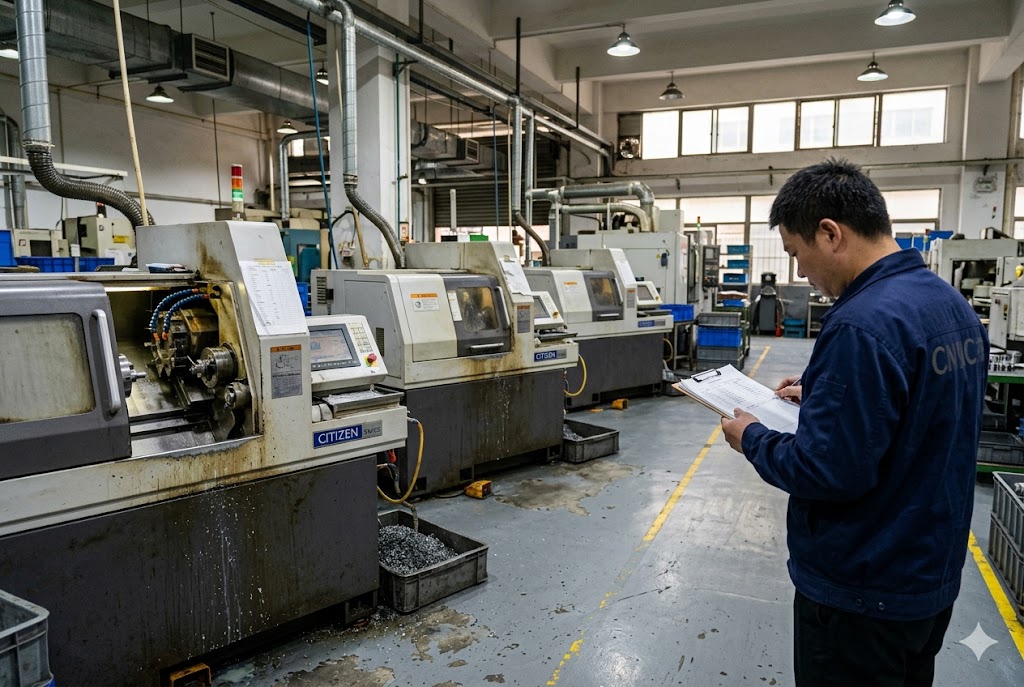
Every week, our team walks the floor of Swiss CNC facilities across Shenzhen, Dongguan, and Suzhou. We see the same question come up repeatedly from purchasing managers: "Can your factory actually handle this material?" The pain of a wrong answer is real — wrong material selection leads to scrapped parts, blown lead times, and awkward conversations with your downstream customer.
Chinese Swiss CNC factories can machine a broad range of materials, including stainless steel (303, 304, 316L, 17-4 PH), aluminum alloys (6061-T6, 7075-T6), brass (H59, H62, C360), copper, titanium (Grade 2, Grade 5/Ti-6Al-4V), alloy steels (4140, 4340), and engineering plastics such as PEEK, POM, PTFE, nylon, and PC — with top-tier facilities also handling Inconel 718 for aerospace applications.
This guide walks through each material family in detail. It covers cost, machinability, and sourcing pitfalls you should know before placing your order.
Which Materials Are Most Cost-Effective to Machine on a Swiss-Type Lathe in China?
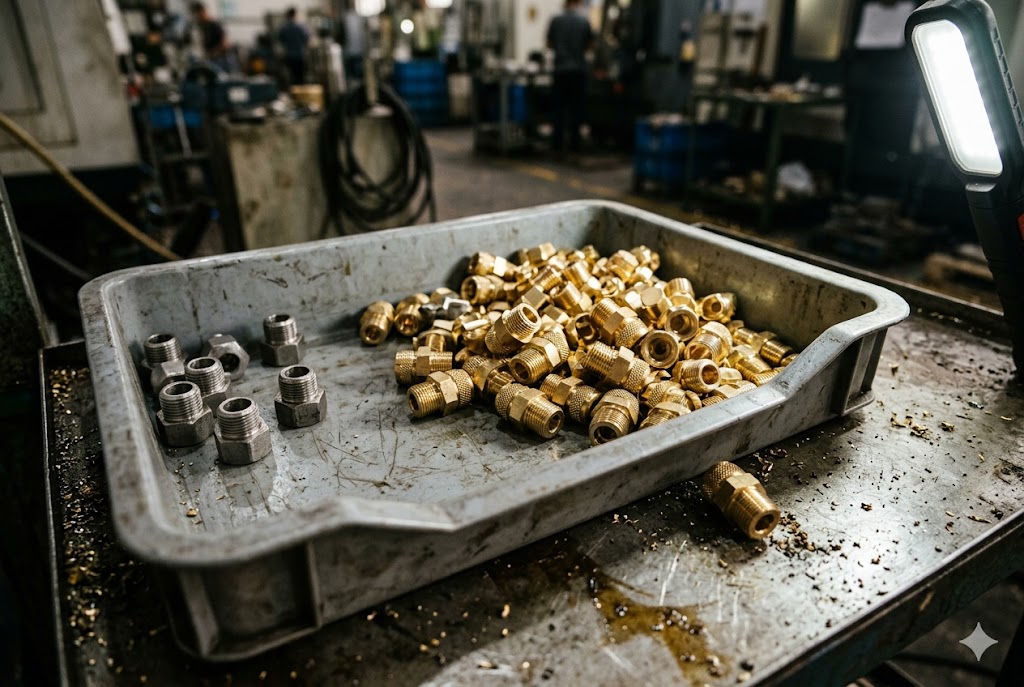
When our sourcing team collects quotes across multiple factories, brass parts consistently come back the cheapest per piece. That is not a coincidence — it is basic physics and economics working together.
Brass (H59, H62, C360) is the most cost-effective material for Swiss CNC turning in China. It machines at high spindle speeds with minimal coolant, produces predictable chips, and keeps cycle times short. Aluminum (6061-T6) ranks second. Stainless steel costs more due to work-hardening, and titanium commands the highest per-part price.
Why Brass Leads on Cost
Brass is the benchmark material for Chinese Swiss shops. Factories in Ningbo and Dongguan run entire production lines dedicated to brass connectors, fittings, and contact pins. The reasons are straightforward.
First, brass cuts cleanly. It breaks chips reliably and does not stick to the cutting edge. Second, it tolerates high spindle speeds — often near the machine's maximum RPM. Third, it needs little or no coolant on smaller-diameter parts. Less coolant means lower operating cost and faster cleanup between jobs.
Here is a cost comparison index based on typical Chinese Swiss lathe production, with brass set as the baseline:
| Material | Relative Cost Index | Reason |
|---|---|---|
| Brass (C360, H62) | 1.0× | Highest machinability, fastest cycle time |
| Aluminum 6061-T6 | 1.2× | Fast cutting, but chip evacuation needs attention |
| Aluminum 7075-T6 | 1.3× | Slightly harder, more tool wear than 6061 |
| Stainless 303 | 1.8× | Better chip-breaking than 304, still demanding |
| Stainless 304 / 316L | 2.2× | Work-hardening, poor chip formation |
| Steel 4140 / 4340 | 2.0× | Hard, requires rigid setup |
| Titanium Grade 2 | 3.5× | Low cutting speeds, high coolant pressure needed |
| Titanium Grade 5 (Ti-6Al-4V) | 4.5× | Most demanding common metal |
| PEEK (unfilled) | 3.0× | Requires annealing, special tooling |
| Inconel 718 | 6.0×+ | Extreme tool wear, reserved for certified shops |
Aluminum: The Lightweight Runner-Up
Aluminum 6061-T6 is the second-most economical Swiss CNC material in China. It cuts fast. It dissipates heat well. And it is widely used in drone parts, medical instrument handles, and semiconductor tooling.
One practical issue is chip control. Aluminum produces long, stringy chips that can wrap around tooling in the confined gang-tool zone of a Swiss lathe. Chinese factories running Citizen machines with Low Frequency Vibration (LFV) cutting technology 1 handle this better than shops without it. If your aluminum part has deep holes or internal features, ask the factory whether their machines support LFV.
Stainless Steel: High Demand, Higher Cost
Stainless steel — especially 316L — is the most common material across medical, automotive, and electronics Swiss CNC orders. But it is not cheap to machine. Its work-hardening behavior punishes slow feeds and dull tools. Chinese shops managing 316L well use sharp carbide inserts with positive rake geometry and deliver high-pressure coolant close to the cutting zone.
Grade 303 is the free-machining alternative to 304. It costs nearly the same in raw material but machines faster and produces better surface finish. If your application allows 303, it is worth specifying — you will pay less per part.
What Material Limitations Should I Be Aware of When Sourcing Swiss CNC Parts From China?
Our team has walked into factories that list every material on their website but lack the equipment or process knowledge to run half of them correctly. Knowing what to ask separates a costly lesson from a smooth project.
The main limitations to know when sourcing Swiss CNC parts from China are bar stock quality consistency, machine-to-material matching, and process knowledge depth — especially for titanium, Inconel, and reinforced-grade PEEK. Not every factory advertising a material can actually hold tolerance on it across a full production run.
The Bar Stock Quality Problem
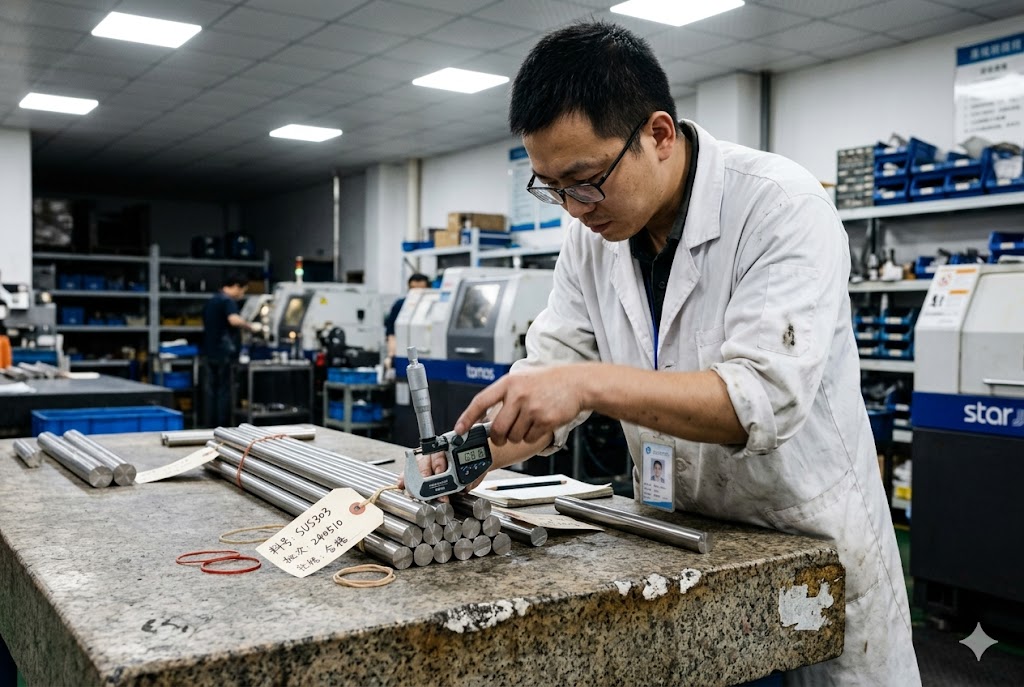
This is one of the least-discussed sourcing risks in Chinese Swiss CNC procurement. Swiss lathes use a guide bushing 2 that requires bar stock diameter consistency within ±0.013 mm along the full bar length. Domestic Chinese bar stock — particularly for stainless steel and titanium — does not always meet screw-machine-quality standards for straightness and diameter consistency.
Factories producing precision Swiss parts for export either source imported bar from Japan, Germany, or the US, or maintain in-house centerless grinding to qualify domestic bar before feeding it into the machine. When you are qualifying a new Chinese Swiss shop, ask directly: "What is your bar stock source for titanium and stainless?" The answer tells you a great deal about their process maturity.
Machine-to-Material Matching
Top-tier Chinese Swiss CNC shops assign specific material families to specific machines. This is not just preference — it is a process control requirement.
| Material Family | Coolant System Required | Notes |
|---|---|---|
| Titanium, Inconel | Cutting oil (not water-soluble) | Prevents work hardening, reduces tool adhesion |
| Stainless, steel alloys | Water-soluble emulsion or cutting oil | High pressure preferred for stainless |
| Brass, aluminum | Oil or water-soluble | Either works; aluminum benefits from flood coolant for chip flushing |
| PEEK, POM, PTFE | Dry or air-blast only | Coolant absorption or thermal shock can cause dimensional drift |
A factory that runs all these materials on the same machine without a documented changeover and cleaning protocol is a risk. Ask about their machine assignment practice before you approve them for multi-material orders.
Inconel: Capability Is Concentrated
Inconel 718 and 625 are machinable on Swiss lathes 3, but only in a small number of Chinese facilities. These nickel-chromium superalloys work-harden extremely quickly and generate intense heat at the cutting edge. Shops capable of Inconel Swiss turning need TiAlN or AlTiN coated carbide tooling, continuous uninterrupted cutting passes, and high-pressure coolant at 500+ PSI. If you need Inconel Swiss-turned parts from China, verify aerospace certifications — AS9100 or NADCAP 4 — before sampling.
PEEK: Grade Matters More Than Most Buyers Realize
Many factories say they can machine PEEK. Fewer can handle it reliably across a full production run. And fewer still understand the difference between PEEK grades.
Unfilled PEEK-1000 is the most manageable grade. Glass-fiber-reinforced PEEK-GF30 and carbon-fiber-reinforced PEEK-CA30 5 are 3–5× more abrasive on cutting tools than the unfilled grade. Shops without genuine high-performance plastics experience will experience rapid tool wear, dimensional drift mid-run, and burring on features. Ask the factory how often they change inserts on a PEEK-GF30 run and what their in-process measurement frequency is. Vague answers are a red flag.
How Does Material Machinability Affect Cycle Time, Tool Wear, and My Per-Part Price?
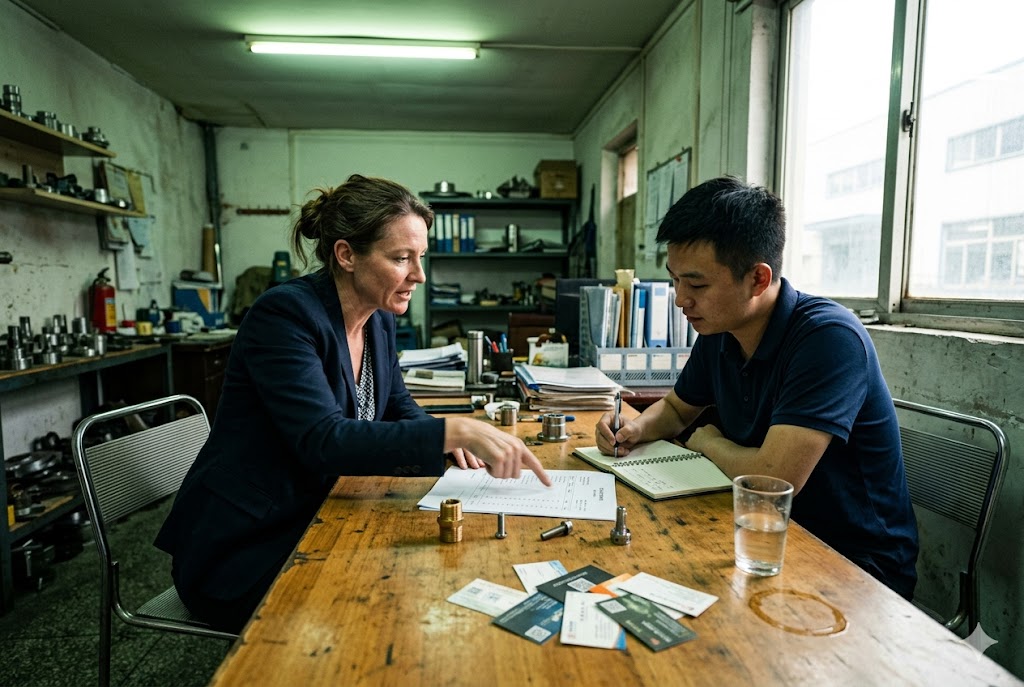
When we collect supplier quotations for our clients, material machinability is the single biggest driver of price variation on identical part geometries. Understanding the mechanism helps you negotiate better and avoid surprises.
Material machinability directly affects cycle time, tool wear rate, and per-part cost on Swiss CNC parts. Low-machinability materials like titanium Grade 5 require slower cutting speeds, higher coolant pressure, and more frequent insert changes — all of which increase cost per part significantly compared to free-machining materials like brass or aluminum.
How Cycle Time Translates to Cost
Swiss lathes are expensive to operate. Machine time is the dominant cost driver. Cycle time is primarily determined by cutting speed, feed rate, and depth of cut — all of which are constrained by the material's machinability.
Here is how cutting speed varies by material on a typical Swiss lathe with carbide tooling:
| Material | Typical Cutting Speed | Feed Rate Range | Cycle Time vs. Brass |
|---|---|---|---|
| Brass C360 | 200–400 SFM | 0.003–0.010"/rev | 1.0× (baseline) |
| Aluminum 6061-T6 | 300–600 SFM | 0.004–0.012"/rev | 0.9× (faster) |
| Stainless 303 | 100–150 SFM | 0.002–0.006"/rev | 2.0–2.5× |
| Stainless 316L | 80–120 SFM | 0.002–0.005"/rev | 2.5–3.0× |
| Titanium Grade 5 6 | 30–60 SFM | 0.003–0.006"/rev | 5.0–7.0× |
| Inconel 718 | 20–40 SFM | 0.001–0.003"/rev | 8.0–10× |
Tool Wear: The Hidden Cost Multiplier
Cutting inserts are consumables. The faster they wear, the more the factory spends on tooling — and that cost goes into your price. Titanium's poor thermal conductivity concentrates heat at the cutting edge rather than dissipating it into the chip. This accelerates insert wear dramatically. Chinese factories running titanium Grade 5 on Swiss lathes use TiAlN-coated carbide with through-tool high-pressure coolant 7 at 70–150 bar. Even then, insert life is short.
PEEK-GF30 and PEEK-CA30 are similarly aggressive on tooling 8 due to the abrasive glass and carbon fiber content. Frequent insert changes during a production run are not unusual.
What This Means for Your Quote
When you receive a quote that looks unusually high for a geometrically simple part, check the material first. A small titanium screw with a modest feature count can cost 4–5× more than the same geometry in brass — not because the factory is overcharging, but because the physics demand it. Understanding this prevents unnecessary back-and-forth during negotiation and builds credibility with your supplier.
Can I Mix Multiple Materials Across Different Part Numbers in One Purchase Order?
Purchasing managers often want to consolidate. Sending one PO for ten different part numbers — each in a different material — sounds efficient. The reality is more nuanced, and our project managers handle this question on almost every multi-part project.
Yes, you can mix multiple materials across part numbers in a single purchase order to a Chinese Swiss CNC factory. However, production scheduling, machine assignment, and minimum order quantities per part number will vary by material. Clear BOM documentation and material call-outs on drawings are essential to avoid mix-ups.
How Factories Schedule Multi-Material Orders
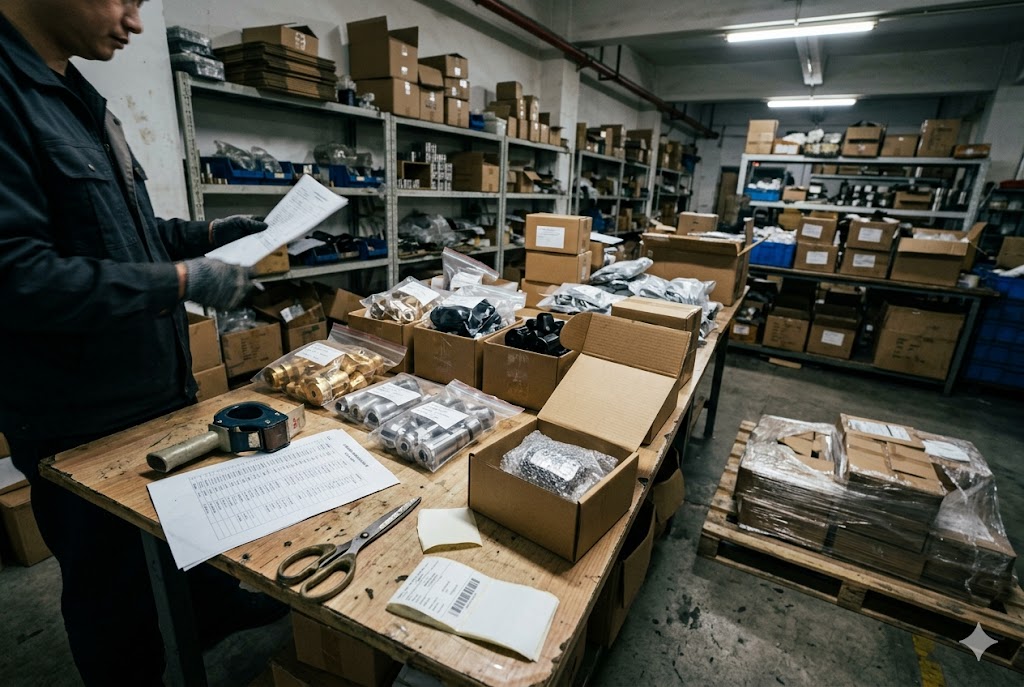
A Swiss CNC factory does not run all materials simultaneously on the same machine. Each material family requires its own setup, coolant system, and tooling. When you submit a multi-material PO, the factory's production planner groups your parts by material and schedules them in batches.
This affects your lead time. If you order five brass parts and two titanium parts, the brass parts will likely be ready first — by a week or more. Plan your internal receiving and inventory accordingly.
Minimum Order Quantity Per Part Number
Mixed-material orders sometimes run into MOQ friction. Here is how it typically plays out:
- Brass and aluminum parts with simple features: low MOQ tolerance, often 50–200 pieces per part number
- Stainless 316L or 17-4 PH with tight tolerances: factories prefer 200+ pieces to justify setup cost
- Titanium Grade 5: factories often want 100+ pieces minimum due to high tooling cost per setup
- PEEK (especially reinforced grades): most shops want 100+ pieces minimum and may require NRE for fixture setup
When consolidating a multi-material PO, share your forecast volumes upfront. A well-run factory can plan capacity better and may offer pricing breaks on materials where your volumes are strong.
Documentation Is Everything
Our service team has seen costly mix-ups on multi-material orders. A part labeled "SS" on the drawing without specifying the grade ends up in 304 when the customer needed 316L. The fix costs two weeks and a dispute.
Every part number in a mixed PO needs a drawing with the full material specification — including grade, standard (ASTM 9, DIN, GB), and any certification requirement (e.g., RoHS, material certificate, Certificate of Conformance). Do not leave material specification to verbal agreement or email thread. Put it on the drawing title block and the PO line item.
Our team at Luckym reviews every drawing for material ambiguity before submitting to factories — this one step has prevented more quality escapes than any other single practice in our supply chain workflow. Understanding how Swiss turning compares to conventional CNC turning 10 also helps purchasing managers set accurate tolerance expectations when specifying parts across different material families.
Conclusion
Chinese Swiss CNC factories cover a commercially mature material range — from brass and aluminum to titanium, PEEK, and Inconel. The key is matching your material requirement to a factory with the right equipment, bar stock sourcing practices, and process knowledge to hold tolerance across a full production run.
Footnotes
1. How Citizen's LFV technology breaks chips to prevent entanglement during aluminum and difficult-material machining. ↩︎
2. How Swiss lathe guide bushings work and why they require tight bar stock diameter consistency. ↩︎
3. Cutting strategies, tool coatings, and coolant requirements for Inconel 718 and 625 machining. ↩︎
4. AS9100 and NADCAP certification requirements for aerospace-grade CNC machining suppliers. ↩︎
5. Guide to machining PEEK grades, including tool wear challenges with GF30 and CA30 variants. ↩︎
6. Comprehensive overview of titanium CNC machining grades, tolerances, and per-part cost drivers. ↩︎
7. How TiAlN-coated carbide and high-pressure coolant extend tool life on Grade 5 titanium. ↩︎
8. PEEK grade selection guide covering GF30 and CA30 abrasiveness and tooling recommendations. ↩︎
9. ASTM B16 standard for free-cutting brass rod, bar, and shapes used in machined components. ↩︎
10. Swiss turning vs. conventional CNC turning: tolerances, L/D ratios, and volume thresholds explained. ↩︎