Skip to main content Skip to footer

Every week, we field questions from purchasing managers who have been burned by a supplier that promised 2K capability but delivered defects, delays, and finger-pointing. We have visited enough factories across Shenzhen and Dongguan to know the difference between a shop that truly owns this process and one that is faking it.
Yes, capable Chinese suppliers can absolutely perform both two-shot molding and overmolding. These processes are well-established across Guangdong manufacturing clusters. The real question is not whether China can do it — it is whether the specific factory you are evaluating has the right equipment, mold design experience, and in-house trial capability to do it reliably at your required volume.
This guide breaks down what you need to verify before you commit tooling budget to any supplier. Read on — the details matter more than most buyers realize.
Which Chinese Injection Molding Factories Specialize in Two-Shot and Overmolding for Custom Parts?
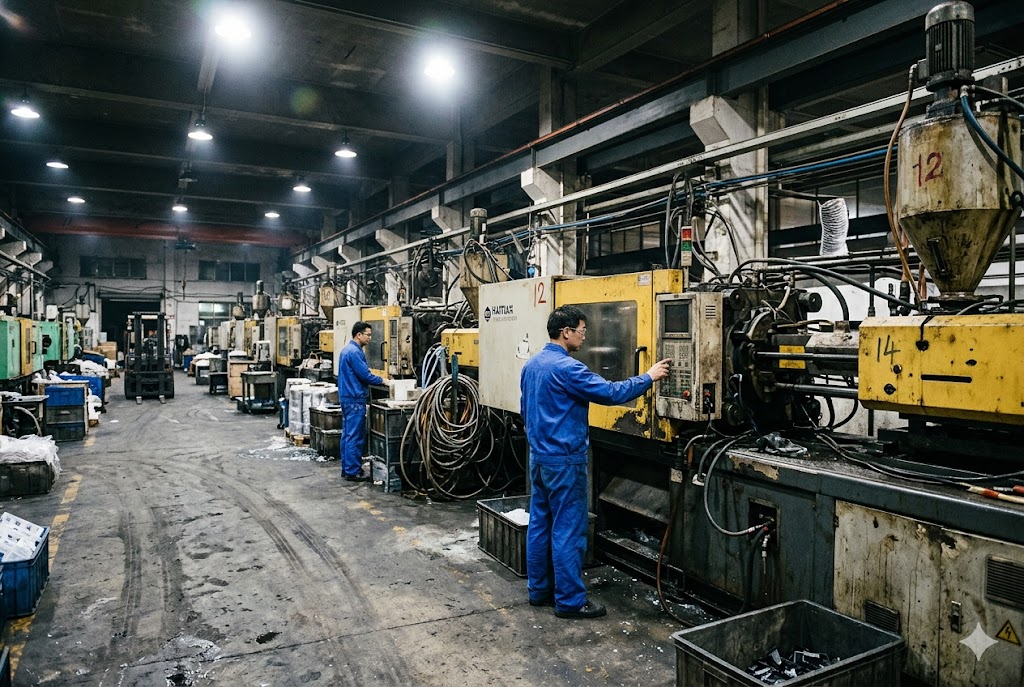
When we help clients evaluate suppliers in the Pearl River Delta, the first thing our team looks for is not a sales brochure — it is the press floor.
Factories that genuinely specialize in two-shot and overmolding for custom parts are concentrated in Shenzhen, Dongguan, and Guangzhou. They typically serve automotive, consumer electronics, and medical device clients. Look for shops with dedicated rotary-platen two-component presses, an in-house mold room with CNC and EDM machines, and documented production references in your target industry.
Where Are the Best Suppliers Located?
The Guangdong province manufacturing cluster 1 — especially the Shenzhen–Dongguan corridor — is home to the highest concentration of advanced injection molding capability in China. Factories here have supplied Tier 1 automotive and global electronics brands for decades, which means the process knowledge and equipment investment are real.
Outside Guangdong, Zhejiang (Ningbo, Taizhou) also has strong injection molding clusters, particularly for industrial and consumer goods applications. However, for two-shot and overmolding specifically, Guangdong factories tend to have more dedicated equipment and engineering depth.
What to Look for When Evaluating a Supplier
Not every factory that lists "two-shot molding" 2 on its website actually owns the equipment. Some subcontract T1 sample trials to third-party shops. This adds risk and delays you will not see coming until it is too late.
Here is a quick comparison of what separates a genuine specialist from a generalist claiming the capability:
| Capability Indicator | Genuine Specialist | Generalist / Risk |
|---|---|---|
| Press type | Owns rotary-platen 2K press in-house | Uses standard single-shot press for both shots |
| Mold room | In-house CNC + EDM machining | Outsources mold work |
| Material pairing data | Can show documented test records | Only quotes from material datasheets |
| Sample trials | T1 run on-site, engineer present | Sends out to subcontractor |
| Production references | References in your industry sector | General "we can do it" claims |
Industry Sectors with Strong Supplier Pools
In our experience coordinating sourcing projects for US clients, these sectors in China have the deepest two-shot and overmolding supplier pools:
- Automotive interior components — door handles, HVAC controls, soft-touch trim
- Consumer electronics — grips, button pads, dual-material enclosures
- Power tools — overmolded handles, vibration-dampening grips
- Medical devices — soft-touch housings, ergonomic grips, sealed enclosures
- Wearables and hearables — LSR overmolding over thermoplastic substrates
If your part falls into one of these categories, qualified suppliers exist and are findable. If your part is outside these sectors, expect a longer qualification process.
What Are the Cost and Lead Time Differences Between Standard Injection Molding and Two-Shot Molding in China?
Our team has helped clients price out dozens of two-shot and overmolding programs alongside equivalent single-shot alternatives. The cost gap is real, and it surprises people on both ends — tooling is much more expensive, but per-part cost can actually be lower at high volumes.
Two-shot molding tooling costs roughly two to three times more than a single-shot equivalent, and mold lead times run four to eight weeks longer. However, at production volumes above 100,000 to 200,000 parts per year, the elimination of secondary assembly labor typically makes the total landed cost lower than producing the same part with two separate molds and a bonding or assembly step.
Tooling Cost Comparison
The higher tooling cost for two-shot molds is structural, not negotiable. A 2K tool must contain two complete matched cavity sets, a rotating or indexing platen mechanism, two independent runner systems, and separate gate and cooling controls for each shot. That is fundamentally more engineering and machining than a single-shot tool.
| Cost Category | Standard Single-Shot | Two-Shot (2K) | Overmolding (2 separate tools) |
|---|---|---|---|
| Tooling cost (indicative) | $8,000–$25,000 | $20,000–$60,000+ | $12,000–$40,000 (combined) |
| Mold lead time | 4–6 weeks | 8–14 weeks | 6–10 weeks (sequential) |
| Per-part cycle time | Baseline | Slightly longer | Longer (two press runs) |
| Secondary assembly needed | Often yes | No | No |
| Minimum volume for cost justification | Any | 100,000–200,000+/yr | 20,000–100,000/yr |
Any Chinese supplier quoting two-shot tooling at single-shot prices is either underspecifying the tool or planning to run it as an overmold and misrepresenting the process. Push for a detailed tooling specification before you approve any deposit.
When Two-Shot Makes Sense vs. Overmolding
Two-shot molding and overmolding are not the same process 3. This distinction matters for your budget and your program timeline.
Two-shot (2K) molding uses a single specialized press with two injection units and a rotating platen. Both materials are injected in one continuous automated cycle. This is best suited to high volumes where the tooling investment can be amortized.
Overmolding uses two separate standard presses and two separate molds. The first shot is produced, then transferred to the second press for the overmold. This is better suited to lower production volumes where a 2K-specific press investment is not justified.
Lead Time Realities
In our experience managing programs from China, realistic lead times look like this:
- Tooling design and fabrication for a 2K mold: 8 to 14 weeks
- T1 sample trial and engineering review: 2 to 4 weeks
- T2 corrections and approval: 2 to 3 weeks
- Production ramp: 1 to 2 weeks
Total time from program start to first production shipment is typically 16 to 24 weeks for a complex two-shot part. Importers who plan for 12 weeks almost always miss their launch date.
How Do I Qualify a Chinese Supplier for Overmolding or Insert Molding Capability?
We conduct supplier factory audits as a core part of our service, and qualification for two-shot and overmolding capability follows a specific checklist. Skipping steps here is where importers lose time and money.
To qualify a Chinese supplier for overmolding or insert molding capability 4, verify in-house press ownership, inspect mold room equipment, request documented material pairing test data for your specific substrate and overmold combination, and require a reference part from prior production — not a sample made specifically for your evaluation. Do all of this before any tooling deposit is paid.
Step-by-Step Qualification Process
Qualification is not a single visit or a questionnaire. It is a structured process with specific verification points at each stage.
Stage 1: Desktop Screening
Before you visit or send an RFQ, screen suppliers on these verifiable indicators:
- Does the supplier list specific 2K press models (brands like Engel, Arburg, Husky, or Chinese equivalents like Haitian) with platen specs?
- Do they have a quality system certification (ISO 9001 5 minimum; IATF 16949 for automotive)?
- Can they provide customer references in your industry sector with contact details?
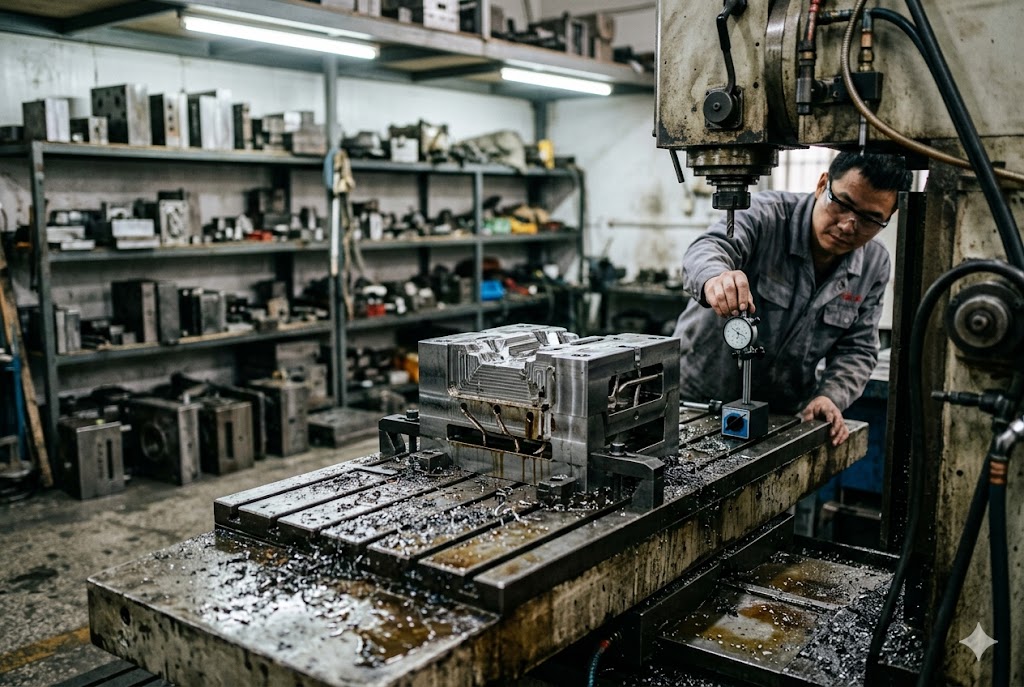
Stage 2: Factory Audit
Our team visits factories in person before recommending them to clients. Here is what we check on-site:
| Audit Area | What to Verify |
|---|---|
| Press floor | Confirm 2K rotary-platen press exists and is operational — not just listed on a spec sheet |
| Mold room | CNC and EDM machines present; ask for machining tolerance capability (should be ±0.005mm or better) |
| Material storage | Proper drying equipment for hygroscopic materials (nylon, PC, TPU); temperature and humidity logs |
| QC lab | CMM or optical measurement equipment; documented inspection records from prior jobs |
| Material pairing records | Physical test data for your specific substrate + overmold material combination |
Stage 3: Technical Review
Before tooling design begins, require a Design for Manufacturability (DFM) review 6. A capable supplier will flag issues proactively. Watch for these red flags:
- No DFM feedback at all (they are just going to build it and hope)
- DFM comments are generic, not specific to your geometry
- No questions about material selection or shrinkage compensation
Material Compatibility
Material chemical compatibility between the first and second shot 7 is the most frequent failure mode in these programs. Thermoplastic elastomers like TPE and TPU bond well over rigid substrates such as ABS, PC, and nylon. Incompatible material pairs produce delamination or adhesion failure in end use.
Require documented material pairing test data or prior production references for your specific substrate and overmold combination before approving any tooling design. Do not accept a supplier's verbal assurance on this point.
LSR Overmolding — A Special Case
Overmolding with liquid silicone rubber over thermoplastic substrates 8 is a specialized variant. Chinese suppliers in the medical and wearables sectors have developed strong capability in this area, but it requires an inverted thermal setup (cool mold, hot LSR material — opposite of standard thermoplastic molding), clean room conditions for medical applications, and verified partnerships with top-tier LSR material suppliers such as Wacker, Dow, or Shin-Etsu.
Ask to see material certificates from these suppliers, not just the brand names listed on a marketing page.
What Design Guidelines Should I Follow When Planning Two-Shot Injection-Molded Parts for Chinese Production?
Our engineers have found that most design problems in two-shot programs are not discovered at the press — they are baked in during the CAD stage. A few constraints are non-negotiable, and knowing them early saves you redesign cycles and tooling rework costs.
When designing two-shot injection-molded parts for Chinese production, the first-shot geometry must be self-supporting when the mold rotates 180 degrees, wall thickness transitions between materials must be gradual to prevent stress concentration, shut-off contact tolerances between cavities must be held to 0.001–0.002 inch, and all design decisions must be validated in a DFM review before mold design is approved.
First-Shot Geometry Must Be Self-Supporting
The core mechanical challenge of two-shot mold design is that the first shot must survive the mold rotation before the second shot is injected. Any unsupported thin features longer than approximately three times their wall thickness are at risk of distortion or displacement during rotation. This creates a dimensional defect in the second shot that no process adjustment can correct without redesigning the part.
Raise this constraint explicitly during DFM review before mold design is approved. It is much cheaper to fix in CAD than in a cut mold.
Shut-Off Tolerance
Maintaining shut-off contact between the first and second shot cavities to tolerances of 0.001–0.002 inch prevents second-shot material from flashing across the first-shot surface. This demands high-precision CNC and EDM mold machining capability.
Ask suppliers to show mold drawings and cavity machining equipment specifications — not just finished part samples. A supplier that can only show you a pretty sample but not the engineering behind it is not a supplier you want to trust with complex tooling.
Wall Thickness Guidelines
The overmolding design principles for wall thickness and gate location 9 apply equally to two-shot programs. Consistent wall thickness prevents sink marks, voids, and uneven cooling that compromise part integrity.
| Design Parameter | Guideline | Risk if Ignored |
|---|---|---|
| First-shot unsupported feature length | Max ~3× wall thickness | Distortion during platen rotation |
| Wall thickness transition between materials | Gradual, ≥3:1 taper | Stress concentration, cracking |
| Shut-off surface contact tolerance | 0.001–0.002 inch | Second-shot flash on first-shot surface |
| Overmold wall thickness | 0.5–3mm typical | Sink marks, incomplete fill, or tearing |
| Gate location (second shot) | Away from thin sections | Short shots, flow marks |
Tooling Ownership and Transfer Rights
The most overlooked import-specific risk in two-shot programs is tooling ownership and portability. If the specialized 2K press the supplier uses is their own equipment and the tool is designed around that machine's platen dimensions, ejector pattern, and tie-bar spacing, transferring the tool to a different supplier later requires either purchasing matched equipment or rebuilding the tool at significant cost.
Negotiate tooling ownership, machine specifications, and transfer rights into the contract before any deposit is paid. This is not a detail — it is a strategic risk that affects your supply chain flexibility for the life of the program.
DFM Review Checklist
Before approving any mold design, confirm these items have been addressed. For automotive-grade programs, 10 this checklist is often a contractual requirement under IATF 16949-certified quality systems:
- First-shot self-support geometry validated
- Material pairing compatibility confirmed with test data
- Shut-off surfaces identified and tolerances specified
- Gate locations for both shots approved by the mold engineer
- Shrinkage compensation calculated separately for each material
- Cooling circuit design reviewed for each shot independently
- Ejector pin locations confirmed to avoid cosmetic surfaces
A supplier who pushes back on providing this level of DFM documentation is telling you something important about how they will manage quality once the tool is in production.
Conclusion
China can absolutely handle two-shot molding and overmolding at a high level — but only with the right supplier. Verify equipment ownership, qualify material pairings, and lock down tooling rights before you commit a dollar. That discipline is what separates a successful program from an expensive lesson.
Footnotes
1. Research report on China's injection molding industry, documenting the Pearl River Delta's dominance in national output. ↩︎
2. Detailed comparison of two-shot injection molding vs. overmolding, covering process mechanics and tooling requirements. ↩︎
3. Side-by-side breakdown of two-shot molding and overmolding differences to guide process and budget decisions. ↩︎
4. Protolabs Network knowledge base explaining how overmolding works and its common industrial applications. ↩︎
5. ASQ resource defining ISO 9001 requirements and how organizations use it to demonstrate quality system compliance. ↩︎
6. Expanded DFM guide for injection molding covering draft angles, wall thickness, gate location, and tooling implications. ↩︎
7. Quick guide to overmolding material compatibility, covering common substrate and overmold pairings including ABS, PC, TPE, and TPU. ↩︎
8. SIMTEC overview of medical-grade LSR overmolding, including clean room requirements and device application examples. ↩︎
9. Complete overmolding design guide covering wall thickness, gate location, sealing features, and shrinkage considerations. ↩︎
10. DNV explanation of IATF 16949 automotive quality management requirements and their role in supply chain certification. ↩︎