Skip to main content Skip to footer

Every time we help a client build a shortlist, the first filter we apply is U.S. export history. Buyers who skip this step end up spending weeks correcting documentation errors, chasing misclassified HTS codes, and re-explaining tolerance standards that a U.S.-experienced factory would have already understood. The onboarding cost is real, and it shows up fast.
Yes, you can and should ask for a shortlist of China sheet metal suppliers with active U.S. export history. This is one of the smartest early filters available. Suppliers who already export to the U.S. have cleared customs hurdles, understand American quality expectations, and reduce your compliance risk from day one.
Once you know why U.S. export experience matters, you can ask better questions, verify claims independently, and build a shortlist that actually saves you time. Keep reading.
Why Does U.S. Export Experience Matter When I Choose a Sheet Metal Factory in China?
When we walk a factory floor in Guangdong or Jiangsu, one of the first things we check is their export documentation history. A factory with zero U.S. shipments on record is a very different risk profile from one that has shipped to American industrial buyers for five consecutive years. The gap matters more than most buyers realize.
U.S. export experience matters because it means the factory has already dealt with CBP customs documentation, HTS code classification, American packaging norms, and English-language engineering drawings. These are not small things. Each one can stall your shipment or trigger a costly correction if the factory is learning them for the first time on your order.

What a Factory With U.S. Export History Has Already Figured Out
A factory that has shipped to U.S. buyers has cleared a long checklist of compliance steps. Here is what that experience typically includes:
| Area | What an Experienced Factory Already Knows |
|---|---|
| HTS Classification | Correct chapter codes for fabricated sheet metal parts (Chapters 73, 76) |
| Section 301 Tariffs | 25% additional duties on most Chinese sheet metal; knows misclassification risk |
| CBP Documentation | Commercial invoice, packing list, and Bill of Lading format requirements |
| Packaging & Labeling | U.S. marking requirements, country-of-origin labeling standards |
| English Drawings | Reading inch-based tolerances, GD&T callouts, and U.S. title block formats |
| FAI Reports | First Article Inspection format aligned with U.S. customer expectations |
A factory without this history is not disqualified. But you need to factor in the learning curve. That curve often shows up as delays, rework, and miscommunication — all of which land on your timeline and your budget.
Section 301 Tariffs: A Specific Risk for Factories Without U.S. Experience
Section 301 tariffs 1 currently add 25% to the cost of most Chinese-fabricated sheet metal parts entering the U.S. A factory with active U.S. export relationships already understands this burden. Their sales team can explain it clearly, quote with tariff impact included, and discuss strategies like first-sale valuation. A factory with no U.S. export history will not know these options exist — and that knowledge gap becomes your problem.
Why English-Language Technical Communication Is a Proxy for Readiness
Factories that have fulfilled U.S. orders have processed English-language drawings. They have learned to distinguish millimeters from inches, kilograms from pounds, and surface finish designations like Ra 1.6 µm from U.S.-standard 63 µin equivalents. They have also submitted FAI reports 2 that passed U.S. buyer review. Without this practice, even a technically capable factory will make unit-conversion errors that require costly correction cycles before production begins.
Industry Match Matters More Than Country Alone
Not all U.S. export experience is equal. A factory that has shipped enclosures to U.S. consumer electronics brands has been held to cosmetic and dimensional standards completely different from one that has shipped brackets to U.S. agricultural equipment OEMs. Ask specifically which U.S. industries the factory has served. Match their prior customer profiles to your application. That match is more predictive of success than simply confirming they have exported to the U.S. at all.
What Should I Ask to Confirm That a Supplier Understands U.S. Buyer Expectations?
In our experience handling RFQ processes for U.S. clients, the questions that reveal the most are not the obvious ones. Asking "do you export to the U.S.?" gets you a yes or no. Asking the right follow-up questions separates a factory that has genuinely served American industrial buyers from one that completed a single shipment three years ago and has listed "North America" as a market ever since.
To confirm a supplier understands U.S. buyer expectations, ask about their First Article Inspection process, how they handle GD&T callouts on English drawings, which U.S. industries they have shipped to, and whether they can name the U.S. importer of record from a recent shipment. Answers to these questions reveal real experience far more reliably than any self-reported claim.

The Questions That Reveal Real Experience
Start with technical communication. Ask the factory to walk you through how they process a new English-language drawing. A factory with real U.S. experience will describe a specific workflow — DFM review, tolerance confirmation, material substitution check. A factory without it will say "we read the drawing and make the part."
Next, ask about their FAI process. First Article Inspection is standard in U.S. manufacturing supply chains. Ask what their FAI report looks like and request a sample. If they do not have a standard format, or if their format does not include dimensional inspection data matched to drawing callouts, that is a gap you will need to manage.
Key Questions to Ask a Potential Supplier
| Question | What a Strong Answer Looks Like |
|---|---|
| How do you handle GD&T callouts 3 on customer drawings? | Describes a DFM review step; mentions flagging ambiguous callouts before quoting |
| What does your FAI report include? | Lists dimensional data, material certs, surface finish measurement, photo evidence |
| Which U.S. industries have you shipped to? | Names specific sectors (medical devices, industrial equipment, automotive Tier 2) |
| Can you name a U.S. importer of record from a recent shipment? | Provides a company name you can verify independently |
| How do you handle a dimensional nonconformance discovered after shipment? | Describes a clear corrective action and root cause analysis process |
| What is your lead time to a U.S. West Coast port? | Gives a specific range including production and transit time |
Why Asking for the Importer of Record Is So Powerful
This is the question most buyers never ask. The U.S. importer of record from a past shipment is a public record. If the factory gives you a name, you can verify the relationship exists through trade data platforms. You can also contact that company directly and ask for an unfiltered assessment of the factory's delivery performance, defect rates, and communication quality. This turns a factory-curated reference into an independently sourced one — which is the most reliable form of supplier due diligence 4 short of a full audit.
Watch for These Red Flags in Supplier Responses
If a factory cannot answer questions about their FAI process, cannot name a specific U.S. customer industry, or provides vague answers about how they handle drawing discrepancies, treat those as yellow flags. They do not disqualify a factory automatically, but they indicate a communication and process maturity gap that will require more active management from your side during production.
How Can I Tell If a Supplier Has Real Experience With U.S. Quality and Logistics Requirements?
We have visited hundreds of factories across Guangdong, Zhejiang, and Jiangsu on behalf of U.S. clients. The gap between what a factory says in a sales call and what you see when you walk the floor is often significant. The good news is that real U.S. export experience leaves traceable evidence — in their documentation systems, on their production floor, and in publicly available trade records.
You can verify real U.S. experience by checking commercial trade databases like Panjiva or ImportGenius, which pull from U.S. Customs records and show actual shipment dates, volumes, and importers. A factory absent from these records despite claiming U.S. exports should be treated as unverified until it produces Bills of Lading or commercial invoices as evidence.
Use Trade Data Platforms First
Before you contact a factory, check the data. Three platforms give you direct access to U.S. Customs import records:
| Platform | What It Shows | Best Use Case |
|---|---|---|
| Panjiva 5 | Factory name, shipment dates, U.S. importer, product descriptions, volume | Verifying named suppliers; researching competitor supply chains |
| ImportGenius 6 | Detailed HS code data, shipment frequency, consignee information | Cross-referencing multiple shipments for the same factory |
| Flexport Trade Data | Historical import volume trends, port of entry data | Understanding shipment patterns over time |
A factory with genuine U.S. export history will appear in these databases with multiple shipments across different dates. A single large shipment from three years ago is a weaker signal than consistent smaller shipments across multiple years.
What to Look for When You Visit the Factory
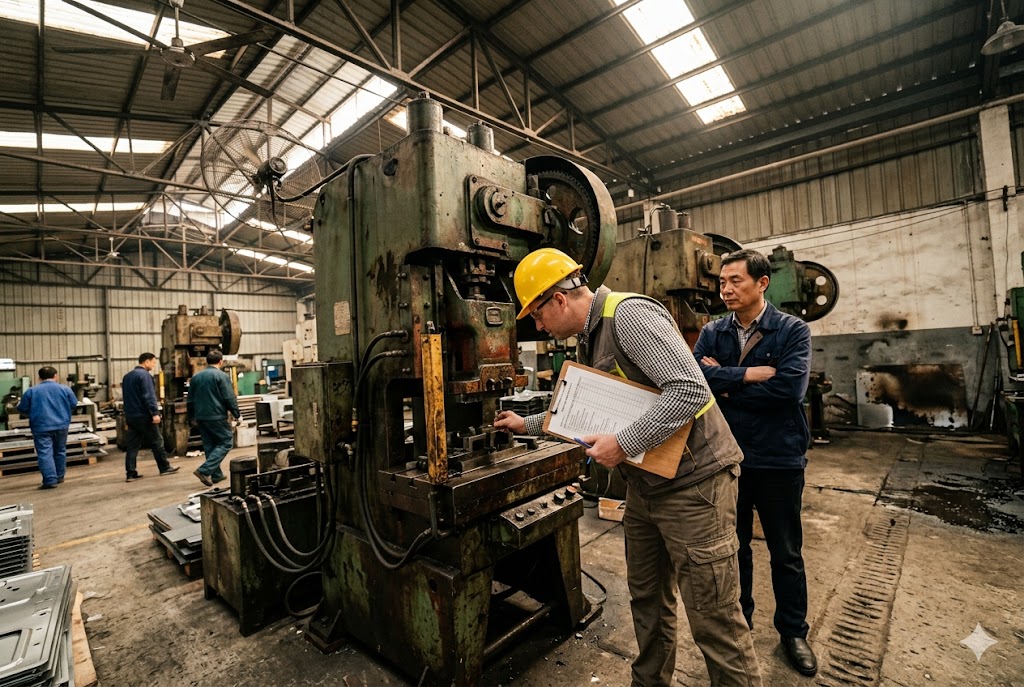
If trade data confirms active U.S. exports, the next step is a factory visit or third-party audit 7 — either in person or through an independent inspection firm. On the floor, look for these indicators of genuine U.S. export readiness:
Inspection equipment calibrated to international standards. U.S. buyers expect dimensional reports tied to calibrated instruments. Check for calibration certificates on CMMs, calipers, and surface roughness gauges.
English-language drawing capability on the production floor. Can the floor supervisor read your drawing without translation? Can they identify a GD&T callout and explain what it means for their process setup?
In-process inspection records. A factory that regularly ships to U.S. quality-conscious buyers will have standardized in-process check sheets. Ask to see a completed example from a recent production run.
Distinguish the Factory From the Trading Company
This is a critical check. Some entities with strong U.S. export records on commercial databases are trading companies or consolidators, not the actual fabricating facility. The name on the Bill of Lading may be a Shenzhen trading firm that sourced from multiple workshops. Confirm that the factory you are auditing is the same legal entity named in the export records. If there is a mismatch, ask for the manufacturing address on the original customs declaration to identify which facility actually made the goods.
Should I Prefer a Factory That Already Works With American Industrial Customers?
This is the question behind all the other questions. After helping U.S. clients source from China for many years, our answer is consistent: yes, preferring a factory with existing American industrial customers is a rational and defensible sourcing strategy — but the preference should be applied as a weighted factor, not an absolute requirement. Here is why, and where the nuance lies.
Prefer factories with existing American industrial customers because they have already passed real commercial tests — repeated quality reviews, U.S. shipping window compliance, and demanding buyer communication standards. Continuous multi-year U.S. export volume is the strongest signal of sustained operational discipline available before a trial order.
Why Continuous Export Volume Is the Signal That Matters Most
A factory that exported once, three years ago, is a different risk profile from one that has shipped to U.S. buyers every quarter for five years. Continuous export volume tells you the factory has successfully navigated repeat quality reviews, sustained long-term customer relationships, and maintained the production discipline to meet U.S. shipping windows across multiple production cycles. A single historical shipment tells you much less.
When reviewing trade data, look for:
- Shipment frequency: quarterly or better is a stronger signal than annual
- Consistency: exports spread across multiple years, not clustered in one period
- Variety of U.S. importers: multiple customers is stronger than a single large buyer
- Product description alignment: make sure the parts they have shipped are similar in complexity and material to what you need
Where the Preference Has Limits
A factory with strong U.S. export history in consumer electronics enclosures is not automatically the right choice for precision machined brackets going into U.S. industrial equipment. The quality bar, tolerance regime, and documentation requirements differ significantly. Industry match matters as much as geographic export history.
Similarly, a technically superior factory with limited U.S. export experience but strong internal quality systems, English communication capability, and willingness to invest in onboarding may outperform a factory with longer U.S. export history but weaker process controls. Use U.S. export experience as a filter — not as the only filter.
How to Frame Your Shortlist Request for Best Results
When you ask a sourcing partner or platform for a shortlist, be specific. Do not ask generically for "China sheet metal suppliers that export to the U.S." Instead, specify:
- Material: e.g., 1.5mm 5052 aluminum
- Finish: e.g., powder coat to RAL 9005, 60–80 µm
- Tolerance class: e.g., ±0.3mm bends, ±0.1mm punched features
- Annual volume range: e.g., 5,000–20,000 parts per year
- Target end market: e.g., U.S. industrial equipment OEMs
- Preferred U.S. industry experience: e.g., agricultural equipment, HVAC, material handling
When building this shortlist, verify that parts are correctly classified under the Harmonized Tariff Schedule 8 before requesting quotes, as HTS chapter assignment directly affects the duty rate your supplier should be quoting against. Similarly, confirm that country-of-origin marking requirements 9 are addressed in your packaging specifications from the start, since errors here can trigger CBP holds on arrival. This specificity eliminates commodity sheet metal exporters whose capability and quality level would not meet your technical requirements, and it gives any sourcing partner the information they need to match factories with genuine relevant experience. A factory experienced in submitting eCFR-compliant customs documentation 10 will already understand these requirements and can flag issues before shipment rather than after.
Conclusion
Asking for a shortlist filtered by U.S. export experience is a smart first move. Verify claims with trade data, ask the right qualifying questions, and match industry experience to your application. That process builds a shortlist worth acting on.
Footnotes
1. Current Section 301 tariff rates and HTS lists for Chinese imports in 2026. ↩︎
2. Step-by-step guide to AS9102 First Article Inspection reports and requirements. ↩︎
3. Official ASME Y14.5 standard defining GD&T symbols and tolerancing rules. ↩︎
4. Comprehensive 2026 guide to verifying and vetting Chinese suppliers before sourcing. ↩︎
5. Panjiva S&P Global platform for searching shipment and import/export records by country. ↩︎
6. ImportGenius provides U.S. customs shipment data for supplier verification and trade intelligence. ↩︎
7. Practical guide to conducting factory audits in China for procurement due diligence. ↩︎
8. Official U.S. International Trade Commission tool to look up HTS classification codes. ↩︎
9. Overview of U.S. country-of-origin marking rules under the Tariff Act and CBP regulations. ↩︎
10. eCFR Part 134 — the federal regulation governing country-of-origin marking for imports. ↩︎