Skip to main content Skip to footer

We see this question come up in almost every new project inquiry we handle. A buyer sends a brief description—"I need a bracket that holds weight and resists rust"—and expects a specific material callout in return. That gap between a functional description and a finalized material spec is where costly mistakes happen.
A competent supplier can narrow candidates to two or three material families from functional requirements alone, but they cannot finalize a specific alloy and temper without quantified data. Minimum yield strength, target weight, operating temperature, and corrosion exposure class are the minimum inputs needed to move beyond a generic recommendation.
Here is what you actually need to know before your next RFQ goes out.
What Information Should I Provide to Get a Useful Material Recommendation from My Supplier?
Our sourcing team has processed hundreds of sheet metal RFQs. The ones that come back with a sharp, defensible material callout all share one thing: they give the supplier a structured picture of the part's job.
To get a useful material recommendation, provide your supplier with load type and magnitude, operating environment, surface finish requirements, joining method, weight ceiling, regulatory requirements, and cost ceiling. Together these seven inputs map directly onto the decision matrix experienced fabricators already use internally.

Why a Narrative Description Is Not Enough
Most buyers write a short paragraph. Most fabricators read it and fill in the blanks with their most common stocked grade. That is not an engineering decision—it is a guess dressed up as a recommendation.
A checklist forces precision. Here is what each item on that checklist does for your supplier:
The Seven Inputs That Drive Material Selection
1. Load type and magnitude
Static load-bearing and cyclic fatigue loading 1 point to different alloys. A part sitting under a fixed compressive load can be mild steel. A bracket flexing thousands of times per day needs a grade with better fatigue resistance. Saying "it needs to be strong" does not communicate which condition applies.
2. Operating environment
This single input eliminates entire material families immediately. Salt spray eliminates bare mild steel. Elevated temperature eliminates certain aluminum tempers. Chemical exposure eliminates copper in many cases. Be specific: indoor dry, outdoor coastal, chemical washdown, food contact, or elevated temperature above 150°C.
3. Surface finish and appearance
Visible consumer-facing parts favor anodized aluminum or brushed stainless steel. Internal structural brackets can use coated mild steel. If you leave this blank, the supplier will pick what is easiest to fabricate—not what looks right on your product.
4. Joining method
This is one of the most overlooked inputs. Mild steel is forgiving under MIG and TIG welding. 6xxx-series aluminum loses strength in the heat-affected zone after welding. Copper and brass are typically brazed or soldered. A material recommendation driven by strength alone can make your assembly process completely unworkable.
5. Weight ceiling
Weight is a functional constraint, not an optional note. It often decides between steel and aluminum before any other factor comes into play. State your maximum allowable part weight in kilograms or pounds.
6. Regulatory requirements
RoHS compliance 2, food-safe grade, medical-grade surface treatment—these constraints are non-negotiable and they narrow the field immediately. Do not assume your supplier will ask.
7. Cost ceiling and lead time
Budget and lead time are legitimate engineering inputs. Common stocked grades like cold-rolled mild steel, 6061 aluminum, and 304 stainless steel move into production fastest. Specialty grades such as duplex stainless steel can extend delivery by several weeks regardless of technical fitness.
Input-to-Material Mapping Table
| Your Input | What It Eliminates | What It Points Toward |
|---|---|---|
| Outdoor coastal environment | Bare mild steel, uncoated aluminum | 316 stainless 3, 5052 aluminum |
| Cyclic fatigue loading | High-strength brittle alloys | 6061-T6, 304 stainless |
| MIG/TIG welding required | Dissimilar metals, some 2xxx aluminum | Mild steel, 308L/304 stainless |
| Weight ceiling under 0.5 kg | Thick steel sections | Aluminum sheet, thin stainless |
| RoHS compliance required | Certain surface treatments and coatings | Bare 304 stainless, anodized 6061 |
| Food-contact application | Coated mild steel, leaded brass | 304/316 stainless, food-safe HDPE-backed sheet |
A Note on Budget Expectations
We regularly see buyers list "low cost" as the only financial input. That is not actionable. State a target unit cost range. Your supplier can then tell you immediately whether 304 stainless fits your budget or whether you need to consider a coated mild steel alternative with a corrosion warranty instead.
How Can I Evaluate Whether a Supplier's Material Suggestion Is Technically Sound?
When we present a material recommendation to a client, we expect to be challenged on it. That is professional purchasing. If your supplier cannot walk you through the logic behind their suggestion, that is a warning sign.
A technically sound material suggestion includes the alloy designation, the temper or condition, the applicable material standard, the reason each environmental and load requirement is satisfied, and a note on any trade-offs accepted. If any of these five elements is missing, ask for them before approving.

The Five-Point Technical Review
Use this checklist every time a supplier hands you a material recommendation:
1. Is the Alloy and Temper Fully Specified?
"Strong aluminum" is not a specification. 6061-T6 5 is a specification. The temper designation is as critical as the alloy designation. 6061-O (annealed) has roughly half the yield strength of 6061-T6 (heat-treated). A supplier who recommends "6061 aluminum" without a temper callout has left the most important variable undefined.
2. Does It Reference a Material Standard?
A credible recommendation references ASTM, EN, JIS, or GB standards. For example:
| Material | Common Standard | What It Controls |
|---|---|---|
| Cold-rolled mild steel | ASTM A1008 | Mechanical properties, surface quality |
| 304 stainless steel sheet | ASTM A240 6 | Composition limits, tensile requirements |
| 6061-T6 aluminum sheet | ASTM B209 7 | Temper, thickness tolerance, mechanical properties |
| 5052-H32 aluminum | ASTM B209 | Strength, formability, corrosion resistance |
If your supplier's recommendation does not mention a standard, ask which one they intend to order to. A grade without a standard reference leaves room for substandard substitution.
3. Does the Supplier Explain the Trade-offs?
Every material choice involves trade-offs. 304 stainless is stronger than 5052 aluminum but heavier and harder to bend without springback. 6061-T6 is lightweight and machinable but loses strength in the weld heat-affected zone 8. A supplier who presents a recommendation without discussing trade-offs has either not thought it through or is avoiding a harder conversation.
4. Can the Supplier Provide a Bend Test Sample?
Batch-to-batch material variation means a recommendation is a starting point, not a performance guarantee. For tight-tolerance formed parts, request a test bend on the actual stock before freezing the design. This is a standard practice in professional fabrication. Any supplier unwilling to do this should be questioned.
5. Does the Recommendation Match Your Joining Method?
We see this mismatch regularly. A supplier recommends 6061-T6 for a weldment without noting that the heat-affected zone will lose roughly 30–40% of tensile strength post-weld. That changes the structural calculation. If the recommendation does not address your joining method explicitly, raise it directly.
Red Flags in a Material Recommendation
| Red Flag | What It Signals |
|---|---|
| No temper designation on aluminum | Supplier is not thinking at the engineering level |
| No standard reference cited | Material quality is not formally controlled |
| Only one option presented, no alternatives | Supplier may be defaulting to their stocked grade |
| No mention of your environment requirements | Supplier did not read your functional spec carefully |
| Recommendation changes frequently between contacts | No internal engineering review process |
Why Is It Risky to Let a Supplier Choose My Material Without Clear Performance Specs?
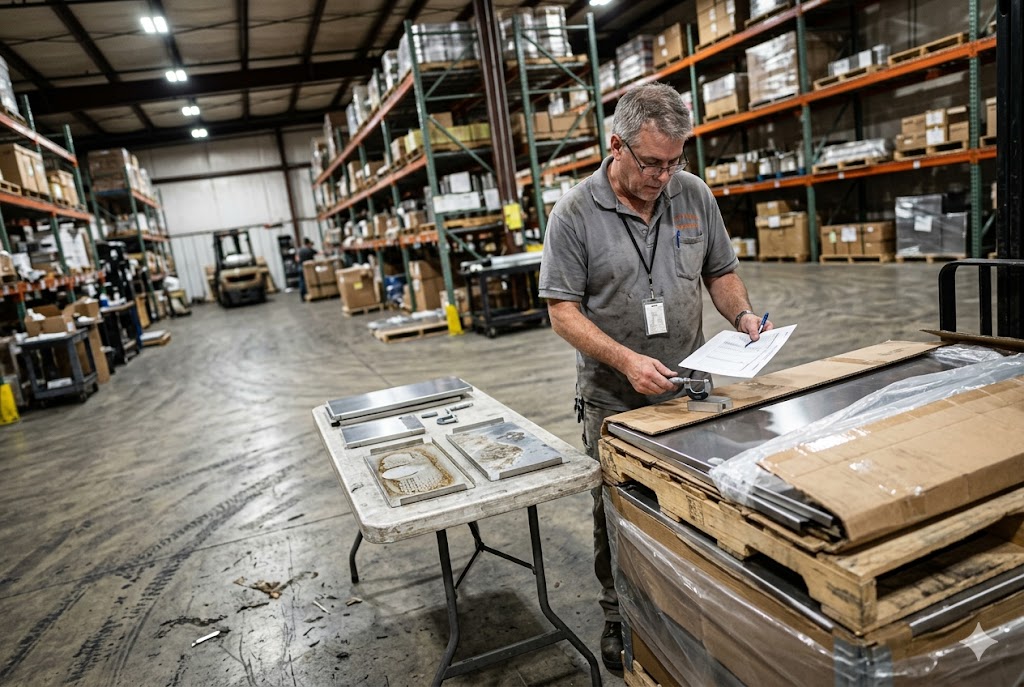
Our team has managed quality disputes where the root cause was a verbal material suggestion with nothing written into the contract. The financial exposure in those cases fell on the buyer—not the supplier.
Letting a supplier choose your material without documented performance specs creates contractual ambiguity, removes measurable acceptance criteria, and shifts all liability to you if the part fails in service. The supplier's verbal suggestion carries no engineering accountability without a drawing callout specifying alloy, temper, surface treatment, and applicable standard.
Where the Risk Actually Lives
The risk is not that suppliers are incompetent. Most experienced sheet metal fabricators have solid working knowledge of common grades. The risk is structural: without a formal spec, there is no defined acceptance or rejection criterion. That means when something goes wrong, there is nothing to measure against.
Risk Category 1: Alloy Substitution Without Notification
If your drawing says only "stainless steel," a supplier can legally ship 430 ferritic stainless 9 when you expected 304 austenitic stainless. Both are stainless steel. 430 is magnetic, has lower corrosion resistance, and is not suitable for many outdoor or food-contact applications. Without the grade called out on the drawing, you have no contractual basis to reject the parts.
Risk Category 2: Temper or Condition Drift
Suppliers order from sheet metal service centers. Service centers carry multiple tempers of the same alloy. If the procurement team orders "6061 aluminum" without specifying T6, they may receive O-condition sheet at a lower cost without informing you. Your parts will form correctly but fail under load.
Risk Category 3: Coating and Surface Treatment Gaps
A supplier recommends cold-rolled mild steel and mentions it will be powder-coated. If the drawing does not specify minimum coating thickness, adhesion standard, or salt-spray test requirement, the supplier can apply the thinnest coating that still looks acceptable. Corrosion appears within the first season of outdoor use.
Risk Category 4: Regulatory Non-Compliance
If your part must be RoHS-compliant or food-safe, and the supplier's recommended material uses a surface treatment that contains restricted substances, the liability rests with you as the importer. Customs authorities do not ask the supplier.
Financial Exposure Summary
| Risk Scenario | Potential Financial Impact | Who Bears It Without a Spec |
|---|---|---|
| Alloy substitution | Full batch rejection and re-order cost | Buyer |
| Wrong temper shipped | Part failure in service, downstream liability | Buyer |
| Insufficient coating | Early corrosion, warranty claims | Buyer |
| Regulatory non-compliance | Customs hold, fines, product recall | Buyer |
| Dimensional failure from wrong material stiffness | Rework, assembly line stoppage | Buyer |
The common thread: without a controlled drawing callout, the supplier did what they were told to do—make a part from "sheet metal." The performance failure was not in their scope.
How Can I Document a Supplier-Recommended Material to Protect Myself If Problems Arise Later?
We coach every client we work with on this point: the moment a supplier makes a material recommendation, that recommendation must enter a controlled document. A conversation is not protection. A WeChat message is not protection. A drawing revision is.
To protect yourself, convert the supplier's recommendation into a drawing callout that specifies alloy designation, temper or condition, applicable material standard, surface treatment with acceptance criteria, and a material certification requirement. Issue this as a controlled revision and get written confirmation from the supplier before placing the purchase order.

Step 1: Convert the Recommendation into a Drawing Note
The recommendation "304 stainless, 2mm, brushed finish" becomes a drawing note that reads:
Material: 304 stainless steel sheet per ASTM A240, 2.0mm ±0.1mm, 2B finish per ASTM A480, No. 4 brushed post-fabrication.
Every word in that note is a measurable, inspectable requirement. "Brushed finish" alone is not.
Step 2: Require a Mill Certificate
A mill certificate 10 (also called a mill test report or MTR) is the foundational traceability document for metal. It records the heat number, chemical composition, and mechanical properties of the actual coil or sheet used in your order. Without it, you cannot prove what material was actually used, even if the drawing callout was correct.
Request this at order placement. Include it as a required document in your purchase order terms. Our quality team in China and Vietnam checks MTRs against drawing callouts before releasing any shipment.
Step 3: Issue a Material Approval Record
For any supplier-recommended material, issue a simple one-page Material Approval Record (MAR) that captures:
- Part number and revision
- Recommended material (alloy, temper, standard)
- Name and contact of the supplier representative who made the recommendation
- Date of recommendation
- Functional basis for the recommendation (the inputs you provided)
- Confirmation that the supplier reviewed and approved the drawing callout derived from their recommendation
Get the supplier's signature or written email confirmation. This is the document you produce if a dispute arises.
Step 4: Define Incoming Inspection Criteria
Document what you will check when parts arrive. For a material-related concern, this typically includes:
| Inspection Item | Method | Acceptance Criterion |
|---|---|---|
| Material identification | PMI (XRF) spot check | Composition matches ASTM A240 304 SS |
| Thickness | Micrometer | 2.0mm ±0.1mm |
| Surface finish | Visual + profilometer | Ra value per drawing note |
| Mill certificate review | Document check | Heat number traceable to drawing lot |
| Hardness (if temper-critical) | Rockwell or Brinell test | Within range per alloy/temper standard |
Step 5: Archive Everything
Every email exchange about material selection, every drawing revision, every MTR, every MAR—archive them against the purchase order number. We maintain this documentation for every order we manage for our clients. If a part fails six months after delivery, this archive is what enables a structured claim rather than a he-said-she-said dispute.
Conclusion
Getting a reliable material recommendation requires structured inputs, a technical review of the supplier's logic, formal drawing callouts, and documented approval records. Skipping any one of these steps shifts risk entirely to you as the buyer.
Footnotes
1. Explains how cyclic fatigue loading differs from static load and why it drives different alloy choices. ↩︎
2. Official FAQ on RoHS compliance requirements and restricted substances in electrical and electronic equipment. ↩︎
3. Comparison of 304 vs 316 stainless steel corrosion resistance for coastal and chloride-heavy environments. ↩︎
4. Overview of 5052 aluminum's corrosion resistance in marine and saltwater environments. ↩︎
5. Detailed mechanical properties of 6061-T6 aluminum, including yield strength and temper differences. ↩︎
6. ASTM A240 standard explained for 304 stainless steel sheet, covering composition and mechanical minimums. ↩︎
7. ASTM B209 standard covering aluminum and aluminum-alloy sheet and plate temper and tolerance requirements. ↩︎
8. Technical analysis of how welding weakens 6xxx aluminum alloys through heat-affected zone strength loss. ↩︎
9. Key differences between 304 austenitic and 430 ferritic stainless steel, including corrosion resistance and magnetism. ↩︎
10. Comprehensive guide to mill test reports: what they certify, how to read them, and why they matter for quality assurance. ↩︎