Skip to main content Skip to footer
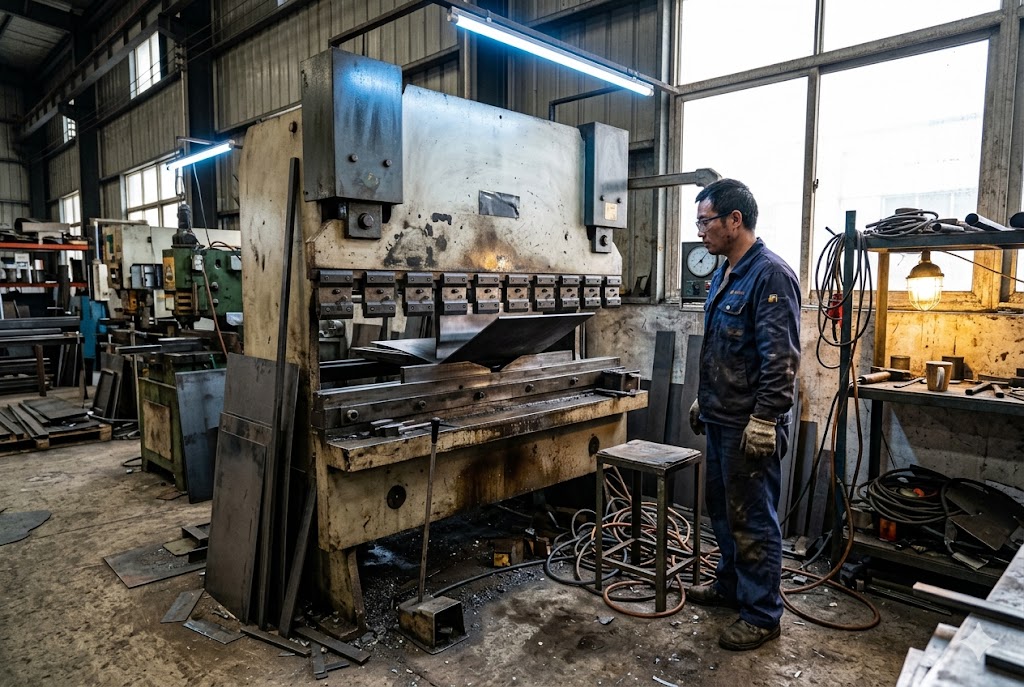
Every time we receive a new drawing from a client, the first thing we check is material spec. Get that wrong, and nothing else matters.
Material hardness and tensile strength directly control three things in a bending setup: the minimum bend radius, the amount of springback, and the tonnage required. Higher-strength materials need larger radii, more over-bending to hit the final angle, and heavier press capacity. Using the wrong parameters causes cracking, angular error, or tool damage.
The details below will help you understand each factor — and how to communicate them clearly to your supplier.
Why Does High-Strength Material Require Different Tooling and Bend Angles?
When we calibrate press brake programs for different materials, tensile strength 1 is the first number we look at — not the alloy name.
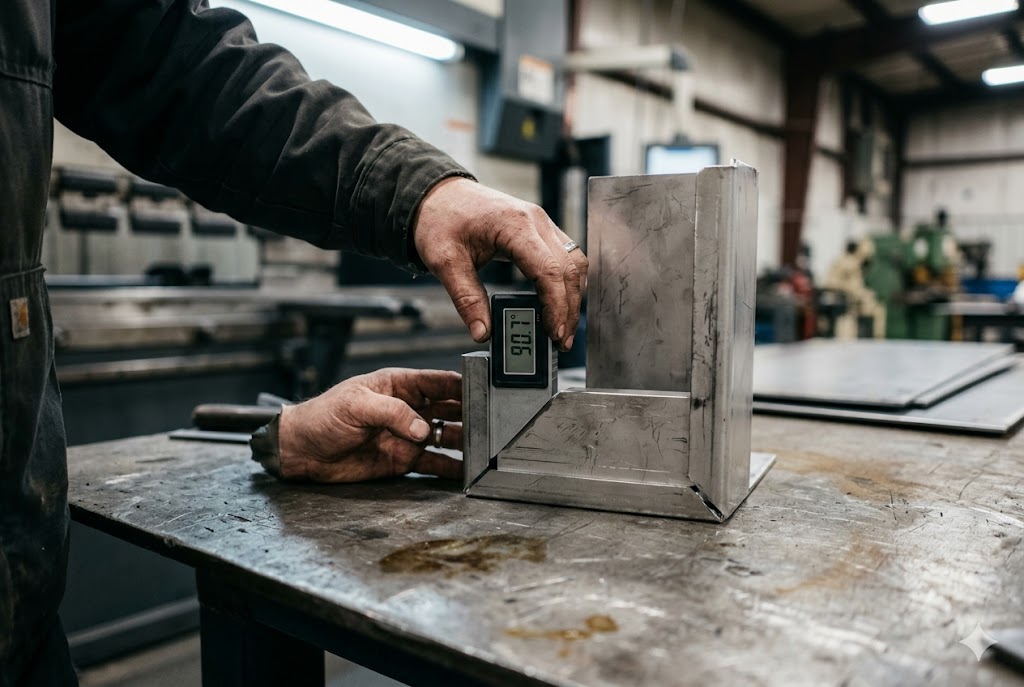
High-strength materials require different tooling and bend angles because their higher yield strength means the metal resists deformation more strongly. The press must apply greater force to exceed yield, springback is more pronounced, and the inner bend radius must be larger to prevent outer-fiber fracture. Standard 90° tooling rarely delivers a true 90° finished angle on these materials.
Why Yield Strength Matters More Than Alloy Name
Two sheets can share the same alloy designation but have different yield strengths 2 depending on temper, heat treatment, or batch variation. A 304 stainless sheet in annealed condition behaves very differently from a cold-rolled 304 in a half-hard temper. The alloy label alone tells you only part of the story.
When tensile strength is high, a larger share of the applied bending stress remains in the elastic zone. That elastic energy releases the moment the punch retracts. The part springs back toward its original flat position. The higher the tensile strength, the more it springs back.
Standard vs. High-Strength Tooling
| Parameter | Mild Steel (250 MPa) | Stainless 304 (515 MPa) | High-Strength Alloy (700+ MPa) |
|---|---|---|---|
| Typical inner radius | 1× thickness | 1.5–2× thickness | 2–4× thickness |
| Die angle to achieve 90° | 90° V-die | 88° V-die | 85–87° V-die |
| Springback range | 1–2° | 3–5° | 6–10°+ |
| Punch material | Standard tool steel | Hardened tool steel | Carbide-tipped |
Over-Bending as the Standard Correction
For stainless steel and other high-strength alloys, operators do not aim for 90° during the bend stroke. They aim past it — typically by the expected springback angle. A common setup for 304 stainless uses an 88° V-die instead of a standard 90° die. When the part springs back, it lands at the target 90°.
This is not a workaround. It is the correct setup method for high-strength materials. Any supplier who claims a standard 90° die delivers a true 90° angle on stainless steel 3 is either measuring poorly or running thin-gauge annealed material in ideal conditions.
Tonnage Requirements
Required press tonnage scales directly with tensile strength. The formula is straightforward: higher tensile strength means higher force needed per millimeter of bend length. A machine that handles mild steel comfortably may not have sufficient capacity for the same part profile in high-strength stainless or tool steel.
| Material | Approximate Tonnage Factor vs. Mild Steel |
|---|---|
| Mild steel (S235/A36) | 1.0× baseline |
| Aluminum 6061-T6 | 0.5–0.6× |
| Stainless 304 | 1.5–1.7× |
| Stainless 316L | 1.6–1.8× |
| High-strength structural steel | 2.0–2.5× |
Submitting a high-tensile part to a supplier without confirming their press brake capacity is a common cause of production delays. The machine may physically reject the bend mid-stroke or produce inconsistent angles across the bend line.
How Can I Avoid Springback or Cracking When I Bend Harder Alloys?
In our experience processing harder alloys for export clients, cracking and springback are the two most common failure modes — and they pull in opposite directions.
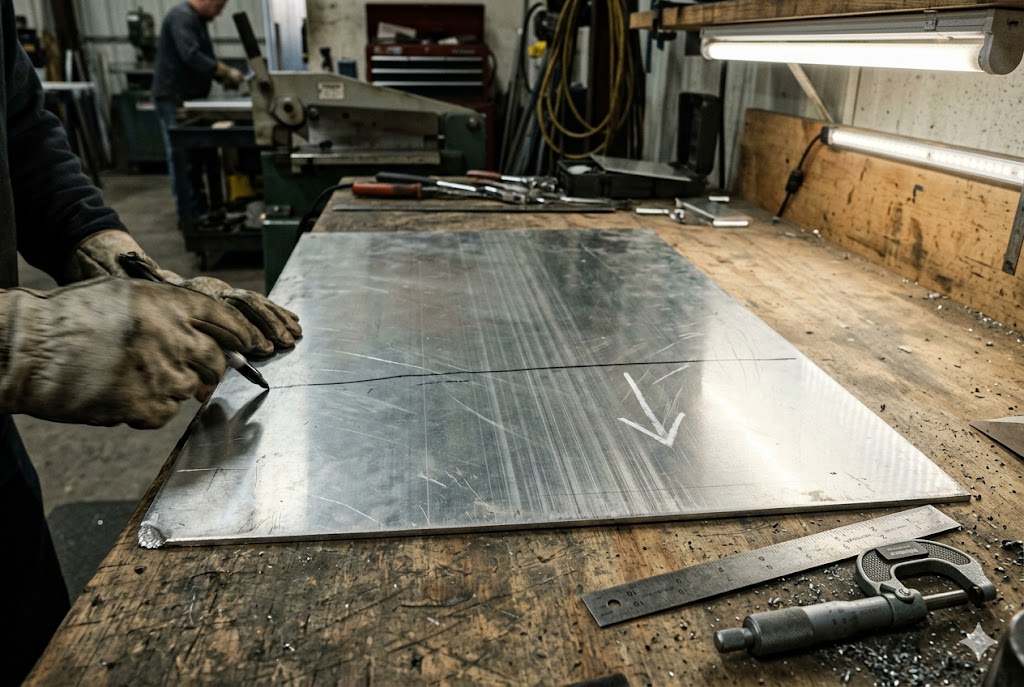
To avoid springback in harder alloys, over-bend past the target angle and use a smaller V-die opening relative to material thickness. To avoid cracking, increase the inner bend radius and orient the bend perpendicular to the sheet's rolling grain direction. Both problems share a root cause: the material's limited ductility and high elastic recovery.
Understanding the Two Failure Modes
Springback and cracking seem like opposites. One means the part moves too much after bending. The other means it breaks during bending. But both trace back to the same root property: low elongation at break combined with high yield strength.
A material with high tensile strength and low elongation has a narrow window for plastic deformation before it either springs back aggressively or fractures at the outer fiber of the bend. Understanding sheet metal bending fundamentals 4 — including the relationship between springback, radius, and material properties — is essential before setting up a bend program.
Grain Direction: The Overlooked Variable
Rolling direction is one of the most underspecified variables in sheet metal bending. When steel or aluminum is rolled into sheet, the grain aligns parallel to the rolling direction. Bending perpendicular to this grain (cross-grain bending) allows the material to elongate more evenly during the bend. Bending parallel to the grain concentrates stress along the grain boundaries.
| Bend Orientation | Risk Level | Recommended For |
|---|---|---|
| Perpendicular to rolling grain | Low | High-strength, low-elongation alloys |
| Parallel to rolling grain | High | Soft, high-elongation materials only |
| 45° to rolling grain | Medium | Balanced option when layout is constrained |
On high-tensile materials like full-hard stainless or 7075 aluminum, bending parallel to the rolling grain direction 5 can cause surface cracking even when the bend radius looks adequate on paper. The drawing may specify a radius that works in one direction but causes fracture in the other.
Minimum Bend Radius by Material
The inner bend radius must be large enough to keep outer-fiber strain below the material's fracture threshold. As a working rule, softer materials can tolerate a bend radius equal to one times the material thickness (1T). Harder materials need more.
| Material | Minimum Inner Radius (T = thickness) |
|---|---|
| Aluminum 1100-O | 0T (sharp bend possible) |
| Aluminum 6061-T6 | 1T–1.5T |
| Mild steel (annealed) | 0.5T–1T |
| Stainless 304 (annealed) | 1T–1.5T |
| Stainless 301 (full hard) | 3T–4T |
| Spring steel / tool steel | 4T–6T+ |
If a drawing specifies a bend radius 6 tighter than the material's minimum, the outer fiber will crack. This is not a tooling problem. It is a design problem. The fix is either to increase the radius on the drawing or to change the material specification.
Work Hardening in Multi-Bend Parts
Each bend in a sequence work-hardens 7 the material slightly. On mild steel, this effect is small. On high-tensile stainless or spring alloys, it compounds. The fifth bend in a complex part may require noticeably more tonnage than the first. On full-hard stainless, the difference can be significant enough to exceed the machine's rated capacity if the press was sized only for the first bend.
Bend sequence planning on high-strength parts is not just about part geometry. It is a capacity calculation. Suppliers who do not account for work hardening across a bend sequence will either under-press the later bends or stall the machine.
When a client sends us only "304 stainless, 2mm" on a drawing, we always come back with questions — because that data alone is not enough to set up the press correctly.
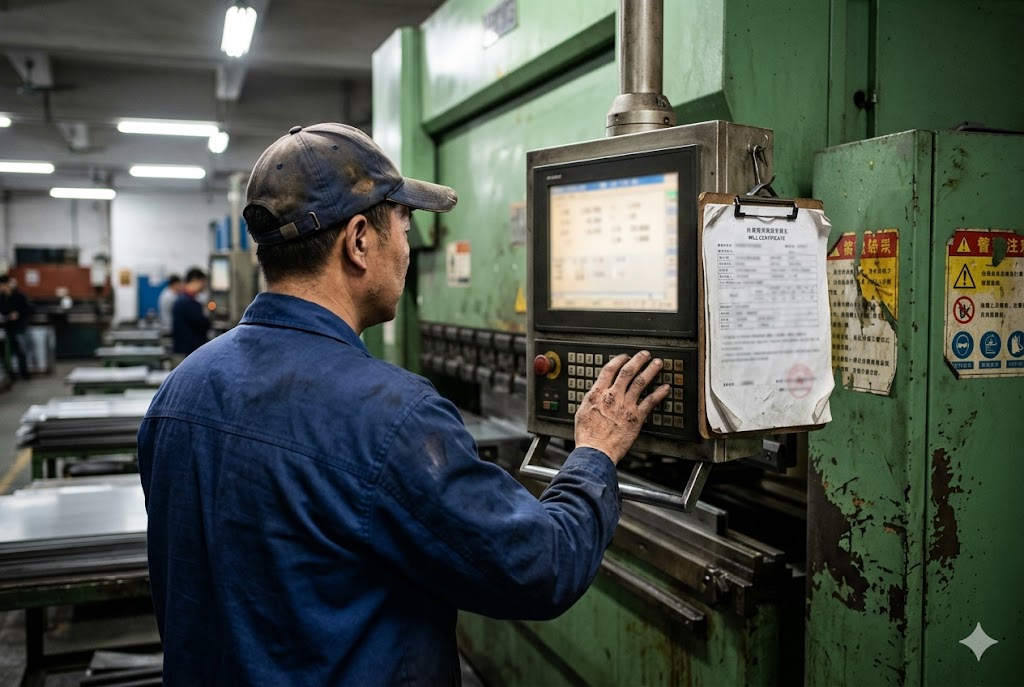
To ensure correct bending parameters, share the mill certificate listing actual tensile strength, yield strength, elongation percentage, and hardness value. Also specify the material temper or condition, sheet rolling direction, and any tolerance requirements for finished bend angles. Nominal alloy grades alone are insufficient for accurate CNC press brake programming.
Why Nominal Alloy Grades Are Not Enough
CNC press brake software uses material libraries to calculate bend deduction, K-factor, and recommended tonnage. These libraries are built on nominal (average) values for each alloy. But real sheet metal varies. Two coils of the same grade from different mills — or even from the same mill in different batches — can differ in actual yield strength by 10–20%.
A 10% difference in yield strength translates to a measurable angular error in the finished part. For tight-tolerance flanges, that error compounds across every bend in the part.
The K-Factor Problem
The K-factor is the ratio that describes where the neutral axis sits during bending. For soft, ductile materials, the neutral axis sits closer to the center of the sheet thickness. For hard, low-ductility materials, it shifts inward — closer to the inner surface. Using the wrong K-factor produces systematic bend deduction errors. Every flange in the run will be the wrong length by a consistent amount.
| Material Condition | Typical K-Factor |
|---|---|
| Soft aluminum, annealed copper | 0.50 |
| Mild steel, annealed | 0.42–0.44 |
| Stainless 304, annealed | 0.38–0.42 |
| Stainless 301, half-hard | 0.35–0.38 |
| Full-hard stainless, spring steel | 0.30–0.35 |
If you use a default K-factor for annealed stainless when the actual material is half-hard, every bend deduction will be wrong. The error is small per bend but multiplies across a part with six or eight bends.
What to Include in Your Material Data Package
Send your supplier the following with every new material or new coil, including the mill test report 8:
- Mill certificate (actual tensile strength, yield strength, elongation %)
- Hardness value (Rockwell B or C, Vickers, or Brinell — whichever the mill cert provides)
- Material temper or condition (annealed, half-hard, full-hard, T6, etc.)
- Sheet rolling direction (relative to part orientation on the flat blank)
- Required finished angle tolerance (e.g., ±0.5°, ±1°)
- Any previous lot data if re-ordering from a different batch
Batch-to-Batch Variation
Even when re-ordering the same material grade, hardness and yield strength can shift between coil lots. A responsible supplier runs a test bend on every new coil before committing to full production. They do not assume the new coil matches the program settings from the last run.
If your supplier has never mentioned coil-to-coil variation to you, ask them directly: "Do you run test bends on new material lots?" The answer tells you a great deal about their process discipline.
How Does Material Strength Affect the Tooling Wear Cost I May Be Charged For?
This is a cost question that rarely appears on a quote sheet — but it should. Harder materials eat tooling, and tooling costs end up somewhere.
Material strength directly affects tooling wear rate. High-hardness materials — stainless steel, tool steel, hardened alloys — abrade punch and die surfaces significantly faster than mild steel or aluminum. Suppliers absorb this cost through tooling surcharges, higher per-part pricing, or accelerated maintenance schedules that affect lead times and angular accuracy.

How Hardness Damages Tooling
Every bending cycle presses a punch tip and V-die surface against the workpiece under high contact pressure. On mild steel, this contact is relatively gentle. On hardened or high-tensile material, the contact stress is much higher. The abrasion is also higher if the material has surface scale, rough edges, or inconsistent hardness across the sheet.
Over time, the punch tip radius grows as the tip wears. A worn punch tip changes the effective inner radius of the bend, which shifts the K-factor and introduces angular error. A worn V-die changes the shoulder friction, which affects springback behavior. Both forms of wear degrade part accuracy without any obvious visible sign until inspection catches the angular drift.
Tooling Material Selection for High-Strength Work
Running high-strength material with standard tool steel punches and dies is possible but accelerates wear. Suppliers who regularly process stainless steel or hardened alloys typically use harder punch materials. The selection of press brake tooling materials 9 — from standard 42CrMo to carbide-tipped inserts — directly determines wear rates and dimensional stability on abrasive jobs.
| Punch/Die Material | Suitable For | Wear Resistance |
|---|---|---|
| Standard tool steel (42CrMo) | Mild steel, aluminum | Moderate |
| Hardened tool steel (D2, H13) | Stainless, structural steel | High |
| Carbide-tipped inserts | High-strength alloys, abrasive materials | Very high |
| PU-coated or nitrogen-treated | Soft decorative surfaces | High (scratch-free) |
Carbide-tipped tooling costs more to purchase but lasts significantly longer on abrasive, high-strength materials. Suppliers who pass tooling amortization costs to the customer typically apply a per-part tooling surcharge for high-hardness jobs.
Back Gauge Accuracy and Maintenance
Tooling wear does not only affect the punch and die. As wear shifts the effective bend radius, the back gauge must be recalibrated to maintain consistent flange lengths. On high-volume runs with abrasive materials, recalibration may be needed mid-run rather than only at the start of a new job.
If your supplier does not mention recalibration intervals when quoting high-strength jobs, ask them: "How often do you recalibrate the back gauge on runs of stainless or structural steel?" Suppliers who manage this proactively deliver more consistent angular accuracy across a full production batch. Understanding how grain direction affects bending performance 10 alongside tooling wear is equally important when planning high-strength production runs.
What This Means for Your Quote
When you submit a part made from high-strength material, a well-structured quote from a capable supplier should reflect:
- Higher per-part unit price due to lower output rates and higher setup time
- A tooling wear surcharge for high-hardness materials (especially on prototypes or small batches where tooling amortization is short)
- Possibly a setup fee for first-article test bends on new material lots
If a quote on high-strength stainless looks identical to a quote on mild steel with no explanation, ask for clarification. Either the supplier is absorbing the cost silently (and may cut corners elsewhere), or they have not correctly identified the material's processing requirements.
Conclusion
Material hardness and tensile strength touch every part of the bending setup: radius, angle, tonnage, grain direction, K-factor, and tooling cost. Share your mill certs, specify the temper, and confirm your supplier runs test bends on new coil lots. Those steps eliminate most bending errors before production starts.
Footnotes
1. Explains what tensile strength is and why it governs material selection in manufacturing. ↩︎
2. Defines yield strength and how it determines when permanent metal deformation begins. ↩︎
3. Overview of sheet metal bending processes including stainless steel behavior and springback. ↩︎
4. Engineers' guide covering bend radius, K-factor, and springback fundamentals for sheet metal. ↩︎
5. Explains how rolling direction and grain size affect cracking risk during bending operations. ↩︎
6. Covers K-factor, bend allowance, and minimum bend radius guidelines for sheet metal design. ↩︎
7. Details how repeated bending work-hardens metal, increasing strength while reducing ductility. ↩︎
8. Guide to reading mill test reports to verify steel tensile, yield, and hardness data. ↩︎
9. Compares press brake tooling materials — from tool steel to carbide — for high-strength work. ↩︎
10. Explains how grain direction in sheet metal affects bending strength, flexibility, and cracking risk. ↩︎