Skip to main content Skip to footer
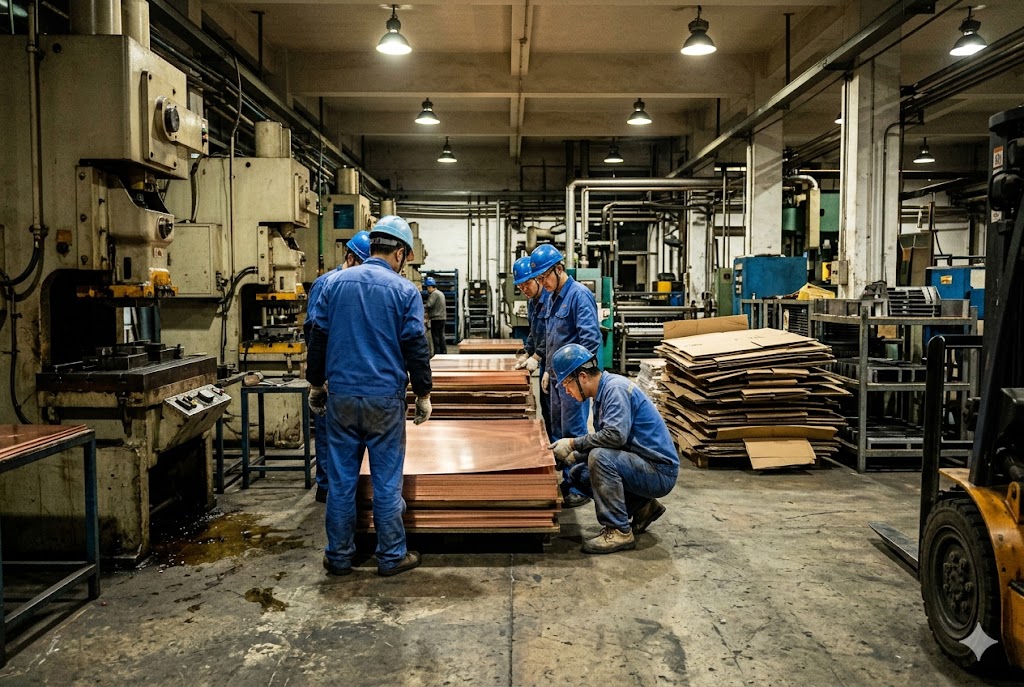
Copper parts look straightforward on a drawing. In practice, they are one of the most error-prone categories we handle in our supply chain work — from alloy substitution at intake to oxidation damage on arrival.
Sourcing copper alloy sheet metal parts from China requires upfront alloy verification, tight surface protection protocols, correct HTS classification, a pre-shipment inspection against a formal ITP, and an NNN agreement executed under Chinese law before any drawings are shared. These steps protect quality, IP, and landed cost.
Miss any one of these and you are likely looking at rework, customs penalties, or a re-order. Here is what to do at each stage.
How Can I Prevent Surface Oxidation on My Copper Parts During Production and Transit?
Oxidation is the first thing that surprises buyers new to copper. Steel parts tolerate a lot of handling. Copper does not. Our team sees surface failures on copper far more often than on any other metal we move.
Preventing copper oxidation during production and transit requires controlling humidity exposure at every stage: specifying VCI (vapor corrosion inhibitor) packaging, requiring parts to be dried and sealed before bagging, and keeping desiccants active inside cartons for the full ocean freight duration.
Why Copper Oxidizes Faster Than You Expect
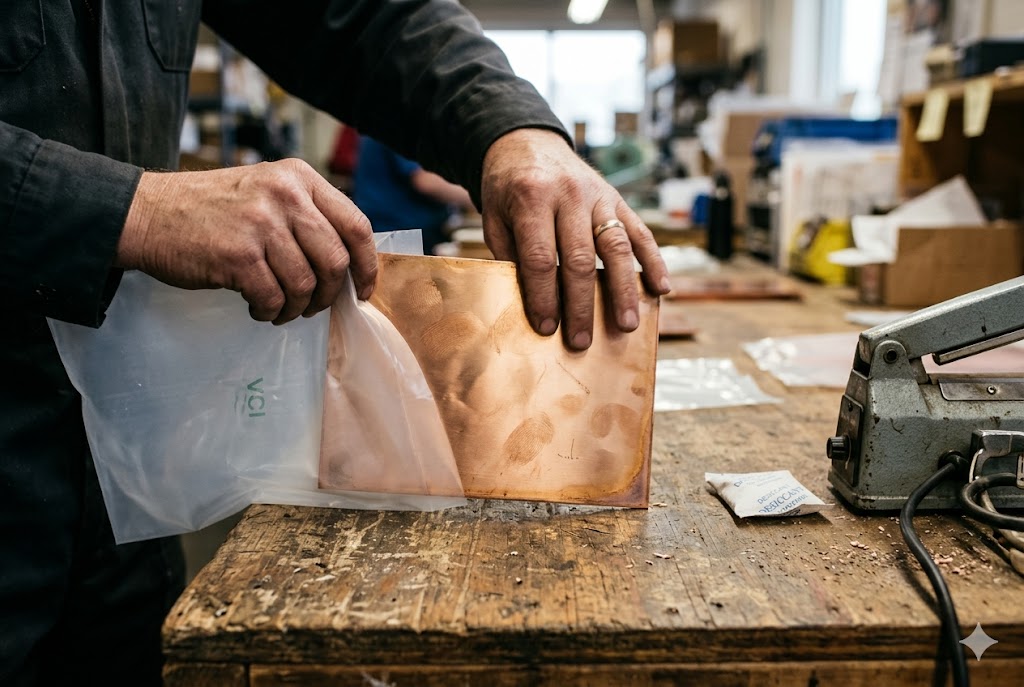
Copper reacts with oxygen and moisture at room temperature. This is not a defect — it is chemistry. But it becomes your problem when parts arrive with tarnish, green patina, or pitting that your customer's QC team rejects.
The risk compounds during ocean freight. A 20–30 day voyage from a Chinese port to the US West Coast puts parts through temperature swings, humidity cycles, and salt air exposure. Without the right packaging, surface degradation is almost certain on bare copper or high-zinc brass alloys.
What to Specify in Your Packaging Requirements
Start at the factory floor. Parts should be cleaned and fully dry before any protective treatment is applied. Common shop floor failures include parts bagged while still warm from machining (trapped condensation) or parts handled with bare hands (fingerprint acids accelerate tarnish).
The table below shows which protection method suits which alloy type. For C11000 ETP copper 1, which has an electrical conductivity of up to 101% IACS, surface exposure is especially critical given its very high oxidation susceptibility.
| Alloy | Common Name | Oxidation Risk | Recommended Protection |
|---|---|---|---|
| C11000 | ETP Copper | Very High | VCI bag + desiccant + sealed carton |
| C10200 | OF Copper | Very High | VCI bag + desiccant + sealed carton |
| C26000 | Cartridge Brass | Moderate | VCI bag or anti-tarnish paper |
| C17200 | Beryllium Copper | Low-Moderate | VCI bag + silica gel |
| C51000 | Phosphor Bronze | Moderate | VCI bag + desiccant |
Temperature and Humidity Control During Production
Ask your supplier whether their production floor is climate-controlled. For precision copper parts, it matters. If machining and packaging happen in an open workshop with seasonal humidity above 70%, you need additional protective steps regardless of what the spec sheet says.
Require the supplier to log temperature and humidity at time of packaging. This takes ten minutes and gives you a document trail if a claim arises.
Transit-Specific Requirements
For LCL shipments 2, insist on a moisture barrier bag around the entire pallet or crate — not just individual part bags. LCL containers are opened and repacked at consolidation warehouses, and exposure during that process is a common hidden cause of transit damage.
For FCL, add silica gel desiccant packs rated for the cubic volume of the container. Specify quantity in the packing instructions.
What Packaging Requirements Should I Specify to Protect Copper Parts from Damage?
Copper is softer than steel. C11000 sits at roughly 45 HRB on the Rockwell scale. That means it scratches, dents, and deforms under contact pressure that steel would shrug off. Packaging that works fine for steel stampings will mark copper every time.
To protect copper sheet metal parts from transit damage, specify individual part separation using polyethylene foam, anti-tarnish interleaving paper between stacked parts, rigid outer cartons rated for the part weight, and clear labeling of fragile and orientation-sensitive stacks. Always include a packing list with part count and AQL pass confirmation 3.

Part-to-Part Contact Is the Most Common Damage Source
Thin copper sheet parts flex easily. When stacked without interleaving, they shift during transit and the edges of one part scratch the face of the next. This is cosmetic on structural parts but a rejection event on any part with a plated or polished finish.
Specify interleaving paper — either acid-free tissue or anti-tarnish paper — between every layer. For parts with tight flatness tolerances, require a rigid foam tray rather than loose stacking.
Carton and Crate Requirements
Use the table below as a starting point for carton specifications based on part size and weight:
| Part Size | Part Weight per Carton | Carton Type | Inner Packing |
|---|---|---|---|
| Small (<100mm) | Up to 10 kg | Double-wall corrugated | Individual PE bags + foam layer |
| Medium (100–400mm) | Up to 20 kg | Double-wall corrugated | Foam tray + interleaving paper |
| Large (>400mm) | Up to 30 kg | Wooden crate | Foam padding on all 6 sides |
| Precision / plated | Any | Double-wall + moisture barrier | Individual foam pocket per part |
Labeling and Handling Instructions
Include handling labels in both English and Chinese. Marks like "FRAGILE," "THIS SIDE UP," and "DO NOT STACK" need to be in the language of every handler in the chain — which includes the factory floor, the freight forwarder warehouse, and the port.
Require the supplier to photograph carton markings before shipment as part of the pre-shipment inspection record. This adds under ten minutes to the process and gives you immediate evidence if a claim arises at destination.
Weight Distribution and Stack Height
Copper is dense. A carton of copper sheet parts is heavier than a same-size carton of aluminum or plastic. Confirm that carton gross weight does not exceed the printed bursting strength of the corrugated material. Overloaded cartons fail at the bottom of a pallet stack, and that is where your parts end up.
Limit pallet stack height to four cartons maximum for copper parts. Label the pallet with max stack height in a visible position.
Why Is Copper Sheet Metal Harder to Laser Cut Than Steel, and How Does It Affect My Lead Time?
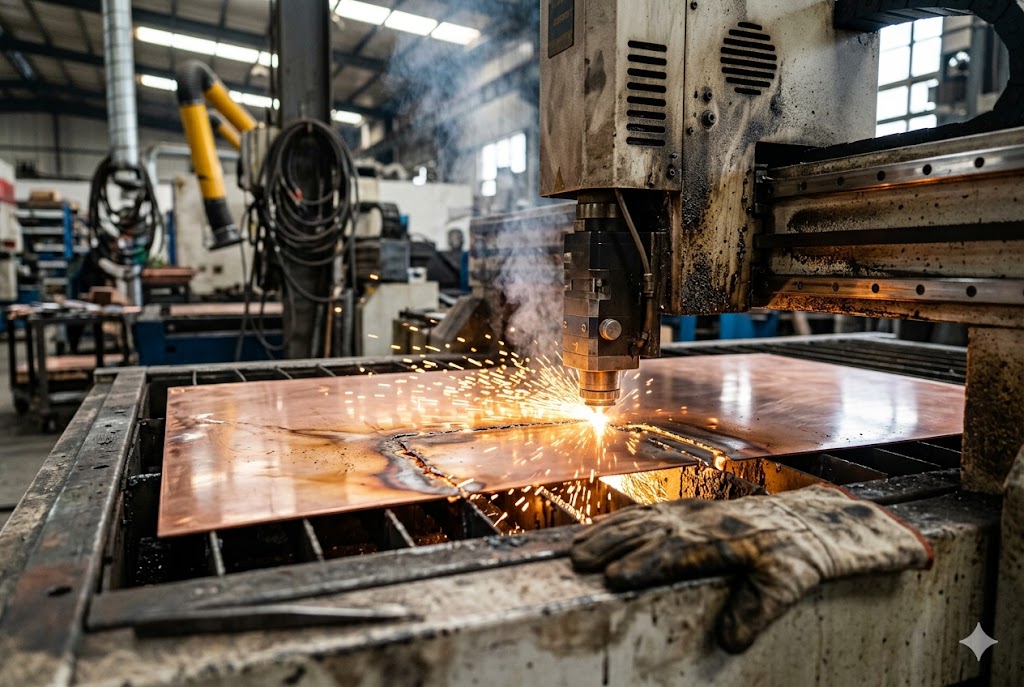
This question catches many buyers off guard. Copper reflects laser energy instead of absorbing it. Our engineers discovered early on that Chinese sheet metal shops quoting copper laser cutting at standard steel rates are often underestimating the process — and that underestimate shows up in your delivery date.
Copper sheet metal is harder to laser cut than steel because its high reflectivity deflects the laser beam rather than absorbing it, which reduces cutting speed, risks damaging the laser head, and requires fiber laser equipment 4 rather than CO2 lasers. This typically adds 30–50% to cutting lead time versus equivalent steel parts and may reduce the supplier pool to shops with compatible equipment.
The Physics Behind the Difficulty
Steel absorbs around 35–40% of CO2 laser energy. Copper absorbs less than 5%. Most of it reflects straight back toward the optics. This is why CO2 lasers simply cannot cut copper effectively — they stall, burn inconsistently, or damage the cutting head.
Fiber lasers operate at a shorter wavelength (around 1 micron versus 10 microns for CO2) and achieve better absorption on copper. But even with a fiber laser, cutting copper requires slower feed rates and higher power settings than equivalent-gauge steel.
How This Affects Your Supplier Selection
Not every Chinese sheet metal shop has a capable fiber laser. Many have CO2 lasers only. When you send a copper RFQ to a broad supplier list, the shops without fiber capability may still quote — and then outsource the cutting step to a subcontractor you have not vetted.
Ask directly before accepting a quote:
- Do you have an in-house fiber laser?
- What is the maximum power rating (kW)?
- Have you previously cut this specific alloy (e.g., C26000, C11000) at this thickness?
Lead Time Impact by Process
| Process | Typical Lead Time (Steel) | Typical Lead Time (Copper) | Reason for Difference |
|---|---|---|---|
| Laser cutting | 3–5 days | 5–8 days | Lower absorption, slower feed rate |
| CNC punching | 3–5 days | 5–7 days | Tooling wear is faster on copper |
| Bending / forming | 2–3 days | 3–5 days | Springback compensation adds setup time |
| Surface finishing | 3–5 days | 5–10 days | More sensitive to pre-treatment steps |
Planning Your Timeline
Add a minimum 30% buffer to any copper sheet metal lead time versus what the same shop quotes for steel. For first-order runs with a new supplier, add a further 5–7 days for first-article inspection and approval before production release.
Communicate this reality to your internal stakeholders before locking the program schedule. Downstream production stoppages caused by late copper parts are among the most expensive outcomes our clients face — and they are almost always traceable to an overly optimistic lead time assumption at the quoting stage.
Before sharing any drawings with a new supplier, execute an NNN agreement 5 under Chinese law to protect your design IP. A standard Western NDA is not enforceable in Chinese courts and provides no meaningful protection against unauthorized use or circumvention.
What Surface Protection Options Are Available for Copper Sheet Metal Parts Before Delivery?
Surface protection is not cosmetic. For copper parts used in electrical, thermal, or outdoor applications, the wrong or missing surface treatment will cause field failures. We always ask clients to define this requirement in the drawing — not in a back-and-forth email thread where it gets lost.
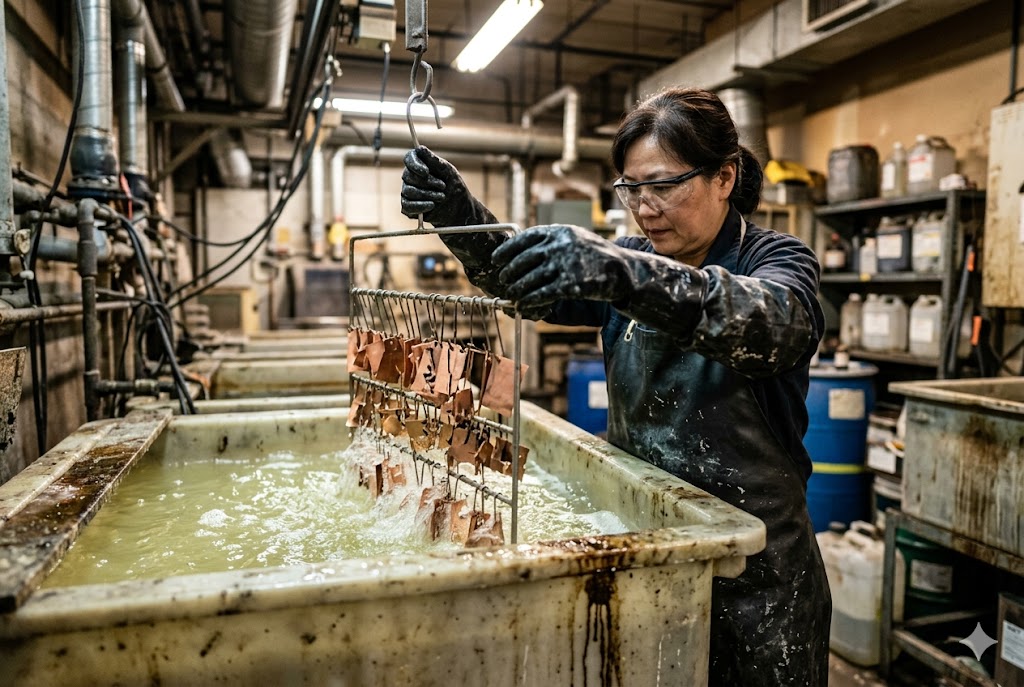
Surface protection options for copper sheet metal parts before delivery include electroplated tin, nickel, or gold for conductivity applications; chromate conversion coating 6 for general corrosion resistance; lacquer or clear coat for decorative bare-copper aesthetics; and passivation or anti-tarnish chemical treatment for short-term storage protection. The correct choice depends on the part's end-use environment and electrical requirements.
Matching Protection to Application
There is no single correct answer. The right surface protection depends on three factors: the end-use environment, the electrical or thermal function of the part, and the cosmetic requirements. The table below maps common options:
| Surface Treatment | Best For | Conductivity Impact | Typical Cost Adder |
|---|---|---|---|
| Tin plating (bright or matte) | Electrical connectors, busbars | Minimal | Low–Medium |
| Nickel plating | Wear-resistant parts, medical | Slight increase in contact resistance | Medium |
| Gold plating | High-frequency RF, precision contacts | Excellent | High |
| Chromate conversion | General corrosion resistance, outdoor | Moderate | Low |
| Clear lacquer | Decorative bare copper aesthetics | None (insulating) | Low |
| Anti-tarnish chemical treatment | Temporary storage protection only | None | Very Low |
| Passivation | Electrical copper, pre-assembly | Minimal | Low |
What to Specify in the Purchase Order
Surface treatment requirements must appear on the drawing or in a referenced specification document — not in email. At minimum, specify:
- Treatment type (e.g., electroless nickel, bright tin)
- Thickness in microns (e.g., 3–5 µm tin)
- Applicable standard (e.g., ASTM B545 7 for tin plating)
- Adhesion test requirement (tape test or cross-hatch per ASTM D3359 8)
Suppliers who have not done this before will ask questions. That is a good sign. Suppliers who say "no problem" without any follow-up questions are often the ones who deliver out-of-spec plating.
Conductivity Considerations for Electrical Parts
If the part carries current, the plating choice affects electrical performance. Tin plating for busbars and electrical connectors 9 is the standard choice — it preserves conductivity, solders easily, and is well-supported in Chinese plating shops. Gold is used for low-force contact applications where surface oxide formation would cause resistance drift over time.
For C10100 or C11000 parts used in high-conductivity applications, require IACS% test certificates alongside the composition report. Conductivity can drop even when composition is within spec, particularly if the material has been cold-worked without annealing. This is rarely tested unless you ask for it in writing.
Before production begins, qualify any new plating supplier by requesting a sample run with documented pre-shipment inspection 10 records that include visual inspection, thickness measurement, and adhesion test results. This one step eliminates the majority of plating rejections our clients experience on first orders.
Conclusion
Copper alloy sheet metal parts from China are manageable — but only with the right controls in place. Lock in alloy verification, surface protection, packaging specs, and IP agreements before production starts, not after a problem surfaces.
Footnotes
1. Properties and conductivity specs for C11000 ETP copper used in electrical applications. ↩︎
2. Risks, handling steps, and best practices for LCL ocean freight shipments. ↩︎
3. AQL sampling methodology and how to set pass/fail thresholds for inspections. ↩︎
4. Comprehensive guide to fiber laser copper cutting, parameters, and process steps. ↩︎
5. Expert overview of China NNN agreements and why standard NDAs are insufficient. ↩︎
6. What chromate conversion coating is and how it protects metals from corrosion. ↩︎
7. ASTM B545 specification for electrodeposited tin coatings, thickness classes, and service conditions. ↩︎
8. ASTM D3359 cross-hatch tape test method for evaluating coating adhesion on metal substrates. ↩︎
9. Standards governing tin plating on copper terminals, including ASTM B545 service classes. ↩︎
10. What a pre-shipment inspection covers and how AQL sampling is applied at Chinese factories. ↩︎