Skip to main content Skip to footer

We visit Chinese CNC factories every week, and one thing we see repeatedly is this: a supplier with a shiny ISO 9001 1 certificate on the wall — and a shop floor that tells a very different story. Machines uncalibrated. Material certs filed nowhere near the actual stock. Inspectors checking parts by eye instead of CMM. If you've ever received a shipment of custom parts that looked wrong on arrival, this might be why.
Yes, you need to audit suppliers regularly when importing custom CNC machining parts from China. ISO certifications confirm a supplier has documented processes, but they do not verify those processes are followed daily. Routine audits — whether on-site or remote — are the only reliable way to catch quality drift before it becomes a costly shipment problem.
Most buyers discover audit gaps the hard way: a rejected batch, a missed delivery, a downstream production stoppage. The good news is that a structured audit program is not complicated to build. Here is exactly what to do and why it matters.
How Often Should I Review Supplier Performance and Process Control?
Skipping a supplier review for two years feels harmless — until a key person leaves their quality team and nobody tells you. Our team has watched good factories quietly deteriorate between visits, and the buyers who caught it earliest were the ones who had a review schedule locked into their calendar.
Audit frequency should follow a risk-tiered model. New suppliers or orders with tight tolerances need a review annually. Established suppliers with a clean defect and delivery record can be reviewed every two to three years, backed up by random pre-shipment inspections between formal audits.

Why One Schedule Does Not Fit All Suppliers
Not every supplier carries the same risk. A factory producing simple turned bushings with loose tolerances is a different risk profile from one machining complex five-axis aerospace brackets to ±0.005 mm. Treat them differently.
| Supplier Risk Level | Criteria | Recommended Audit Frequency |
|---|---|---|
| High Risk | New supplier, complex parts, tight tolerances, past quality issues | Every 12 months |
| Medium Risk | Established supplier, standard parts, minor past issues | Every 18–24 months |
| Low Risk | Long-term supplier, simple parts, clean track record | Every 24–36 months + spot checks |
Beyond calendar-based reviews, certain events should trigger an unscheduled audit immediately:
- A sudden, unexplained drop in quoted prices
- A missed delivery or spike in defect rates
- News that the supplier has taken on a significantly larger client
- Key personnel changes — especially in quality or engineering roles
- Any subcontracting of your parts without prior written approval
Supplementing Formal Audits with Ongoing Monitoring
Formal audits are not the only tool. Between full reviews, you can run lighter-touch checks:
- Pre-shipment inspections — Conducted when goods are 80–100% complete, before they leave the factory. These catch dimensional failures and cosmetic defects before shipping costs are sunk.
- In-process quality reports — Request first-article inspection (FAI) reports 2 and in-process CMM data for critical dimensions. Reputable CNC factories produce this data anyway; you should be receiving copies.
- Supplier scorecards — Track on-time delivery rate, defect rate (PPM), and responsiveness to corrective actions. Review the supplier scorecard 3 quarterly and share it with the supplier.
A supplier who is performing well will not object to sharing this data. One who pushes back on routine data requests is telling you something important.
What Should I Include in a Routine Supplier Audit?
Walking onto a shop floor without a checklist is not an audit — it is a factory tour. We have structured supplier evaluations covering more than 400 checkpoints, and even a condensed version takes a full day on-site minimum. Knowing what to look for makes the difference between catching a real problem and missing it entirely.
A complete routine audit for a Chinese CNC machining supplier should cover quality management documentation, machine calibration and maintenance records, material traceability from certificate to shop floor stock, in-process inspection data, and corrective-action history. A thorough on-site review typically takes two to five days.
The Core Audit Checklist Areas
1. Quality Management System
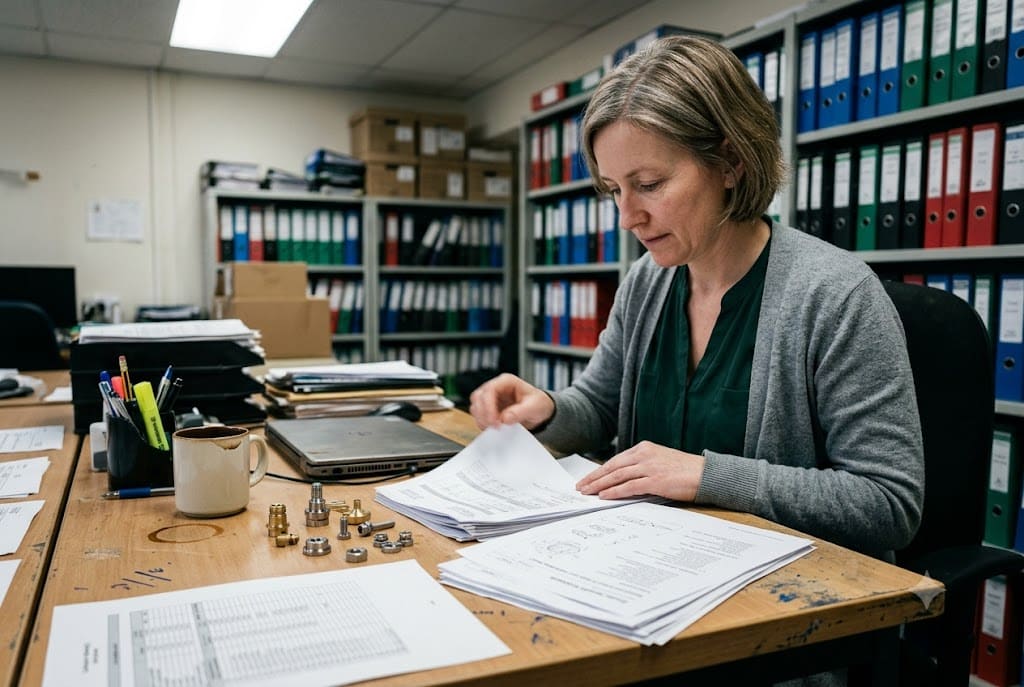
Start with the paper trail. Does the factory have documented work instructions for every operation type? Are those instructions available at the machine — not just filed in an office? Is the quality manual current, and do operators actually know what is in it?
Check ISO 9001 certificate validity and the scope of the certification. Some factories are certified only for a subset of their processes. If you are ordering parts that fall outside the certified scope, the certificate is meaningless for your order.
2. Machine Calibration and Maintenance
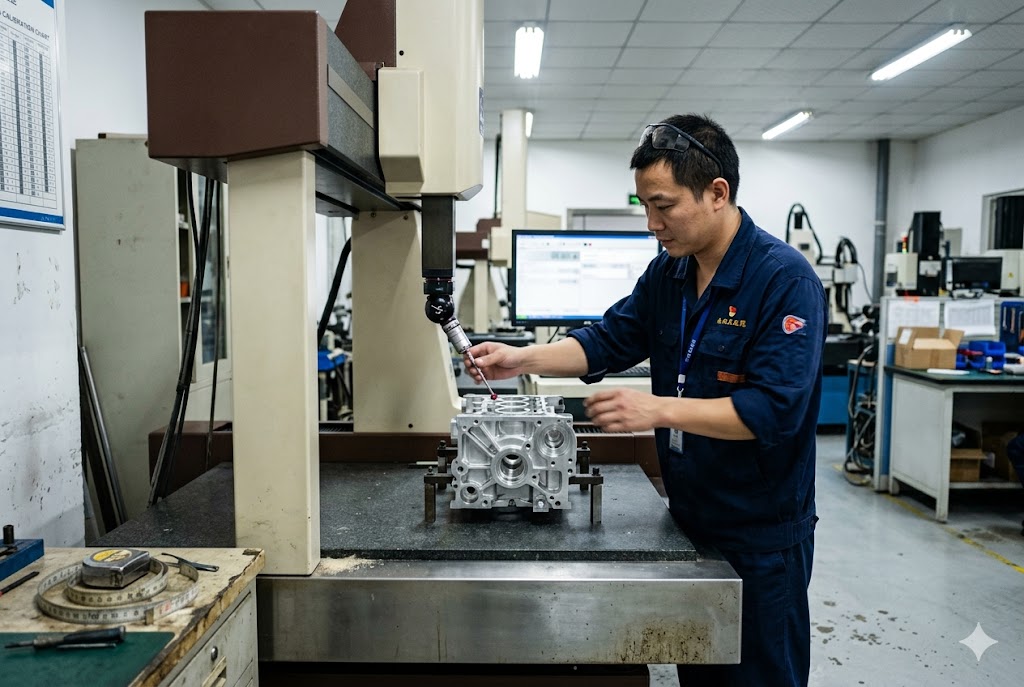
Ask to see calibration records for CNC machines, coordinate measuring machines (CMMs) 4, and all inspection gauges. Records should show calibration date, calibration frequency, acceptable tolerance range, and the name of the calibrating technician or service provider. Any machine with an overdue calibration is producing parts with unverified accuracy.
Look at the physical condition of the machines. Heavy rust, oil leaks, worn tooling stored carelessly, and chip buildup inside the machine enclosure are all signs of poor maintenance discipline.
3. Material Traceability
Material substitution is one of the highest-risk failure modes in Chinese CNC sourcing. During the audit, pull a sample of raw stock from the floor and ask the supplier to produce the corresponding mill certificate 5. Verify the heat number or lot number on the certificate matches the physical tag on the material. Then check that non-conforming stock is physically segregated — in a separate, clearly labeled area — and that it cannot accidentally re-enter the production flow.
| Audit Area | Key Evidence to Request | Red Flags |
|---|---|---|
| Quality Management | ISO certificate, work instructions at machines | Certificate expired or out of scope |
| Machine Calibration | Calibration logs for CNC & CMM equipment | Overdue calibrations, missing records |
| Material Traceability | Mill certs tied to shop floor lot numbers | Unlabeled stock, unsegregated scrap |
| In-Process Inspection | FAI reports, CMM printouts for critical dims | Inspection by eye only, no data |
| Corrective Actions | CAPA records for past NCRs | No documented root cause analysis |
4. Confirming Direct Manufacturer Status
One audit goal that buyers often overlook: verifying that you are dealing with an actual manufacturer, not a trading company or broker. Brokers obscure production controls and may subcontract your order to a factory you have never seen without your knowledge.
Ask to walk the entire production floor. If staff resist or redirect you to a showroom, that is a warning sign. Request to see raw material arriving, parts in-process, and finished parts being inspected — all in sequence. A genuine manufacturer can show all three.
5. Financial Health Indicators
A financially distressed factory will cut corners on materials and maintenance well before it makes any public announcement. During the audit, check that the business license is current and valid. Ask indirect questions about capacity utilization. A shop running at 30% capacity with a full headcount on the payroll is under financial stress. Look at equipment age and upkeep — deferred maintenance is a visible early signal.
Can Remote Audits Work for CNC Suppliers?
Travel costs add up fast when you are auditing factories in Shenzhen, Dongguan, or Ningbo from a US headquarters. After COVID-era necessity forced remote auditing into mainstream practice, we have run dozens of live video assessments ourselves and learned exactly where they work and where they fall short.
Remote audits using live video streaming are a practical supplement between full on-site visits. They allow real-time observation of shop floor conditions, active job travelers, and CMM operations without travel cost. However, remote audits should not fully replace periodic physical audits for high-criticality parts.

What Remote Audits Can and Cannot Do
A remote audit works best when you already have an established relationship with the supplier and want to verify that nothing has changed since your last on-site visit. Via live video, a skilled auditor can:
- Observe the general cleanliness and organization of the production floor
- Watch an operator run a setup and confirm they are following the work instruction
- View in-process inspection being performed and read CMM output in real time
- Check that calibration stickers on gauges are current
- Review documents held up to the camera — calibration logs, material certs, NCR records
What remote audits cannot do is walk freely. A camera goes where the operator or factory guide points it. Physical access to drawers, storage areas, and unlabeled material bins is not possible remotely. Detecting hidden scrap, unofficially stored non-conforming stock, or the actual condition of machine internals requires physical presence.
Third-Party Audit Firms as a Practical Solution
For buyers who cannot send their own staff to China, third-party audit firms are a reliable alternative. Firms such as SGS 6, Intertek, Bureau Veritas, and QIMA 7 provide impartial on-site assessments and can typically schedule an audit within 48 hours of booking. Their auditors are based in China and speak Mandarin, which removes the language barrier that can cause a factory to manage what you see during a self-conducted remote session.
| Audit Method | Best For | Limitations |
|---|---|---|
| On-site by buyer's team | New suppliers, high-criticality parts | High travel cost, time-intensive |
| Third-party audit firm | Impartial assessment, fast scheduling | Requires clear scope briefing |
| Remote / live video | Check-ins between formal audits | Cannot verify hidden areas or physical access |
| Pre-shipment inspection only | Low-risk, established suppliers | Catches defects late — after production cost is sunk |
Geographic Calibration Matters
Audit benchmarks should not be applied uniformly across all of China. Factories in Guangdong Province — particularly in Shenzhen, Dongguan, and Foshan — statistically show higher precision capability, more advanced equipment, and more mature quality systems than the national average. Calibrate your pass thresholds and expectations accordingly. A factory in a less industrially developed region may legitimately operate at a lower baseline capability, which may or may not be sufficient for your specific part requirements.
How Do Regular Audits Help Me Reduce Quality and Delivery Risk?
A buyer we work with shipped a container of custom brackets — only to have 40% rejected on arrival for out-of-tolerance bores. The supplier had quietly started skipping first-article inspection to hit a delivery date for a bigger client. A review three months earlier would have caught the process change. Regular audits do not just tick a compliance box. They directly protect your margin.
Regular supplier audits reduce quality and delivery risk by identifying process deviations, personnel changes, and capacity problems before they affect your order. Buyers who audit consistently report lower defect rates, fewer delivery delays, and stronger supplier accountability over time.

The Risk Reduction Mechanism
Audits work because they change supplier behavior. A factory that knows it will be reviewed regularly — with documented findings and corrective-action requirements — maintains its processes more carefully than one that never expects a visit. This is not cynical. It is how accountability works in any supply chain.
Specific risks that regular audits directly address:
Quality Risk
- Dimensional tolerance failures caught early through CMM data review, before production runs are completed
- Material substitution identified by verifying mill cert traceability on the shop floor
- Process deviations (skipped inspection steps, unapproved tooling changes) detected while still correctable
Delivery Risk
- Capacity overcommitment identified by assessing the factory's current order book and equipment loading
- Subcontracting risk mitigated by verifying that your parts are being produced in-house, not passed to an unknown third party
- Equipment breakdown risk reduced by reviewing maintenance schedules and identifying deferred maintenance before it causes a line stoppage
Building a Corrective-Action Loop
An audit is only as useful as the corrective actions that follow it. When findings are documented, share a formal audit report with the supplier. Require a written corrective action plan (CAP) 8 with specific deadlines for each finding. Schedule a follow-up — remote or on-site — to verify that corrections have been implemented.
Suppliers who complete corrective actions fully and on time are reliable long-term partners. Suppliers who dispute findings, delay responses, or partially address issues without explanation are signaling a deeper management problem.
Long-Term Partnership Value
Regular audits also create a positive dynamic with good suppliers. Sharing your audit criteria in advance tells a reputable factory exactly what standard you hold them to — and gives them a framework to improve. Over time, this produces a supplier who understands your quality requirements at a process level, not just at the final inspection stage. That kind of alignment is worth more than the cost of any audit program. For a broader perspective on structuring a China factory audit program 9, independent sourcing advisors offer useful benchmarks on checkpoints, cost, and scheduling norms. Buyers seeking an additional layer of protection before goods leave the factory can also build pre-shipment inspections 10 into their quality process as a final safeguard between production completion and container loading.
Conclusion
Regular supplier audits are not optional when you import custom CNC parts from China. They are the only reliable mechanism to verify that quality systems are followed in practice, not just on paper — and to protect your margin before problems reach your dock.
Footnotes
1. ISO 9001 is the international standard for quality management systems used by manufacturers worldwide. ↩︎
2. First Article Inspection (FAI) validates that a manufacturing process produces parts meeting all design specifications. ↩︎
3. Supplier scorecards track on-time delivery, defect rates, and corrective-action responsiveness in one dashboard. ↩︎
4. Coordinate measuring machines (CMMs) verify part geometry to high precision, replacing subjective manual inspection. ↩︎
5. A mill test report (MTR) certifies a metal's chemical and physical properties, linking material to its production batch. ↩︎
6. SGS is a global leader in factory auditing, certification, and supply chain inspection services in China. ↩︎
7. QIMA provides on-demand factory audits and product inspections in China within 48 hours of booking. ↩︎
8. A corrective action plan (CAP) is a structured process to identify root causes and prevent recurrence of quality failures. ↩︎
9. Independent guide covering audit checkpoints, cost benchmarks, and scheduling norms for China factory assessments. ↩︎
10. Pre-shipment inspections verify product quality, quantity, and packaging compliance before goods leave the factory. ↩︎