Skip to main content Skip to footer
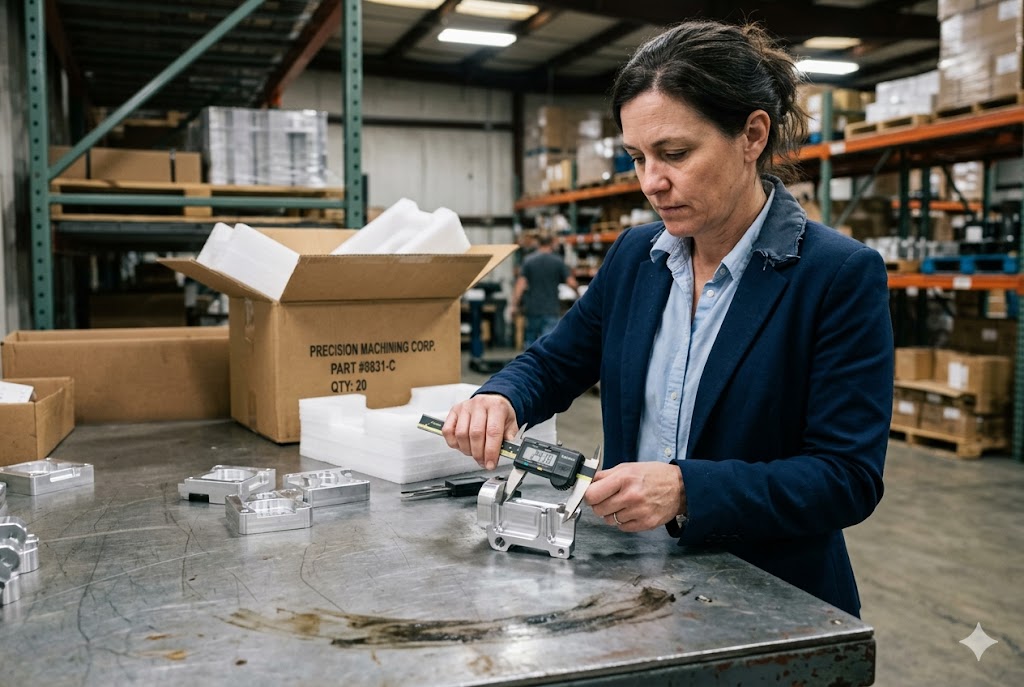
We see it every year. A buyer receives a shipment, opens the boxes, and finds parts that are out of tolerance. The drawing said 0.02 mm. The parts are off by 0.15 mm. Now what?
To claim compensation for defective CNC parts imported from China, you need a written manufacturing agreement signed before production that defines quality standards, inspection rights, defect categories, claim deadlines, and remedy obligations. Without this contract, your claim depends entirely on the supplier's goodwill — not on any enforceable right.
This article walks you through every step: the evidence you need, the contract terms that protect you, how to negotiate a fair remedy, and how to keep the relationship intact.
What Evidence Do You Need Before You Ask for a Quality Claim?
Poor documentation is the number one reason quality claims stall. When our team manages pre-shipment inspections in China, the first thing we check is whether the buyer has a paper trail. Most do not.
Before filing a claim, you need timestamped photographs of every defect, actual measured values versus drawing specifications, the affected part count, the PO and batch numbers, and a written statement of your financial loss. Vague claims with blurry photos almost never result in a settlement.

Build Your Evidence File Immediately
The clock starts the moment the shipment arrives. Most contracts specify a claim window of 7 to 30 days from receipt. Miss that window and the supplier — and any Chinese court — will treat the late submission as grounds to reduce or reject liability entirely.
On the day the shipment arrives, do this:
- Photograph the outer packaging before opening it.
- Photograph every carton, every layer, every part tray.
- Measure a statistically meaningful sample — not just the obvious rejects.
- Record every measurement against the drawing tolerance.
- Count total parts received and total non-conforming parts.
The Five Documents That Win Claims
| Document | What It Proves | How to Get It |
|---|---|---|
| Timestamped defect photos | Defect existed at receipt, not during your handling | Camera with automatic date/time stamp |
| Measurement report | Actual vs. specified values, in numbers | Caliper, CMM 1, or third-party lab |
| Third-party inspection report | Independent verification of defect | Hire SGS 2, Bureau Veritas, or similar |
| Signed purchase order + drawing revision | What was agreed | Your own procurement records |
| Golden sample or FAI record 3 | The approved standard | Retained from pre-production approval |
Third-party inspection is worth the cost. A report from SGS or Bureau Veritas 4 carries weight in negotiation and in arbitration. An internal report you wrote yourself does not carry the same credibility.
What Counts as a Financial Loss
Quantify your damages in specific line items. A general statement like "this caused us losses" does not move the conversation forward. Chinese suppliers respond to numbers.
Your claim should separately state:
- Value of non-conforming parts (unit price × rejected quantity)
- Cost of third-party inspection that confirmed the defects
- Internal labour cost for incoming sorting and rework
- Expedited freight you paid to meet your downstream delivery commitments
- Documented losses caused to your own customers, where attributable
Under Article 584 of China's Civil Code 5, the defaulting party is liable for foreseeable losses. Losses that were predictable at the time of contracting are recoverable. Consequential losses that could not have been foreseen at order placement are generally not. Keep this distinction in mind when drafting your claim.
A Sample Claim Summary Format
| Line Item | Calculation | Amount (USD) |
|---|---|---|
| Rejected parts | 240 parts × $18.50 | $4,440 |
| Third-party inspection | Actual invoice | $620 |
| Internal sorting labour | 16 hours × $35/hr | $560 |
| Expedited airfreight | Actual invoice | $1,800 |
| Total claimed | $7,420 |
This format is professional. It shows you have done the work. It gives the supplier a specific number to respond to, not a vague grievance to argue around.
Should You Define Compensation Terms Before Production Starts?
Every experienced sourcing manager we have worked with learned this lesson the hard way. The time to define what happens when parts fail is before the parts are made — not after a bad shipment lands on your dock.
Yes, you must define compensation terms before production starts. A purchase order with only price and delivery date gives you no enforceable quality remedy under Chinese contract law. A China-specific manufacturing agreement in both English and Chinese that specifies quality standards, defect classification, inspection rights, claim deadlines, and liquidated damages transforms a dispute from a favour to a contractual right.

Why a Standard PO Is Not Enough
A purchase order is a commercial transaction document. It records what you are buying and at what price. It is not a quality management document. Suppliers in China are experienced at reading POs. They know that a PO without a referenced quality agreement leaves most of the liability undefined.
A China-specific manufacturing agreement is a separate, detailed document. It covers everything a PO does not. Here is what it must include:
Key Clauses Your Contract Must Have
Quality standards clause. Name the specific drawing revision, material standard, surface finish specification, and dimensional tolerance system (ISO, ASME, etc.). Do not say "per drawing." Say "per drawing part number XYZ revision C, dated 01 March 2025, tolerance class ISO 2768-m 6."
Defect classification clause. Define what is a critical defect, a major defect, and a minor defect. Attach your AQL (Acceptable Quality Limit) 7 table. This prevents argument about whether a 5% reject rate is acceptable.
Inspection rights clause. Confirm your right to send a third-party inspector to the factory at any time during production and before shipment. Without this clause, some suppliers will refuse access.
Claim deadline clause. State explicitly: claims must be submitted within X days of shipment receipt, in writing, with measurement data.
Remedy obligations clause. State what the supplier must do for each defect class: rework, replace, or refund. Set a deadline for each remedy.
Liquidated damages clause. Pre-agree a specific penalty for defined quality failures. For example: if the AQL inspection fails at the shipment stage, the supplier owes a stated percentage of the order value. Under Chinese Civil Code Article 585, liquidated damages 8 clauses are enforceable. Courts or arbitration bodies may adjust them only if the agreed amount is grossly disproportionate to actual loss.
Dispute resolution clause. Name CIETAC 9 (China International Economic and Trade Arbitration Commission) as your arbitration body. Do not accept a clause that names the supplier's local city court. Litigating in a remote Chinese county court is expensive and practically impossible for a foreign buyer.
Language clause. The Chinese-language version of any contract governs in Chinese courts and arbitration. If your contract exists only in English, or if the Chinese version was provided by the supplier without independent review, you may be bound by terms you did not intend to agree to. Have any China-specific manufacturing contract reviewed by a lawyer with Chinese commercial law experience.
Contract Clause Comparison Table
| Clause | Without It | With It |
|---|---|---|
| Quality standard reference | Supplier defines "acceptable" | Drawing revision locks the standard |
| Defect classification + AQL | Dispute over what constitutes a defect | Clear pass/fail criteria, no argument |
| Inspection rights | Supplier may block access | Your right to inspect is contractual |
| Claim deadline | Supplier argues claim is too late | Window is defined; your position is protected |
| Liquidated damages | Compensation is open negotiation | Amount is pre-calculated, not debated |
| CIETAC arbitration | Supplier's local court is impractical | Enforceable award in China and 170+ countries |
Building this contract takes time and a modest legal budget. It is far cheaper than absorbing a defective shipment with no recourse.
How Can You Negotiate Rework, Replacement, or Credit Fairly?
Once you have your evidence file and a contract to reference, you are in a position to negotiate. This is where most buyers make mistakes. They either demand too much too fast and break the relationship, or they accept too little because they want to avoid conflict.
To negotiate rework, replacement, or credit fairly, withhold your final payment installment until the claim is resolved in writing, present a specific quantified claim rather than a general complaint, and insist on cash credit or a replacement shipment — never accept a discount on a future order as compensation for a current defect.

Your Strongest Lever: The Final Payment
In most Chinese manufacturing payment terms, the buyer pays 30% on order and 70% before or after shipment. If you have not yet released the final 70%, do not release it until the defect claim is formally resolved in writing. Once full payment clears, your practical leverage drops to near zero. The supplier has all their money and limited commercial incentive to prioritise your claim.
If you have already paid in full, your leverage is weaker but not absent. You still have the power to damage the relationship, to withhold future orders, to post a sourcing platform review 10, and to pursue formal arbitration.
Three Remedy Options and When to Accept Each
Rework is appropriate when the defect is superficial or dimensional and can be corrected without scrapping the part. Confirm that the supplier can actually correct the defect before agreeing. Ask for a rework sample to inspect first. Set a deadline.
Replacement is appropriate when the defect is critical and the part cannot be reworked. The supplier manufactures a new batch at their cost, including freight. Confirm the timeline. If you need parts urgently, negotiate partial airfreight at the supplier's expense.
Credit against invoice is appropriate when rework or replacement would take too long to meet your downstream commitments. The rejected parts are scrapped or returned. The supplier issues a credit memo reducing the outstanding balance by the agreed amount.
What You Should Never Accept
Do not accept a discount on a future order. This arrangement creates a perverse incentive: the supplier cuts costs on the future order to recover the margin they conceded. It also delays your financial recovery to an indefinite future date. If the commercial relationship ends before that order is placed, you recover nothing.
Do not accept a verbal agreement. All resolution terms must be in writing, referenced to the original PO, and signed or confirmed by email by a named person with authority on the supplier's side.
Negotiation Tone and Approach
Keep the tone professional and factual. Present your measurement data. Present your financial summary. State clearly what remedy you are requesting and by what date. Chinese suppliers respond well to structured, document-based communication. They respond poorly to emotional or accusatory language, which causes loss of face and hardens positions.
If your team does not have a Mandarin-speaking representative, consider engaging your China-based sourcing partner to communicate the claim directly. Cultural and language context matters. A respected intermediary who can frame the claim in terms of protecting the long-term relationship often achieves a faster resolution than purely adversarial written demands from overseas.
What Claim Process Helps You Resolve Defects Without Damaging the Relationship?
A quality dispute does not have to end a supplier relationship. In our experience managing cross-border supply chains between China, Vietnam, and North America, the disputes that damage relationships are almost always the ones that were handled reactively and emotionally. The disputes that preserve relationships are handled with a clear process, professional language, and a focus on resolution.
A structured claim process — written notice within the contract window, a documented evidence file, a specific quantified demand, and a named resolution deadline — resolves most defect disputes without legal action. Relationships survive when both sides feel the process was fair and transparent.

A Step-by-Step Claim Process
Step 1 — Inspect on receipt. Measure a sample. Document findings. Photograph everything.
Step 2 — Engage a third-party inspector if the defect is contested. Get an independent written report.
Step 3 — Submit a formal written claim within the contract window. Include PO number, batch number, defect photos, measurement data, affected part count, and a quantified financial loss summary.
Step 4 — Request a written response by a specific date. Give the supplier 5 to 7 business days to respond in writing with their position and proposed remedy.
Step 5 — Negotiate the remedy. Use the table in the previous section as a guide. All agreed terms must be in writing.
Step 6 — Withhold final payment until the written resolution agreement is signed. Only release payment when the remedy has been confirmed, or when the replacement/credit has been received.
Step 7 — Document the resolution. Keep the resolution agreement on file. Use it as a reference point if similar issues arise on future orders.
When Direct Negotiation Fails
If direct negotiation stalls and the amount at stake does not justify formal CIETAC arbitration — which carries filing fees starting at several thousand dollars plus legal costs — consider engaging a China-based sourcing agent or quality management firm as a mediator.
Chinese business culture places significant weight on face and on long-term relationships. A respected intermediary who communicates in Mandarin, frames the claim constructively, and proposes a structured resolution often achieves a settlement that adversarial written demands from overseas do not. This is a practical step that experienced sourcing managers use routinely.
Build Your Infrastructure Before the Next Order
Every quality dispute is a signal to improve your process prospectively. After resolution, review your contract and ask:
- Does it include a liquidated damages clause with a pre-agreed penalty schedule?
- Does it name CIETAC as the arbitration body?
- Does it include a Chinese-language version reviewed by a qualified lawyer?
- Does it define your AQL criteria and inspection rights?
If the answer to any of these is no, fix it before placing the next order. Buyers who build this infrastructure into every order spend less time managing disputes and more time scaling their supply chain.
Documentary Evidence Checklist
| Document | Purpose | Who Holds It |
|---|---|---|
| Pre-production quality agreement | Establishes standards | Buyer files |
| Signed drawing with revision date | Locks the specification | Buyer files |
| FAI report or golden sample | Approved standard for production | Buyer files |
| Third-party inspection report | Independent defect confirmation | Inspection firm |
| Timestamped defect photographs | Proves condition at receipt | Buyer files |
| Measurement report | Quantifies non-conformance | QC lab or buyer |
| Written claim notice | Starts the formal claim | Buyer files |
| Written resolution agreement | Closes the claim | Both parties |
Conclusion
Your ability to recover compensation for defective CNC parts from China comes down to preparation. A strong contract, a thorough evidence file, a specific quantified claim, and a structured resolution process are what turn a quality dispute into a recoverable situation — and keep the supplier relationship intact for the next order.
Footnotes
1. Overview of Coordinate Measuring Machines (CMM) used for precision dimensional inspection of manufactured parts. ↩︎
2. SGS industrial manufacturing inspection services for verifying supplier product quality and conformance. ↩︎
3. First Article Inspection (FAI): the process of approving an initial production sample against the engineering specification. ↩︎
4. Bureau Veritas manufacturing quality inspection services used globally to verify supplier conformance. ↩︎
5. China's Civil Code Article 584 on liability for foreseeable losses caused by contractual breach. ↩︎
6. ISO 2768 standard defining general tolerances for linear and angular dimensions in manufacturing drawings. ↩︎
7. Acceptance sampling and AQL methodology for statistically defining acceptable defect levels in production batches. ↩︎
8. Explanation of liquidated damages clauses and how courts assess their enforceability in contract disputes. ↩︎
9. CIETAC: China's primary international arbitration body, whose awards are enforceable in 170+ countries. ↩︎
10. Guide to evaluating and reviewing suppliers on sourcing platforms to support quality accountability. ↩︎