Skip to main content Skip to footer

We see this question on almost every RFQ where black oxide is listed as the default finish — and the answer almost always surprises buyers.
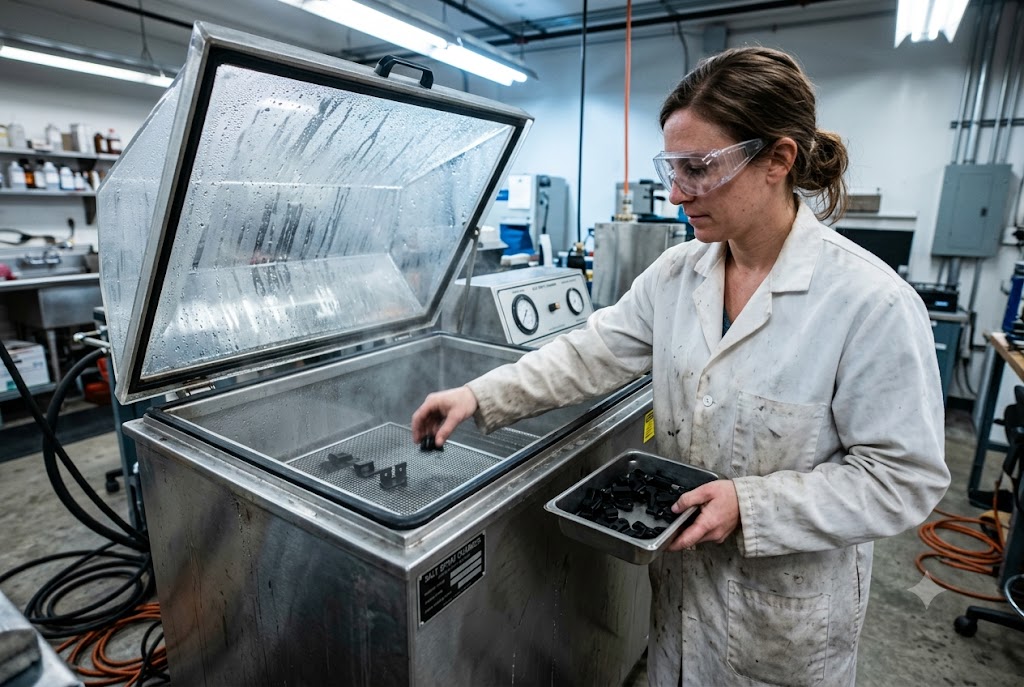
Black oxide creates a magnetite layer only 0.5–1.5 microns thick. Without a post-seal, it fails ASTM B117 salt spray in as little as 1–4 hours. With an oil or wax seal, performance reaches 100–175 hours in humidity testing — adequate only for dry indoor use.
So if your drawing calls for black oxide on precision Swiss CNC parts that will see moisture, read this before signing off on that specification.
What Is the Typical Salt Spray Hours Rating for Black Oxide Treated Steel Swiss-Turned Parts?
Most buyers assume black oxide is a real coating. In practice, our QC team treats it as a surface conversion — not a barrier.
Unsealed black oxide steel parts fail ASTM B117 neutral salt spray testing in 1–4 hours. With an oil post-seal, performance reaches roughly 100–175 hours under ASTM D-2247 humidity chamber conditions — well below the 200–500+ hour threshold required for outdoor or high-humidity service.
Why the Numbers Are So Low
Black oxide is a chemical conversion process, not an electroplated coating. The reaction converts the iron surface into magnetite (Fe₃O₄), a mineral oxide. The resulting layer is only 0.5–1.5 microns thick. For comparison, zinc plating runs 5–25 microns, and electroless nickel typically starts at 12–25 microns.
That thinness is actually useful for Swiss-turned parts. Tolerances on Swiss CNC components are often held to ±0.005 mm or tighter. A 1-micron oxide conversion adds essentially zero measurable dimension — so the part fits the same after treatment as before. That dimensional stability is the main reason engineers reach for black oxide on precision parts.
But the same property that makes it dimensionally safe makes it corrosion-vulnerable. A 1-micron layer has no meaningful barrier effect. Oxygen and moisture pass through almost immediately.
How Sealants Change the Numbers
The coating's corrosion performance is entirely dependent on a secondary sealant applied after oxidation. Common options are oil, wax, or polymer lacquer. The sealant fills the pore structure in the magnetite and temporarily blocks moisture ingress.
According to ASTM D2247 1, this humidity chamber method exposes coated specimens to 100% relative humidity at 38°C — a far less aggressive environment than the neutral salt spray fog used in ASTM B117, which explains why black oxide results in D2247 hours are notably higher than its B117 results.
| Finish System | Test Standard | Typical Hours to First Rust |
|---|---|---|
| Black oxide, no seal | ASTM B117 | 1–4 hours |
| Black oxide + oil seal | ASTM D-2247 humidity | 100–175 hours |
| Black oxide + polymer seal | ASTM D-2247 humidity | 150–200 hours |
| Zinc plating (Type II chromate) | ASTM B117 | 200–500 hours |
| Zinc-nickel plating | ASTM B117 | 500+ hours |
| Electroless nickel (>10% P) | ASTM B117 | 500–1,000+ hours |
Even with the best sealant, black oxide systems land below 200 hours in standard testing. That number matters because most outdoor or humid environments impose sustained corrosive load. A 150-hour ASTM D-2247 result does not translate to 150 hours of outdoor service — real environments include UV, temperature cycling, and surface contamination that accelerate failure further.
What Drawing Specifications Should Require
One recurring issue our quality team finds when reviewing supplier drawings is that black oxide is specified without performance criteria. A drawing that says "black oxide per MIL-DTL-13924 Class 1 2" but sets no minimum salt spray hours creates a contractual gap. The supplier will apply the cheapest conforming process — bare oxide with minimal oil — and remain technically correct.
When black oxide must be used, the drawing should require:
- Hot process only (280–290°F bath temperature)
- Named sealant type (oil, wax, or polymer) with minimum performance criterion
- Minimum humidity chamber hours per ASTM D-2247 as a lot acceptance criterion
- Supplier-furnished test panel per production lot
Without these four elements, you cannot verify conformance, and you cannot hold a supplier accountable for early corrosion in the field.
How Does Black Oxide Compare to Zinc Plating or Nickel Plating for Rust Protection in Outdoor Use?
Buyers sometimes ask us to compare finishes on cost alone. We always redirect that conversation to service environment first.
For outdoor or humid service, zinc plating achieves 200–500 hours in ASTM B117 and electroless nickel exceeds 500 hours, while black oxide with sealant rarely passes 200 hours. The performance gap is categorical. Choose finish based on service environment, not aesthetics or unit cost.
Barrier Plating vs. Conversion Coatings
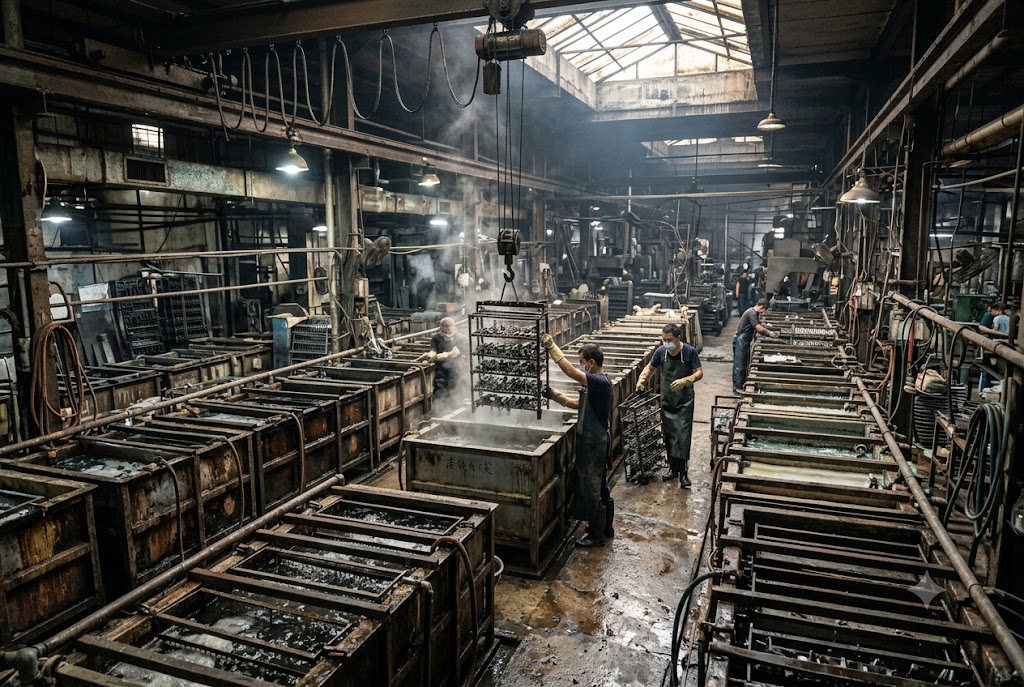
This is the core distinction. Zinc plating and electroless nickel are barrier coatings — they deposit a physically separate layer of metal onto the substrate. That layer has mass, thickness, and electrochemical protection properties independent of the steel beneath.
Black oxide is a conversion coating. It does not add a separate layer; it chemically converts the outermost steel molecules into a different compound. There is no added barrier mass. When moisture reaches the surface, it contacts the base steel within microns of travel.
Zinc Plating
Zinc plating per ASTM B633 3 provides sacrificial protection. Zinc is anodic to steel, meaning when exposed to moisture, the zinc corrodes preferentially and protects the underlying steel — even where the coating has minor damage or pinholes. With a Type II chromate conversion topcoat, zinc-plated steel routinely achieves 200–500 hours in ASTM B117, depending on deposit thickness.
For Swiss CNC parts, zinc plating is feasible but requires careful thickness specification. At 5–8 microns, it adds only minimal dimension. At 12–25 microns (ASTM B633 SC3 or SC4), dimensional fit must be checked. Precision bores, threaded features, and close-clearance assemblies may require pre-plating allowance designed into the machined part.
Electroless Nickel
High-phosphorus electroless nickel 4 (greater than 10% phosphorus by weight) deposits an amorphous, non-crystalline coating with excellent corrosion resistance. The amorphous structure eliminates grain boundaries where corrosion typically initiates. These coatings regularly achieve 500–1,000+ hours in ASTM B117 and are a strong choice for outdoor precision parts where tolerances must be maintained.
Electroless nickel plates uniformly on complex geometries — including internal bores, threads, and undercuts common in Swiss CNC parts — making it more compatible with precision components than many electroplating alternatives.
Zinc-Nickel Plating
For the most demanding outdoor environments, zinc-nickel alloy plating 5 (typically 12–15% nickel) achieves 500+ hours in ASTM B117 with superior performance at elevated temperatures compared to straight zinc. It remains sacrificial like zinc but offers better resistance to zinc whisker formation and performs well in salt-road and marine-adjacent environments.
| Finish | Coating Type | Protective Mechanism | ASTM B117 Hours | Dimensionally Safe for Swiss CNC? |
|---|---|---|---|---|
| Black oxide + oil | Conversion | Sealant only, no barrier | <200 | Yes (0.5–1.5 µm) |
| Zinc plate + Type II chromate | Barrier/sacrificial | Sacrificial zinc | 200–500 | Mostly (specify thickness) |
| Zinc-nickel plate | Barrier/sacrificial | Sacrificial zinc-nickel | 500+ | Mostly (specify thickness) |
| Electroless nickel (>10% P) | Barrier | Physical barrier | 500–1,000+ | Yes (uniform deposit) |
| Passivation (stainless only) | Conversion | Enhanced passive Cr film | N/A (not ASTM B117) | Yes |
Cost Is the Wrong Primary Variable
Black oxide costs less per part. On a $0.50 Swiss-turned component, that difference can look meaningful. But if a black-oxide-finished part rusts in the field and triggers a warranty return, a production line stoppage, or a customer complaint, the unit cost arithmetic changes immediately. Specifying finish based on service environment first — then optimizing cost within acceptable options — is the approach our sourcing team takes on every project.
Can Black Oxide Be Applied to Stainless Steel Swiss CNC Parts, and Does It Improve Corrosion Performance?
This comes up often when buyers want a dark finish on 303 or 304 stainless components. The answer is more nuanced than most suppliers will tell you.
Black oxide can be applied to stainless steel grades 303, 304, and 316, but high chromium content produces inconsistent coating uniformity and adds negligible corrosion performance on top of the existing passive film. Passivation per ASTM A967 is the more effective and reliable specification for stainless Swiss CNC parts.
Why Stainless Steel Behaves Differently
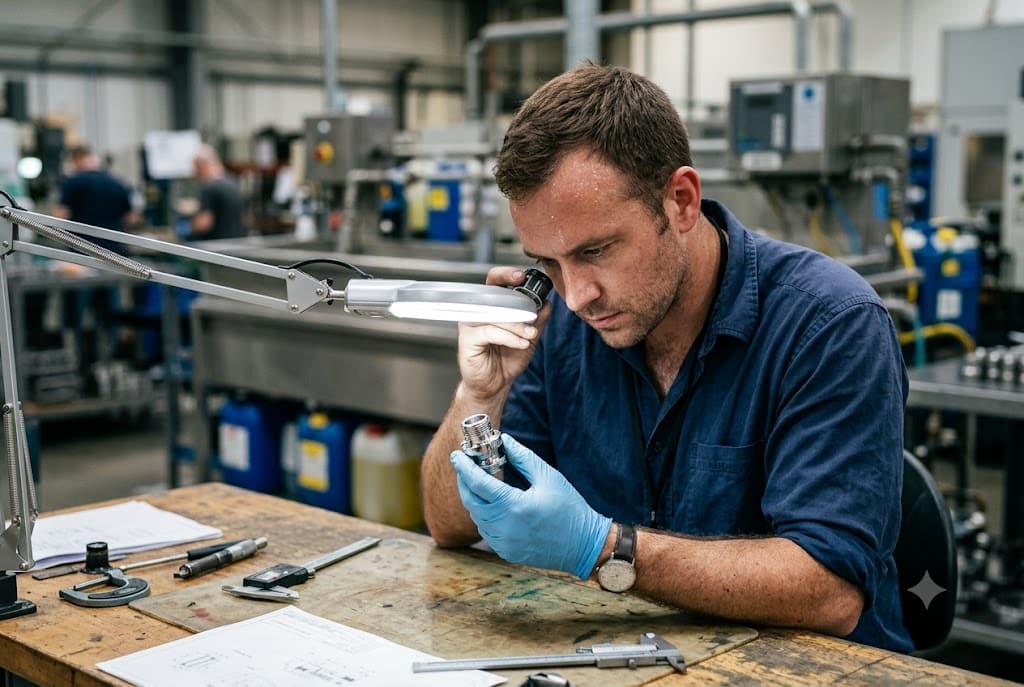
Stainless steel derives its corrosion resistance from a passive chromium oxide film that forms naturally on the surface when the steel is exposed to oxygen. This film is self-healing — minor scratches or abrasions re-passivate in air. Grades 303, 304, and 316 are the most common substrates for Swiss CNC parts due to their excellent machinability and inherent corrosion resistance.
When black oxide is applied to stainless, the alkaline oxide bath must disrupt the existing passive film to allow the conversion reaction to occur. That disruption is chemically aggressive. On stainless grades with 10–18% chromium, the resulting magnetite layer is uneven. High-chromium areas resist conversion, while lower-chromium micro-regions convert more readily, producing a patchy, non-uniform appearance. This is a documented limitation in precision surface finishing practice.
Corrosion Performance on Stainless: The Numbers
After black oxide, a stainless part has a disrupted passive film plus a thin, non-uniform magnetite layer. The net corrosion performance is typically no better than — and sometimes worse than — the original uncoated stainless. Re-passivation after black oxide treatment, per ASTM A967 6 or AMS 2700, is the correct remediation step. Most Chinese finishing shops do not include this unless it is explicitly specified on the drawing or purchase order.
| Stainless Finish | Chromium Passive Film | Surface Uniformity | Corrosion Performance vs. Bare Stainless |
|---|---|---|---|
| Bare (as-machined) | Intact (natural) | Good | Baseline |
| Passivated (ASTM A967) | Enhanced | Excellent | Better than baseline |
| Black oxide only | Disrupted, partially reformed | Inconsistent | Equal to or worse than baseline |
| Black oxide + re-passivation | Re-established | Good | Approaches passivated |
What to Specify Instead
For stainless Swiss CNC parts where corrosion performance matters, passivation per ASTM A967 or AMS 2700 7 is the correct specification. It enhances the natural passive film without adding measurable dimensional thickness, making it fully compatible with tight Swiss-turned tolerances. It does not significantly alter part appearance.
If a black or dark aesthetic is required on a stainless part, physical vapor deposition (PVD) black coatings are worth evaluating — though they carry higher cost and require vendor capability verification. This option should be discussed with the supplier early, not added to a drawing after production begins.
Supplier Awareness Gap
In our experience working with Chinese surface finishing subcontractors, black oxide is frequently offered and applied to stainless parts without any discussion of its limitations. A supplier quoting "black oxide on 304 stainless" may not have considered whether the coating will be uniform, whether re-passivation is needed afterward, or whether the result meets the buyer's actual corrosion performance expectation. Drawings should explicitly state whether re-passivation post-oxide is required — or whether passivation alone is the preferred specification — to close this gap before production begins.
What Additional Sealing (Oil, Wax) Is Typically Applied After Black Oxide to Enhance Protection?
When black oxide is legitimately specified for indoor precision parts, the post-seal step is not optional — it determines whether the finish functions at all.
After black oxide, parts are sealed with oil, wax, or polymer to fill the porous magnetite layer. Oil is most common but requires periodic re-application in service. Polymer lacquer provides the best humidity resistance of the three options but adds 1–5 microns of dimensional thickness.
Oil Post-Seal
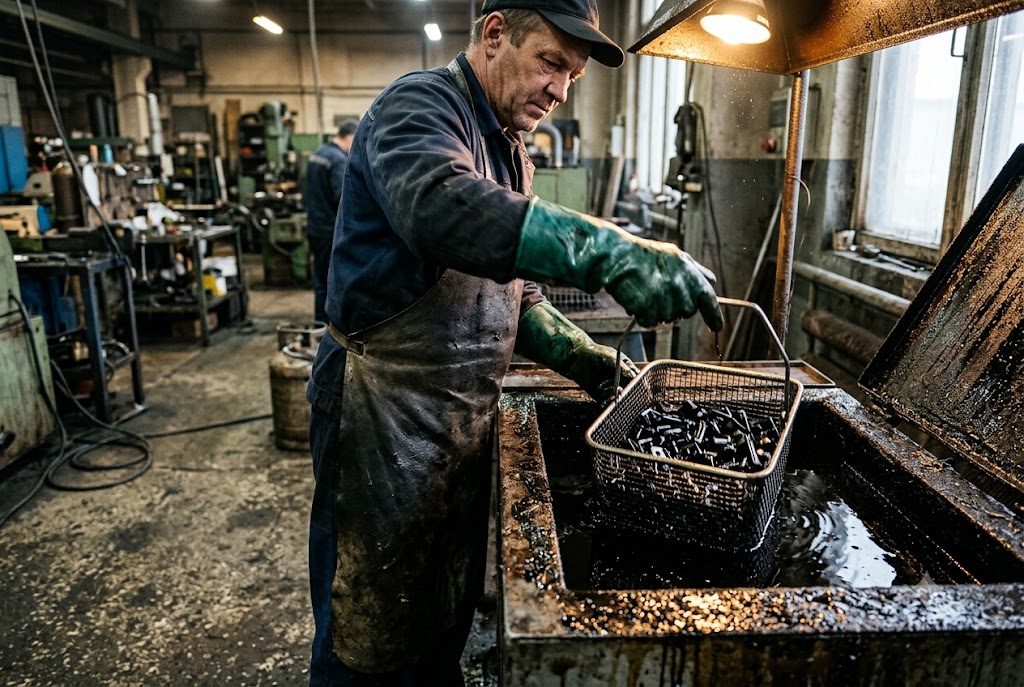
Oil is the default sealant applied by most Chinese black oxide subcontractors. After hot oxide treatment, parts are dipped or wiped with a rust-preventive oil — often a light petroleum-based product. The oil fills the pore structure in the magnetite and temporarily blocks moisture access.
The limitation is consumability. Oil volatilizes at elevated temperatures, washes away with water or solvents, and depletes through normal handling. In outdoor or humid service, an oil-sealed black oxide part may lose its protection in days to weeks. In clean indoor storage, it may last months. For deployed assemblies, oil-sealed black oxide is impractical unless scheduled maintenance re-oiling is built into the service protocol — and most assemblies do not have this provision.
Wax Post-Seal
Wax sealants — microcrystalline wax or Renaissance wax formulations — offer longer sealant life than oil. Wax is less prone to drip-off and provides a more stable film at ambient temperatures. However, wax remains a consumable and will eventually thin out in service, particularly in high-cycle or high-contact applications.
Wax is appropriate for parts that are handled infrequently and stored in controlled conditions. It is not a long-term solution for outdoor or high-cycle components.
Polymer Lacquer and Dry-Film Sealants
Polymer topcoats applied over black oxide — including acrylic lacquers and dry-film PTFE coatings — provide the best humidity resistance of the three sealant categories. Dry-film sealants also add minor lubrication, which can be useful for moving Swiss CNC components like pins, shafts, and valve bodies.
The tradeoff is dimensional addition. A polymer film adds 1–5 microns, which may matter on parts with tight bore diameters or thread fits. Dimensional impact must be specified and verified before production begins.
Cold-Process Black Oxide: A Specific Warning
One issue our QC team watches for when auditing Chinese finishing shops is the use of cold-process or room-temperature black oxide. As explained in the black oxide Wikipedia entry 8, these baths deposit a copper selenide (Cu₂Se) compound on the steel surface — not magnetite. The result looks similar visually but provides even less corrosion resistance than hot oxide. Cold-process black oxide is not compliant with MIL-DTL-13924 and should be explicitly prohibited on drawings.
| Sealant Type | Application | Durability | Re-Application Needed? | Dimensional Impact |
|---|---|---|---|---|
| Rust-preventive oil | Dip or wipe | Weeks to months | Yes, periodic | None |
| Microcrystalline wax | Wipe or dip | Months | Yes, annual or per-use | None |
| Polymer lacquer | Spray or dip | Long-term (indoor) | Rarely | 1–5 microns |
| Dry-film PTFE | Spray | Long-term (indoor) | Rarely | 1–3 microns |
Contractual Requirements for Sealant
When black oxide with sealant is specified on a drawing or purchase order, the specification must name the sealant type — not just "sealed." A drawing that says "black oxide, oil sealed" allows the supplier to apply any available oil, including lightweight cutting fluids not intended for rust protection. Better specifications name the sealant category, require minimum performance per ASTM D-2247 humidity chamber testing 9, and call for documented test panel results per production lot.
Without these requirements, part acceptance is based on visual inspection only. A part that looks black and slightly oiled passes incoming inspection regardless of how long it will actually resist corrosion in service.
The ASTM B117 salt spray standard 10 remains the ultimate benchmark for comparing surface finish systems across product families, because its aggressive neutral salt fog environment forces clear differentiation between conversion coatings like black oxide and genuine barrier platings like zinc or electroless nickel.
Conclusion
Black oxide is not a corrosion protection coating — it is a conversion finish that requires a post-seal to function at all, and even then performs poorly in outdoor or humid conditions. Specify finish based on service environment, write performance criteria into your drawings, and do not leave sealant type open to supplier interpretation.
Footnotes
1. ASTM D2247 evaluates coating water resistance at 100% relative humidity — the standard used for black oxide sealant performance testing. ↩︎
2. MIL-DTL-13924 is the primary military specification governing black oxide coatings on ferrous metals, including Class 1 hot-process requirements. ↩︎
3. ASTM B633 covers electrodeposited zinc coatings on iron and steel, defining service condition classes and minimum salt spray performance thresholds. ↩︎
4. High-phosphorus electroless nickel (10–12% P) outperforms lower-phosphorus alloys by 4:1 in ASTM B117 salt spray tests due to its amorphous deposit structure. ↩︎
5. Zinc-nickel plating (12–15% Ni) achieves 500+ hours in ASTM B117 and offers superior heat tolerance compared to standard zinc, making it a leading outdoor fastener finish. ↩︎
6. ASTM A967 specifies chemical passivation treatments for stainless steel, including nitric and citric acid methods and acceptance testing requirements. ↩︎
7. ASTM A967 and AMS 2700 are the general industry and aerospace specifications respectively governing passivation of stainless steel components. ↩︎
8. Cold black oxide is not a true conversion coating — it deposits a copper selenide compound at room temperature, producing inferior abrasion and corrosion resistance versus hot oxide. ↩︎
9. ASTM D2247 tests water resistance of coatings at 100% relative humidity and is commonly used as a lot-acceptance criterion for black oxide sealant performance. ↩︎
10. ASTM B117 is the most widely used salt spray standard globally, providing a controlled corrosive environment for comparing relative corrosion resistance of metals and coatings. ↩︎