Skip to main content Skip to footer
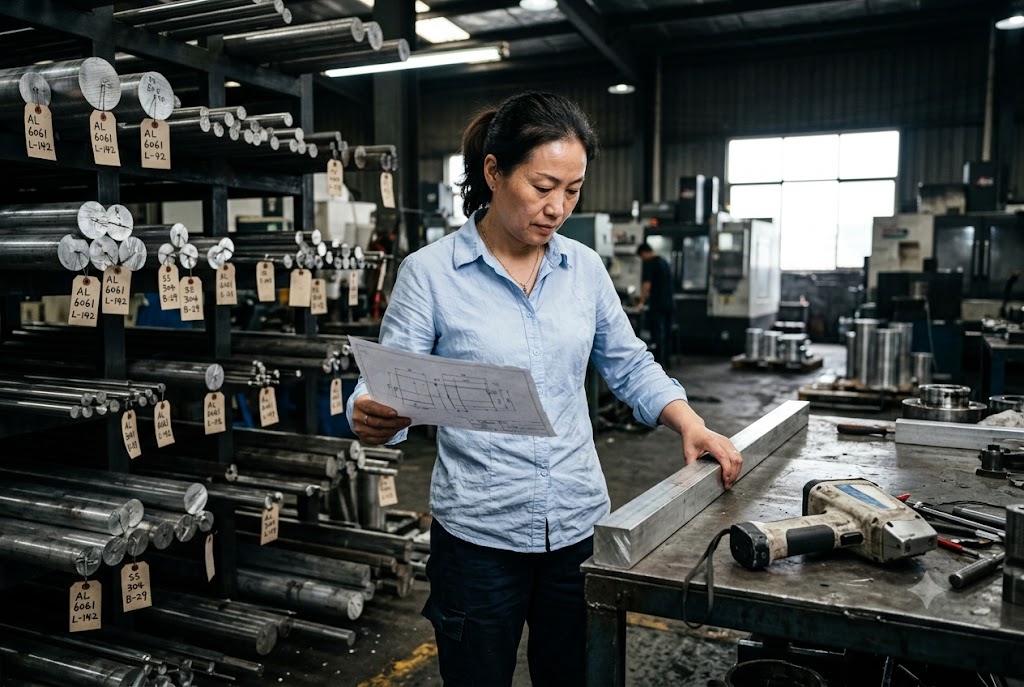
We have turned away orders that looked simple on paper — a brass connector, a leaded steel pin — only because the destination assembly was covered by RoHS. That experience taught us to check compliance before quoting, not after.
RoHS restricts ten substances in EEE, including lead, cadmium, and hexavalent chromium, with a 1,000 ppm limit for most. REACH adds disclosure obligations for 250-plus SVHCs above 0.1% per article. Both frameworks directly affect material and surface treatment choices for Swiss CNC parts entering US supply chains.
The four questions below cover the compliance decisions purchasing managers face most often. Read them in order — each builds on the last.
Does My Swiss CNC Part Require a RoHS Compliance Declaration to Enter the US Market?
Many buyers are surprised to learn that US Customs does not enforce RoHS at the border. But by the time a part reaches their assembly line, the compliance question has already been decided upstream.
RoHS is an EU directive, not a US federal law. California SB 20/SB 50 enforces identical substance limits for covered electronic devices sold in the state, giving RoHS practical legal force domestically. Parts for EEE assemblies sold in California or exported to the EU must meet RoHS limits.

When RoHS Applies to Your Parts
RoHS scope is product-driven, not geography-driven. If the finished product qualifies as electrical or electronic equipment — whether it ends up in a medical device, consumer electronics, or an industrial control system — then every component in that product is in scope. Swiss CNC turned parts are rarely the final product. They are connectors, housings, shafts, and inserts inside something larger. That larger assembly determines the obligation.
Ask your downstream customer two questions before accepting a PO:
First, is the finished assembly sold or used in California or the EU? Second, is it classified as EEE under RoHS Directive 2011/65/EU 1 or California's covered electronic device list? If both answers are yes, your parts must comply — regardless of where they were machined.
RoHS Restricted Substance Limits
| Substance | Limit (ppm) | Common Source in CNC Parts |
|---|---|---|
| Lead (Pb) | 1,000 | C360 brass, 12L14 steel, solder |
| Cadmium (Cd) | 100 | Cadmium electroplating |
| Hexavalent chromium (Cr⁶⁺) | 1,000 | Yellow chem-film, decorative chrome |
| Mercury (Hg) | 1,000 | Backlight assemblies |
| PBB / PBDE | 1,000 each | Flame retardants |
| DEHP / BBP / DBP / DIBP | 1,000 each | Plasticizers |
The Surface Treatment Problem
The base metal is usually not the first failure point. The finishing step is. Cadmium electroplating, hexavalent chromate conversion coatings, and traditional decorative chrome all introduce restricted substances. A drawing callout for "yellow zinc" or "MIL-spec chem-film" without specifying trivalent (Cr³⁺) chemistry will produce non-compliant parts from most Chinese finishing subcontractors. Their default plating baths are hexavalent — it is cheaper and easier to run at volume.
Our QC team requires written confirmation of trivalent chemistry before every finishing order. We also verify with colorimetric wet chemistry testing, not just XRF. XRF is the standard initial screening tool 2. It detects lead, cadmium, chromium, mercury, and bromine at ppm levels non-destructively. But XRF cannot distinguish Cr³⁺ from Cr⁶⁺. Colorimetric testing per IEC 62321-7-2 3 is the only method that specifically confirms hexavalent chromium absence in conversion coatings. Contracts specifying XRF-only testing leave the most common Chinese plating failure mode completely undetected.
How Do Lead-Containing Free-Machining Materials (e.g., C36000 Brass) Comply with RoHS Regulations?
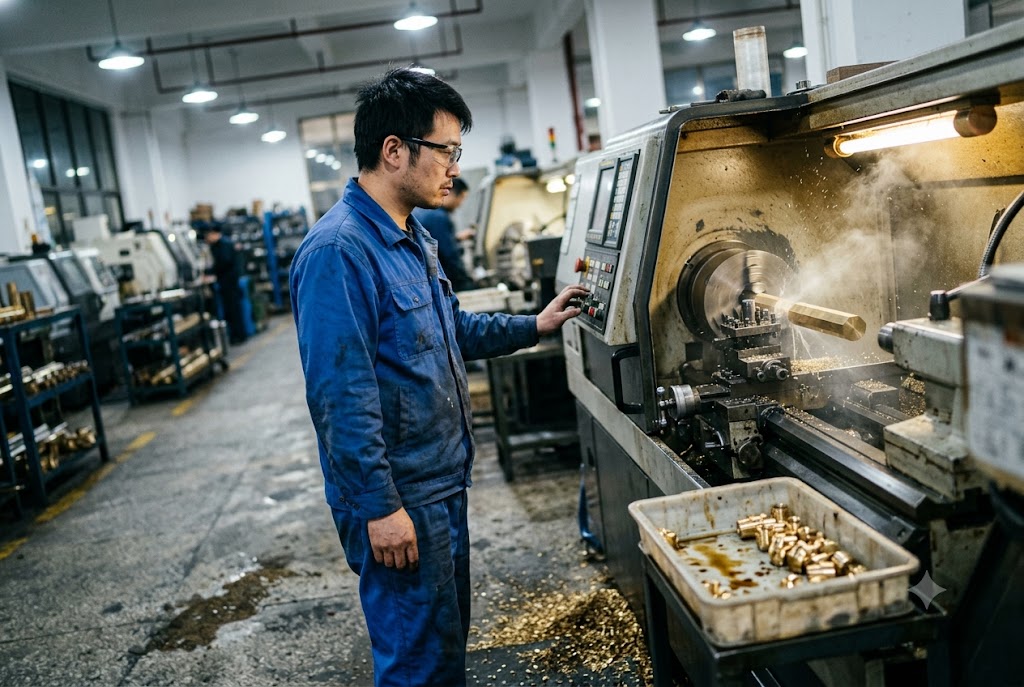
C360 brass 4 runs fast, chips clean, and machines beautifully on a Swiss-type lathe. It is also 2.5–3.7% lead by weight — roughly 25,000–37,000 ppm. That is 25 to 37 times the RoHS limit. There is no workaround. If the assembly is in scope, the material must change.
C36000 brass and 12L14 leaded steel both exceed RoHS lead limits and cannot be used in RoHS-scoped assemblies. Lead-free alternatives include Eco-Brass C69300, Naval Brass C46400, and tellurium copper C14500, each carrying a 15-25% cost premium and requiring adjusted machining parameters on Swiss-type lathes.
Why Leaded Alloys Are the Default in Swiss CNC Shops
Swiss-type lathes run bar stock at high spindle speeds and tight tolerances. Free-machining alloys break chips short and clean, preventing bird-nesting around the guide bushing. Lead acts as a built-in lubricant at the cutting edge. Without it, chip control becomes the machinist's problem — and in lights-out production, that problem can shut down an entire cell.
Chinese Swiss CNC shops default to C360 and 12L14 because they run without issue at volume. Switching materials requires proving the alternative works reliably at production rates. That validation takes time and adds setup cost. Buyers who specify lead-free alloys without flagging it early often receive a re-quote midway through supplier engagement — or worse, receive parts made with the wrong material.
Lead-Free Alloy Comparison
| Alloy | Lead Content | Chip Control | Cost vs C360 | Best Use Case |
|---|---|---|---|---|
| C36000 (standard) | 2.5–3.7% | Excellent | Baseline | Non-RoHS assemblies |
| C69300 Eco-Brass | < 0.09% | Good (Si-P) | +15–20% | RoHS connectors, fittings |
| C46400 Naval Brass | < 0.20% | Moderate | +10–15% | Marine and structural parts |
| C14500 Tellurium Copper | < 0.005% | Good | +20–25% | Electrical contacts |
| 303 Stainless Steel | None | Moderate | +30–40% | Corrosion-critical applications |
Bar Feed and Parameter Adjustments
Eco-Brass C69300 5 uses silicon and phosphorus for chip-breaking instead of lead. It machines well, but behaves differently at the spindle. Our engineers have found that feed rates typically need to drop 10–15% compared to C360, and coolant flow must increase to manage the slightly higher cutting temperature. Guide bushing clearances also need re-checking — C69300 has a different coefficient of thermal expansion, which matters on long-run production where the bar heats up progressively.
For 12L14 leaded steel, the lead-free equivalent is 1215 sulfur-bearing steel or AISI 303 stainless. Sulfur provides some lubricity, but tool life is shorter than with leaded grades. Budget for more frequent insert changes when quoting RoHS jobs in steel.
The cost premium for lead-free alloys is real — 15–25% on material alone, before accounting for shorter tool life and slower cycle times. Build this into your target price before issuing the RFQ. Suppliers quoting lead-free jobs at leaded-alloy prices are either running the wrong material or absorbing losses they will recover through other means.
Can Chinese Factories Provide REACH SVHC Substance Declarations for My Precision Machined Parts?
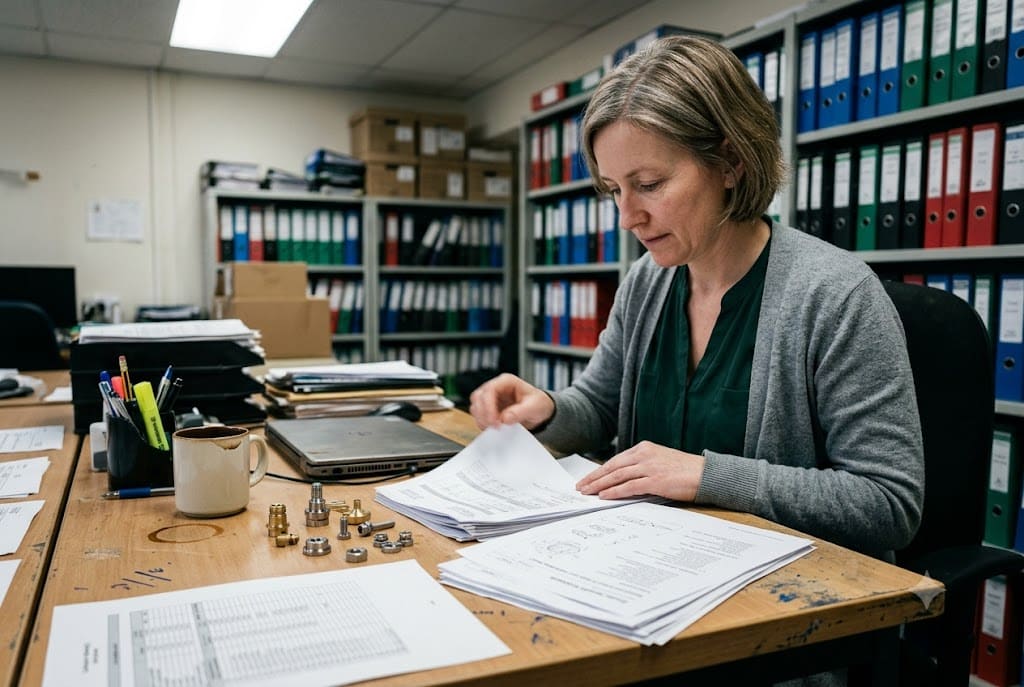
Yes — but the declaration you receive is only as reliable as the process behind it. Most Chinese CNC shops will issue an SVHC declaration on request. The harder question is whether they are tracking the right version of the Candidate List, and whether that declaration covers their finishing subcontractors.
Chinese factories can provide REACH SVHC declarations, but reliability is limited. ECHA updates the Candidate List twice per year, so a declaration valid at PO acceptance may be outdated by shipment. Declarations also typically cover only base material, not tier-2 finishing subcontractors whose plating may introduce SVHCs.

What REACH Article 33 Actually Requires
REACH is not a ban list in the same sense as RoHS. It is a disclosure and authorization framework. Article 33 requires suppliers 6 to declare any SVHC present above 0.1% by weight in an article and to respond to downstream customer requests within 45 days. The 0.1% threshold is assessed per discrete article, not per assembled product. This distinction matters enormously in practice.
The ECHA Candidate List 7 currently holds more than 250 SVHCs, updated twice annually. Lead, cadmium, and hexavalent chromium all appear on it. A supplier who last checked the list six months ago may not realize that a substance used in their subcontractor's plating bath was added in the latest update.
The "Once an Article, Always an Article" Rule
The European Court of Justice (ECJ) ruling on "Once an Article, Always an Article" (O5A) confirms that the 0.1% SVHC threshold applies to each individual component independently — not to the diluted percentage across a whole assembled product. A single Swiss-turned brass connector in a multi-component assembly is assessed on its own lead content, not on the connector's weight as a fraction of the total.
This is the most common miscalculation we identify when auditing Chinese supplier compliance documentation. A supplier calculates lead at the assembly level, shows 0.08% across the whole product, and issues a passing declaration. But the brass sub-component alone is 3% lead. Under O5A, that sub-component triggers an Article 33 disclosure obligation regardless of the assembly-level figure.
SVHC Declaration Risk Factors
| Risk Factor | How It Fails | Mitigation |
|---|---|---|
| Outdated Candidate List | Declaration valid at PO, outdated by shipment | Require supplier to re-confirm at date of shipment |
| Tier-2 subcontractor chemistry | Plating shop uses SVHC not tracked by primary supplier | Require separate declaration from finishing subcontractor |
| O5A miscalculation | Compliance assessed at assembly level, not per article | Specify per-article assessment in contract language |
| No version control | ECHA list version not cited; obligation unclear | Lock contract to specific ECHA Candidate List version at delivery |
Contractual SVHC compliance clauses should require the supplier to re-confirm against the then-current Candidate List at the date of shipment. The contract should name the specific ECHA Candidate List version in effect at time of delivery as the governing reference. Without this, you are accepting a declaration that may have been accurate at PO but is technically outdated by the time goods clear customs.
What Documentation Should I Request from My Supplier to Prove RoHS and REACH Compliance?
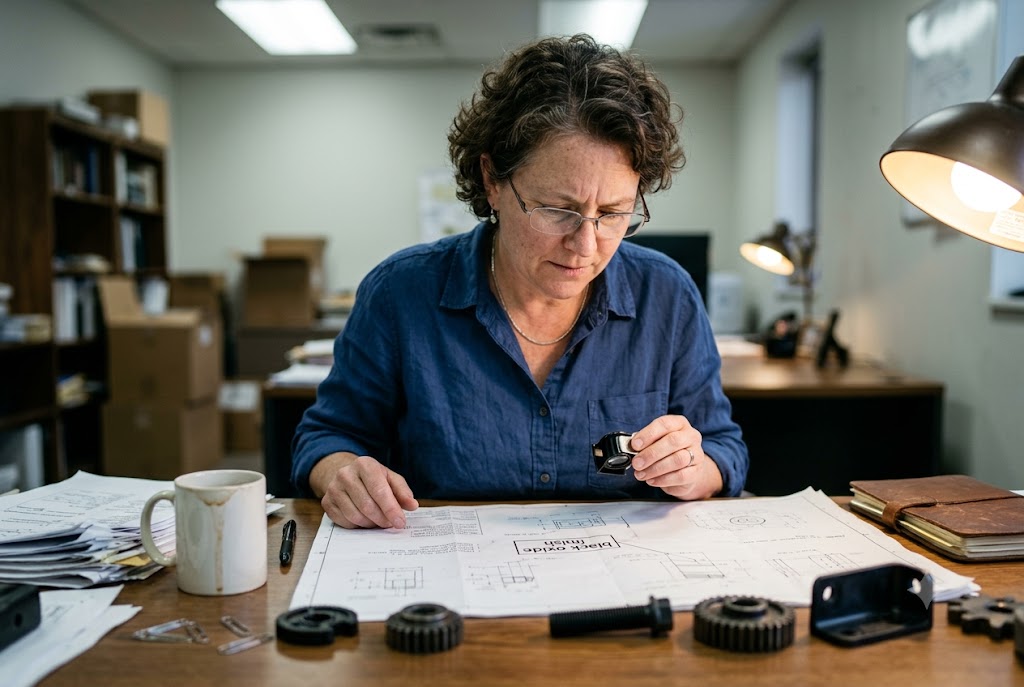
Getting a compliance declaration is easy. Getting one that holds up under scrutiny is harder. We have seen Chinese suppliers issue RoHS certificates covering only the base material and go silent when asked about the plating chemistry. Knowing which documents to request — and what each must contain — closes that gap.
Request a RoHS test report per IEC 62321 covering base material and surface treatment separately, colorimetric Cr6+ results per IEC 62321-7-2, an SVHC declaration citing the current ECHA Candidate List version, and plating subcontractor certification naming the finishing facility and confirming trivalent chromate chemistry only.

The Minimum Document Set
A well-structured compliance document request covers four areas: test methodology, scope of materials tested, supply chain coverage, and version control for the regulatory list. A one-page signed declaration without supporting test data does not satisfy any of these areas. It is a statement of intent, not evidence of compliance.
Compliance Document Request Checklist
| Document | What to Verify | Red Flag |
|---|---|---|
| RoHS test report (IEC 62321 series) | Covers each homogeneous material separately | Single-page declaration with no test data |
| Cr⁶⁺ colorimetric test (IEC 62321-7-2) | Names the specific conversion coating tested | XRF-only report used for chromate coating |
| SVHC declaration | References ECHA Candidate List version and date | "Compliant with REACH" only, no version number |
| Plating subcontractor certificate | Names finishing facility and confirms bath chemistry | Issued only by primary CNC shop, no sub-tier detail |
| Mill test certificate (MTC) | Confirms alloy composition (e.g., C69300 vs C360) | Generic grade listed without chemical composition data |
Emerging Substances: RoHS Pack 15
RoHS is not static. Pack 15 discussions are actively evaluating seven additional substances for restriction. Beryllium is receiving the most attention for Swiss CNC applications. Beryllium copper C17200 8 is widely used in springs, contacts, and high-fatigue components. If beryllium is added to the restricted list, parts currently in production using C17200 will require re-qualification on an alternative alloy.
The other Pack 15 candidates — cobalt compounds, diantimony trioxide, indium phosphide, medium-chain chlorinated paraffins, nickel compounds, and TBBP-A — appear less frequently in Swiss CNC base metals but may be present in coatings, lubricants, or soldering materials used in the same assembly. Procurement strategies that lock in beryllium copper as a long-term specification should account for potential future re-qualification costs now, while lead times are manageable.
Contractual Flow-Down Language
Supplier contracts must explicitly require compliance documentation to flow down to tier-2 subcontractors. Without this clause, RoHS and REACH declarations from Chinese CNC shops cover only what happens inside their own facility. The finishing shop using hexavalent chromate baths because it is cheaper remains invisible to the compliance chain 9 — unless you make it visible through contract language.
Require the primary supplier to obtain and provide plating chemistry certification from the finishing house. That certificate should name the sub-tier facility, state the specific bath chemistry used, and be dated within the production window of your order. "RoHS compliant" printed on a generic form is not a substitute for a named facility and a named chemistry.
Conclusion
RoHS and REACH compliance in Swiss CNC sourcing comes down to three things: the right base material, controlled finishing subcontractors, and documentation that traces both. Get those three right, and the paperwork follows naturally. For parts destined for California's covered electronic device market 10, that documentation chain must be in place before the first shipment, not assembled in response to a customer audit.
Footnotes
1. Full text of RoHS Directive 2011/65/EU, covering restricted substances and EEE scope definitions. ↩︎
2. Overview of XRF capabilities and limitations for RoHS screening, including the chromium speciation gap. ↩︎
3. IEC 62321-7-2:2017 standard for colorimetric determination of hexavalent chromium in electronics and polymers. ↩︎
4. C36000 free-machining brass specifications, including 2.5–3.7% lead content and machinability data. ↩︎
5. C69300 Eco-Brass alloy data, compliance status, and machining applications as a lead-free alternative. ↩︎
6. ECHA summary of legal obligations triggered by REACH Candidate List inclusion, including Article 33 duties. ↩︎
7. The official ECHA Candidate List of Substances of Very High Concern, updated twice annually. ↩︎
8. Beryllium copper C17200 alloy data from Farmers Copper, relevant to RoHS Pack 15 risk assessment. ↩︎
9. RoHS testing methodology guide covering IEC 62321 methods, screening tools, and documentation requirements. ↩︎
10. CalRecycle overview of California's SB 20/SB 50 covered electronic waste program and substance restrictions. ↩︎