Skip to main content Skip to footer
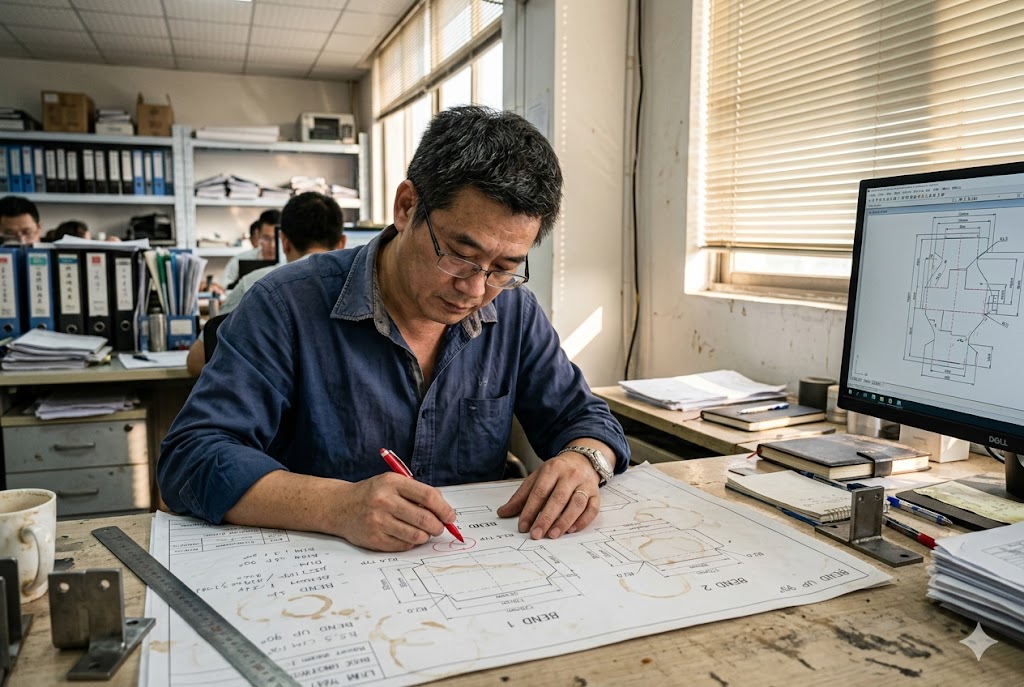
Every year, our team handles sourcing cases where a client's complex bracket reaches first-article stage only to fail dimensional inspection — not because the factory was careless, but because no one verified the flat pattern before cutting began. That single missed step costs real money.
A flat pattern confirms whether your sheet metal part is manufacturable by unfolding the 3D geometry into a 2D blank, exposing bend allowance errors, flange length violations, hole-to-bend conflicts, and tolerance stack problems before any material is cut or tooling committed.
If you source sheet metal parts 1 from China or Vietnam, flat pattern review is the fastest DFM gate available to you. Here is how to use it properly.
Why Should I Ask My Supplier to Review a Flat Pattern Before Mass Production Starts?
When we place a sheet metal order with a new factory, the first document we request back is their calculated flat pattern — not a production schedule. That one step has saved our clients from expensive first-article failures more times than we can count.
Asking your supplier to review the flat pattern before production starts ensures their tooling, K-factor, and bend deduction assumptions match your drawing intent, catching dimensional errors when they cost minutes to fix rather than weeks and thousands of dollars to rework.

Why This Step Gets Skipped — And Why That Is a Problem
Most purchasing managers send a 3D model or a 2D drawing with a bend table and assume the supplier will figure out the rest. Suppliers often do — but "figure it out" means they apply their own default K-factor 2, their own bend deduction tables, and their own material assumptions. If those assumptions differ from yours, the finished part will be off-dimension in ways that are hard to trace back to the root cause.
The flat pattern makes every assumption explicit. It forces agreement on the following variables before any metal moves.
Key Variables a Flat Pattern Review Confirms
| Variable | What It Controls | Risk If Mismatched |
|---|---|---|
| K-factor | Neutral axis position during bending | Flat blank wrong size; part out of tolerance |
| Bend deduction | Material shortening per bend | Cumulative dimensional error across multi-bend parts |
| Bend radius | Inside corner radius | Cracking, springback deviation |
| Material grain direction | Minimum safe bend radius | Cracking along bend root in production |
| V-die opening | Minimum flange length | Unbendable flanges; press brake cannot register part |
How to Structure the Flat Pattern Review Request
Do not simply email the supplier and ask them to "check the flat pattern." Give them a specific deliverable to return. Here is a practical format:
- Send your flat pattern as a DXF file with bend lines annotated — angle, direction (up or down), and radius labeled on each line.
- State the K-factor and bend deduction values your CAD system used to generate the flat pattern in the title block.
- Ask the supplier to return a redlined DXF showing their own calculated flat pattern overlaid on yours.
- Set an acceptance criterion: critical dimensions must match within ±0.2 mm.
What Discrepancies at This Stage Actually Mean
A ±0.5 mm discrepancy between your flat pattern and the supplier's calculated blank sounds small. On a single-bend bracket, it probably is. On a part with five sequential bends, that same error compounds. By the fifth bend, a feature intended to land at a specific hole location can be 1.5–2 mm off — enough to fail assembly fit entirely.
Resolving a flat pattern discrepancy before production is a 30-minute engineering conversation. Resolving it after 500 parts are cut and bent is a rework negotiation, a delivery delay, and potentially a customer stoppage claim. The cost difference is not proportional. It is categorical.
When to Make Flat Pattern Review a Contractual Requirement
For parts with more than three bends, any flange under 8 mm in the 3D model, or any hole within 5 mm of a bend line, make flat pattern supplier sign-off a formal step in your purchase order terms. Require written confirmation — email is sufficient — that the supplier's calculated flat pattern matches your submitted DXF within tolerance before the order proceeds to cutting.
How Can a Flat Pattern Help Me Detect Design Errors and Avoid Costly Rework?
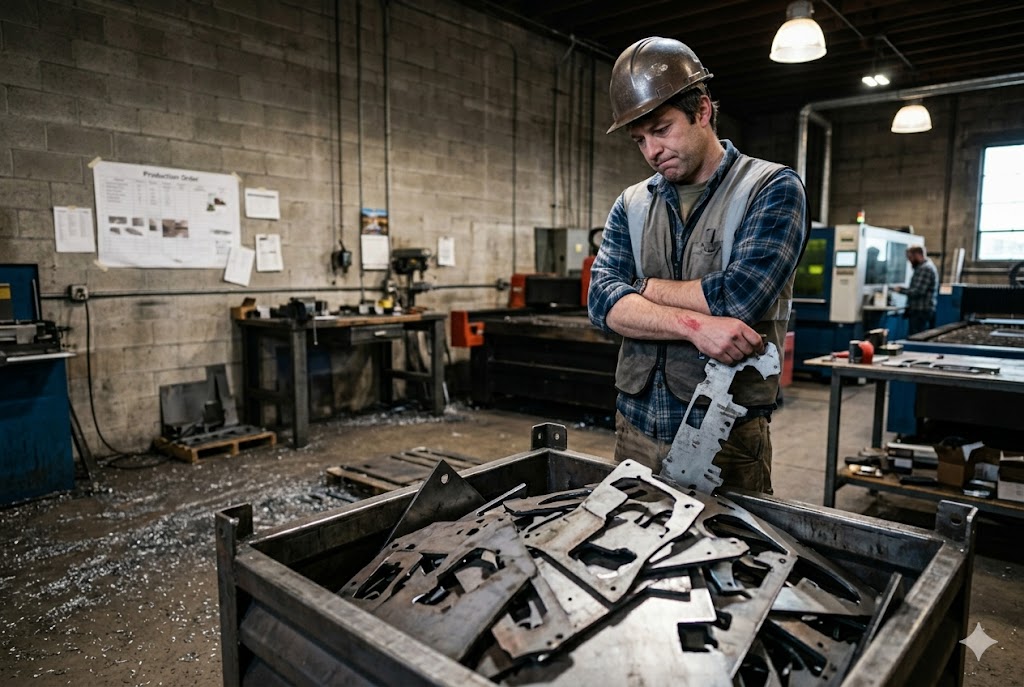
Our engineers catch more design problems from a flat pattern in ten minutes than from reviewing a 3D model for an hour. The flat pattern collapses complex geometry into a single 2D view where failures become obvious.
A flat pattern detects design errors by making flange lengths, hole positions relative to bend lines, blank size against standard stock, and tolerance accumulation visible in one 2D view — problems that remain hidden in a 3D model until the part fails at first article.
The Eight Design Errors a Flat Pattern Exposes
Most costly rework situations in sheet metal sourcing come from the same small set of design mistakes. The flat pattern catches all of them.
Minimum Flange Length Violations
Unfold the part and measure every flange in the flat pattern against the supplier's minimum bend flange formula 3. The general rule: minimum flange = 2–3× material thickness plus half the V-die opening. A flange that looks proportional in 3D can unfold to a length the press brake punch physically cannot register. Flag any flange shorter than 4× material thickness as high risk before sending the drawing to any factory.
Hole and Cutout Distortion Risk
On the flat pattern, check whether any punched holes, slots, or cutouts fall within the bend deformation zone — defined as 2× material thickness from the bend line on each side. Holes inside this zone distort during bending, elongating into ovals and destroying locating accuracy for downstream assembly. This is among the most frequent DFM failures on complex machined brackets designed in 3D without flat pattern review.
Blank Size vs. Standard Stock
| Chinese Standard Sheet Size | Common Materials | Implication for Oversized Blanks |
|---|---|---|
| 1000 × 2000 mm | Mild steel, aluminum | Most common; oversized blanks require premium cut-to-length |
| 1250 × 2500 mm | Mild steel, stainless | Larger format; still has limits |
| 1000 × 2000 mm | Aluminum alloy | Standard; custom widths add lead time and cost |
If your flat pattern envelope exceeds standard stock dimensions, you will pay a premium for cut-to-length material and face longer lead times. Catch this before tooling is committed.
Poor Nesting Efficiency
An irregular flat pattern geometry can nest at 50–55% material utilization 4 on a standard sheet. A small redesign — removing a non-functional notch or adjusting a corner radius — can push nesting efficiency above 70%, meaningfully reducing per-part material cost at volume. Ask your supplier for a nesting simulation before the order goes to production.
Tolerance Stack Accumulation
For multi-bend parts, walk the tolerance chain on the flat pattern. Each bend contributes angular error that translates to linear positional error at downstream features. A part with five sequential bends, each holding ±0.5°, can accumulate a final feature positional error of 1.5–2 mm at the far end. If that exceeds your assembly clearance, either tighten bend angle tolerances or redesign to reduce bend count between critical datums.
Bend Sequence Collision
The flat pattern, combined with a bend sequence simulation, reveals whether existing bends will collide with the press brake back-gauge during later operations. A complex part requiring six or more repositions is a redesign candidate — each reposition adds labor cost and cumulative tolerance.
Grain Direction Misalignment
In the flat pattern, orient bend lines relative to the material's rolling direction. Bends parallel to the rolling direction require 1.5–2× the bend radius needed for cross-grain bends. For sub-1 mm stainless or hard-temper aluminum, ignoring grain direction causes cracking at the bend root in production.
K-Factor Default Mismatch
K-factor 5 typically runs 0.33 for sharp bends in mild steel and 0.40–0.45 for air-bend operations on aluminum. If your CAD system uses a different default than the supplier's press brake setup, the flat pattern will be dimensionally wrong even if geometrically coherent. Always confirm K-factor with the factory before generating the flat pattern.
What Software Do Reliable China Sheet Metal Factories Use to Unfold and Verify My Drawing?
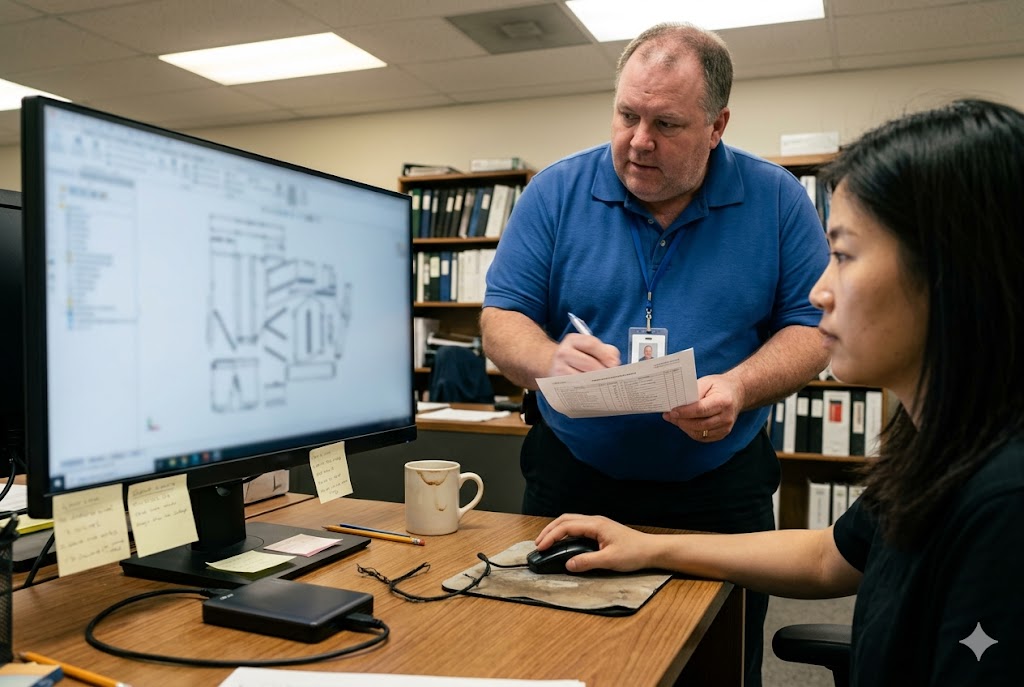
When we audit a sheet metal factory in China or Vietnam, one of our standard questions is: what unfolding software do you use, and can you show us a recent flat pattern output? The answer tells us a great deal about the factory's engineering capability.
Reliable Chinese sheet metal factories use SolidWorks Sheet Metal, AutoCAD, Inventor, Tekla, or dedicated CAM platforms such as Lantek and Metalix to unfold and verify drawings — factories using only manual calculations or general-purpose 2D CAD represent a higher DFM risk.
Software Tiers in Chinese Sheet Metal Factories
Not all factories have the same software capability. The table below maps common software to what it can and cannot do for flat pattern verification.
| Software | Flat Pattern Generation | Bend Sequence Simulation | Nesting | DXF Export |
|---|---|---|---|---|
| SolidWorks Sheet Metal | Yes — parametric | Yes | Via add-on | Yes |
| Autodesk Inventor | Yes — parametric | Yes | Via add-on | Yes |
| AutoCAD (2D only) | Manual only | No | No | Yes |
| Lantek Expert | Yes | Yes | Yes — automatic | Yes |
| Metalix cncKad | Yes | Yes | Yes | Yes |
| Bend-Tech | Yes | Yes | Limited | Yes |
Factories using only AutoCAD in 2D rely on engineers manually calculating bend deductions — which introduces human error and limits traceability. Parametric CAD and dedicated CAM platforms calculate bend allowances automatically from material and tooling parameters, making the flat pattern auditable and repeatable. SolidWorks Sheet Metal 6 is one of the most widely adopted parametric tools for this purpose, enabling factories to generate and export flat patterns directly from 3D models.
What to Ask During a Factory Audit
When assessing a Chinese supplier's sheet metal capability, ask these questions directly:
- Which software do you use to generate flat patterns from customer 3D files?
- Can you show us your bend deduction table for 2 mm mild steel and 2 mm aluminum 6061?
- Do you simulate bend sequences before programming the press brake, or do operators determine sequence on the floor?
- Can you export a DXF flat pattern with annotated bend lines for customer review before cutting?
A factory that answers confidently and shows you documented bend deduction tables is operating at a professional level. A factory that answers vaguely or cannot produce a sample DXF output is a higher risk for complex parts.
Why Software Capability Matters for Your Order
For simple one- or two-bend brackets, most factories can produce acceptable results regardless of software. For complex multi-bend enclosures, frames, or brackets with tight tolerances, the factory's software capability directly determines whether DFM problems are caught before or after your first article.
Our team has visited factories in Guangdong, Jiangsu, and Vietnam that run full Lantek Expert 7 suites — these factories can receive a STEP file, generate a parametric flat pattern, run a nesting simulation, and return a DXF for customer review within 24 hours. That speed and transparency is a meaningful quality signal.
Should My Supplier Send Me a Flat Pattern for Approval Before Cutting Begins?
Every order our team manages for complex sheet metal parts includes a flat pattern approval step as a formal hold point. We do not release the cutting order until the client or our QC team has signed off on the flat pattern DXF. It is not optional for us, and we recommend it is not optional for you either.
Yes — your supplier should send you a flat pattern DXF for approval before cutting begins on any part with more than two bends, flanges under 10 mm, holes near bend lines, or assembly-critical tolerances, because this is the last low-cost intervention point before material and tooling costs are committed.

How to Build Flat Pattern Approval Into Your Purchase Order
The flat pattern approval step works only if it is defined in your purchase order before the supplier starts work. Here is a practical structure:
- State in the PO: "Supplier must submit flat pattern DXF for buyer approval before cutting commences."
- Set a review turnaround time — 48 hours is reasonable for most orders.
- Define the acceptance criterion — typically ±0.2 mm on critical dimensions, ±0.5 mm on non-critical.
- Include a hold: cutting does not begin until buyer returns written approval or a redline with change requests.
This language makes flat pattern approval a contractual step, not a courtesy request. Suppliers who skip it are in breach of the PO terms.
What You Are Checking When You Review the Flat Pattern
When the supplier sends the DXF, review it against these criteria following established sheet metal design guidelines 8:
- Overall blank dimensions match your calculated flat pattern within tolerance
- All bend lines are present, annotated with angle, direction, and radius
- No holes or cutouts fall within the bend deformation zone
- All flanges meet minimum length requirements
- Blank fits within standard stock dimensions
- K-factor and bend deduction values used by the supplier are documented
If you lack in-house sheet metal engineering resources to review the DXF, this is exactly the kind of pre-production quality service our team provides — reviewing the supplier's flat pattern against your drawing before sign-off.
The Real Cost of Skipping This Step
A first-article failure 9 on a complex sheet metal part typically costs the following:
- Scrap material for the prototype run
- Rework labor or re-cutting cost
- Engineering time to diagnose root cause
- Delay — typically 2–4 weeks on a China-sourced order
- In some cases, expedited freight to meet a downstream deadline
None of those costs appear in the original quotation. Following good press brake tooling selection practices 10 and performing flat pattern approval before cutting eliminates most of them at the cost of a 48-hour delay at the start of the order — a trade that virtually always makes sense.
Conclusion
Flat pattern review is the single highest-leverage DFM step in sheet metal sourcing. It costs almost nothing. It catches the problems that cause first-article failures, rework, and delivery delays. Build it into every complex part order — before cutting begins.
Footnotes
1. Comprehensive overview of sheet metal fabrication processes, materials, and design best practices. ↩︎
2. Wikipedia reference explaining the K-factor as a key bending capacity metric in sheet metal work. ↩︎
3. Detailed guide on minimum flange length requirements relative to V-die opening and material thickness. ↩︎
4. Industry resource on maximizing sheet nesting efficiency to reduce per-part material cost. ↩︎
5. Xometry guide on K-factor values and how they affect flat pattern accuracy in bend operations. ↩︎
6. Official SolidWorks documentation for creating and exporting flat pattern configurations from 3D sheet metal parts. ↩︎
7. Lantek Expert product page for the industry-leading CAD/CAM nesting software used in sheet metal factories. ↩︎
8. Xometry's design guide covering tolerancing, bend radii, flanges, and sheet metal DFM best practices. ↩︎
9. Illustrates real-world consequences of skipping DFM review at the press brake design stage. ↩︎
10. Expert rules for press brake V-die selection and flange length limits during sheet metal bending. ↩︎