Skip to main content Skip to footer
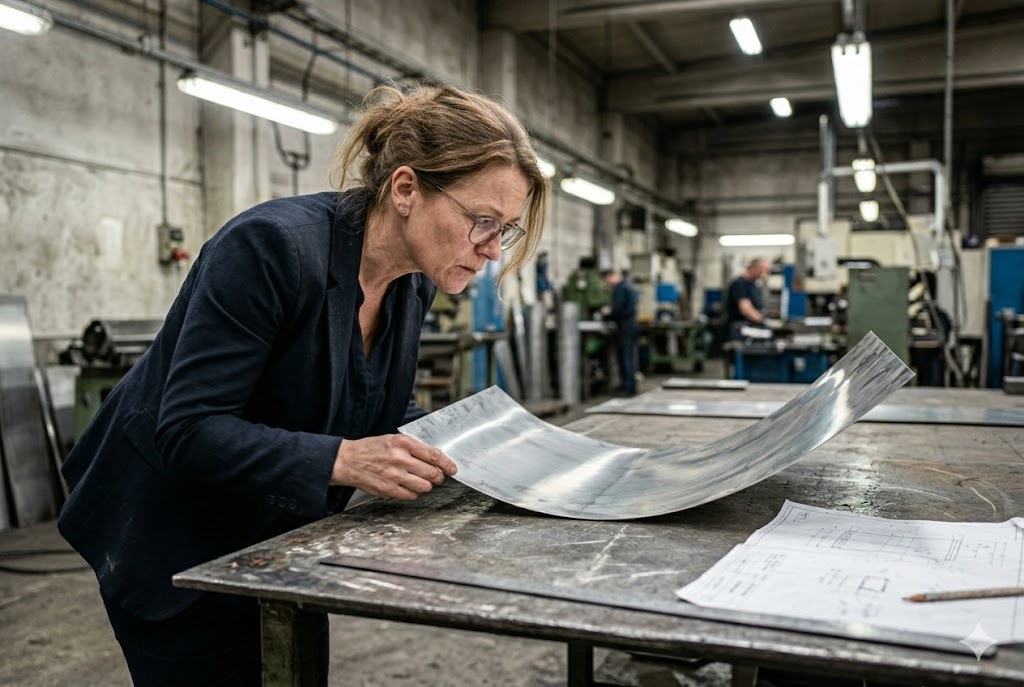
We see it every week. A client sends us a drawing. The parts look simple on screen. Then production starts — and that is when the real problems begin. Thin sheet metal under 1mm warps. Thick plate over 6mm cracks at the weld. Both destroy timelines and budgets.
The main manufacturing challenges for thin sheet metal under 1mm include thermal warping, springback, and burr formation. For thick plate over 6mm, the key issues are weld penetration defects, residual stress, and edge quality after cutting. Both extremes require specialized equipment, process controls, and supplier vetting to avoid costly rework.
Understanding these challenges upfront saves you from expensive surprises. Here is what you need to know before you place your next order.
Why Is Thin Sheet Metal Harder to Cut and Weld Without Deformation?
Our production teams handle sub-1mm parts regularly — and we will be direct: thin gauge work is unforgiving. A small error in laser power or clamp position shows up immediately in the finished part.
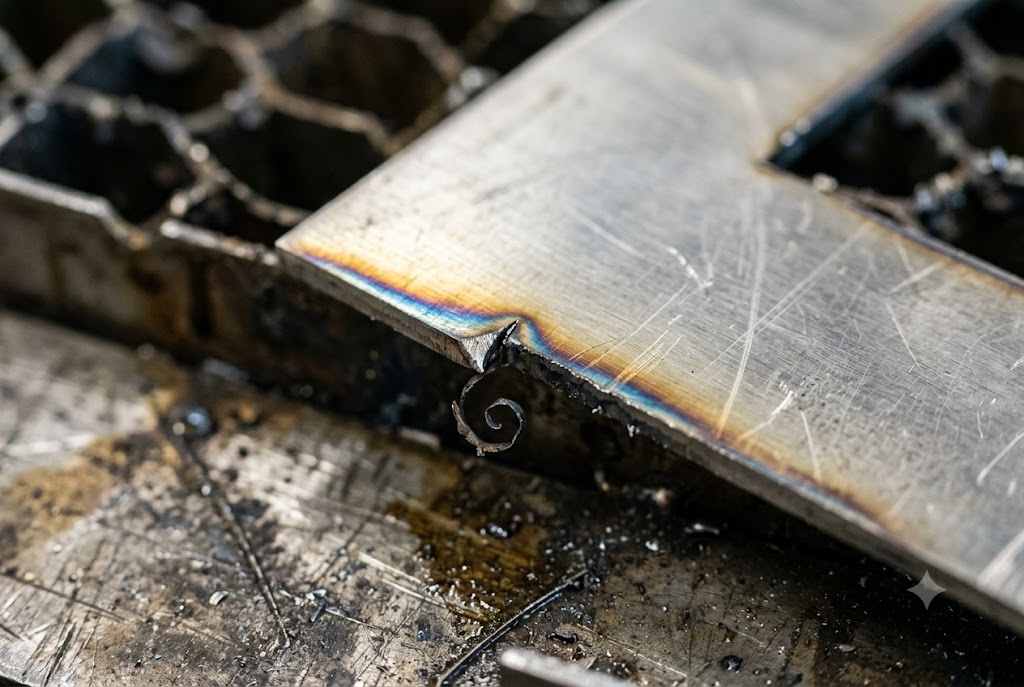
Thin sheet metal under 1mm is harder to cut and weld because the material has almost no heat capacity. Laser cutting and welding concentrate heat into a tiny area, which causes burn-through, surface discoloration, and geometric distortion. These defects are difficult to reverse and often result in part rejection.
Why Heat Is the Core Problem
Sub-1mm material cannot absorb or spread heat the way thicker plate does. When a laser head moves across a 0.5mm stainless sheet, the heat builds up faster than the metal can release it. The result is warping — sometimes visible to the naked eye, sometimes only measurable with a CMM.
Welding makes this worse. Standard MIG or TIG settings suitable for 2mm plate will burn straight through 0.8mm material. Qualified fabricators use stitch-welding protocols, pulsed TIG 1, or laser welding to control heat input. Shops without these processes will improvise — and the parts will show it.
Springback in Thin Stamped Parts
Springback 2 is elastic recovery after a press operation. In plain terms: you bend the metal, and it springs back partway when the press opens.
For thin high-tensile steel or 6000-series aluminum alloys, springback after stamping can produce angular deviations of 3–10°. This is large relative to part size. A bracket designed at 90° may come out at 87° or 93° — outside drawing tolerance.
| Material | Thickness | Typical Springback Range | Compensation Method |
|---|---|---|---|
| Mild Steel (SPCC) | 0.5–0.8mm | 1–3° | Die overbend |
| High-Tensile Steel | 0.5–0.8mm | 4–8° | Bottoming + overbend |
| Aluminum 6061 | 0.5–1.0mm | 5–10° | Pre-stretch + overbend |
| Stainless 304 | 0.5–0.8mm | 3–6° | Overbend + iterative die trial |
Good tooling engineers account for springback during die design. They overbend the part intentionally. The part springs back to the correct angle. This requires die trials and measurement iterations — which take time and add to tooling cost.
Burr Formation and Edge Quality
For thin gauge parts, burrs are a serious defect — not just a cosmetic issue. A burr over 0.1mm on a sealing surface causes leaks. A burr on an electronic enclosure panel creates a short circuit risk.
Burrs form when the punch-to-die clearance is wrong or when the punch is worn. For 0.5mm material, the correct clearance is typically 5–10% of material thickness — about 0.025–0.05mm. This is a precision that many tier-2 and tier-3 Chinese fabricators do not maintain consistently.
Process Documentation Is the Hidden Risk
Here is something most buyers do not check: whether the supplier keeps laser power calibration logs and written process SOPs for thin gauge work. Many smaller Chinese fabricators do not. This means part-to-part consistency degrades silently during a production run. The first-article inspection passes. Mid-run parts drift out of tolerance. By the time you find out, you have a full shipment of non-conforming parts.
Require incoming inspection protocols — AQL sampling 3 at first article and again at mid-run. Do not assume process stability. Verify it.
What Equipment Should My Supplier Have to Handle Heavy-Gauge Sheet Metal Accurately?
When we visit factories handling thick structural plate, the first thing we check is the cutting bay. Equipment tells you almost everything you need to know about a supplier's capability.
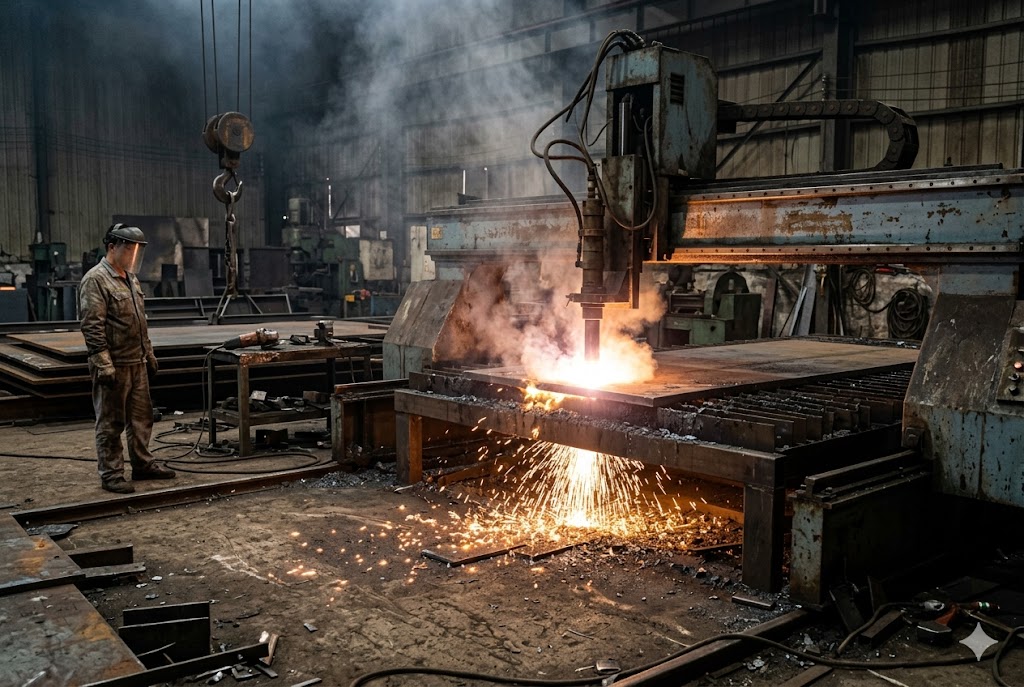
To handle thick plate over 6mm accurately, a supplier needs plasma or oxy-fuel cutting for rough stock, laser or waterjet for precision edges, robotic MIG or submerged arc welding (SAW) for full-penetration welds, and post-weld heat treatment (PWHT) furnaces for stress relief. Without this equipment combination, thick plate work will produce dimensional and structural defects.
Cutting Equipment by Thickness Range
Not all cutting processes work at all thicknesses. The table below shows what is appropriate for structural plate work.
| Thickness Range | Suitable Process | Edge Quality | Notes |
|---|---|---|---|
| 6–12mm | Fiber laser | Good | Clean edge, fast cycle |
| 12–20mm | Plasma cutting | Moderate | Expect edge taper 1–3° |
| 20–50mm | Oxy-fuel or plasma | Lower | Secondary machining often needed |
| Any thickness | Waterjet | Excellent | No HAZ, slow, higher cost |
Plasma and oxy-fuel cutting above 20mm frequently produces edge taper, surface hardening, and micro-cracking. These are not cosmetic problems. If your part has a mating surface or a weld preparation, a tapered edge causes fit-up problems and weld defects downstream.
Waterjet cutting 4 solves the edge quality problem — it produces no heat-affected zone (HAZ). But it is slow and expensive at heavy gauges. Buyers must decide whether precision justifies the cycle time penalty.
Welding Capability for Full Penetration
Welding thick plate is fundamentally different from welding thin sheet. The heat input required to achieve full penetration in a single pass exceeds what most shop-floor MIG machines can deliver without introducing porosity or undercuts.
Proper thick plate welding uses:
- Multi-pass MIG or MAG welding — multiple weld beads build up the joint layer by layer
- Submerged arc welding (SAW) 5 — automated process, high deposition rate, good for long straight welds in structural fabrication
- Robotic MIG — consistent torch angle and travel speed, reduces human error in multi-pass sequences
Heat-Affected Zone and PWHT
Every fusion weld creates a heat-affected zone. In the HAZ, the base metal microstructure changes due to rapid heating and cooling. In thick plate, this zone is wider and experiences more severe thermal gradients.
The result: HAZ-induced brittleness, hardness changes, and residual stress. In structural applications — frames, pressure vessels, machine bases — this is a safety and fatigue issue, not just a dimensional one.
Post-weld heat treatment (PWHT) 6 at 595–675°C relieves residual stress and restores toughness in the HAZ. Any supplier handling thick plate structural fabrication should have a PWHT furnace large enough for your parts. If they outsource PWHT, ask for the subcontractor's furnace certification and temperature log records.
Clamping and Fixturing
Thick plate moves during welding. Residual stress accumulates. If parts are not properly clamped and welded in a controlled sequence, warping follows. A flat 20mm plate can come out with several millimeters of bow after welding if the fabricator did not use a proper welding sequence and restraint fixtures.
Ask your supplier to show you their fixturing setup and their standard weld sequence documentation. If they cannot produce it, this is a red flag.
How Does Material Thickness Affect My Lead Time and Unit Cost?
Every time a client asks us to quote, the first variable we look at is thickness. It changes almost everything — process selection, machine time, material cost, and which factories can even take the job.
Material thickness directly affects lead time and unit cost because thinner material requires more precise, slower processes to prevent defects, while thicker material demands more machine time, more welding passes, and post-processing such as heat treatment. Both extremes cost more than mid-range gauges and take longer to produce correctly.
How Thickness Changes the Cost Structure
For thin sheet under 1mm, most of the cost is in process control and rework prevention. Laser time per part may be short — but the setup, calibration, and inspection time is high relative to part size. Any rework is expensive because the material is so easily damaged.
For thick plate over 6mm, raw material cost rises sharply. Machine time increases because cutting is slower, welding requires multiple passes, and PWHT adds hours or days to the schedule. Secondary machining of edges after plasma cutting adds further cost.
| Thickness Range | Primary Cost Driver | Typical Lead Time Impact vs. Mid-Range |
|---|---|---|
| Under 1mm | Process control, inspection, rework | +10–25% longer per batch |
| 1–6mm | Standard — baseline cost and lead time | Baseline |
| 6–20mm | Machine time, multi-pass welding | +20–40% longer per batch |
| Over 20mm | PWHT, secondary machining, material cost | +40–80% longer per batch |
Geographic Supply Chain Impact
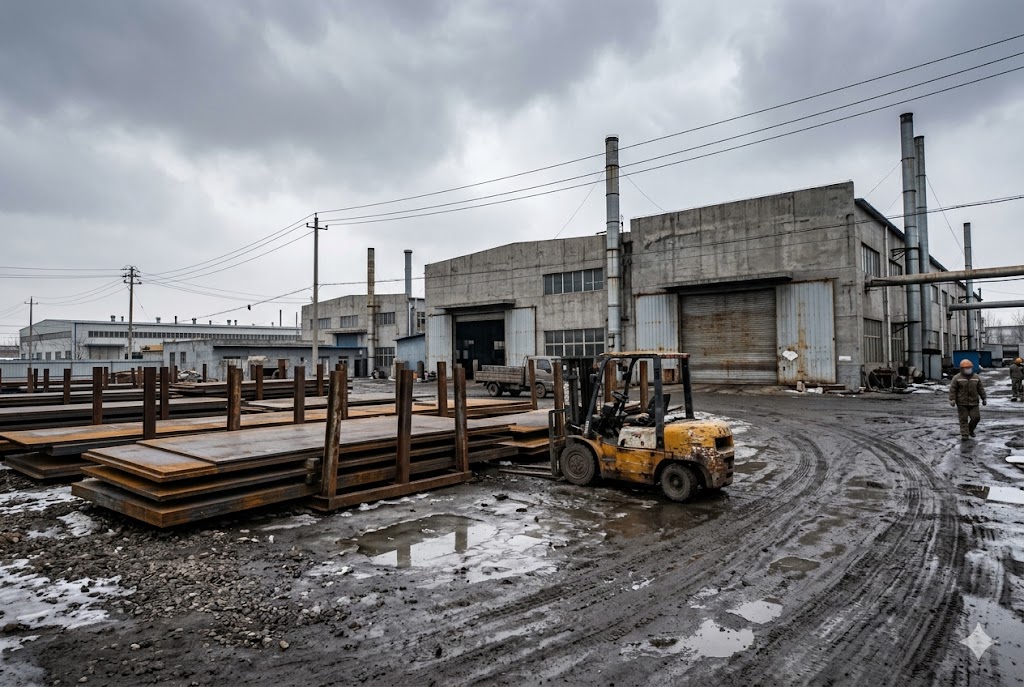
China's fabrication industry is geographically segmented. Sub-1mm precision sheet metal work is concentrated in Shenzhen, Dongguan, and the Pearl River Delta — primarily serving electronics and consumer product manufacturers. Thick structural plate fabrication is concentrated in Liaoning, Hebei, and Shandong — the heavy industry belt in northern and northeastern China.
If your program requires both thin gauge and heavy plate components, a single-supplier strategy will almost certainly create a capability mismatch. Either the thin-gauge specialist cannot handle heavy plate, or the structural fabricator lacks the precision equipment for sub-1mm work.
We manage multi-supplier chains specifically to address this. Parts go to the right factory for their thickness range. This approach adds coordination complexity — but it prevents the quality failures that come from forcing a factory to work outside its capability.
Material Lot Variance and Its Hidden Cost
One underappreciated cost driver is material lot variance. Sub-1mm coil stock from Chinese mills can carry yield strength variation of ±15–20 MPa between production batches. This shifts the optimal blank holder force and springback compensation values between runs.
If a supplier does not verify incoming material mechanical properties — not just dimensions — forming parameters set for the first batch may be wrong for the second. This produces out-of-tolerance parts with no obvious process change to explain the failure.
Incoming material mechanical verification is a necessary quality gate. It adds cost. But it prevents the much higher cost of a non-conforming shipment.
What Tolerance Standards Should I Apply When My Design Uses Very Thin or Very Thick Sheet Metal?
Our engineers review customer drawings before we approach any factory. The most common problem we find is not wrong dimensions — it is unrealistic tolerances for the specified material and process.
For thin sheet metal under 1mm, apply ISO 2768-m 7 or tighter for cut features, but accept wider angular tolerances of ±1–2° for bent features due to springback. For thick plate over 6mm, weld joint tolerances should follow AWS D1.1 8 or ISO 5817 9, and flatness tolerances must account for thermal distortion. Applying the same tolerance standard across all thicknesses without process adjustment leads to high rejection rates.
Tolerance Realities for Thin Sheet Under 1mm
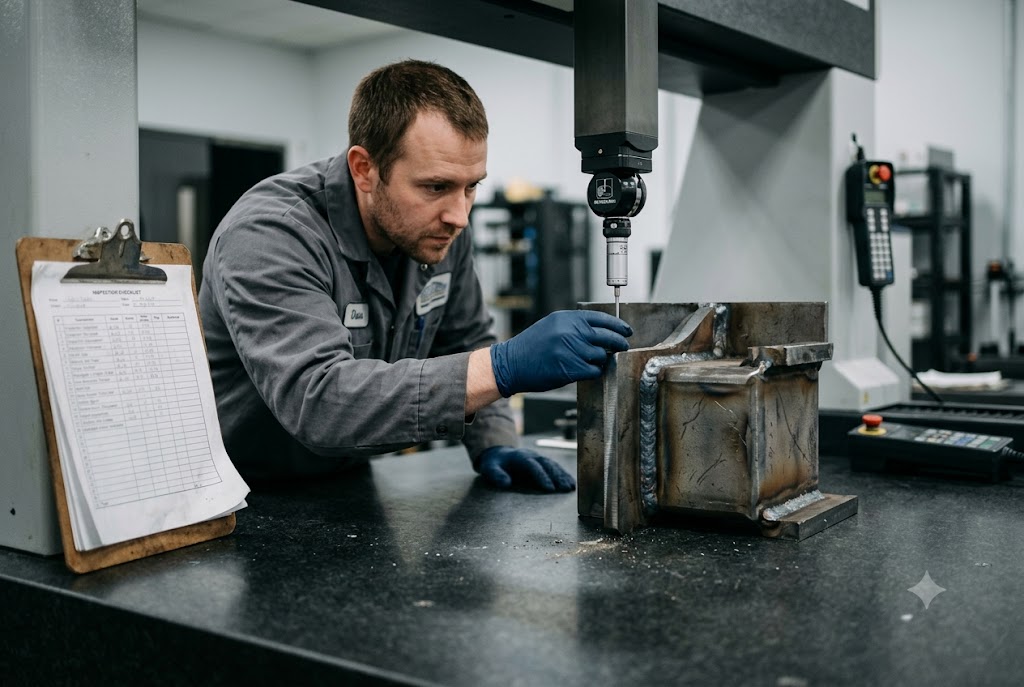
Laser-cut hole positions and profile dimensions on thin sheet can typically hold ±0.1mm with a calibrated fiber laser. This is achievable. But bent features are a different story. Angular tolerances tighter than ±1° on sub-1mm material require die trials, material testing, and iterative adjustment — which adds cost and lead time.
Tolerance Realities for Thick Plate Over 6mm
Thick plate introduces different challenges. Cut edge squareness after plasma cutting may deviate 1–3° from true. Weld distortion can move features by several millimeters relative to pre-weld positions. Post-weld flatness on a large welded plate assembly may require machining to hold tight flatness requirements.
The applicable standards for weld quality are AWS D1.1 (structural steel) and ISO 5817. Both define acceptable limits for porosity, undercut, incomplete fusion, and cracks by quality level (B, C, D for ISO 5817).
Specifying Tolerances on Your Drawing
The table below shows a practical guide to realistic tolerances by thickness and feature type.
| Feature Type | Thickness Range | Realistic Tolerance | Notes |
|---|---|---|---|
| Laser-cut profile | Under 1mm | ±0.10mm | Requires calibrated fiber laser |
| Bent angle | Under 1mm | ±1–2° | Springback-dependent |
| Punched hole position | Under 1mm | ±0.15mm | Punch-die alignment critical |
| Plasma-cut edge | 12–25mm | ±0.5–1.0mm | Edge taper expected |
| Weld joint position | Over 6mm | ±1.0–2.0mm | Post-weld measurement required |
| Flatness (welded assembly) | Over 6mm | ±1.5–3.0mm per 1000mm | PWHT and fixturing reduce this |
Material Traceability for Thick Structural Plate
For thick structural plate, especially in load-bearing or pressure-containing applications, material traceability matters. Chinese mill certifications are frequently issued as heat-average data — one certificate covers an entire production heat of many plates.
If your application requires ASTM A516, EN 10025, or equivalent per-plate traceability, you must contractually mandate mill test reports (MTRs) 10 with specific plate identification marks tied to each individual plate. Batch-level certificates are not sufficient for these applications. This distinction must be written into your purchase order and verified on receipt.
Conclusion
Thin and thick sheet metal both demand specific processes, equipment, and supplier capabilities. Knowing the risks before you order protects your timeline, your quality, and your margins. Choose your suppliers by what they can actually do — not just what they say they can do.
Footnotes
1. How pulsed TIG welding reduces heat input and prevents burn-through on thin gauge materials. ↩︎
2. Overview of springback in stamped parts and die compensation strategies for high-strength materials. ↩︎
3. How AQL sampling sets statistically valid accept/reject thresholds for manufactured goods. ↩︎
4. Comparison of waterjet cutting to plasma and laser, including its zero-HAZ advantage for precision edges. ↩︎
5. Submerged arc welding process overview: high deposition rates and deep penetration for thick structural plate. ↩︎
6. How PWHT at 595–760°C relieves residual weld stress and restores toughness in carbon steel. ↩︎
7. ISO 2768 tolerance classes (fine, medium, coarse) for linear and angular dimensions in CNC fabrication. ↩︎
8. What AWS D1.1 covers: design, fabrication, inspection, and qualification for structural steel welding. ↩︎
9. ISO 5817 quality levels B, C, and D: acceptance criteria for weld imperfections in fusion-welded joints. ↩︎
10. How mill test certificates establish material traceability, linking each plate to its chemical and mechanical data. ↩︎