Skip to main content Skip to footer

Every year, we help clients catch material substitutions before they become expensive field failures. The problem is real, it is common, and it is almost invisible — until something breaks or fails an audit.
You can confirm your China sheet metal supplier is using the correct material grade by requesting a Mill Test Certificate linked to the specific heat number on the received material, cross-checking the chemical composition values against the declared grade, and using portable XRF analysis to physically verify the metal before or during shipment.
Three steps will protect you. Get the certificate. Check the heat number. Test the metal. The sections below break down exactly how to do each one.
What Documents Should I Request to Verify Material Compliance Before Production?
When clients send us a new project, one of the first things our team does is define the documentation package required before any cutting starts. Missing documents at this stage cause delays and disputes down the line.
To verify material compliance before production, request a Mill Test Certificate — also called an MTR or MTC — from your supplier for every material batch. The certificate must show the chemical composition, mechanical properties, heat number, grade, and the mill's quality control stamp. Require this document in your purchase order terms.

What Is a Mill Test Certificate?
A Mill Test Certificate 1 (MTC) is issued by the steel mill that produced the raw material. It documents the actual chemical composition and mechanical properties of that specific batch of metal. It is not a generic product datasheet. Each certificate ties to a unique heat number — a batch identifier assigned during production.
EN 10204 Certificate Types
Not all certificates carry the same weight. The table below explains the most common types.
| Certificate Type | Who Issues It | Third-Party Witnessed | Reliability |
|---|---|---|---|
| EN 10204 2.1 | Manufacturer | No | Low — generic statement only |
| EN 10204 2.2 | Manufacturer | No | Medium — based on testing |
| EN 10204 3.1 | Mill's own QC | No | High — standard for most industrial use |
| EN 10204 3.2 | Independent inspector | Yes | Highest — required for critical applications |
For most custom mechanical parts, EN 10204 3.1 is the minimum acceptable standard. For aerospace, medical, or pressure-vessel applications, require 3.2. The ISO 10474 standard for steel inspection documents 2 provides the international framework that governs how these certificates are structured and issued.
What to Check on the Certificate
Receiving the MTC is step one. Reading it correctly is step two. Check these fields:
| Field to Check | What to Look For | Red Flag |
|---|---|---|
| Declared grade | Must match your drawing exactly (e.g., SUS304, SPCC, SGCC) | Grade listed differently from drawing |
| Heat number | Must match marking stamped or tagged on the physical material | No heat number or illegible stamp |
| Chemical composition | Element percentages must be consistent with the declared grade | Values out of range for that grade |
| Mill stamp | Should show the producing mill's identity and QC signature | Generic or missing stamp |
| Test date | Should be current and predate your order shipment | Certificate older than material delivery |
Embed Requirements in Your Purchase Order
Verbal agreements on material documentation are not enforceable. Add a clause to every purchase order. State the required certificate type, the elements that must be reported, and the consequence for non-submission — such as a shipment hold or payment delay. This creates a contractual obligation your supplier cannot ignore. Guidance on material traceability requirements in structural steelwork 3 offers a useful reference framework for understanding how traceability is built into procurement specifications.
How Can Material Substitution Happen Without My Knowledge, and How Do I Prevent It?
In our experience managing supply chains across China and Vietnam, material substitution is rarely deliberate fraud by a large factory. It most often happens when a supplier sources cheap unmarked stock from a secondary market and does not have a functioning material segregation system.
Material substitution happens when a supplier receives unmarked or mislabeled stock, fails to segregate materials by grade, or presents fabricated certificates to cover a cheaper purchase. You prevent it by requiring heat-number-matched MTCs, conducting pre-shipment PMI testing, and auditing the supplier's incoming material handling process.
Why Visual Inspection Fails
A sheet of 304 stainless and a sheet of 316 stainless look identical. So do many carbon steel grades. Standard dimensional inspection will not catch a substitution. Even basic mechanical testing may not catch it if the substituted grade has similar hardness or tensile strength. This is what makes material fraud so dangerous — and so common.
The Three Most Common Substitution Scenarios
| Scenario | How It Happens | Why It Is Hard to Detect |
|---|---|---|
| 304 supplied against 316 order | Lower-cost grade sourced; certificate fabricated or re-used | Visually identical; XRF is the only reliable check |
| Thinner gauge than specified | Supplier uses thinner stock to cut material cost | Only caught by dimensional measurement before forming |
| Lower grade coated steel | SECC substituted with an uncoated carbon steel and post-painted | Coating weight test required; XRF alone may not catch it |
How to Build a Prevention System
Step 1 — Receive MTCs before shipment. Do not wait until the parts arrive at your dock. Request the MTC digitally before material leaves the mill. If the heat number or composition values are wrong, you can resolve it while the stock is still at the source.
Step 2 — Audit incoming material handling at the supplier. Walk the factory floor and physically follow a sheet from the incoming coil tag through the cutting queue. Ask the operator how they know which material is which. If materials are stored in mixed piles without tags or travelers, substitution risk is high — no certificate review after the fact can fix a broken segregation system.
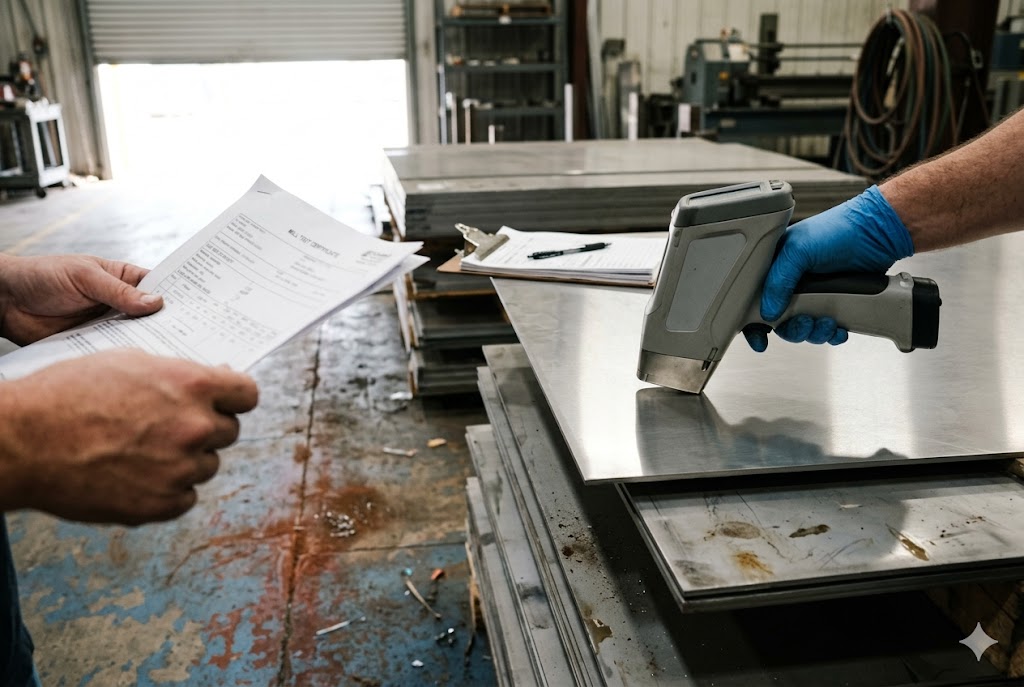
Step 3 — Use PMI testing. Positive material identification (PMI) 4 using portable XRF (X-ray fluorescence) devices can be brought to the factory by a third-party inspector. Testing takes seconds per part and delivers elemental composition readings that confirm or refute the MTC. This is the single most powerful countermeasure available.
Step 4 — Write prevention requirements into the Approved Quality Plan. The AQP should specify how the supplier must tag, store, and track materials through production. Require photos of material tags before cutting begins. An informal request is not enough.
Should I Ask My Supplier to Label and Photograph Raw Materials Before Cutting Begins?
Our team started requiring pre-cutting photo evidence on all stainless and aluminum orders after one client received 6061 parts that tested as 6063. The supplier had no photographic record and no way to prove what material entered the cutting queue.
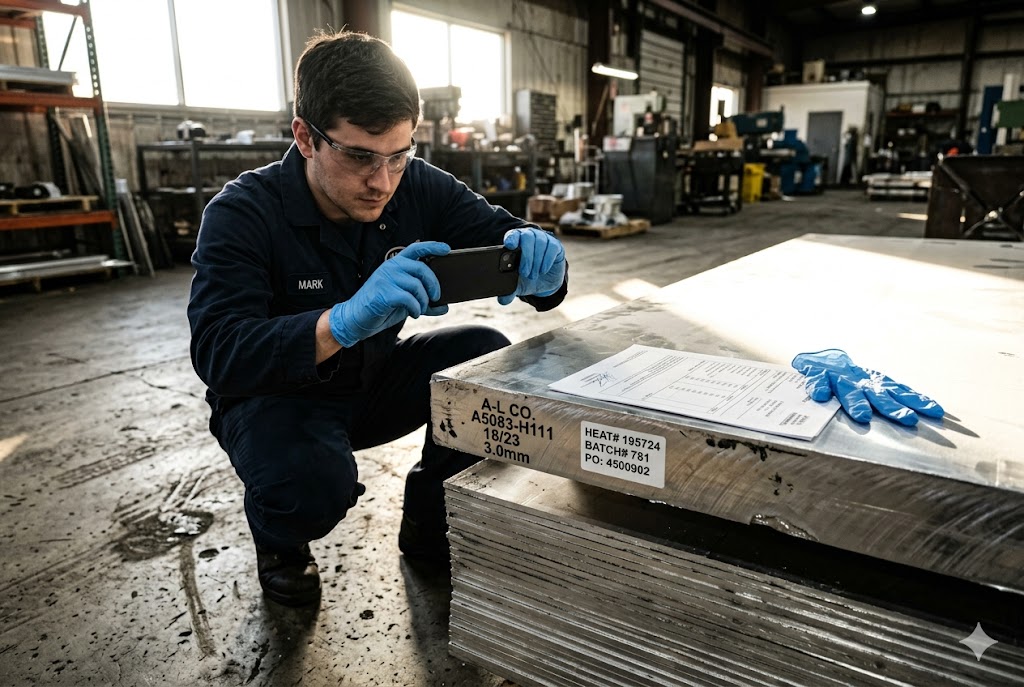
Yes. Requiring your supplier to photograph and label raw materials before cutting begins is a low-cost, high-value control. Photos should show the material tag, heat number, and the associated MTC side by side. This creates a visual audit trail that connects the certified material to the parts actually produced.
What to Request and When
Ask for this photo evidence at a specific moment in the production process: after incoming inspection, before the material enters the cutting queue. The photos must show:
- The physical material tag or mill stamp
- The heat number clearly readable
- The MTC document alongside the material
- The date and time stamp from the camera or phone
This takes less than five minutes per batch. It is not a burden on a compliant supplier. If a supplier resists, that resistance itself is informative.
How to Store and Use This Evidence
Photo evidence is only useful if it is organized and retrievable. Ask your supplier to submit photos through a shared folder or quality management system indexed by your part number and order number. Store the photos alongside the MTC and your incoming inspection records.
If a field failure occurs six months after delivery, you need to trace the failed part back to a specific material batch. Without photo evidence and a heat-number-linked MTC, that traceability does not exist. With it, you can answer a customer complaint or insurance claim in hours instead of weeks.
When to Escalate to Third-Party Inspection
For high-value orders, repeat programs, or suppliers you are working with for the first time, consider sending a third-party inspector to witness the material labeling and photograph the process independently. Agencies such as SGS 5, Bureau Veritas 6, and Intertek 7 offer pre-production material verification services. Their independently issued report adds contractual weight and removes the conflict of interest inherent in supplier-submitted photos.
Labeling Requirements by Material Type
| Material Type | Labeling Method | Additional Verification Recommended |
|---|---|---|
| Stainless steel sheet | Mill stamp or adhesive tag with heat number | XRF PMI before cutting |
| Carbon steel sheet | Mill tag tied to coil or sheet | MTC cross-check sufficient for most grades |
| Aluminum sheet/plate | Alloy stamp or supplier tag | XRF PMI — alloy fraud is common in aluminum |
| Galvanized / pre-coated steel | Mill tag plus coating weight stamp | Coating weight test per JIS H0401 or equivalent |
What Testing Methods Can Confirm the Actual Material Grade of My Finished Parts?
After years of working with factories across China and Vietnam, our engineers have found that certificate review alone is not enough for critical applications. Physical testing is the only way to verify what is actually in the part — not what the paperwork says.
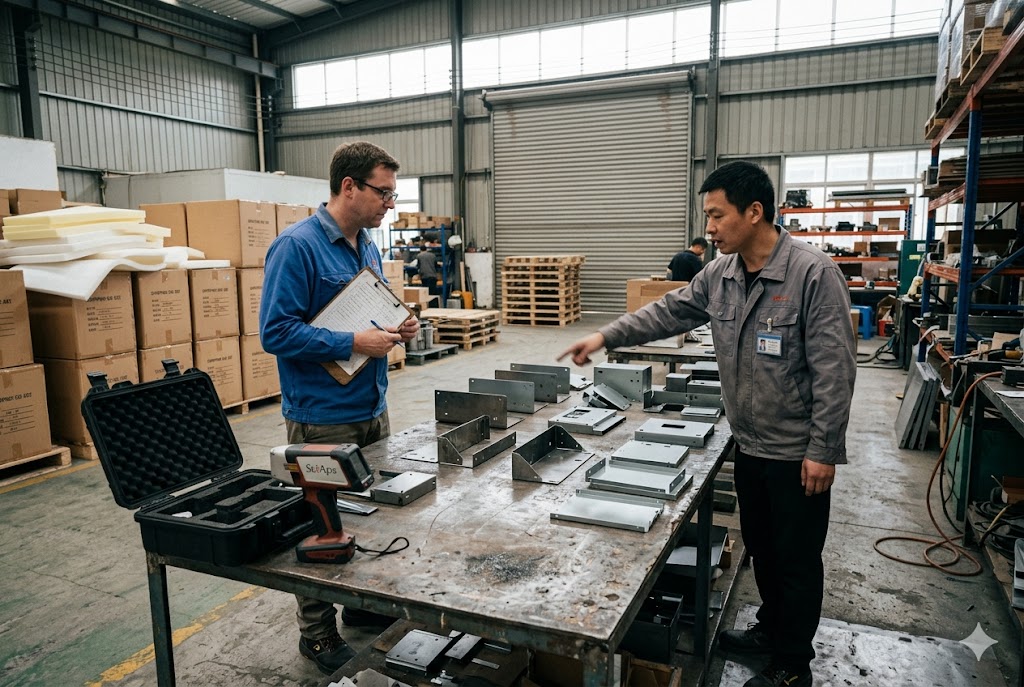
The most reliable method for confirming material grade on finished parts is portable XRF (X-ray fluorescence) analysis, which delivers non-destructive elemental composition readings in seconds. For galvanized and coated steels, supplement XRF with a coating weight test. For critical applications, laboratory OES (Optical Emission Spectrometry) provides the highest accuracy.
Portable XRF: The Field Standard
XRF analyzers work by firing X-rays at a material surface and measuring the energy of the fluorescent X-rays emitted back. Each element produces a unique energy signature. The device reads the composition in under 30 seconds and compares it to a library of known alloy grades. Leading instrument manufacturers such as Bruker 8 produce handheld XRF units widely used for on-site PMI in metal parts verification.
XRF is:
- Non-destructive — no damage to the part
- Fast — results in under a minute
- Accurate enough to distinguish 304 from 316, 6061 from 6063, and most commercial grades
- Portable — usable at a factory, warehouse, or receiving dock
XRF units can be rented or operated by third-party inspectors. You do not need to own one. Budget approximately $300–$600 USD per inspection visit for third-party PMI services, depending on the volume of parts tested.
When XRF Is Not Enough
XRF reads through zinc coatings on galvanized steel to the substrate below. But it does not measure the coating weight — the grams of zinc per square meter — which is a grade-defining parameter for galvanized materials like SECC and SGCC. For these materials, use the stripping-and-weighing method per JIS H0401 to verify coating weight separately.
XRF also has limitations with very thin coatings, very thin sheet stock, and some exotic alloys. For these cases, use laboratory Optical Emission Spectrometry (OES) 9, which is more accurate but destructive — it requires a small sample cut from the part.
Testing Methods Compared
| Method | Destructive | Speed | Accuracy | Best Use Case |
|---|---|---|---|---|
| Portable XRF | No | Seconds | High for most grades | Pre-shipment PMI on most metals |
| Laboratory OES | Yes (small sample) | Hours | Very high | Critical or high-value parts |
| Coating weight test (JIS H0401) | Yes (strip sample) | Hours | Definitive | Galvanized / pre-coated steel |
| Hardness testing | No | Minutes | Indirect only | Supporting check, not a substitute for PMI |
| Visual inspection | No | Instant | None | Cannot detect substitution |
When and Where to Test
Test before shipment, not after it arrives at your facility. Testing at the supplier's factory — or at a third-party inspection point before loading — means any nonconformance can be addressed while the parts are still in China. After a container crosses the ocean, your options are much more limited and expensive.
For new suppliers, test on the first three orders. For established suppliers with a clean track record, you can move to periodic sampling — for example, one PMI check per quarter on randomly selected batches. A detailed breakdown of how XRF, OES, and LIBS technologies compare for PMI work 10 is a useful technical reference when deciding which method best suits your application.
Conclusion
Material verification is not optional on cross-border orders. Get the MTC before shipment, check the heat number, test the metal with XRF, and build these requirements into your purchase order terms. Paper controls plus physical testing is the only combination that works.
Footnotes
1. Wikipedia overview of Mill Test Reports — what they certify and how heat numbers enable traceability. ↩︎
2. ISO 10474 defines international inspection document types for steel and steel products. ↩︎
3. SteelConstruction.info guide to material traceability and procurement requirements in structural steelwork. ↩︎
4. Wikipedia article explaining PMI methods — XRF and OES — for verifying metallic alloy composition. ↩︎
5. SGS pre-shipment inspection services for verifying product quality and specifications before loading. ↩︎
6. Bureau Veritas testing, inspection and certification services for global manufacturing supply chains. ↩︎
7. Intertek technical auditing services for independent factory and supplier quality assessments. ↩︎
8. Bruker's guide to PMI testing with handheld XRF for alloy grade verification in metal parts. ↩︎
9. Element's OES analysis laboratory service for high-accuracy elemental composition of metal alloys. ↩︎
10. Thermo Fisher comparison of XRF, OES, and LIBS technologies for positive material identification. ↩︎