Skip to main content Skip to footer

Every quarter, our sourcing team reviews supplier claims that simply do not hold up — factories that look real on paper but fall apart the moment you ask a technical question.
You can identify a fake CNC machining factory in China by cross-checking its business registration on gsxt.gov.cn, asking specific technical questions about machine models and processes, requesting a live unscripted video tour, and commissioning a third-party audit from firms like QIMA or SGS. Each step filters out a different type of fraudulent supplier.
These checks take time upfront. But they cost far less than a delayed shipment or a batch of parts that fail inspection. Keep reading — we will walk through every layer.
What Signs Show That a So-Called Factory Is Actually a Trading Company?
When we screen new suppliers before recommending them to our clients, the first red flags almost always appear in the product catalogue and in how their sales team answers technical questions.
A trading company masquerading as a factory typically shows one or more of these signs: an implausibly wide product range covering unrelated categories, a sales team that cannot answer basic process questions, stolen factory photos that appear on other company websites, and a registration date that contradicts their claimed years of experience.
The Product Catalogue Problem
A real CNC machining factory specializes. It has invested in specific machines, tooling, and process knowledge for particular materials and geometries. That investment limits what it can do — and that limitation shows in its catalogue.
If a supplier offers CNC parts, injection-molded components, sheet metal fabrication, die casting, electronics assemblies, and consumer goods all on one page, stop. No single factory has all of those capabilities at a competitive cost. That product range describes a trading company placing orders across many unrelated factories.
The Technical Question Filter
Ask the supplier a specific process question. For example: "What CNC machines do you run for 5-axis aluminum aerospace components? What controller do you use? How do you fixture a thin-wall part to prevent chatter?"
A real machinist answers immediately and precisely. A trading company gives a vague answer, says "let me check with our engineer," or sends a copy-pasted capability statement that does not address your question.
Here is a quick comparison:
| Question | Real Factory Response | Trading Company Response |
|---|---|---|
| What CNC machines do you operate? | "We run DMG Mori DMU 50 and Mazak Integrex, both 5-axis" | "We have advanced multi-axis CNC equipment" |
| What controller type? | "Siemens 840D on the DMG, Mazatrol on the Mazak" | "We use the latest CNC controllers" |
| How do you hold thin-wall parts? | "Custom soft jaws, sometimes with a wax fill strategy" | "Our engineers will handle that" |
| What surface finish can you hold on 6061-Al? | "Ra 0.8 µm with a ball-nose finish pass" | "We can meet your requirements" |
Precision in language reflects precision in process. Vagueness reflects a lack of hands-on experience.
The Reverse Image Search
Download every factory photo from the supplier's website, catalogue, and messaging app profile. Run each one through Google Images or TinEye 1. Fraudulent operators routinely take production floor photos from legitimate Chinese manufacturers and present them as their own. If an image search traces a photo to a completely different company name, that is definitive evidence of misrepresentation. Do not proceed.
Registration Date vs. Claimed Experience
Ask when the company was founded. Then verify it independently — which we cover in the next section. A supplier claiming ten years of CNC experience whose company was registered two years ago cannot be both things at once.
How Can I Verify Factory Address, Equipment, and Staffing?
Our team has visited hundreds of supplier sites in China and Vietnam. The gap between what a supplier claims and what we find on arrival is often significant — and it always starts with the address.
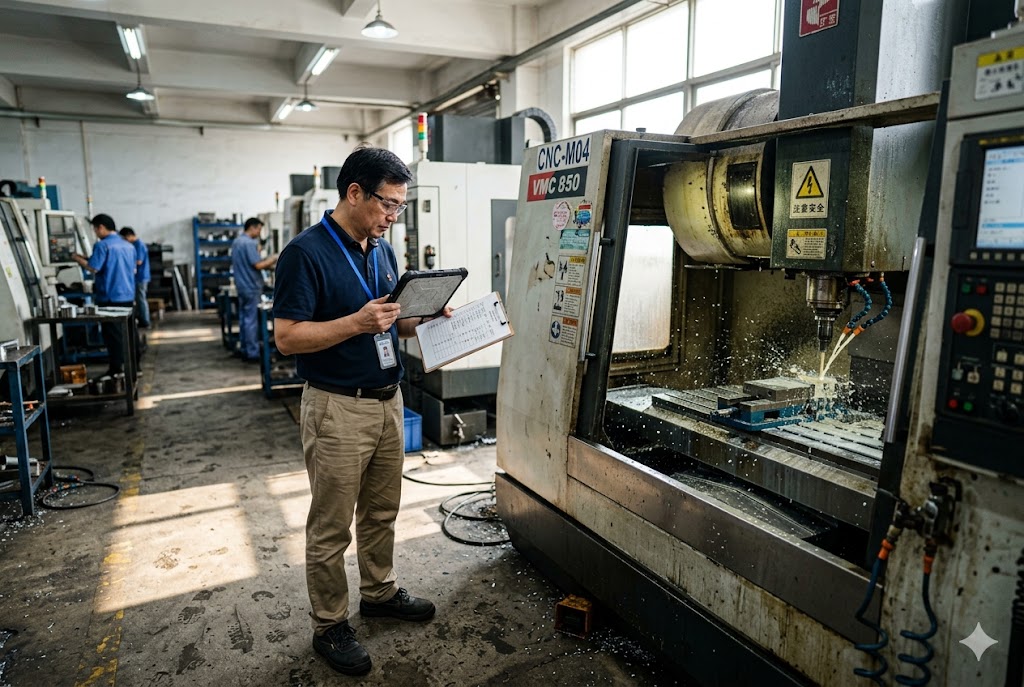
To verify a Chinese factory's address, equipment, and staffing, check the supplier's Unified Social Credit Code on gsxt.gov.cn, cross-reference the registered address against the physical site address provided, use Qichacha or Tianyancha for deeper background data, and compare the supplier's specific machine claims against what you observe during a live video call or site visit.
Step 1 — Check the Unified Social Credit Code
Every legally registered Chinese company has a Unified Social Credit Code (统一社会信用代码). Ask the supplier for this code. Then search it on China's National Enterprise Credit Information Publicity System 2 at gsxt.gov.cn.
On that page, confirm:
- Registered business scope — does it include manufacturing or machining?
- Registration date — does it match what the supplier claims?
- Legal representative name
- Registered capital amount
- Operational status — active, cancelled, or abnormal?
A factory claiming a decade of CNC experience but registered within the last two years is an immediate red flag. A company whose registered business scope lists "trading" or "import/export" but not "manufacturing" or "mechanical processing" is not a factory.
Step 2 — Go Deeper With Commercial Intelligence Platforms
Take the same company name or registration number to Qichacha 3 (qcc.com) or Tianyancha 4 (tianyancha.com). These platforms aggregate data that gsxt.gov.cn does not show in one place.
| Data Type | What to Look For | Red Flag |
|---|---|---|
| Shareholder structure | Who owns the company | Legal rep appears in multiple recently dissolved companies |
| Court judgments | Active litigation or past judgments | Unresolved supplier disputes or fraud cases |
| Administrative penalties | Regulatory violations | Tax evasion, customs violations, quality failures |
| Business status flags | Abnormal operation labels | Company flagged by authorities for non-compliance |
| Related companies | Linked entities | Shell company network suggesting a front operation |
If a supplier has active litigation with multiple buyers, that history tells you exactly what your experience is likely to be.
Step 3 — Match the Registered Address to the Real Address
This is where many buyers skip a step and pay for it. Fake factories and trading companies often register at a legitimate business address — a serviced office building, an industrial park reception office, or in some cases a residential block — while claiming to operate a full production facility there.
Ask the supplier: "What is your exact factory address, including building number and floor?" Then compare that address to the one in the SAMR registration record. If they do not match, ask for an explanation. If the explanation is vague, walk away.
Step 4 — Verify Equipment Claims Specifically
Ask the supplier to provide a machine list. A real factory can give you make, model, axis configuration, spindle speed, working envelope, controller type, and approximate year of manufacture for each key machine. A trading company cannot — because it does not own any machines.
Cross-check the machine names against publicly available specs. If a supplier claims to run a "5-axis Haas UMC-750" but then describes a working envelope that does not match the published specs for that machine, they are not operating it.
Should I Request a Live Video Factory Tour or Third-Party Audit?
We recommend both — but at different stages of the process, and with different goals in mind.
A live unscripted video tour is a fast, low-cost first filter that rules out ghost factories quickly. A third-party audit from a firm like QIMA, SGS, or Intertek is a deeper, independent verification that confirms machine inventory, workforce, quality systems, and whether the company truly operates as a manufacturer. Use the video tour first, then the audit before your first order.

The Live Video Tour — What to Do
Schedule a call over WeChat Video or Zoom. Tell the supplier you want to do a walkthrough of the production floor during a working shift. Do not accept a pre-recorded video. Do not accept a tour of the front office and showroom only.
During the call, direct the camera yourself. Ask to see:
- Specific machines — by name, not just "the CNC area"
- Live control panels showing an active program running
- An operator performing a tool change
- The inspection area and any CMM or measurement equipment
- Raw material storage and in-process parts on carts or racks
A real factory will accommodate every one of these requests without hesitation. Common signs of a fake factory during a video call include:
- Resistance to going live, with excuses about "maintenance day" or "shift changeover"
- A tour that stays in hallways and meeting rooms
- Machines that are all shut down during claimed working hours
- Noise level inconsistent with a live production environment
The Third-Party Audit — Why It Matters
A video call is a good filter. But it cannot confirm calibration records, count the workforce accurately, review quality management documentation, or verify whether parts in the building were actually made there.
An independent audit from QIMA 5, SGS 6, Intertek, TÜV, or Bureau Veritas covers all of that. An auditor physically visits the site, verifies the machine list against the supplier's claims, photographs the workforce and floor layout, checks whether ISO 9001 or other quality certifications are current and genuine, and produces a written report.
| Verification Method | Cost | Time | What It Confirms |
|---|---|---|---|
| Live video tour | Free | 30–60 minutes | Basic existence of machines and staff |
| gsxt.gov.cn check | Free | 15 minutes | Legal registration and business scope |
| Qichacha / Tianyancha | Low | 30 minutes | Litigation, penalties, corporate structure |
| Third-party audit (QIMA, SGS) | $300–$600 | 1–2 business days | Machine inventory, workforce, QMS, site identity |
The audit fee is a small fraction of the value of a first order. If the audit confirms the factory is legitimate, you proceed with confidence. If it reveals misrepresentation, you have saved yourself from a far more expensive problem. For a practical step-by-step reference, the China Factory Audit Guide from QINCheck 7 covers the full documentation and on-site checklist importers should follow.
One Rule for Both Methods
Pre-recorded videos are not acceptable. Coached tours where the supplier controls the camera path are not acceptable. The value of both the live call and the third-party audit comes from their unscripted, independent nature. Insist on that, or the verification is worthless.
What Documents Can Help Me Confirm the Factory Is Legitimate?
Documents alone cannot prove a factory is real. But specific documents, cross-checked against independent sources, add important layers of verification.
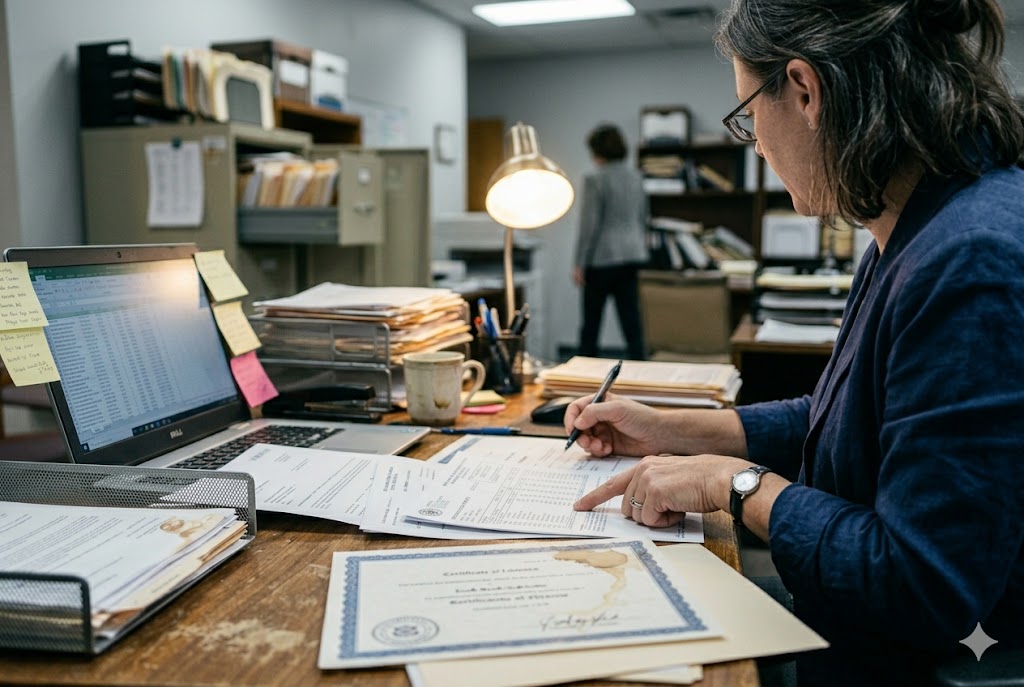
To confirm a Chinese supplier is a legitimate manufacturer, request the business license, tax registration certificate, ISO or other quality certifications, and a bank account confirmation letter. Verify each document independently — check the business license against gsxt.gov.cn, confirm certifications with the issuing body, and ensure the bank account receiving your payment is registered to the exact same legal entity as the contracting party.
Business License (营业执照)
The business license is the most fundamental document. It shows the company name, Unified Social Credit Code, legal representative, registered address, registered capital, and business scope. Every legitimate Chinese company has one.
Take the code from the license and verify it on gsxt.gov.cn. If the information on the license matches the government database exactly — including business scope and registration date — the license is genuine. If there are discrepancies, the license may have been altered.
Watch for one detail: the business scope. If it lists only "trade," "wholesale," or "import/export" with no mention of manufacturing, processing, or machining, the company is legally a trading company. That does not mean it cannot provide good parts — but it means it is not a factory, and you should price and manage risk accordingly.
Quality Certifications
Ask for ISO 9001 certification 8 at minimum. Some industries require AS9100 (aerospace) or IATF 16949 9 (automotive). The certificate will show:
- Issuing certification body
- Scope of certification — does it cover CNC machining?
- Certificate number
- Expiry date
Do not accept the certificate at face value. Look up the issuing body and search the certificate number in their public registry. Counterfeit ISO certificates are common in Chinese B2B markets. A real certification body maintains a searchable database of valid certificates.
Bank Account Verification
This step is critical and often skipped. Before sending any payment, ask the supplier for a bank account confirmation letter on company letterhead. Confirm that:
- The account holder name matches the contracting legal entity exactly
- The account is held at a mainland Chinese bank, not a Hong Kong or overseas account
- The account number matches what appears on the invoice
A mismatch between the contracting entity and the payment recipient — or payment routed to a personal account — is a serious warning sign. It may indicate fraud, or it may indicate a structural arrangement that makes fund recovery legally impossible if the relationship fails.
Baidu and B2B Platform Footprint
Search the supplier's Chinese company name on Baidu. Look for mentions across multiple years — news coverage, exhibition participation, industry association memberships, customer references, or domestic B2B platform listings on Made-in-China or Global Sources 10. A real CNC machining factory operating for several years accumulates a traceable Chinese-language online presence.
A supplier with no Baidu footprint, no domestic platform history, and whose entire presence consists of a recently created English-language Alibaba storefront lacks the operational history that any real factory builds over years of domestic and export trade.
Conclusion
Fake factories are a real risk in Chinese CNC sourcing, but they are not undetectable. Check registrations, ask technical questions, run reverse image searches, do a live video tour, commission an independent audit, and verify every document against its source. Each step closes a gap that fraudulent suppliers rely on buyers to leave open.
Footnotes
1. TinEye reverse image search helps expose stolen factory photos used by fraudulent suppliers. ↩︎
2. China Justice Observer explains how to use gsxt.gov.cn to verify Chinese company registration. ↩︎
3. QCC (Qichacha) is a compliance intelligence platform for verifying Chinese corporate data internationally. ↩︎
4. Guide comparing Qichacha and Tianyancha for foreign buyers conducting supplier due diligence. ↩︎
5. QIMA offers independent factory audits in China with detailed reports and 48-hour turnaround. ↩︎
6. SGS Supplier Verification Program provides independent audits and a verified supplier mark. ↩︎
7. QINCheck's China factory audit guide covers documents, on-site checks, and red flags for importers. ↩︎
8. ISO 9001:2015 is the international standard for quality management systems, widely used in manufacturing. ↩︎
9. Intertek explains ISO 9001 and IATF 16949 certification requirements for quality management systems. ↩︎
10. Guide to verifying a Chinese manufacturer's license, certifications, and B2B platform presence. ↩︎