Skip to main content Skip to footer
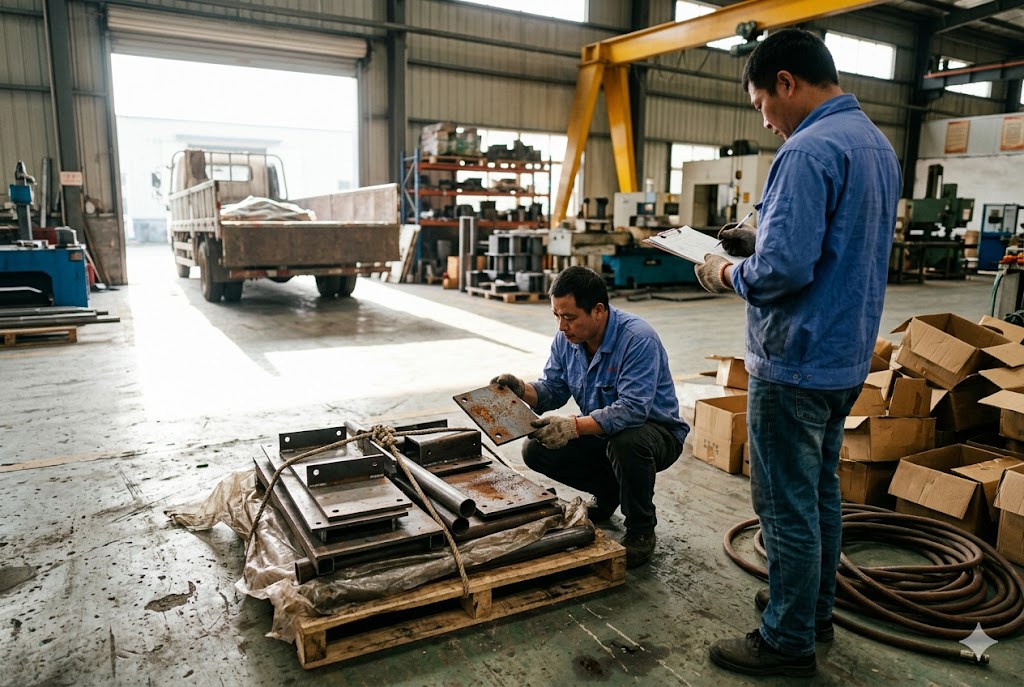
We see this problem every month. A buyer receives a batch of coated parts, finds adhesion failures or surface defects, and then both suppliers point fingers at each other. Nobody owns the defect. Nobody pays for the scrap.
When fabrication and surface treatment happen at separate factories in China, quality risk multiplies at every handoff point. The solution is to define ownership, document every transfer, and build inspection gates between factories — not just at final delivery.
Here is how to do that across four practical areas: handoff inspection, responsibility tracking, inter-process reporting, and contract protection.
What Handoff Inspection Should Happen Between the Fabrication and Finishing Stages?
Parts that reach a coating house with dimensional errors or surface contamination become expensive scrap the moment pre-treatment starts. Our sourcing team has seen this destroy entire batches.
Before parts leave the fabricator, a dimensional outgoing inspection must be completed and signed off against your ballooned drawing. At the coating house, a written incoming inspection must accept or reject parts based on defined surface condition criteria before any work begins.

The Outgoing Gate at the Fabricator
The fabricator must measure finished parts against your drawing tolerances before releasing them for coating. This is not a visual check. It is a dimensional check: bend angles, hole positions, flatness, and weld geometry.
The fabricator must produce a dated, signed outgoing inspection record for each batch. This record should reference the drawing revision number and the specific parts inspected.
Why does this matter? Parts with out-of-tolerance bends or weld distortion cannot be fixed after coating. The surface treatment adds cost and locks in the defect. If you catch the problem before the batch leaves the fabricator, you scrap formed metal. If you catch it after coating, you scrap coated metal and lose the coating cost as well.
First article inspection in sheet metal manufacturing 1 establishes the documented process baseline that makes outgoing dimensional checks traceable to a specific drawing revision.
The Incoming Gate at the Coating House
Most Chinese coating subcontractors do not perform incoming inspection. They accept whatever the fabricator delivers and start processing.
You need to change this by contract. Define a written incoming inspection requirement at the coating house with the following criteria:
| Defect Category | Reject Criteria |
|---|---|
| Surface rust or oxidation | Any visible rust on steel; oxide scale from laser cutting |
| Weld spatter | Any unremoved spatter in the coating zone |
| Mechanical damage | Dents, deep scratches, or bent flanges beyond drawing tolerance |
| Contamination | Oil, grease, or marking pen residue on coated surfaces |
| Dimensional nonconformance | Parts already outside tolerance from fabrication |
Any batch that fails incoming inspection must be quarantined and documented. Parts must not be silently returned or processed anyway. The coating house must notify your fabricator and issue a written nonconformance report 2.
Why Surface Condition at Handoff Is the Most Ignored Risk
Scratches, laser oxide scale, and weld spatter that arrive at the coating house will telegraph through powder coat or liquid paint. Research into powder coating failure modes 3 confirms that blistering, poor adhesion, and surface pitting almost always trace back to surface contamination present before application — not to the coating process itself. Neither supplier accepts responsibility: the coater says the fabricator delivered bad parts; the fabricator says the coater's pre-treatment caused the issue.
Without a documented incoming surface condition record, you cannot prove which party introduced the defect. The quarantine-and-document requirement at incoming inspection is your only evidence.
Transit Packaging Between Factories
Transport between factories is an underestimated defect source. Open-truck delivery of loose fabricated parts is standard practice in Chinese subcontractor networks. Parts arrive with scratches, dents, and edge damage that get attributed to the coating process.
Require a written packing specification for inter-factory transport. VCI poly bags 4 prevent corrosion and oxidation during transit for steel and aluminum parts:
| Part Type | Required Packaging |
|---|---|
| Aluminum sheet parts | VCI poly bags, foam interleave, edge protection |
| Steel fabricated parts | VCI poly bags, racked or separated to prevent contact damage |
| Welded assemblies | Individual foam wrap, rigid crating for complex geometry |
| Small stamped parts | Bulk bag with interleave sheet, not loose in a cardboard box |
The packing specification must be approved by you before the first production run and followed for every subsequent batch.
How Can I Track Quality Responsibility When Multiple Suppliers Are Involved in My Order?
Responsibility gaps between suppliers are not accidental. They are structural. No single person at the fabricator owns what happens to the parts after they leave.
Assign the fabricator as your prime contractor with full accountability for the finished, coated part. Name the coating subcontractor in your purchase order, require written approval before any subcontractor change, and hold the fabricator financially liable for defects that originate at the coating house.

Why the Fabricator Must Be the Prime Contractor
When you buy a fabricated and coated part, you have one purchase order and one delivery. The surface treatment is a subcontracted process within that order, whether or not the fabricator disclosed it. You should treat it that way contractually.
If you allow the fabricator and the coater to be separate, parallel suppliers without a defined hierarchy, defects that occur between factories fall into a contractual gap. Neither party accepts liability. Your only recourse is litigation, which is slow and expensive in cross-border situations.
The prime contractor model solves this. Managing subcontractor risk in supply chain networks 5 consistently shows that concentrating accountability in one prime contractor is the most reliable structural fix when direct oversight of sub-tiers is limited. The fabricator is responsible for the finished coated part. Any defect — regardless of which factory caused it — is the fabricator's liability. The fabricator's internal relationship with the coating subcontractor is their business to manage.
The Batch Traveler Card System
The most practical accountability tool in a split-factory flow is a physical batch traveler card that accompanies every production lot from fabrication through coating and back.
Each card records:
| Field | Recorded By |
|---|---|
| Part number and drawing revision | Fabricator — at job setup |
| Fabrication completion date | Fabricator — at outgoing inspection |
| Outgoing dimensional sign-off | Fabricator QC — named individual |
| Departure date to coating house | Fabricator logistics |
| Coater incoming acceptance sign-off | Coating house QC |
| Pre-treatment batch date and bath ID | Coating house |
| Coating date and oven run number | Coating house |
| Final inspection sign-off | Fabricator QC — after parts return |
This card creates a documented chain of custody. Every process handoff becomes a recorded event with a named responsible person. When a defect is found, you can trace exactly where and when it occurred.
Naming the Subcontractor in Your Purchase Order
Your purchase order should explicitly name the approved coating subcontractor. This accomplishes two things. First, it prevents undisclosed subcontractor substitution — a common practice in Chinese supply chains when the approved coater is at capacity or raises prices. Second, it gives you audit rights at the coating house, not just the fabricator.
Add a clause requiring written notice and your approval at least 10 business days before any subcontractor change. Include a right to re-inspect and re-qualify the new subcontractor before production resumes.
Assigning a Named Quality Contact
In Chinese supplier organizations, split-factory flows frequently have no internal owner at the fabricator who inspects returned coated parts against the outgoing baseline. The fabricator's final inspection process may check only gross cosmetic appearance, not whether coated dimensions still meet drawing tolerance.
Require the fabricator to name a specific quality contact — a real individual with a phone number — who is personally accountable for both the outgoing fabrication record and the final inspection of returned coated parts. This person should sign both records.
Should I Ask for Inter-Process Inspection Reports at Each Production Stage?
Most buyers request a final inspection report. That is too late in a split-factory flow. By the time parts are fully coated, every defect is already embedded.
Yes. Require inter-process inspection reports at three defined stages: fabrication outgoing, coating house incoming, and final inspection after coating. Also require the coating house to maintain a pre-treatment bath chemistry log and make it available on request.

The Three Required Inspection Records
A complete inspection record set for a split-factory order includes three documents, not one:
Record 1 — Fabrication Outgoing Inspection
Produced by the fabricator before parts are released to the coating house. Must reference the drawing revision and inspection date. Must include dimensional measurements for critical features as defined in your ballooned drawing. Must be signed by a named QC person.
Record 2 — Coating House Incoming Inspection
Produced by the coating house upon receipt of parts. Must document surface condition against the defined reject criteria. Must note any quarantined parts and the nonconformance reference number. Must be signed and dated before pre-treatment begins.
Record 3 — Final Inspection After Coating
Produced by the fabricator when coated parts return from the coating house. Must include a visual and dimensional check, coating thickness measurement per your specification, and sign-off before parts ship to you.
Pre-Treatment Bath Chemistry Logs
Pre-treatment process parameters are the highest-probability root cause of adhesion failures on parts that visually pass incoming inspection. A part can look clean and still carry contamination or insufficient phosphate conversion that causes coating to delaminate in service.
Iron phosphate conversion coating 6 applied as a pre-treatment step before powder coating dramatically improves adhesion and corrosion resistance — but only when bath chemistry is properly controlled. The pre-treatment sequence for powder-coated steel typically includes:
| Stage | Parameter Monitored | Typical Control Range |
|---|---|---|
| Alkaline degreasing | pH, concentration, temperature | pH 10–13, 55–70°C |
| Water rinse | Conductivity | <100 µS/cm |
| Iron phosphate conversion | pH, concentration, temperature | pH 4–6, 45–55°C |
| Water rinse | Conductivity | <50 µS/cm |
| Dry-off oven | Temperature, dwell time | 120–140°C, 10–15 min |
Require the coating house to maintain a bath chemistry log recording these parameters at least once per shift. Bath degradation between change cycles is the most common undocumented variable in Chinese coating subcontractor operations. Log entries must include the date and time so you can cross-reference them against the batch production date on the traveler card.
First-Article Approval for the Combined Flow
For parts where coating adhesion or corrosion resistance is a functional requirement, first-article approval must cover the combined fabrication-and-coating process — not just dimensional FAI at the fabricator.
Require the following from the first coated production batch:
- Cross-hatch adhesion test per ISO 2409 7 (minimum Grade 0 or 1)
- Salt spray test coupon per ISO 9227 8 (minimum 240 hours for standard environments, 500+ hours for outdoor or marine exposure)
- One coated coupon retained by the coating house for 90 days as a traceable reference
This establishes a documented process baseline. If field failures emerge after shipment, you have a retained coupon from the same production run for root cause comparison.
What Contract Terms Protect Me When Defects Are Caused Between Two Separate Sub-Suppliers?
Most purchase orders between importers and Chinese fabricators say nothing about subcontractors. That silence is expensive.
Your quality agreement must name the approved coating subcontractor, require written approval before substitution, hold the fabricator liable for defects regardless of where in the sub-supply chain they originate, and require written notification and your approval before any rework begins on returned parts.

The Four Contract Clauses You Need
Clause 1 — Approved Subcontractor List
Name the coating house in the purchase order or quality agreement by company name, address, and contact person. Include a right to audit the coating house directly. Require 10 business days' written notice and your written approval before any subcontractor is changed. Unauthorized substitution should trigger a hold on payment for the affected batch.
Clause 2 — Prime Contractor Liability
State explicitly that the fabricator is responsible for the quality of all subcontracted work as if it were performed by the fabricator. Defects originating at the coating house are the fabricator's liability. This clause prevents the fabricator from deflecting responsibility to the coater in any dispute.
Clause 3 — Rework Notification and Approval
This is the most structurally underspecified risk in a split-factory flow. When coated parts fail your incoming inspection, the standard Chinese supplier response is to return them to the coater for strip-and-recoat without telling you. This happens because:
- Stripping chemistry can alter part dimensions, particularly on thin gauge material
- Mechanical handling during rework introduces new mechanical damage
- The fabricator's outgoing dimensional check is not repeated after stripping
- The reworked parts ship to you as complete, first-quality parts
Your contract must require:
- Written notification to you within 24 hours of any rework decision
- Your written approval before rework begins
- A dimensional check after stripping, before recoating
- The rework batch treated as a new production run with the same inspection gates as original production
Clause 4 — Defect Origin Documentation Requirements
Define that both parties are required to produce documented evidence of part condition at each handoff point. If the fabricator cannot produce a dated outgoing inspection record, they cannot claim the defect originated at the coating house. If the coating house cannot produce a dated incoming inspection record, they cannot claim the defect was present on arrival. Absence of documentation defaults liability to the party that failed to document.
Annual Process Audit of Both Factories Together
The contract is only as strong as your ability to verify compliance. Conduct a combined process audit of both the fabricator and the coating house at least once per year. Audit them together, not separately.
The combined audit specifically evaluates the interface between factories:
| Audit Item | What to Verify |
|---|---|
| Transit packaging | Are parts packed per your specification for inter-factory shipment? |
| Incoming inspection execution | Does the coater actually quarantine rejected parts, or just process them? |
| Pre-treatment bath records | Are logs current, signed, and cross-referenceable to batch dates? |
| Coating specification on the shop floor | Does the coater have your approved color standard and specification, not verbal instructions? |
| Rework handling | Can the coater show you a rework log? Is your approval required before rework? |
| Traveler card compliance | Are batch cards physically present and fully filled in? |
Chinese coating subcontractors frequently operate from informal verbal briefs from the fabricator's purchasing staff, not from your documented specification. The audit verifies that your requirements actually exist at the point of production, not just on paper in the fabricator's office.
Adequate surface preparation before powder coating 9 is the single most verifiable indicator of coating durability during an on-site audit — and the most frequently shortcut item in informal subcontractor operations. Use the audit to physically confirm that the coater's pre-treatment line is operating to your specification, not to their default shop practice.
Conclusion
Managing quality across a split fabrication-and-coating supply chain requires three things: inspection gates at every handoff, a prime contractor who owns all liability, and contract clauses that control rework before it happens — not after the parts arrive at your dock. The phosphate conversion coating 10 process at the coating house is the highest-leverage chemical variable in the entire flow — and the one most commonly left unmonitored. Document it, audit it, and require traceable bath chemistry logs from every production run.
Footnotes
1. Covers FAI process, ballooned drawings, and inspection records for sheet metal parts. ↩︎
2. Explains NCR structure, quarantine workflow, and corrective action requirements in manufacturing. ↩︎
3. Details ten causes of powder coat failure including weld spatter, contamination, and inadequate pre-treatment. ↩︎
4. Explains VCI packaging chemistry, formats, and use for inter-factory metal part transit. ↩︎
5. Analyzes subcontractor risk structures and prime contractor accountability in supply chains. ↩︎
6. Explains iron phosphate pre-treatment benefits for powder coat adhesion and corrosion resistance on steel. ↩︎
7. Describes ISO 2409 cross-cut adhesion test procedure, classification grades, and testing scope. ↩︎
8. Official ISO page for the salt spray corrosion test standard used to qualify coated metal parts. ↩︎
9. Covers how surface prep directly determines powder coating durability and common failure modes. ↩︎
10. Wikipedia overview of phosphate conversion coating chemistry, types, and industrial applications. ↩︎