Skip to main content Skip to footer
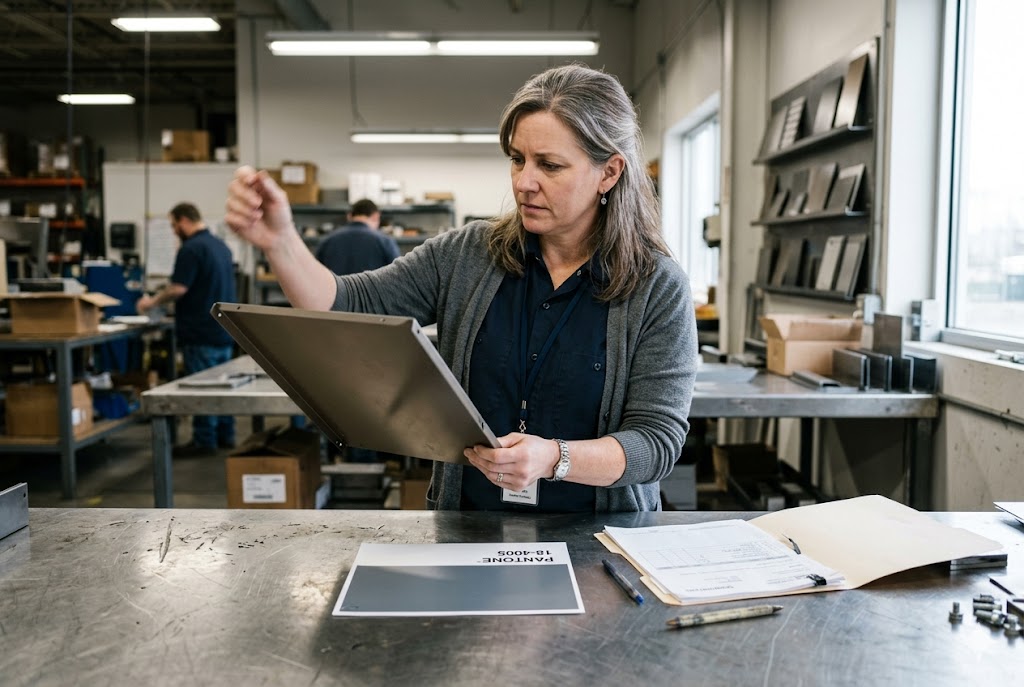
Color disputes are one of the most common friction points we see in cross-border sheet metal orders. A client sends a Pantone number, production ships, and the parts arrive looking nothing like what was approved. On our end, we have watched this happen repeatedly when the root cause is always the same: the color specification was incomplete from the start.
The color approval process for sheet metal parts from China runs in three stages: a documented color specification in the purchase order, physical coupon approval before production begins, and a production trial batch sign-off on actual parts. Each stage requires a signed record. Without all three, color consistency across repeat orders cannot be enforced.
The good news is that this process is not complicated. It just requires discipline at each step. Here is how to run it correctly.
How Many Rounds of Color Samples Should I Expect Before I Sign Off on a Color?
Most buyers assume one sample round is enough. In our experience managing coating approvals for US and Canadian clients, that assumption causes most of the delays we spend time resolving downstream.
For a standard powder coat color on steel or aluminum sheet metal, expect two to three rounds: a flat metal coupon approval, then a production trial batch on actual parts. If the color is a custom Pantone mix with no direct RAL equivalent, add one more round for the powder formulation coupon before anything else.
Why Two Rounds Are the Minimum
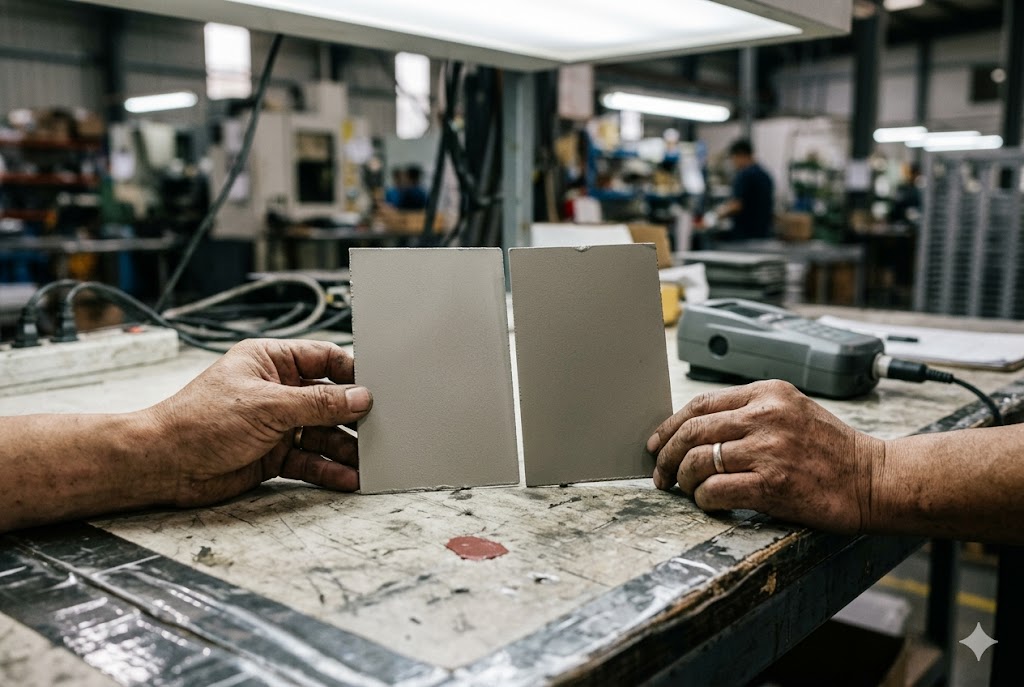
A flat coupon is not a finished part. It is a controlled surface — no edges, no corners, no rack shadows. Powder coat film build changes on complex geometry. A color that passes on a 100×150 mm coupon can look visibly lighter on a deep-formed flange or darker on a recessed panel face. That is why you need a second approval round on actual production parts.
Here is how the two-stage sequence works in practice:
| Stage | What Is Produced | What You Approve |
|---|---|---|
| Stage 1 | Flat metal coupon (100×150 mm), coated and cured at production oven settings | Color, gloss level, surface texture |
| Stage 2 | Trial batch on actual production parts, same oven profile | Appearance on real geometry, edge coverage, uniformity |
| Stage 3 (if custom color) | Powder formulation coupon from the coating house | Color match to physical Pantone chip before any metal is coated |
What the Supplier Must Submit With Each Sample
Do not accept a coupon without data. Each submitted sample must include:
- Spectrophotometric readings in CIELAB 1 (L*, a*, b* values)
- Gloss reading at 60° geometry (per ISO 2813) 2
- Powder product code and powder manufacturer name
- Oven cure profile (temperature, dwell time)
Without these, you have a physical sample but no enforceable baseline. If the supplier changes powder batches next order, you have no documented reference to compare against.
Custom Pantone Colors: An Extra Step Most Buyers Skip
Published Pantone-to-RAL conversion tables 3 are approximations. They are not equivalences. If your color spec is a Pantone number with no matching RAL code, the correct process is:
- Send a physical Pantone coated chip to the powder coating house
- The coater formulates a custom powder batch via spectrophotometric match
- Approve the formulation coupon first — before any production parts are coated
- Lock the resulting powder batch number into your specification
Skipping the physical chip and relying on a table lookup is one of the most common causes of "close but not right" color results on first production runs.
How Long Does This Take?
Realistically, budget two to three weeks for the full coupon-to-trial-batch approval sequence when ordering from a Chinese supplier, assuming no revision rounds. Each revision adds five to seven business days for recoating and shipping.
What Documents Should I Keep After I Approve a Color to Protect Consistency in Future Orders?
Approving a color without archiving the right records is one of the most expensive mistakes a purchasing manager can make. Six months later, when you place a repeat order, the supplier has no reference — and neither do you.
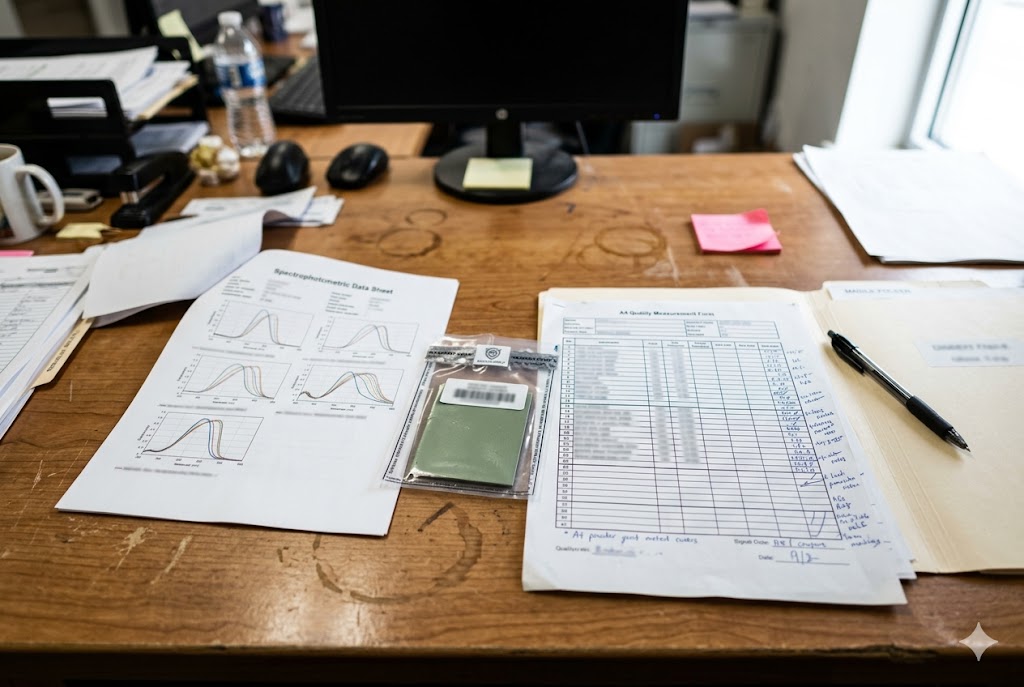
After color approval, archive the following as a version-controlled quality record tied to your part number and drawing revision: the approved coupon's spectrophotometric data file (L*, a*, b* values and reflectance curve), the powder product code and batch number, the signed approval record with date, and the oven cure profile parameters used during approval.
The Five Documents You Must Keep
Most buyers keep a photo of the approved sample. That is not sufficient for enforcement. A photograph changes appearance under different screen brightness, color calibration, and ambient lighting. Here is the full document set you need:
| Document | Format | Purpose |
|---|---|---|
| Spectrophotometric data file | Digital (.CSV or .XML from instrument) | Provides L*, a*, b* values and full reflectance curve for objective comparison |
| Gloss measurement record | Digital or printed | Documents target GU value and tolerance at 60° geometry |
| Powder product code + batch number | Written spec or email confirmation | Locks the specific powder used; triggers re-approval if changed |
| Oven cure profile | Supplier's process sheet | Documents temperature and dwell time during approval; drift in this profile causes color change |
| Signed approval record | PDF with date and approver name | Creates a traceable version-controlled gate |
Physical Coupon Storage
Keep the approved physical coupon — not a photo, not a scan. Store it in a tamper-evident, light-protected package. UV exposure changes surface appearance over time and will invalidate it as a visual reference.
Both you and the supplier must each hold a copy. If only the supplier holds the golden sample, you have no independent reference when a dispute arises.
When Color Approval Is Invalidated
A color approval is tied to a specific drawing revision and a specific pre-treatment and powder combination. It must be re-run from the coupon stage when any of the following change:
- Drawing revision that affects coating thickness specification
- Substrate material changes (e.g., SPCC cold-rolled to SGCC galvanized)
- Pre-treatment chemistry change at the coating house
- Powder source change (different manufacturer or product code)
This matters because upstream pre-treatment chemistry 4 — iron phosphate, zinc phosphate, or chromate-free zirconium — produces different surface chemistries that affect how powder adheres, film build uniformity, and final color. A coating house switching pre-treatment to cut costs will not announce it. Yet it will produce batch-to-batch color drift that passes every other incoming inspection check.
Colorimetric Tolerance: Put a Number in Writing
"Match the approved sample" is not an enforceable specification. Visual judgment under different lighting conditions always produces disputes. Specify your acceptance criteria as a maximum ΔE (Delta-E) value in CIELAB color space 5:
| Application | Recommended ΔE Limit |
|---|---|
| Standard industrial parts | ΔE ≤ 2.0 |
| Brand-color critical applications | ΔE ≤ 1.0 |
| Gloss tolerance (all applications) | ±5 GU at 60° (ISO 2813) |
Without a numeric ΔE value documented on your purchase order or drawing, you cannot reject a non-conforming batch on objective grounds.
How Can I Make Sure My Supplier Reuses My Approved Color Standard for Every Repeat Order?
Approval records alone do not guarantee repeat order consistency. The system breaks down when the supplier's coating subcontractor changes a powder batch, adjusts the oven profile, or switches pre-treatment chemistry — often without telling anyone.
To enforce color consistency on repeat orders, lock the approved powder product code and batch range into the purchase order, require the supplier to submit a pre-production coupon against the archived ΔE limit before each coating run, and specify that any powder source change triggers a new approval cycle.
The Core Problem: Subcontracted Coating Lines
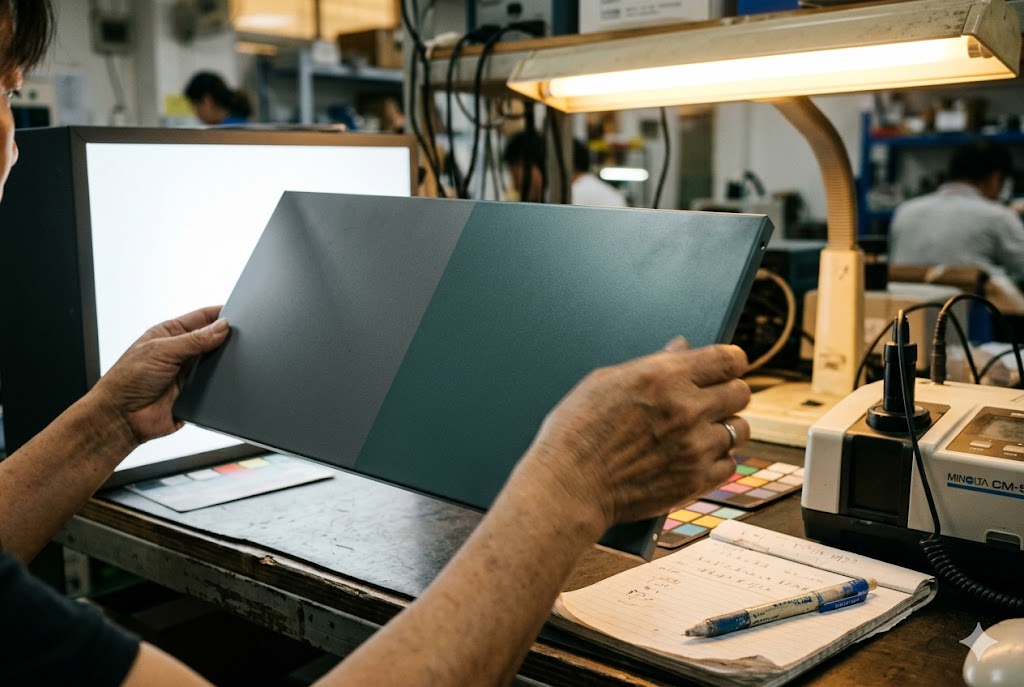
Most Chinese sheet metal fabricators do not run their own coating line. They subcontract powder coating to a separate finishing house. Your supplier's direct quality control leverage over that coater is limited. The coater answers to their own production schedule, not yours.
This creates a structural gap: the coater may change powder suppliers between your orders, adjust oven settings between shifts, or switch pre-treatment chemistry to reduce cost — and none of these changes will be visible to incoming color inspection unless you have built the right system.
What to Include in Your Purchase Order
Every repeat order should reference the original color approval documentation by version number and include:
- Approved powder manufacturer name and product code
- Approved ΔE limit (e.g., ΔE ≤ 2.0 under D65 illuminant)
- Approved gloss level ± tolerance (e.g., 30 GU ± 5 at 60°)
- Requirement for pre-production coupon submission before production coating begins
The Pre-Production Coupon Gate
For every repeat order, require the coating house to produce one new coupon from the current production powder batch and compare it against the archived spectrophotometric data before production starts. This single step catches most batch-to-batch drift before it reaches your parts.
The coupon must be measured on the same instrument type used for original approval (or instrument correlation data must be provided). A different instrument without correlation introduces measurement error that masks real color shift.
Metamerism: The Risk Nobody Specifies
A coating can pass ΔE measurement under D65 (daylight) illuminant and still look visibly wrong under fluorescent office lighting or incandescent light. This phenomenon is called metamerism 6. It happens when two colors have different spectral reflectance curves that happen to produce the same tristimulus values under one light source but diverge under another.
If your parts are viewed under mixed or non-daylight conditions — a warehouse, a retail floor, a factory floor with fluorescent overhead lighting — specify visual approval under two illuminants:
| Illuminant | Lighting Condition | When to Specify |
|---|---|---|
| D65 | Standard daylight | Always include as primary |
| F11 | Fluorescent office / retail | Add when parts are viewed indoors |
| A | Incandescent | Add for residential or mixed-source environments |
Powder Source Change: Treat It Like a New Approval
Require that any change to powder manufacturer or product code — even if the new powder is nominally the same color — triggers a new coupon approval cycle before production resumes. This requirement must be written into your supplier agreement, not assumed. Powder formulations vary between manufacturers in pigment loading, resin chemistry, and cure behavior, all of which affect final color and gloss. The RAL color system 7 assigns standardized four-digit codes to specific shades, but two powders carrying the same RAL code from different manufacturers are not guaranteed to be spectrally identical.
What Should I Do If the Production Batch Color Drifts from My Approved First-Article Sample?
Color drift on a production batch is a quality nonconformance. The question is whether it is caught before shipment or after. The answer depends entirely on whether you have incoming inspection in place — and whether your acceptance criteria are in writing.
If production batch color drifts from the approved sample, measure the deviation against your documented ΔE limit using spectrophotometer data, not visual judgment. If ΔE exceeds the specified limit, issue a formal nonconformance report, place the batch on hold, and require root cause analysis before any rework or replacement is approved.

Measure First, Argue Second
The first thing to do when a color drift is suspected is to measure it. Visual inspection under a single light source is not a defensible basis for a rejection or an acceptance. Pull the archived spectrophotometric data from the original approval record and compare it against a fresh measurement from the production batch under the same illuminant and instrument conditions.
If ΔE exceeds your documented limit, you have objective grounds to reject. If it does not, the batch passes — even if it looks slightly different to the eye under your facility's specific lighting. That is why the numeric ΔE limit must be established before production, not after.
Common Root Causes of Color Drift
Understanding the cause determines the correct corrective action. The most common causes we see on Chinese coating lines are:
| Root Cause | Symptom | Corrective Action |
|---|---|---|
| Powder batch change | Consistent shift across entire batch | Re-approve new powder batch; adjust formulation |
| Oven temperature drift between shifts | Variation within batch (some parts differ from others) | Recalibrate oven; review cure profile records |
| Pre-treatment chemistry change | Color and adhesion both affected | Re-run adhesion test; review pre-treatment log |
| Film build deviation (over or under application) | Gloss and color both shift | Review application settings; re-measure film build |
| Racking orientation change | Variation in recessed areas or edges | Re-evaluate rack design and density |
Film build deviation is worth examining closely. Many physical and appearance properties of a finished powder coating are affected by film thickness 8, including color, gloss, adhesion, and impact resistance. Over- or under-application shifts both readings simultaneously, which can help distinguish this cause from a pure powder batch issue.
What to Put in the Nonconformance Report
A strong nonconformance report includes:
- Part number and drawing revision
- Order number and production batch identifier
- Measured ΔE value(s) vs. specified limit
- Illuminant and instrument used for measurement
- Photos under controlled lighting (supplementary, not primary evidence)
- Quantity affected
- Disposition request: sort, rework, or replace
Rework vs. Replace
Rework — stripping and recoating — is technically possible on most powder coat parts, but it adds thermal exposure to the substrate and can affect dimensional tolerances on precision parts. For tight-tolerance sheet metal assemblies, replacement from a new batch is usually the more defensible option. Require a new pre-production coupon approval before the replacement batch is coated.
Pre-Shipment Inspection Is Your Last Gate
The most cost-effective point to catch color drift is before the container is loaded, not after it arrives at your warehouse. Our team routinely arranges pre-shipment inspection 9 for coating color on outbound orders, including spectrophotometric measurement against the approved golden coupon at the supplier's facility. Catching a nonconforming batch before shipment avoids freight costs, customs delays, and the production line disruption that occurs when a full order is rejected on arrival.
When selecting a color matching approach, keep in mind that the choice of color reference system itself matters. A complete guide to powder coating color matching 10 outlines how RAL, Pantone, and Federal Standard systems interact differently with powder suppliers — knowing which system your coating house works from natively reduces formulation risk before production begins.
Conclusion
Color approval from a Chinese sheet metal supplier is manageable when you run three gates in sequence: a complete color specification in writing, a physical coupon approval with archived data, and a production trial batch sign-off. Keep the records, lock the powder source, and inspect before shipment.
Footnotes
1. CIELAB (L*, a*, b*) is the standard device-independent color space used for industrial color measurement. ↩︎
2. ISO 2813 specifies gloss measurement methods for coatings at 20°, 60°, and 85° geometries. ↩︎
3. Explains why Pantone and RAL are not interchangeable systems and what converting between them costs. ↩︎
4. Compares iron phosphate, zinc phosphate, and zinc plating as pretreatments before powder coating. ↩︎
5. Explains how CIELAB L*, a*, b* values are measured and used for objective color acceptance criteria. ↩︎
6. Carboline explains how two matched colors can appear different under a changed light source. ↩︎
7. Overview of the RAL colour standard used in powder coating and its four-digit code system. ↩︎
8. Documents how powder coating film thickness affects color, gloss, adhesion, and performance. ↩︎
9. Pro QC outlines what a pre-shipment inspection covers and when to schedule it in China. ↩︎
10. A practitioner's guide to RAL, Pantone, and Federal Standard color systems in powder coating. ↩︎