Skip to main content Skip to footer

Every time a new tariff notice drops, our phones start ringing. Purchasing managers we work with face the same pressure: landed costs shift overnight, and their margins shrink before they can react.
When US tariffs on Chinese CNC machined metal parts change, importers must act on four fronts: verify their HTS classification, review their supplier contracts, model total landed cost across alternative origins, and build a quarterly monitoring routine. Done right, these steps protect margins without sacrificing part quality or delivery reliability.
This article walks through each of those fronts in plain terms. Let's start with what tariff changes actually do to your sourcing math.
How Do Tariff Changes Affect My Sourcing and Pricing Decisions?
When tariff layers stack up, a price that looked competitive in January can become a loss by April. We see this every quarter in the quotes we manage for our clients.
As of mid-2026, CNC machined metal parts from China face a layered duty structure: a base MFN rate, a 25% Section 301 duty, a 10% IEEPA fentanyl surcharge, and a Section 232 surcharge on the aluminum or steel value. Together, these can push your effective duty rate above 45%. Missing any one layer in your landed cost model produces a badly wrong number.

Why One Tariff Notice Can Break Your Budget
Most purchasing managers calculate total landed cost 1 using a single duty percentage. That worked fine a decade ago. Today, US duties on Chinese-origin mechanical parts come in layers — and each layer has its own legal basis, its own HTS code sensitivity, and its own expiry date.
Here is how the current stack looks for a typical CNC machined aluminum part:
| Duty Layer | Rate | Applies To |
|---|---|---|
| MFN Base Rate | 3–7% | All imports by HTS code |
| Section 301 (Lists 1–3) | 25% | Most Chinese-origin machined parts |
| IEEPA Fentanyl Surcharge | 10% | All Chinese-origin goods |
| Section 232 (Metal derivative) | 50% on raw metal value | Aluminum/steel derivative articles |
| Reciprocal Baseline Tariff | 10% (paused until Nov 10, 2026) | All Chinese-origin goods |
The reciprocal tariff is currently paused. But that pause expires on November 10, 2026. If you are not modeling for that date, you are already behind.
How Classification Affects the Rate You Actually Pay
Your 10-digit HTS code 2 determines which rows in that table apply to you. A single digit difference can shift your effective rate by 15 to 30 percentage points. CBP has intensified classification audits under the current tariff environment. A wrong code does not just mean a future correction — it can trigger a retroactive duty assessment on past entries.
The practical step here is simple: get a binding ruling from CBP 3 before your next significant shipment moves. A licensed customs broker can file for this on your behalf. It eliminates classification uncertainty and gives you legal protection on future entries.
What Happens to Your Supplier Negotiation
When your landed cost model is accurate, you negotiate from facts. When it is wrong, you negotiate from assumptions — and your supplier knows the numbers better than you do.
A tariff change clause in your supplier contract is the structural fix. It should define a threshold — for example, any new duty layer exceeding 5% of part value — and require both parties to return to the table when that threshold is crossed. Without this clause, you absorb the entire tariff increase unilaterally. With it, you have a contractual basis to share the burden.
Pricing Decisions Your Competitors Are Already Making
Here is a comparison of how importers typically respond, and what each approach costs:
| Response Strategy | Short-Term Impact | Long-Term Risk |
|---|---|---|
| Absorb the tariff increase | Margin compression | Unsustainable on high-volume parts |
| Pass it to customers | Customer pushback | Competitive disadvantage |
| Renegotiate with supplier | Shared burden | Requires contract leverage |
| Shift to alternate origin | Qualification delay | Quality risk if rushed |
| Claim Section 301 exclusion | Duty eliminated | Requires active monitoring |
None of these options works in isolation. The importers with the most flexibility are those who have done the modeling and know which option applies to which part number.
Should I Ask Suppliers for Alternative Manufacturing Locations?
When a tariff spike hits, the first instinct is to call the supplier and ask if they can ship from Vietnam instead. We have managed that conversation dozens of times — and the answer is rarely as simple as it sounds.
Vietnam, Mexico, India, and Malaysia currently face only a 10% baseline tariff with no Section 301 exposure, creating a potential 25-percentage-point duty saving compared to Chinese-origin parts. However, a lower tariff rate does not automatically produce a lower landed cost. Unit price, qualification time, supply chain maturity, and logistics cost all factor into the final number.
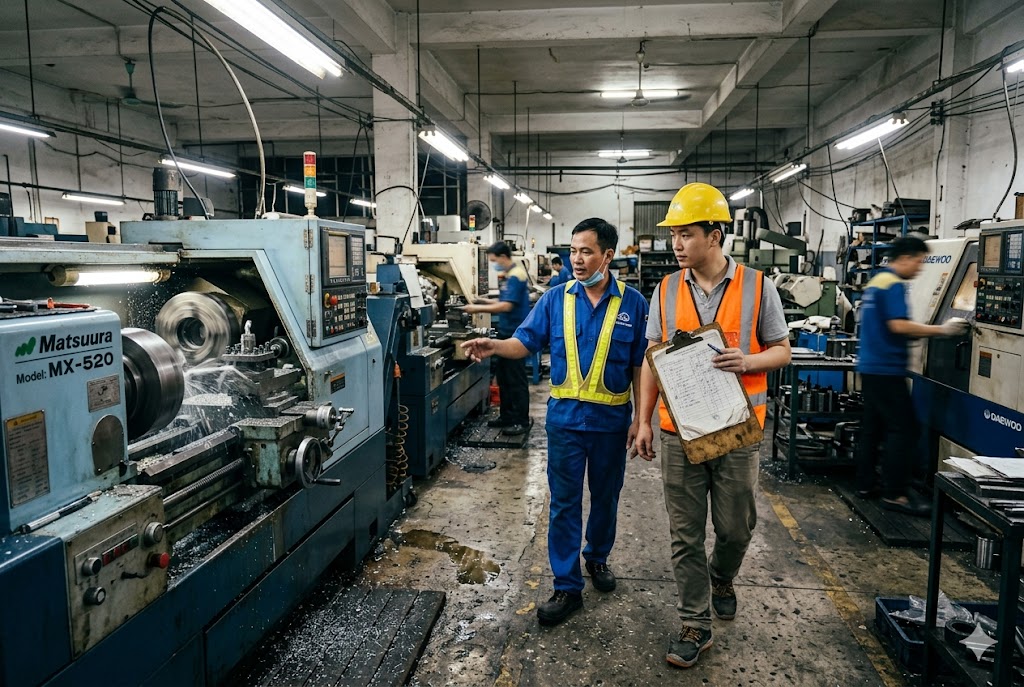
What Alternative Origins Actually Cost You
Our team maintains a branch in Vietnam and works regularly with suppliers in Southeast Asia. The machining capability there is real — but it is not equivalent across all part types. Simple turned parts, standard brackets, and low-tolerance housings shift well. Complex multi-axis geometries, tight-tolerance assemblies, and parts requiring specific material certifications are harder to replicate at competitive cost outside of China.
Here is a realistic comparison for a medium-complexity CNC machined aluminum part:
| Origin Country | Typical Unit Price Index | Tariff Rate (2026) | Qualification Timeline |
|---|---|---|---|
| China | 100 (baseline) | 45–55% effective | Existing — no delay |
| Vietnam | 115–130 | 10% | 3–6 months |
| Mexico | 130–160 | 0–10% (USMCA eligible) | 4–8 months |
| India | 110–125 | 10% | 4–9 months |
| Malaysia | 120–135 | 10% | 4–7 months |
The unit price index is illustrative. The point it makes is real: alternative countries carry higher base unit prices. At a 25-percentage-point duty saving, the math often still favors diversification for standardized parts. For complex parts, it frequently does not.
Questions to Ask Before Redirecting a PO
Before you ask your supplier to shift production, answer these questions:
Does the alternative location have the right equipment?
Vietnam's machining industry is strong in 3-axis CNC turning and milling. 5-axis simultaneous machining capability is less common and concentrated in a smaller number of facilities. If your part requires 5-axis work, your qualification pool shrinks significantly.
Can the supplier actually deliver, or are they just telling you yes?
We conduct factory audits 4 as part of our sourcing service. When a Chinese supplier says they have a Vietnam factory, we visit it. In our experience, roughly one in three of these facilities is either a trading office or a light-assembly operation — not a machining factory capable of producing to drawing. Verify before you commit volume.
What does the full landed cost actually look like?
Run the number, not the headline. A part that costs $8.00 from China with 50% effective duty lands at $12.00. The same part from Vietnam might cost $10.00 with 10% duty, landing at $11.00. That is a saving — but only if the Vietnam supplier can hold your tolerances and deliver on time. If you need two qualification rounds and one rework cycle, the saving disappears.
When Dual-Sourcing Makes More Sense Than Full Migration
For your highest-volume, highest-tariff part numbers, qualifying a backup supplier in a lower-tariff country makes structural sense — even if you continue to source the majority from China. A dual-sourcing strategy 5 gives you negotiating leverage with your existing supplier, a fallback if tariff conditions worsen, and a qualified alternative if China-origin restrictions tighten further.
The key word is "qualify." Start the qualification process now, in Q3 2026, before the November 10 deadline arrives and every other importer in your category is trying to do the same thing at the same time.
How Can I Reduce Tariff Exposure Without Creating New Quality Risks?
Reducing your duty bill is straightforward if you are willing to take shortcuts. Misclassify a part, use a false country of origin, or undervalue the shipment. We will not help you do any of those things — and not only because they are illegal. They destroy the supplier relationship, expose your company to serious CBP liability, and rarely survive an audit.
There are several legitimate tools for reducing tariff exposure on CNC machined parts: Section 301 exclusion claims, first-sale valuation, Foreign Trade Zone entry, and bonded warehouse storage. Each requires upfront effort, but none involves misrepresentation. Together, they can meaningfully reduce the cash duty burden without touching part quality or supplier relationships.

Section 301 Exclusions: Free Money That Most Importers Miss
USTR extended 178 product-specific Section 301 exclusions 6 through November 10, 2026 as part of the US-China trade framework. If any of these exclusions cover your HTS codes, you can claim them on entry and eliminate the entire 25% Section 301 layer — at no cost beyond the monitoring effort.
Most importers do not know this because they check the USTR Federal Register once and stop. Exclusions open and close with limited advance notice. The importers who benefit are the ones who have set up a quarterly monitoring routine — or who work with a broker who does it for them.
If your part is not currently covered, you can petition USTR for a new exclusion. A successful petition requires:
- Documented evidence that the part cannot reasonably be sourced domestically or from non-China suppliers
- Evidence that the tariff creates a disproportionate competitive burden
- Specific HTS code and product description
The process takes time. File in Q3 2026 if you want any chance of coverage before the November deadline.
First-Sale Valuation: The Underused Tool for Buyers Using Agents
If you purchase through a trading company or sourcing agent rather than directly from the factory, first-sale valuation 7 may significantly reduce your dutiable value. Here is how it works:
| Valuation Method | Customs Value | Duty Basis |
|---|---|---|
| Last-sale (default) | Importer pays agent price | Higher — includes agent margin |
| First-sale | Factory-to-agent price used | Lower — before agent markup |
The duty rate does not change. But the value on which duty is assessed drops — sometimes by 10 to 20%. On a $200,000 shipment with a 45% effective duty rate, a 15% reduction in dutiable value saves $13,500 per shipment.
First-sale valuation requires documentation: a factory invoice, proof of payment to the factory, and evidence that the goods were destined for the US at the time of the factory sale. Your customs broker sets this up once and applies it to future entries.
Foreign Trade Zones: Defer and Potentially Restructure
A Foreign Trade Zone 8 lets you receive and store Chinese-origin parts without paying duty until they are released into US commerce. If you have sufficient import volume — typically over $2 million per year in dutiable goods — the cash flow benefit of deferral alone often justifies FTZ setup costs.
FTZs also allow for manipulation or manufacturing within the zone, which can in some cases change the classification of goods and produce a lower duty rate under inverted tariff rules. If you re-export the parts rather than selling them domestically, you pay no duty at all.
Protecting Quality During Tariff-Driven Supplier Changes
Any legitimate duty reduction strategy that involves changing suppliers or adding new factories introduces quality risk. The way to manage that risk is through structured qualification — not through hope.
For any new supplier added in response to tariff changes, require:
- First article inspection with full dimensional report against drawing
- In-process quality control at critical machining stages
- Pre-shipment inspection before cargo is released
These are standard services we provide as part of our supply chain management. They add a small cost per shipment. They prevent the much larger cost of a rejected batch arriving at your customer's facility.
What Planning Should I Do Before Tariff Changes Affect My Margins?
Most tariff problems are not surprises. The dates are published. The USTR docket is public. The issue is that most importers are too busy managing current shipments to plan for policy changes three months out.
Q3 2026 is the critical planning window for US importers of Chinese CNC parts. The 178 active Section 301 exclusions expire on November 10, 2026. The reciprocal tariff pause also ends that date. A new Section 301 investigation initiated in March 2026 could produce additional rate actions in Q1–Q2 2027. Importers who act in Q3 have time to qualify alternatives, file petitions, and renegotiate contracts before the deadlines arrive.

Build a Tariff Calendar, Not Just a Price Sheet
A tariff calendar tracks key policy dates alongside your procurement schedule. Here is a simplified version for the current environment:
| Date | Event | Action Required |
|---|---|---|
| Now – Sep 2026 | Section 301 exclusion window | Verify which exclusions apply; file petitions for uncovered codes |
| Q3 2026 | Alternative supplier qualification | Begin RFQ, samples, and first article inspection for backup sources |
| Oct 2026 | Contract renewal review | Insert tariff change clauses before November events |
| Nov 10, 2026 | Exclusion expiry + reciprocal tariff pause ends | New duty rates take effect if no extension |
| Q1–Q2 2027 | Potential new Section 301 action | Monitor USTR Federal Register for new rate notices |
Planning around this calendar means you are not making decisions under pressure. You are making them while you still have time to execute.
Renegotiate Supplier Contracts Before You Need To
A change-in-law clause is most effective when it is already in your contract before the law changes. If you try to insert it after a tariff announcement, your supplier has no incentive to agree — the cost is already known, and they will hold their price.
A well-drafted clause defines:
- The threshold that triggers renegotiation (e.g., any new tariff layer exceeding 5% of part value)
- The timeline for returning to the table (e.g., within 30 days of the change taking effect)
- The mechanism for sharing the cost (e.g., split proportionally, or pass raw material surcharges only)
We include this language in the supply contracts we manage on behalf of our clients. It has saved several of them from absorbing unilateral cost increases in the past two tariff cycles.
Prioritize by Part Number, Not by Feeling
Not every part in your catalog deserves the same tariff response. Prioritize by:
Tariff exposure — Which part numbers carry the highest effective duty rate?
Volume — Where does the absolute dollar impact of a rate change hit hardest?
Replaceability — Which parts can realistically be qualified from an alternative origin within six months?
For the high-exposure, high-volume, replaceable parts: start alternative supplier qualification now. For the high-exposure, low-replaceability parts: invest in exclusion petitions and first-sale valuation. For low-exposure parts: monitor quarterly, no immediate action needed.
Stay Close to the Data
Set a quarterly review with your customs broker. Review your HTS classifications, check the USTR exclusion list, and run a landed cost model for your top 20 part numbers. This takes two to three hours per quarter and prevents the kind of margin surprise that lands in the CEO's inbox as an unexplained cost overrun.
Companies sourcing from Mexico should also confirm they meet USMCA rules of origin 9 before relying on preferential duty treatment — CBP verification activity has increased sharply in 2026. Likewise, keep track of any updates to the Section 232 tariff framework on steel and aluminum derivatives 10, as the April 2026 restructuring changed how duties are calculated for many machined metal parts.
The importers who handle tariff changes best are not smarter than everyone else. They just have a routine that keeps them current — and they act on what they learn before the deadline, not after.
Conclusion
Tariff changes reward the importers who plan ahead and punish those who react late. Know your HTS code, model your full landed cost, monitor your exclusion options, and start Q3 2026 with a clear action list for each of your top part numbers.
Footnotes
1. Step-by-step guide to calculating total landed cost, including duties, freight, and customs fees. ↩︎
2. Official USITC portal for searching the Harmonized Tariff Schedule and verifying 10-digit HTS codes. ↩︎
3. How to request a CBP binding ruling to lock in your HTS classification before shipment. ↩︎
4. Guide to conducting factory audits in Vietnam, including CNC machining capability checks. ↩︎
5. Overview of dual-sourcing strategy, its benefits for supply chain resilience, and implementation steps. ↩︎
6. USTR announcement extending 178 Section 301 exclusions on Chinese imports through November 10, 2026. ↩︎
7. Complete guide to first-sale valuation for export, with documentation requirements and savings calculations. ↩︎
8. National Association of Foreign-Trade Zones overview of FTZ duty deferral, exemption, and inverted tariff benefits. ↩︎
9. Detailed guide to USMCA rules of origin, qualification tests, and CBP verification requirements for 2026. ↩︎
10. Updated analysis of the April 2026 Section 232 restructuring applying full customs value to steel and aluminum derivatives. ↩︎