Skip to main content Skip to footer
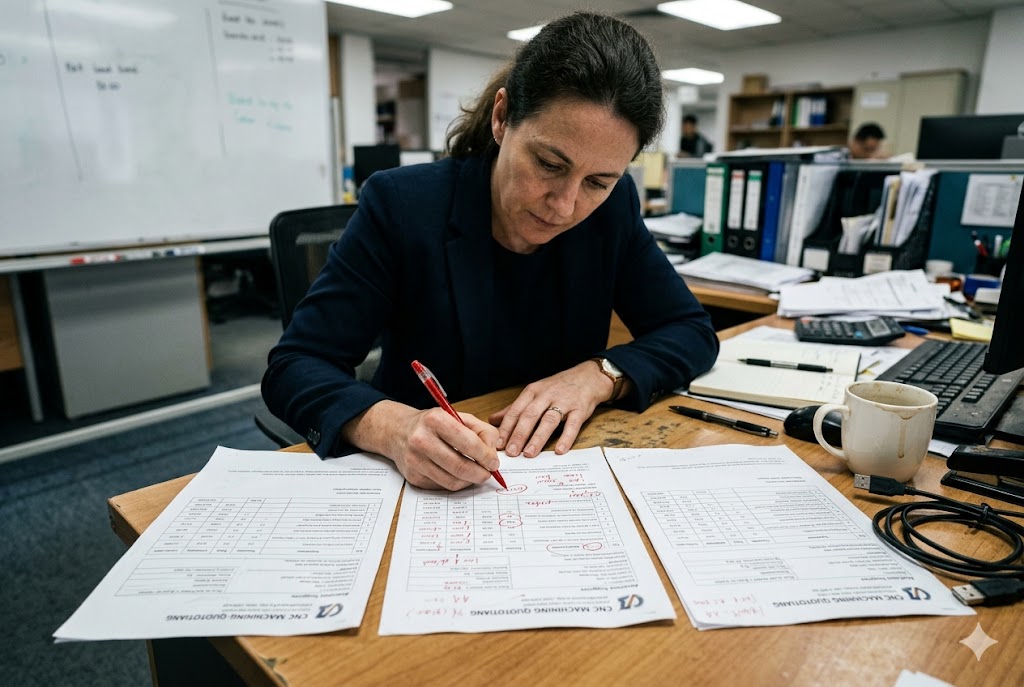
Every week, our team reviews dozens of RFQs from US and Canadian importers. Some come back with quotes that vary by 300% for the identical drawing. That spread is not a coincidence — it is a signal that most buyers have no reliable method for checking whether a price makes sense.
A reasonable CNC quote from China should be itemized by cost category — material, setup, machine time, finishing, inspection, packaging, and freight — and cross-checked against spot metal prices, realistic cycle times, and current shop-floor hourly rates of $15–$35 per hour for 3-axis and $35–$80 per hour for 5-axis work. Collect at least three quotes for every RFQ and treat the median, not the lowest, as your baseline.
Once you have a method for reading quotes, the process becomes faster and more consistent. The sections below give you that method, step by step.
How Can I Benchmark CNC Quotes Without Choosing the Cheapest Supplier?
When we collect quotes on behalf of clients, the first instinct from many buyers is to sort by price and pick the lowest. We understand the pressure. But in our experience coordinating procurement across dozens of Chinese factories, price-sorting without a benchmark leads to problems downstream — rework, delays, and substituted materials.
To benchmark CNC quotes without defaulting to the cheapest supplier, collect a minimum of three quotes for the same fully specified RFQ, identify the median price as your anchor, and flag any quote that falls more than 30–40% below that median for immediate scrutiny. The median reflects real market cost; outliers almost always signal a scope gap or material substitution.

Why the Median Matters More Than the Minimum
Price competition among Chinese CNC shops is intense. Real platform data from 2026 shows that a single RFQ on a major sourcing platform can attract 18 or more responses. That volume means the market has already done most of the price discovery for you — the cluster of mid-range quotes reflects what the job actually costs to do correctly.
When a quote lands 30–40% below that cluster, one of three things is usually happening:
- The supplier missed or ignored a specification (tight tolerance, specific surface finish, material certification).
- The supplier plans to substitute a cheaper material grade.
- The supplier is pricing to win the order and will raise costs through change orders once production begins.
None of these outcomes save you money. The first two create quality failures. The third erodes trust and inflates your actual landed cost.
Build Your Comparison Table First
Before you even open quotes, build a reference table using your drawing. List every cost driver you can identify. Then compare each quote against that table line by line.
| Cost Driver | What to Look For | Red Flag |
|---|---|---|
| Material grade | Named alloy (e.g., 6061-T6, 304 SS) | Generic "aluminum" or "stainless" |
| Setup / programming | Separate line item | Bundled into unit price |
| Machine time | Hours or rate stated | No detail given |
| Surface finish | Specific process and spec | "Finishing included" with no detail |
| Inspection | Method and standard named | Not mentioned |
| Packaging | Export-grade or custom foam | Not mentioned |
| Freight terms | Incoterms clearly stated | No Incoterms at all |
How to Use Response Quality as a Signal
Suppliers who engage with your drawing before quoting — asking about tolerance stack-up, requesting clarification on a surface finish spec, or flagging a thin wall that may need support — are costing your job properly. That engagement takes time. A supplier who returns a price within two hours of receiving a complex multi-feature drawing almost certainly did not model the cycle time or check the material cost.
In our team's experience, suppliers who respond substantively within 24–48 hours and ask at least one clarifying question produce quotes that hold. Quotes that arrive in under two hours with no questions attached should be treated as estimates, not firm prices.
What Should I Compare Besides Unit Price in Each Quote?
Most buyers look at the unit price and move on. That is the single biggest mistake in cross-border CNC procurement. Our sourcing team has seen unit prices that look identical on the surface hide cost differences of over 40% once every line item is unpacked.
Beyond unit price, compare each quote across at least seven categories: material grade and certification, setup and programming fees, surface finishing specification, inspection method and standard, packaging type, freight terms (Incoterms), and payment terms. Omissions in any of these categories shift cost and risk to the buyer.

The Seven Line Items Every Quote Must Show
A quote that presents a single lump-sum number cannot be evaluated. Insist on itemization. Here is what each line should contain and why it matters.
1. Material
The quote must name the alloy grade, the standard it conforms to (ASTM, GB, JIS), and whether a material traceability report (MTR) is included. "Aluminum" is not an acceptable material specification. 6061-T6 per ASTM B209 1 with MTR is.
2. Setup and Programming
Setup covers fixturing, toolpath programming, and first-article inspection. For low-volume runs (under 50 pieces), setup can represent 20–40% of total cost. If this is bundled into unit price, it disappears on repeat orders — but only if the supplier remembers to remove it, which many do not.
3. Surface Finishing
This is the line item most often left vague. The quote should state the process (anodize, zinc plate, powder coat, passivate), the specification (e.g., Type II clear anodize per MIL-A-8625 2), and the thickness range. A quote that says "anodizing included" without a specification can be fulfilled with the cheapest available process, which may fail your functional requirement.
4. Inspection
Inspection should name the method (CMM, 3 go/no-go gauging, visual per AQL 2.5 4) and whether an inspection report ships with each batch. If QC is not specified, the supplier's definition of "passed" may differ significantly from yours.
5. Packaging
Export packaging for metal parts protects against corrosion and transit damage. Ask whether parts ship in vacuum-sealed poly bags with desiccant, custom foam inserts, or standard cardboard. For high-precision parts, inadequate packaging causes surface damage that triggers rejection at your dock.
6. Freight Terms (Incoterms)
This single line can shift thousands of dollars of cost and risk. The table below shows how Incoterms 5 affect your total landed cost.
| Incoterms | Who Arranges Freight | Who Pays Customs | Who Bears Transit Risk |
|---|---|---|---|
| EXW | Buyer | Buyer | Buyer from factory door |
| FOB | Supplier to port | Buyer | Buyer from vessel |
| CIF | Supplier | Buyer | Buyer from destination port |
| DDP | Supplier | Supplier | Supplier to your door |
A quote priced EXW that looks 25% cheaper than a DDP quote may actually cost more once you add international freight, insurance, customs broker fees ($200–$400 per shipment), US import duties 6 (which can exceed 95% for certain metal parts in 2026), and last-mile trucking.
7. Payment Terms
Net 30 or Net 60 on a letter of credit costs the supplier money, and some build that cost into the unit price. Others offer a small discount for T/T in advance. Knowing the payment structure lets you compare prices on a like-for-like basis.
Quick Comparison Template
| Line Item | Supplier A | Supplier B | Supplier C |
|---|---|---|---|
| Material grade + cert | |||
| Setup / programming | |||
| Machine time (est. hrs) | |||
| Surface finish + spec | |||
| Inspection method | |||
| Packaging | |||
| Incoterms | |||
| Payment terms | |||
| True landed cost |
Fill this in for every quote you receive. The true landed cost line — not the unit price line — is the number you compare.
How Do Tolerances, Finish, and QC Requirements Affect Quote Reasonableness?
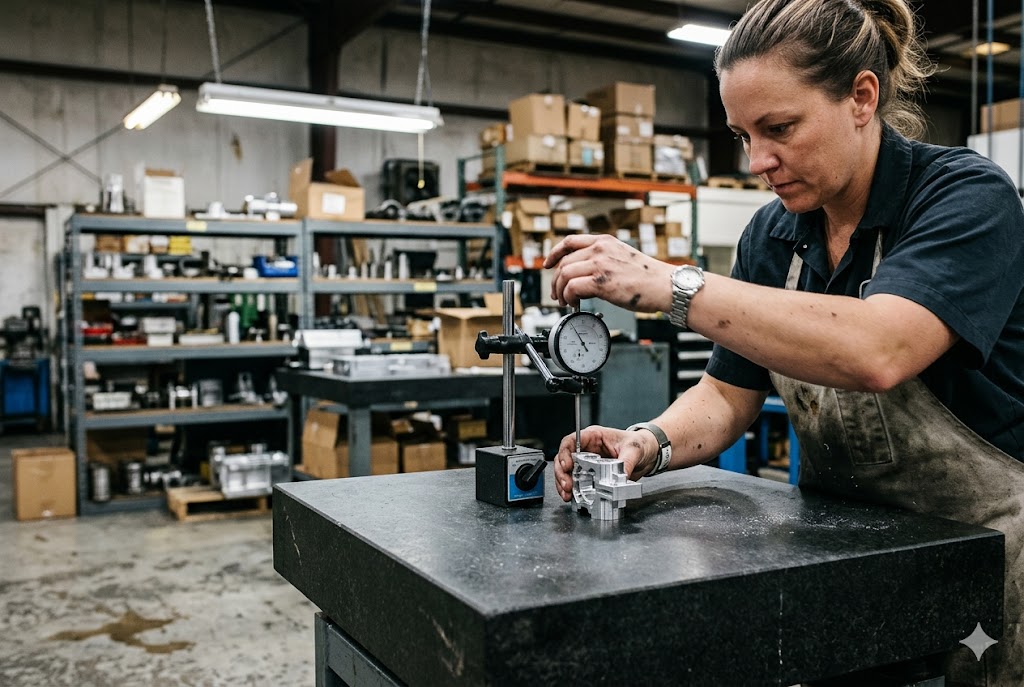
When our engineers review a drawing before quoting, three things determine most of the cost: how tight the tolerances are, what the surface must look like or do, and how thoroughly the part must be inspected. A buyer who does not understand this relationship cannot tell whether a low price reflects efficiency or corner-cutting.
Tolerances, surface finish, and QC requirements directly drive machining time, scrap rate, and inspection cost. A part with tolerances tighter than ±0.001 inch, a Type III hard anodize requirement, and 100% CMM inspection will legitimately cost two to four times more than a visually similar part with ±0.005 inch tolerances, a painted finish, and AQL sampling. A quote that does not reflect this difference has not priced the job correctly.
How Tolerances Affect Machining Cost
Tolerance drives tool selection, cutting speed, number of passes, and scrap rate. A general rule of thumb: every time you halve a tolerance band, cycle time increases by 20–50% for that feature. Tight tolerances on many features compound this effect.
Ask yourself whether every tight tolerance on your drawing is functionally necessary. In our review of client drawings, we regularly find features called out at ±0.001 inch that mate with rubber seals or non-critical housings. Relaxing those tolerances to ±0.003 or ±0.005 inch can reduce unit cost by 15–30% with no impact on function.
How Surface Finish Affects Cost
Surface finish is one of the most commonly under-specified and over-promised items in CNC quotes. Here is a simplified cost ladder for common processes:
| Surface Finish Process | Relative Cost Index | Key Specification to Request |
|---|---|---|
| Deburr and clean only | 1.0× | None beyond Ra value |
| Type II anodize (clear or color) | 1.3–1.6× | MIL-A-8625 Type II, thickness |
| Zinc electroplate | 1.4–1.7× | ASTM B633, class |
| Powder coat | 1.5–1.8× | RAL color, thickness, adhesion |
| Type III hard anodize | 2.0–2.5× | MIL-A-8625 Type III, thickness |
| Electroless nickel plate | 2.2–2.8× | ASTM B733, class, thickness |
| Passivation (stainless) | 1.1–1.3× | ASTM A967 or AMS 2700 |
If a supplier quotes Type III hard anodize at the same price as Type II, either they plan to deliver Type II and call it Type III, or they have miscalculated. Both outcomes create a problem for you.
How QC Requirements Affect Cost
Inspection is not free. A supplier running AQL 2.5 sampling on a 500-piece batch inspects roughly 50 parts. Full 100% CMM inspection of a complex part at $40–$80 per part adds $20,000–$40,000 to a 500-piece order — a cost that must appear somewhere in the quote. If inspection is not itemized, either it is not being done to your standard, or its cost is hidden in the unit price and you cannot verify it.
When reviewing quotes, confirm the following in writing:
- What percentage of parts will be inspected?
- What instrument or method will be used?
- Will an inspection report (with actual measured values, not just pass/fail) ship with the batch?
- Who bears the cost of reinspection if the batch fails?
When Is a Low Quote Too Risky for My Project?
We have seen buyers accept a price that looked great, then spend months managing defects, short shipments, and material non-conformances. The low quote was not a deal. It was a transfer of risk — from the supplier to the buyer.
A low quote becomes too risky when it cannot be reconciled with material spot prices, realistic cycle times, and applicable import duties; when the supplier cannot provide a material traceability certificate; 7 when their DFM feedback 8 is absent; or when the price falls more than 30–40% below the median of a properly benchmarked RFQ. Any one of these signals warrants rejection or deep verification before you commit.

The Back-of-Envelope Sanity Check
Before accepting any quote, run a quick cost check. The formula is:
Total Cost = Material + (Cycle Time × Hourly Rate) + Setup + Finishing + Inspection
Here is how to apply it:
-
Material: Look up the spot price of your specified alloy. 6061-T6 aluminum runs roughly $3–5 per pound. Estimate the billet volume from your CAD geometry, apply a 20–50% scrap factor for material removed during machining, and calculate a rough material cost. If the supplier's material line is dramatically below this number, they are either using a different grade or have made an error.
-
Machine time: China 3-axis shop rates run $15–$35 per hour. 5-axis rates 9 run $35–$80 per hour. Estimate how many hours your part realistically takes. If the quote implies a cycle time that is physically impossible for your part's geometry, or an hourly rate below $15, the price is not sustainable.
-
Setup: For low-volume runs, expect $100–$400 in setup cost. If setup is absent from the quote entirely, ask where it went.
-
Finishing and inspection: Compare against the cost ladder in the previous section.
If the math works out, the quote is plausible. If it does not, ask the supplier to explain the gap in writing before you proceed.
Specific Risk Signals to Watch For
| Risk Signal | What It May Mean | What to Do |
|---|---|---|
| No material grade named | Substituted or unverified alloy | Require named grade + MTR in writing |
| No DFM questions on complex part | Drawing not reviewed carefully | Ask for their DFM feedback explicitly |
| Quote returned in under 2 hours | Estimate, not a costed price | Treat as placeholder; require itemized detail |
| Finishing vague ("anodizing included") | Cheapest available process | Require specific process and spec in writing |
| Price >30–40% below median | Scope gap or substitution | Request full itemized breakdown |
| No Incoterms stated | Hidden landed cost risk | Calculate true landed cost yourself |
| No inspection details | QC not being performed to your spec | Define inspection requirement in PO |
When to Walk Away
Some risk signals are hard to recover from after the order is placed. Walk away — or require a factory audit before committing — when:
- The supplier deflects or ignores your request for a material traceability certificate.
- Their written quote contradicts their verbal assurances (e.g., quote says EXW but salesperson says "we handle everything").
- They cannot name the machine tools or processes they will use for your part.
- They have no verifiable quality management system (ISO 9001 10 certification with a real certificate number you can look up).
For repeat orders, benchmark each new quote against your own cost-per-part history, adjusted for current metal prices. If a supplier's unit price rises more than 10–15% between orders with no change in scope, material market, or volume, ask for a written explanation before approving. That gap is the earliest reliable signal of margin pressure at the factory level.
Conclusion
Evaluating a CNC quote from China is not guesswork. Itemize every cost, sanity-check the material and machine time math, benchmark against the median of three or more quotes, and verify that tolerances, finishing, and QC are fully specified. Do that consistently, and the right supplier becomes obvious.
Footnotes
1. Overview of 6061-T6 aluminum alloy properties, composition, and ASTM standards for CNC machined parts. ↩︎
2. Full breakdown of MIL-A-8625 anodizing types (I, II, III) and their performance specifications. ↩︎
3. How coordinate measuring machines (CMM) deliver precision dimensional inspection in manufacturing. ↩︎
4. Explanation of AQL (Acceptable Quality Limit) sampling methodology and how it governs batch inspection. ↩︎
5. Official ICC Incoterms rules defining buyer and seller responsibilities, costs, and risk in global trade. ↩︎
6. Current duty structure for CNC metal parts shipped from China to the US, including Section 301 and Section 232 tariff stacking. ↩︎
7. Definition of mill test reports (MTR) and why they are essential for verifying material compliance and traceability. ↩︎
8. Design for Manufacturability (DFM) principles and how supplier DFM engagement signals proper drawing review. ↩︎
9. Advantages of 5-axis CNC machining and why it commands higher shop rates than 3-axis work. ↩︎
10. ISO 9001 quality management system certification requirements and how to verify a supplier's certificate number. ↩︎