Skip to main content Skip to footer

We have helped dozens of buyers source custom CNC machined parts from China and Vietnam. One thing surprises almost every new client: they send the same drawing to five suppliers and get back five completely different numbers. The gap is often 30%, sometimes 80%. That is not noise. That is a signal.
When suppliers quote very different prices for the same CNC part, the most common reasons are incomplete RFQ documents, differences in machine capability, supplier type (factory vs. trading company), regional labor costs, and what each supplier includes in their quality scope. Fixing your RFQ package alone can reduce the quote spread by half.
Understanding why quotes differ helps you compare them fairly. It also helps you spot the ones that are too low to be real — and those matter just as much as the ones that are too high.
How Do Machining Capability and Tolerance Requirements Affect the Quote I Receive?
Our engineers review customer drawings every week. We see the same pattern repeatedly: a drawing with tight tolerance callouts goes to three shops, and the quotes come back wildly different — not because the part is complex, but because each shop reads the tolerance differently and budgets machining time accordingly.
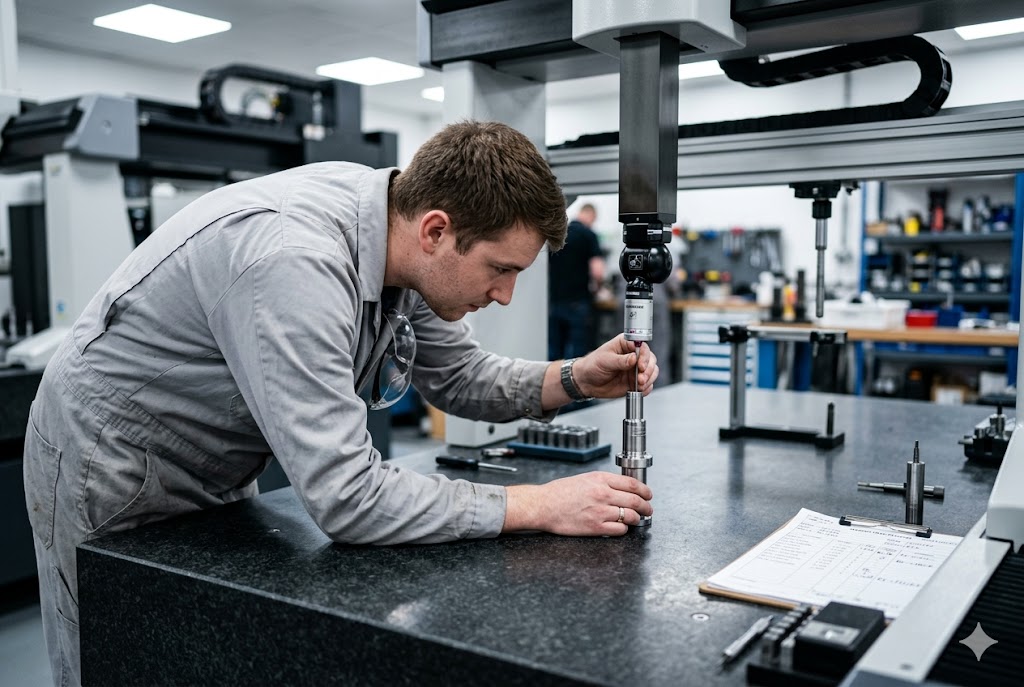
Tolerance requirements directly drive machining time, setup complexity, and inspection cost. A part with ±0.02 mm callouts can cost two to four times more than the same geometry at ±0.1 mm, because it requires slower feeds, more setups, mid-cycle probing, and CMM verification rather than a simple go/no-go check.
Why Tolerance Callouts Split Quotes Apart
Every supplier starts with your drawing and asks: how hard is this to hold? Their answer depends on the machines they run, the skills of their operators, and their internal quality procedures. A shop running a 5-axis DMG MORI or a Mazak will quote a tight tolerance part with confidence and build in one setup. A shop running older 3-axis machines may need two or three setups to achieve the same result — and each setup adds time, handling, and risk of error.
Here is how tolerance tiers typically affect the cost of machining time, according to CNC machining cost guides 1:
| Tolerance Range | Typical Machining Approach | Relative Cost Index |
|---|---|---|
| ±0.1 mm and above | Standard 3-axis, single setup | 1.0× |
| ±0.05 mm | Slower feeds, operator inspection | 1.5–2.0× |
| ±0.02 mm | Climate-controlled, CMM verification | 2.5–4.0× |
| ±0.01 mm or tighter | Precision grinding, jig boring, full CMM | 4.0–6.0× |
The cost index above is not fixed. It varies by part geometry, material, and which supplier you are talking to. But the direction is always the same: tighter tolerances cost more time, and time is what you are paying for.
Surface Finish Adds Another Layer
Surface finish specification (Ra value) 2 compounds the effect. A part that needs Ra 0.8 μm requires fine milling or grinding, plus post-machining inspection. A part at Ra 3.2 μm can be finished in a single operation. If your drawing says "machine all over" without an Ra callout, each supplier assumes a different finish standard. One quotes Ra 3.2 μm and another quotes Ra 1.6 μm. The underlying part is the same. The prices are not.
What Happens When Tolerances Are Ambiguous
When a drawing has conflicting or missing callouts, suppliers do one of three things. Some ask for clarification — these are usually the more experienced shops. Some assume standard commercial tolerances — this keeps their quote low but may not match what you actually need. Some assume the tightest possible interpretation and build in every control step — this protects them from a rejection claim, but it also produces the highest quote.
That spread is not the market telling you different things. It is the market responding to an incomplete input. The fix is simple: lock down your tolerance callouts by following a standard such as ASME Y14.5 for geometric dimensioning and tolerancing 3, specify your Ra values, and state which dimensions are critical. A cleaner drawing closes the gap.
Could Suppliers Be Quoting Different Materials or Inspection Standards?
When we collect and compare quotes on behalf of our clients, we often find that two quotes for the "same part" are actually for different jobs. One supplier quoted 6061-T6 aluminum. Another quoted 6063. One included a material certificate. Another included nothing but a visual check. The drawing was the same. The scope was not.
Suppliers frequently quote different material grades and inspection packages when these are not explicitly stated in the RFQ. A quote with no material certificate, no dimensional report, and no surface finish inspection can be 20–35% lower than a quote that includes all three — even for the same physical part.

Material Grade Differences Are More Common Than You Think
Steel, aluminum, and stainless alloys all have multiple grades within each family. When you write "stainless steel" on a drawing without specifying 304, 316, or 316L, you leave a gap. A supplier who quotes 304 will be cheaper than one who quotes 316L — raw material cost alone can differ by 30–50% between grades. The part looks the same. The corrosion performance does not.
The same issue applies to aluminum. 6061 and 6063 are both common. 6061 machines slightly better and holds tighter tolerances more reliably. 6063 is cheaper. If you did not specify which one, you cannot compare the quotes.
| Material Ambiguity | Common Supplier Assumption | Price Impact |
|---|---|---|
| "Stainless steel" | 304 (lowest cost grade) | Baseline |
| 316 stainless | Higher alloy content | +20–35% |
| 316L stainless | Low carbon, premium grade | +30–50% |
| "Aluminum" | 6061-T6 or 6063 | Varies ±10% |
| "Steel" | Q235 (Chinese standard) vs. 1045 | ±15–25% |
Inspection Scope Is Rarely Spelled Out
Most RFQs do not specify what inspection deliverables are required. As a result, each supplier defaults to their own standard. A small shop with no coordinate measuring machine (CMM) 4 equipment will offer visual inspection and a simple dimensional check with calipers. A more equipped facility will offer a full CMM report. A third will offer First Article Inspection (FAI) 5 with a complete ballooned drawing and traceability.
These are not the same service. They are not the same cost. When you compare a quote that includes CMM + material cert + FAI to one that includes a caliper check and a verbal OK, you are comparing different products. The lower quote is not automatically worse — but you need to know what you are buying.
Certifications Add Cost and Accountability
Some buyers need RoHS compliance 6 documentation, REACH statements, or specific material traceability to their end customer's quality system. If your RFQ does not ask for these, no supplier will volunteer them or price them in. When you later ask for the paperwork, you either pay extra or learn that the supplier cannot provide it at all.
Specify your certification requirements in the RFQ. This filters out suppliers who cannot meet them and makes the remaining quotes genuinely comparable.
How Can I Compare Supplier Quotes on the Same Basis?
In our experience managing sourcing projects for US and Canadian buyers, the single most effective step is not negotiating — it is standardizing. When every supplier receives the same complete package, the quotes become comparable for the first time. Until then, you are comparing assumptions, not prices.
To compare CNC machining quotes on the same basis, send every supplier an RFQ that specifies material grade, critical tolerances, surface finish (Ra value), required inspection deliverables, certification requirements, packaging standards, and Incoterms. Without these inputs locked down, each quote is pricing a different job.

Build a Standardized RFQ Package
Your RFQ should be a complete technical and commercial package. Here is what it needs to cover at a minimum:
| RFQ Section | What to Specify | Why It Matters |
|---|---|---|
| Drawing | Full GD&T callouts, revision number | Eliminates tolerance ambiguity |
| Material | Grade, standard (ASTM/DIN/JIS), heat treatment | Prevents alloy substitution |
| Surface finish | Ra value, plating/anodizing spec | Prevents finish scope gaps |
| Inspection | CMM, FAI, material cert, visual only | Makes quality scope explicit |
| Certifications | RoHS, REACH, ISO cert required? | Filters incapable suppliers |
| Quantity | Exact quantity, with tooling/NRE separated | Clarifies unit price basis |
| Incoterms | FOB, CIF, DDP | Normalizes logistics cost |
| Lead time | Required delivery date | Surfaces capacity issues early |
When every row in that table is answered, your quotes become comparable. When any row is blank, you are inviting assumptions.
Separate Tooling Costs from Unit Costs
Many buyers overlook this. If your part requires a mold, jig, or fixture, some suppliers bundle that cost into the unit price. Others quote it separately. If you compare a quote with hidden tooling to one with explicit tooling, you will misread the cheaper-looking quote as a better deal — until the second order arrives and the "unit price" is suddenly higher.
Ask every supplier to break out NRE (non-recurring engineering) costs, tooling costs, and unit part costs as separate line items.
Normalize for Incoterms
A quote on EXW (ex-works) terms is not comparable to a quote on DDP (delivered duty paid) terms. Incoterms 2020 rules 7 clearly define who bears freight, insurance, customs duties, and last-mile delivery under each term. EXW puts all of those costs on you; DDP puts them all on the supplier. Depending on your part weight and destination, the freight and duty gap between EXW and DDP can be $500–$5,000 per shipment. Always ask for the same Incoterm across all quotes, or request that suppliers break out the cost components so you can build a landed cost comparison yourself.
What Quote Differences Should Make Me Question Quality or Delivery Reliability?
We visit supplier factories before we place orders for our clients. We have walked into facilities where the quote looked attractive and the reality did not match. There are specific patterns in a quote — and in a supplier's behavior — that tell you the price is too low to be sustainable, or too fast to be safe.
A quote that is more than 30% below the median of your other quotes, promises lead times that are 40% shorter than industry norms, or comes from a supplier who cannot answer basic technical questions about your part is a strong signal of quality or delivery risk — not a bargain.
The 30% Below Median Rule
If you collect five quotes and four cluster within 15% of each other, and one is 35–50% lower, that outlier deserves scrutiny — not celebration. Sustainable machining prices are anchored to real costs: material, labor, machine time, and overhead. CNC machining hourly rates 8 for standard operations typically range from $60 to $120 per hour in the US, with the floor set by real input costs. A price that breaks below that floor is being subsidized by something: lower quality steel, skipped inspection steps, deferred maintenance on aging equipment, or a loss-leader pricing strategy to win your account.
Loss-leader pricing is real and it is not always dishonest. Some factories will quote at or below cost to win a new international buyer, expecting to raise prices by the third order. Others use low pricing to hide the fact that they plan to subcontract your part to a cheaper shop without telling you.
Unrealistic Lead Times
Lead time is a function of machine capacity, queue depth, and the complexity of your part. If your part has a realistic cycle time of 45 minutes and the supplier needs to machine 500 pieces, the minimum machining time alone is 375 hours — before setup, inspection, finishing, and packaging. A supplier who promises delivery in two weeks when the math requires four is either skipping steps or planning to miss the date.
Ask the supplier: what is your current machine utilization rate? How many shifts are you running? Where does my order sit in your current queue? A supplier who cannot answer these questions does not have the capacity visibility to reliably manage your lead time.
Red Flags in Supplier Communication
How a supplier answers technical questions tells you as much as the quote itself. A purchasing manager at a US importer should expect clear, specific answers to part-level questions. Watch for these patterns:
- Vague answers to tolerance questions ("we can do it, no problem")
- Inability to name the machine they will use for your part
- No mention of how they handle first article inspection
- Reluctance to share factory audit reports or quality certifications
- Slow or inconsistent communication before the order
These are not personality quirks. They are process signals. A factory that cannot tell you how they will machine your part before the order cannot tell you why it failed after.
Trading Companies Presenting as Manufacturers
This is one of the most common sources of unexpected price gaps. Trading companies typically add a 15–30% markup 9 to the factory rate. When a trading company presents as a manufacturer, their quote looks like a factory quote but includes a hidden margin. If you later find the real factory, their quote will be significantly lower — not because quality is different, but because the intermediary layer is gone.
Ask every supplier directly: do you manufacture this part in your own facility, or do you subcontract? Request the factory address and cross-check it against the company registration 10. We do this for every supplier we audit on behalf of our clients.
Conclusion
Quote spread is a symptom, not the disease. Fix your RFQ, normalize your terms, and ask the right questions before you compare numbers. That is where reliable sourcing starts.
Footnotes
1. CNC machining cost factors including tolerance tiers, hourly rates, and machine types explained. ↩︎
2. Guide to Ra surface roughness values, how they are measured, and their effect on machining cost. ↩︎
3. The authoritative ASME Y14.5 standard for geometric dimensioning and tolerancing on engineering drawings. ↩︎
4. Comprehensive guide to CMM technologies for dimensional inspection and quality assurance. ↩︎
5. Beginner's guide to AS9102 First Article Inspection planning, tools, and documentation. ↩︎
6. Overview of RoHS compliance requirements for restricting hazardous substances in manufactured goods. ↩︎
7. Official ICC Incoterms 2020 rules defining buyer and seller responsibilities in international trade. ↩︎
8. Breakdown of CNC machining hourly cost ranges and the key factors that drive price variation. ↩︎
9. How trading companies and manufacturers differ in price, control, and quality in China sourcing. ↩︎
10. Seven methods to verify whether a Chinese supplier is a real manufacturer or a trading company. ↩︎