Skip to main content Skip to footer

Every week, our team handles incoming inspection disputes between buyers and their Chinese suppliers. The part "looks fine," but it fails in assembly. The root cause is almost always the same: geometric tolerances were never measured correctly — or at all.
To inspect flatness, perpendicularity, and other geometric tolerances on custom sheet metal parts, you need the right tool for each tolerance type, a clearly defined datum reference frame on your drawing, and a two-tier inspection plan that separates routine production checks from full first article inspections. Without all three, your measurement results are unreliable.
The good news is that this is a solvable problem. Here is exactly what you need to know.
What Measuring Tools Should My Supplier Use to Check Geometric Tolerances?
When our engineers review a supplier's inspection capability before we place an order, the first thing we check is not their CMM — it is whether their operators know when to use it and when not to. The wrong tool for the tolerance wastes time and produces false confidence.
The right measuring tool depends on the tolerance value and the feature type. For flatness ≥ 0.1 mm, a Grade B granite surface plate with a 0.001 mm dial indicator is faster and often more accurate than a CMM. For tolerances below 0.05 mm, or where digital records are required for FAI, a CMM is necessary. A straightedge with a feeler gauge is only suitable for pass/fail checks at ±0.02 mm or coarser.

Matching Tool to Tolerance
Not every feature needs a CMM. Using one by default is slow, expensive, and sometimes less accurate than simpler methods. Here is a practical guide:
| Tolerance Type | Tolerance Value | Recommended Tool |
|---|---|---|
| Flatness | ≥ 0.1 mm | Granite surface plate + dial indicator |
| Flatness | < 0.05 mm | CMM (best-fit plane calculation) |
| Perpendicularity | ≥ 0.1 mm | Precision square + dial indicator |
| Perpendicularity | < 0.05 mm | CMM fixture |
| Bend angle | ±1° or coarser | Digital bevel protractor |
| Bend angle | ±0.25° or finer | CMM (two-plane calculation) |
| Hole position | Any | CMM or pin gauge (attribute) |
| Flatness (quick check) | ±0.02 mm or coarser | Straightedge + feeler gauge |
How to Measure Flatness Correctly
This is where many suppliers get it wrong. Placing a part on a granite surface plate 1 and sweeping a dial indicator 2 over it does not measure flatness. It measures parallelism to the table. A part that should fail can pass this incorrect test.
The correct method is the three-point (three-jack) method:
- Support the part on three adjustable points placed roughly 120° apart near the perimeter.
- Zero the indicator directly above each support point to define the measurement plane.
- Sweep the entire surface and record the full indicator movement (FIM).
- The difference between the highest and lowest readings is the actual flatness deviation.
This method is defined in ISO 1101 3 and ASME Y14.5. Any supplier claiming to measure flatness without this setup is measuring something else.
CMM Limitations on Large Flat Surfaces
A coordinate measuring machine 4 is not automatically the most accurate tool. On a 200 mm panel with a 0.05 mm flatness tolerance, a granite plate with a tenths indicator resolves to 0.005 mm. A CMM in a typical production environment may only reach 0.015 mm repeatability due to probe angle variation, thermal drift, and point density limits. Use a CMM where you need positional relationships between features in a single setup — not as a default replacement for surface plate methods.
How Can I Define Acceptance Standards for Form and Position on My Drawing?
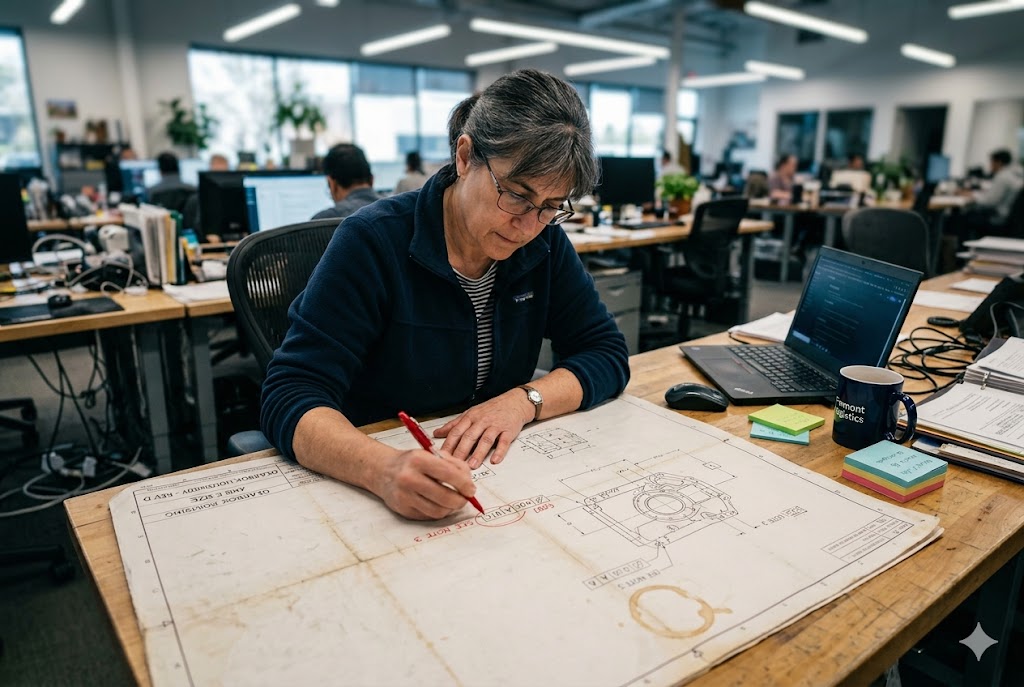
In our experience reviewing drawings from US buyers before we send them to suppliers, the most common problem is not missing dimensions — it is a missing datum reference frame. Without it, every geometric tolerance on the drawing is ambiguous, and two inspectors measuring the same part will produce different numbers.
To define acceptance standards for form and position on your drawing, you must specify a datum reference frame with a primary datum (usually the main flat face), a secondary datum (usually a long edge), and a tertiary datum (usually a short edge or hole). Every geometric tolerance callout must reference these datums explicitly using GD&T feature control frames 5 per ASME Y14.5 or ISO 1101.
Setting Up Your Datum Reference Frame
A datum reference frame 6 (DRF) is the coordinate system your part is measured from. Without it, "perpendicularity" has no agreed-upon reference surface, and "position" has no agreed-upon origin.
For a typical sheet metal panel, the DRF is set up as follows:
| Datum | Surface | Degrees of Freedom Constrained |
|---|---|---|
| Datum A (primary) | Main flat face | Rotation X, Rotation Y, Translation Z |
| Datum B (secondary) | Long edge or reference hole | Rotation Z, Translation X |
| Datum C (tertiary) | Short edge or second hole | Translation Y |
Label these datums on your drawing using datum feature symbols (a square box with a letter, connected to the surface with a triangle). Every geometric tolerance feature control frame must then reference |A|B|C| or the appropriate subset.
Free-State vs. Restrained-State Inspection
This distinction is critical for thin sheet metal parts. Under ASME Y14.5 and ISO 1101, all features are inspected in the free state by default — unsupported, subject only to gravity. Thin panels sag and distort under their own weight. They will fail flatness and perpendicularity inspections that they would pass when mounted in their functional assembly.
If your part is non-rigid, add a general note to your drawing:
INSPECT WHILE FIXTURED TO DATUM A SURFACE WITH FASTENERS TORQUED TO [X] Nm
Without this note, your supplier's QC inspector is required by the standard to inspect the part unsupported. A part that functions perfectly in assembly may be rejected at incoming inspection — or worse, a part that should be rejected passes because gravity distortion hides the actual defect.
Writing Tolerance Callouts Correctly
A geometric tolerance callout must include four elements in the feature control frame:
- The geometric characteristic symbol (flatness, perpendicularity, position, etc.)
- The tolerance value (e.g., 0.1)
- The material condition modifier if applicable (MMC, LMC, or RFS — default is RFS)
- The datum references in the correct order of precedence
Omitting any of these elements creates an unenforceable tolerance. Your supplier's QC team cannot pass or fail the part against a callout they cannot interpret.
Why Do Geometric Tolerances Matter So Much for Assembly Fit and Function?
We have seen a purchasing manager lose a production run because a batch of sheet metal enclosures passed dimensional inspection on every linear dimension but failed in assembly. The holes were in the right place. The flanges were the right height. But the panels were not flat, and the doors would not close. Geometric tolerances are not a formality. They directly control whether your assembly works.
Geometric tolerances matter for assembly fit and function because they control the shape, orientation, and location of features — not just their size. A hole at the correct diameter and position but on a non-flat surface will not align with its mating part. A flange at the correct height but tilted 2° will cause interference. Linear dimensions alone cannot catch these failures.

What Goes Wrong Without Geometric Control
When buyers specify only linear dimensions on sheet metal drawings, they leave large gaps in the definition of the part. A part can meet every linear dimension and still be non-functional. Here are the most common failure modes:
| Failure Mode | Root Cause | Geometric Tolerance That Prevents It |
|---|---|---|
| Panel warps in assembly | No flatness control on main face | Flatness callout on Datum A |
| Flange does not mate square | No perpendicularity control | Perpendicularity of flange to Datum A |
| Holes misalign across panels | Position tolerance too loose | True position callout with MMC |
| Door or cover does not close | Accumulated flatness + perpendicularity errors | Flatness + perpendicularity at assembly level |
| Threaded stud cross-engages | Stud not perpendicular to sheet | Perpendicularity of stud shank to Datum A |
Perpendicularity of PEM Inserts and Studs
This is a characteristic that buyers frequently overlook on their drawings. A PEM insert 7 or clinch stud that is correctly located but tilted 3° will cause thread cross-engagement during assembly. The fastener will feel tight but will not develop its full clamp load, and the joint will loosen in service.
Measure stud perpendicularity using a CMM tactile probe on the stud shank, or with a precision square placed against the stud and a feeler gauge measuring the gap at the base. Divide the maximum gap by the measurement height to get the angular deviation. Add stud perpendicularity as an explicit characteristic on your FAI inspection plan whenever threaded inserts are present.
Bend Angle and Its Effect on Assembly
Bend angle variation is one of the most common geometric issues in sheet metal from press brake 8 operations. Springback after bending causes the actual angle to differ from the nominal. On a deep channel section with two flanges, a 1° springback error on each flange produces a 2° total opening error at the top — enough to prevent a mating panel from seating correctly.
For production-rate inspection, a digital bevel protractor across the two formed legs is adequate for ±1° tolerances. For tighter work, use a CMM to probe both flange planes and calculate the actual included angle. Specify in your inspection plan whether the angle is measured at the neutral zone or the outside mold line — both methods measure the same part and produce different numbers.
What Should I Include in My Inspection Report for Critical Geometric Features?
When our quality team prepares FAI reports for clients sourcing from China, we follow a two-tier structure. The attribute tier catches gross defects fast. The variable tier generates the dimensional records needed to defend against a claim, identify process drift, and validate a golden sample. Both tiers are necessary, and neither replaces the other.
An inspection report for critical geometric features must include the nominal value, actual measured value, tolerance limits, measurement method used, the instrument ID and calibration status, the datum reference frame, the inspector's name and date, and a clear pass/fail result for each characteristic. For first article inspections 9, include a ballooned drawing cross-referenced to each measurement row.

Two-Tier Inspection Plan Structure
Build your incoming inspection plan in two tiers:
Tier 1 — Attribute (Go/No-Go) for Routine Production Lots
This tier is fast. Any trained operator can complete it in under five minutes per part. It catches gross defects and is designed for volume.
- Pin gauges for hole diameters
- Feeler gauges for flatness pass/fail
- Digital angle finder for bend angles
- Go/no-go thread gauges for threaded features
Tier 2 — Variable Measurement for FAI and Process Change Events
This tier is thorough. Use it for first articles, golden sample validation, and any lot where a process parameter has changed — new material heat, tooling replacement, or operator change.
- CMM or surface plate measurements with recorded numerical values
- Ballooned drawing cross-referenced to measurement rows
- Instrument ID and calibration certificate reference
- Statistical summary if applicable (Cpk for critical dimensions)
Minimum Content for a Geometric Inspection Report
| Report Field | Required Content |
|---|---|
| Part number and revision | As shown on drawing |
| Drawing issue date | Date of the revision measured against |
| Nominal value | From drawing callout |
| Tolerance limits | Upper and lower limit |
| Actual measured value | Recorded number, not "OK" |
| Measurement method | e.g., CMM, surface plate + indicator |
| Instrument ID | Traceable to calibration record |
| Datum reference | Which datum frame was used |
| Inspector name | Printed name and signature |
| Inspection date | Date of measurement |
| Pass/Fail | Clear result per characteristic |
Handling Flexibility in Inspection Records
For non-rigid parts inspected under a restrained condition, the report must document the restraint method. Record the fixture ID used, the fastener torque applied, and the restraint points. This information makes the report reproducible — a second inspector using the same fixture and torque should produce the same result. Without this documentation, your report is not repeatable, and your supplier cannot use it to maintain process capability 10 control.
Conclusion
Inspecting geometric tolerances on custom sheet metal parts is not complicated — but it requires the right tools, a defined datum reference frame, and a structured inspection plan. Get these three things right, and your supplier disputes drop sharply.
Footnotes
1. Overview of granite surface plates as precision measurement references for industrial inspection. ↩︎
2. How dial indicators work and their role in measuring surface variation. ↩︎
3. ISO 1101 standard defining geometric tolerancing symbols and measurement rules. ↩︎
4. Explanation of coordinate measuring machines, their types, and accuracy limitations. ↩︎
5. Introduction to geometric dimensioning and tolerancing principles and symbols. ↩︎
6. Definition and setup of datum reference frames in engineering drawings. ↩︎
7. Overview of PEM self-clinching fasteners and their installation requirements. ↩︎
8. How press brake machines form sheet metal and cause springback variation. ↩︎
9. First article inspection process, purpose, and documentation requirements. ↩︎
10. Process capability metrics including Cpk and their role in quality control. ↩︎