Skip to main content Skip to footer

Most rework costs in multi-component sheet metal orders don't show up at final inspection. They show up at the assembly bench, when parts that each passed individual checks simply won't fit together. We see this pattern repeat across sourcing programs every year.
Managing assembly fit tolerances across a multi-component sheet metal order requires a datum scheme shared by all sub-parts, a tolerance stack-up analysis completed before drawings are released, assembly-level GD&T controls on mating features, a first-article assembly inspection, and incoming SPC monitoring to catch dimensional drift before it cascades into fit failures.
The sections below break down each step. Read them in order — each one builds on the last.
What Tolerance Stack-Up Issues Should You Plan For Before You Submit Multi-Part Drawings?
Tolerancing each part in isolation is the single most expensive mistake we help clients fix. When every sub-part references its own edges instead of shared datums, the parts are individually correct and collectively wrong.
Before submitting multi-part drawings, plan for four main stack-up contributors: bend angle error translating into linear positional shift, hole true-position drift across mating patterns, panel bow or oil-canning introducing seating variation, and clearance hole sizing that leaves no room to absorb combined tolerances from three or more parts in a chain.

Why Stack-Up Analysis Is Non-Negotiable
For any assembly with three or more mating components, a formal tolerance stack-up analysis 1 is mandatory before drawings go to a supplier. There are two methods.
Worst-case analysis 2 sums every tolerance in the chain at its maximum value. It is conservative. It tells you the worst assembly outcome that is still within print. If your functional requirement survives worst-case, you are protected.
RSS (root sum square) analysis 3 assumes tolerances are statistically distributed and rarely all peak at once. It produces a less conservative number. It is acceptable for high-volume production where the statistical assumption holds. For low-volume custom orders — which is most of what we handle — worst-case is safer.
| Analysis Method | When to Use | Risk Level |
|---|---|---|
| Worst-case | Low volume, custom orders, safety-critical assemblies | Low risk, conservative |
| RSS | High volume, statistical process control in place | Moderate risk, requires Cpk data |
| No analysis | Never | High risk, guaranteed rework |
Bend Angle Error Is the Most Underestimated Contributor
Sheet metal fabricators work to a standard bend angle tolerance 4 of ±1°. That sounds small. It is not small in a multi-bend chain.
A ±1° bend angle error on a 50 mm flange produces approximately ±0.87 mm of linear positional error at the flange tip. Stack three bends in sequence and worst-case error exceeds 2.6 mm. Standard clearance hole fits for M5 hardware allow roughly 0.5 mm of positional tolerance. The math does not close.
Before tolerancing any mating hole pattern, calculate how much positional error your bend chain contributes. If the number exceeds your clearance hole allowance, you have three options: tighten bend tolerances (cost impact), add slotted holes 5 (preferred), or redesign the assembly split line.
Datum Flow Must Be Defined First
Every hole pattern, flange, and mating edge on every sub-part should be toleranced relative to a shared datum structure — not each part's own edges. Define:
- A primary datum: typically the largest structural panel or mounting face
- Secondary and tertiary datums: establishing orientation and location
- A datum flow: a clear reference hierarchy all sub-parts share
Call out datum feature symbols (A, B, C) explicitly on every drawing. Require your supplier's CMM reports to reference the same datums. A supplier who measures from their own internally chosen origin will produce parts that pass their inspection and fail your assembly.
| Datum Tier | Typical Feature | Controls |
|---|---|---|
| Primary (A) | Largest flat panel or mounting face | Sets the reference plane |
| Secondary (B) | Long edge or first hole pattern | Controls orientation |
| Tertiary (C) | Short edge or secondary hole | Controls location in third axis |
Assign Tolerances by Functional Priority
Over-tolerancing every dimension is as harmful as under-tolerancing. Suppliers — including the factories we work with in China and Vietnam — will either charge tooling premiums or quietly drift on dimensions they judge as unnecessarily tight. Give them a hierarchy they can use.
- Critical fit dimensions (mating holes, locating slots, hinge pivot points): ±0.10–0.15 mm — inspect 100% at first-article
- Structural dimensions (flange lengths, panel widths): ±0.30–0.50 mm — AQL sampling 6
- Non-functional dimensions (cosmetic radii, non-mating edges): ±0.50–1.00 mm — periodic audit
Communicate this tier structure explicitly on drawings. Use a general tolerance block for non-critical dimensions. Use individually called-out GD&T controls 7 for critical features. Suppliers reject fewer parts and produce more reliably when they know which dimensions you will actually hold them to.
How Can You Make Sure All Sub-Parts Will Assemble Correctly After Shipping From China?
Parts that fit on the factory floor in Shenzhen have a way of not fitting at a warehouse in Ohio. Handling, humidity, shipping stress, and re-stacking all introduce minor deformations. In our experience coordinating pre-shipment inspections, the gap between factory fit and destination fit is real.
To make sure all sub-parts assemble correctly after shipping from China, require a first-article assembly inspection using production-lot parts assembled together at the supplier's facility, document all critical assembled dimensions against your assembly drawing tolerances, and ship approved first-article hardware with the production batch as a reference set.

Why First-Article Part Reports Are Not Enough
Suppliers will provide first-article inspection (FAI) 8 reports per part. These are necessary. They are not sufficient.
A set of parts that each pass individual inspection can fail assembly for two reasons. First, each part's tolerance may be correct but biased — all holes positioned 0.10 mm high, for example — and the assembly drawing may require 0.05 mm clearance. Individual parts pass. Assembled fit fails. Second, cumulative tolerance drift across three or more parts in a chain consumes the clearance budget simultaneously.
Require a first-article assembly inspection as a separate contractual deliverable. Specify:
- All sub-components from the first production lot are used (not cherry-picked pre-production samples)
- Parts are assembled together and all critical assembled dimensions are measured
- Gap and flush at all visible seams are recorded
- Mating hole patterns are verified with pin gauges inserted simultaneously through both mating parts
If a pin gauge drops freely through both mating holes, positional alignment is acceptable. If it requires any force, the pattern has drifted beyond functional tolerance — even if each individual hole diameter passed separately.
Assembly Drawing as the Legal Acceptance Standard
The assembly drawing is the contractual document that defines acceptance criteria for the assembled unit. Without it, you can only accept or reject individual parts. You have no legal basis to reject a delivery of individually conforming parts that cannot be assembled.
The assembly drawing should include:
| Feature | What to Specify |
|---|---|
| Critical assembled gaps | Nominal value and tolerance (e.g., 0.5 ± 0.3 mm) |
| Flush requirements at visible seams | Maximum step height (e.g., ≤ 0.3 mm flush) |
| Hole pattern alignment across parts | True position at assembly datum, not individual part datum |
| Panel flatness at seating faces | Flatness control (e.g., ⊞ 0.4) |
| Interference check points | Any location where forced fit would indicate a stack-up failure |
Without these callouts on an assembly drawing, assembled performance is subjective. With them, acceptance and rejection are objective and enforceable.
Use Assembly-Level GD&T Controls on Mating Features
Individual part drawings control individual part geometry. They do not control how parts relate to each other. For any multi-component order, add the following GD&T controls specifically for mating features:
True position on all mating hole patterns, referenced to the shared assembly datums. Add the MMC modifier where functionally appropriate — on sheet metal, a larger clearance hole tolerates more positional error, and the MMC modifier captures this correctly.
Profile of a surface on mating flanges and seating faces where flush or gap requirements exist.
Flatness on any panel that serves as a seating datum for a mating component. Sheet metal panels bow and oil-can. A nominally flat panel without a flatness callout can introduce 0.5–1.5 mm of uncontrolled assembly variation on its own.
These controls go on both the individual part drawings and the assembly drawing. The assembly drawing callout supersedes the individual part callout for any assembled dimension.
Design Adjustability Into Marginal Joints
When stack-up analysis shows that a joint is tight but redesign is not feasible, build in mechanical adjustability at zero or near-zero cost.
Slotted holes instead of round holes at non-critical attachment points. A 1 mm slot on a clearance hole adds ±0.5 mm of positional adjustment. This is the most reliable low-cost mitigation for marginal stack-up joints.
Stepped or relieved mating flanges that create a positive locating feature on one axis while allowing float on the other. Common on instrument panel assemblies.
Tack-weld-then-drill sequencing for welded assemblies. Tack components in fixturing, verify assembled geometry, then final-drill mating holes in-assembly. This eliminates the entire positional hole stack-up by making the assembly the reference, not the individual parts.
What Inspection Steps Help Catch Fit Problems Before Parts Leave the Factory?
Fit problems caught at origin cost a conversation and a re-run. Fit problems caught after shipment cost freight, delay, and often downstream customer compensation. Our team has seen both outcomes, and the difference almost always traces back to what inspection was — or wasn't — specified contractually.
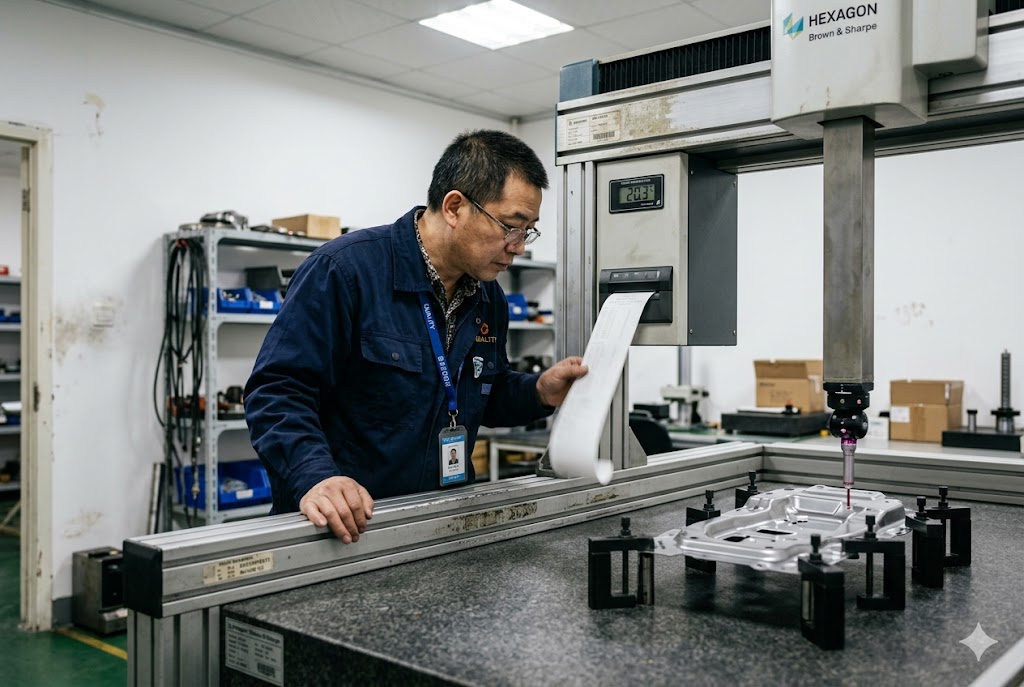
The inspection steps that most reliably catch fit problems before parts leave the factory are: verifying hole true position with CMM against shared assembly datums, assembling a sample set from production stock with pin gauges at mating holes, checking panel flatness at seating faces, measuring critical assembled dimensions against the assembly drawing, and reviewing SPC charts for dimensional drift trends before releasing a batch for shipment.
Specify Inspection at Two Levels
Inspection must happen at the part level and the assembly level. Part-level inspection alone is insufficient for multi-component orders. Assembly-level inspection alone, without part-level data, gives you no information about which part is the source of a fit problem when one occurs.
Part-level inspection checklist:
- Hole diameter at all mating features: verify against nominal and tolerance
- Hole true position: CMM 9 report referenced to drawing datums A, B, C — not supplier's own measurement origin
- Flange lengths at all mating flanges: verify within tolerance
- Flatness at any seating datum surface: verify against drawing callout
- Bend angle at all bends contributing to a positional stack: verify ±1° or as called out
Assembly-level inspection checklist:
- Assemble sample set from production stock (not pre-production samples)
- Insert pin gauges into all mating hole pairs simultaneously — no forcing allowed
- Measure gap and flush at all visible seams
- Measure all critical assembled dimensions called out on assembly drawing
- Document results against assembly drawing tolerances, not individual part tolerances
SPC Monitoring Catches Drift Before It Becomes a Shipment Problem
Once production is running, individual part dimensions drift independently over time. Tool wear, material lot variation, and operator change all contribute. In a multi-component assembly, two parts can each drift within their individual tolerance bands but in opposing directions, consuming the entire assembly clearance budget at once.
Require SPC charts 10 for all critical dimensions on all sub-parts. Define a re-qualification trigger: if any critical dimension's Cpk drops below 1.33 on incoming or in-process data, the next shipment does not release until the supplier performs a documented process review.
Periodically assemble a sample set from production stock — not selected parts, but random draws from production inventory — and verify assembled fit. This catches correlated drift that part-level inspection misses.
The Pin Gauge Test Is the Fastest Assembly Fit Check
For mating hole patterns, nothing is faster or more conclusive than a pin gauge test. Take a pin gauge sized to the mating nominal diameter. Insert it through both mating holes simultaneously. If it passes freely, positional alignment is acceptable. If it requires any force, the pattern has drifted.
This test takes under 30 seconds per joint. It requires no CMM time. It can be performed by a line inspector without engineering involvement. For high-volume production runs, build it into the standard end-of-line check for all sub-components destined for multi-part assemblies.
Should You Request a Trial Assembly Check Before Your Supplier Approves a Batch for Shipment?
Yes. Without exception. Our sourcing team treats a trial assembly check as a non-negotiable step in the pre-shipment inspection process for any order involving three or more mating sub-components.
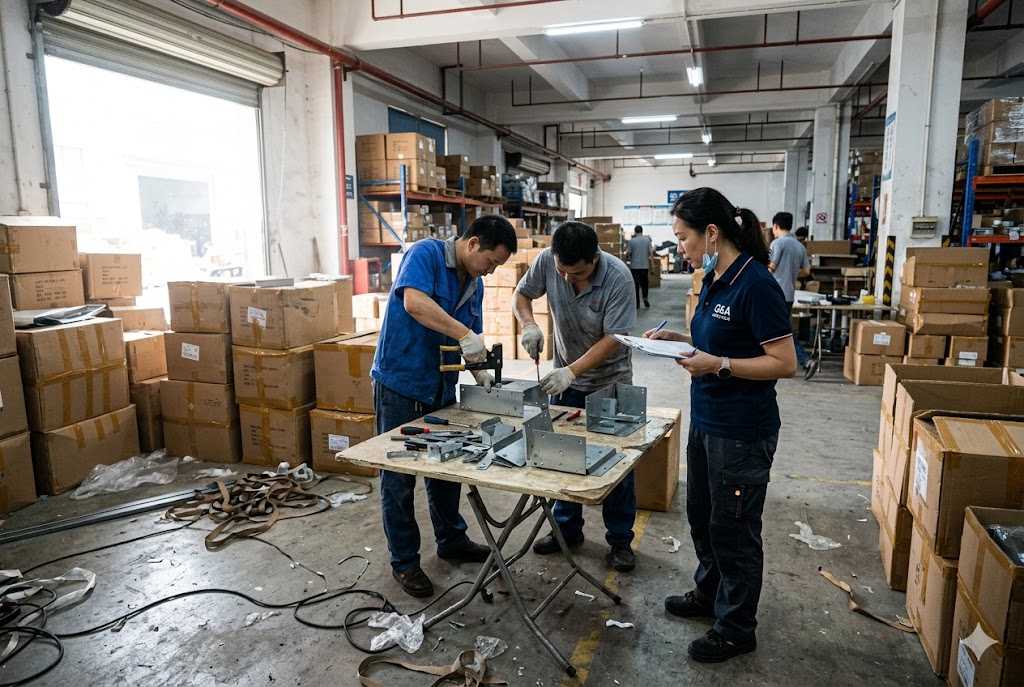
You should always request a trial assembly check before a supplier approves a batch for shipment. The check must use parts randomly drawn from production stock — not pre-selected samples — assembled together and measured against assembly drawing tolerances. Approval of the assembled unit, not individual part conformance, is the release criterion.
What a Trial Assembly Check Covers
A trial assembly check is not a repeat of the first-article assembly inspection. The first-article inspection proves the process. The pre-shipment trial assembly proves that the process was maintained through the production run.
The check should cover:
- Random sample of complete sub-component sets drawn from the production batch — minimum three sets for orders under 500 pieces, five sets for larger runs
- Full assembly of each set without selecting or sorting parts
- Pin gauge test at all mating hole patterns
- Measurement of critical assembled dimensions against assembly drawing callouts
- Gap and flush check at all visible seams
- Documentation in a pre-shipment inspection report, signed by the quality responsible party at the supplier
What Happens If the Trial Assembly Fails
If any randomly drawn set fails trial assembly, the entire batch goes on hold. The supplier must:
- Identify which sub-component is out of tolerance using part-level CMM data
- Determine whether the root cause is process drift, tooling wear, or material variation
- Correct the process and re-run the affected sub-component
- Perform a second trial assembly check on the corrected parts before shipment release
This sequence is slower than releasing a borderline batch and hoping for the best. It is also substantially cheaper than managing a warranty return, a customer production stoppage, or a freight-and-rework cycle from the destination.
How to Build This Into Your Purchase Order
The trial assembly check requirement should be written into the purchase order or quality agreement, not communicated informally. Specify:
| PO / QA Clause | Minimum Requirement |
|---|---|
| Trial assembly sample size | 3 sets (< 500 pcs), 5 sets (≥ 500 pcs), random draw |
| Acceptance criteria | Assembly drawing tolerances — not individual part tolerances |
| Documentation | Pre-shipment inspection report with assembled dimension data |
| Release authority | Written approval from buyer's QA or appointed third-party inspector |
| Consequence of failure | Batch hold, root-cause analysis, corrective action before re-inspection |
A supplier who agrees to individual part tolerances but resists a trial assembly check requirement is telling you something important. It usually means they already know the parts will be marginal in assembly. Push for the clause. If they won't accept it, that information belongs in your supplier qualification decision.
Third-Party Inspection as a Backstop
When our team cannot place a resident inspector at a supplier facility for the pre-shipment check, we arrange third-party inspection through an accredited inspection agency. The inspector works from our client's assembly drawing, performs the trial assembly check per our protocol, and issues a report before the cargo releases.
This adds cost — typically $300–$600 per inspection visit depending on complexity and location. It is less than 1% of the total order value for most of the orders we manage. The protection it provides against a full-container return or downstream customer compensation claim is not comparable.
Conclusion
Assembly fit tolerance management is a system discipline, not a part-level task. Define shared datums first, complete stack-up analysis before releasing drawings, require assembly-level GD&T controls, mandate a first-article assembly inspection, monitor SPC data through production, and enforce a pre-shipment trial assembly check. Do all of these, and fit failures stay at the factory — where they are cheap. Skip any of them, and they arrive at your dock — where they are not.
Footnotes
1. In-depth guide on tolerance stack-up analysis for multi-component assemblies. ↩︎
2. Explains worst-case vs. RSS tolerance analysis methods for manufacturing. ↩︎
3. Interactive calculator comparing worst-case and RSS stack-up outcomes. ↩︎
4. Xometry's official sheet metal manufacturing standards, including ±1° bend angle tolerance. ↩︎
5. Protolabs guide on sheet metal tolerances including slotted hole design strategies. ↩︎
6. Xometry's inspection options covering AQL-based sampling plans for production batches. ↩︎
7. Comprehensive GD&T guide covering symbols, datums, and feature control frames. ↩︎
8. Fictiv's complete guide to first article inspection (FAI) in manufacturing. ↩︎
9. Overview of coordinate measuring machines (CMM), their components, and quality control uses. ↩︎
10. Autodesk's guide to statistical process control (SPC) and Cpk monitoring in manufacturing. ↩︎