Skip to main content Skip to footer
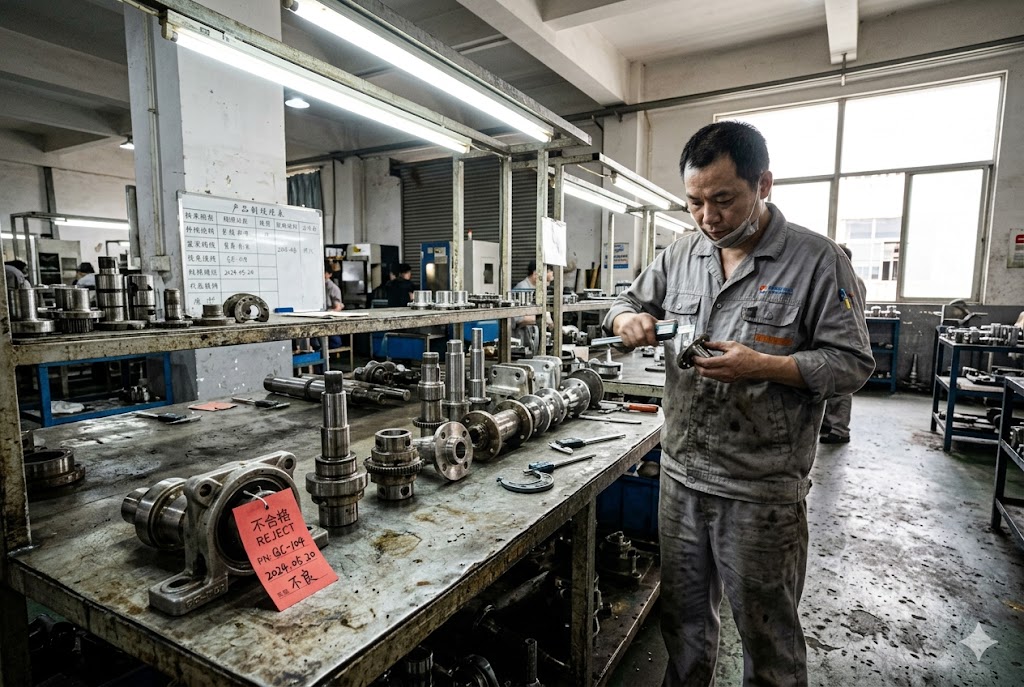
We have seen this problem more times than we can count. A buyer receives a batch of CNC parts, everything looks right, but a field failure or a customer complaint reveals the material was never what the drawing specified.
Preventing material substitution when importing custom CNC machining parts from China requires a layered approach: specify your alloy with its full international standard on the drawing, require a mill test report traceable to a heat number, conduct XRF spot-testing at pre-production and pre-shipment inspections, and write these requirements into your purchase order before production begins.
Once you understand the system behind each of these steps, material substitution becomes a manageable risk — not a guessing game.
What Material Documents Should I Require From the Supplier?
Early in our experience handling export orders, we learned that the documents a supplier volunteers are rarely the documents that matter.
The documents you must require are a Mill Test Report (MTR) — also called a Mill Certificate — traceable to a heat number, issued by the raw material manufacturer for every production batch. A Certificate of Conformance alone is not sufficient for critical or structural parts.

Why the Heat Number Is the Key
An MTR without a heat number 1 is nearly useless for verification. The heat number 2 is the unique identifier assigned to a specific melt or cast of metal at the mill. It links the physical material to the certified chemical and mechanical test data. Without it, you cannot confirm that the certificate belongs to the actual material in your parts.
When you receive an MTR, check these fields:
| Field | What to Look For |
|---|---|
| Heat Number | Unique alphanumeric code traceable to one melt |
| Material Standard | e.g., ASTM A276, ASTM B209 |
| Grade and Temper | e.g., 316L, 6061-T6 |
| Chemical Composition | Actual percentages, not just "meets spec" |
| Mechanical Properties | Tensile, yield, elongation results |
| Mill Name and Country | Named, identifiable origin |
If any of these fields are missing or vague, send the MTR back and ask for a replacement.
Certificate of Conformance vs. Mill Test Report
Many suppliers default to offering a Certificate of Conformance (CoC) 3. A CoC is a self-declaration. It states that the material meets your specification. It requires no test data to support it. Anyone can write one. It gives you no traceability.
An MTR comes from the mill that produced the raw material. It contains spectrographic chemical analysis data. It is generated by laboratory equipment. It cannot be created without access to that equipment.
For low-stress, non-structural parts, a CoC may be acceptable. For any part that carries load, operates under pressure, or must meet regulatory standards, demand an MTR. Make this a non-negotiable line in your purchase order.
How to State Your Material Requirement Clearly
Vague material callouts on drawings are one of the root causes of substitution. Here are correct and incorrect examples:
| Incorrect Callout | Correct Callout |
|---|---|
| "Stainless Steel" | SS 316L per ASTM A276 |
| "Aluminum" | Aluminum Alloy 6061-T6 per ASTM B209 |
| "Steel" | Carbon Steel 1045 per ASTM A108 |
| "Titanium" | Titanium Grade 5 (Ti-6Al-4V) per ASTM B265 |
A vague callout gives the supplier full latitude to use whatever alloy is cheapest or most available. You then have no contractual basis to reject the substitution. Correct callouts include the grade, temper or condition, and the applicable standard.
Grey-Market Material: The Most Common Source of Substitution
In Chinese CNC supply chains, substitution most often comes not from deliberate fraud but from undisclosed sourcing through grey-market distributors 4. These distributors sell non-certified or misidentified stock at a discount. The supplier may genuinely believe the material is correct because they trusted their own supplier's label.
The mitigation is to require the MTR to name the mill of origin. Reject any MTR that cites an unidentifiable or unverifiable source.
Should I Request Mill Certificates or Independent Testing?
When our team sets up a quality plan for a new client order, the first question is always: what are the consequences if this part fails in service?
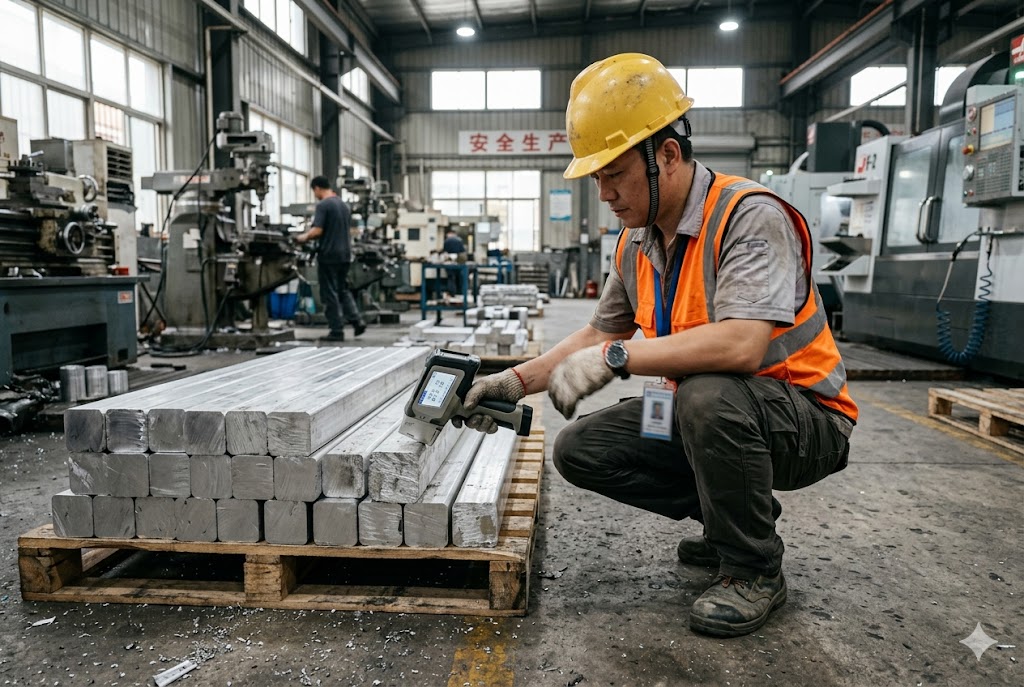
For most critical or structural CNC parts, you should require both: a mill certificate (MTR) from the supplier and independent physical testing — specifically XRF positive material identification — conducted by your third-party inspector at the pre-production stage, before machining begins.
What Is XRF and Why Does It Matter?
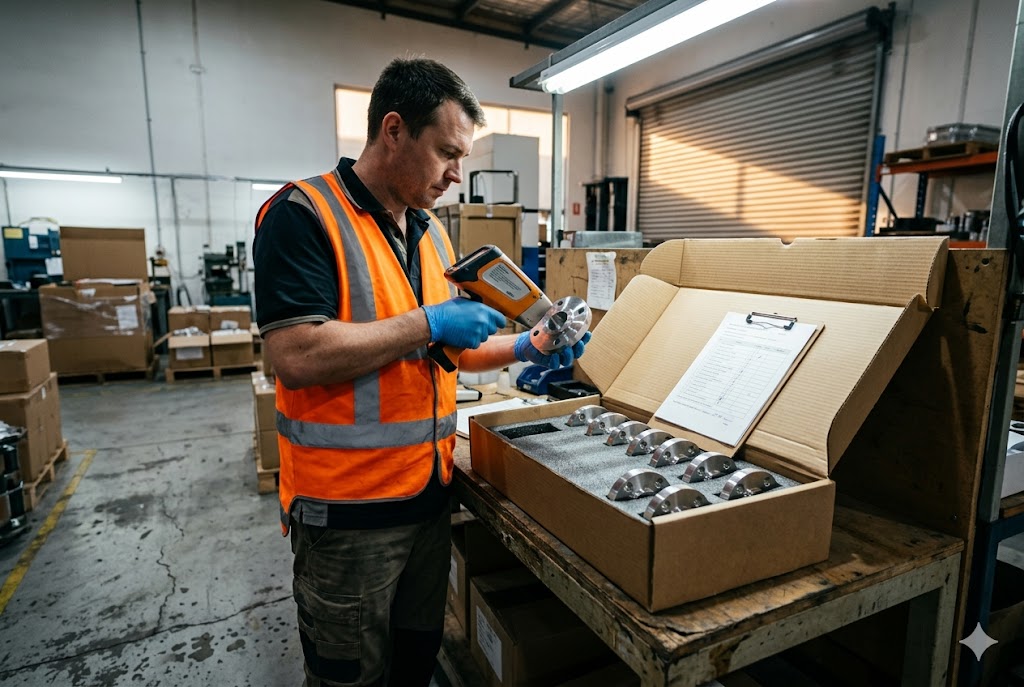
XRF stands for X-ray fluorescence. A handheld XRF analyzer performs positive material identification (PMI) 5 in two to three seconds. It is nondestructive. It identifies all major alloying elements and their percentages. It immediately flags substitution.
For example, if a supplier has substituted 304 stainless steel for 316L — a common and cost-motivated substitution — XRF will catch it. If a lower-grade aluminum alloy has replaced 6061-T6, XRF will catch it.
When to Test: Pre-Production vs. Pre-Shipment
Testing at pre-shipment only is a weak strategy. If material substitution is discovered after machining, the parts must be scrapped. All machining labor is lost. Lead time is wasted.
| Inspection Stage | What Is Tested | Why It Matters |
|---|---|---|
| Pre-Production (Raw Stock) | Raw material before machining | Catch substitution before labor is invested |
| In-Process | Semi-finished parts | Verify material identity continues through production |
| Pre-Shipment | Finished parts | Final confirmation before goods leave the factory |
Always require XRF testing at the pre-production stage, at minimum.
The XRF Carbon Limitation — and How to Address It
XRF cannot reliably measure carbon content. This means it cannot distinguish standard stainless grades from their low-carbon "L" variants. It cannot reliably differentiate 316 from 316L.
This matters because L-grades are specified for specific reasons: better corrosion resistance in welded assemblies, compliance with NACE standards 6, or pressure vessel code requirements.
For applications where an L-grade is specified, supplement XRF testing with LIBS — laser-induced breakdown spectroscopy 7. LIBS accurately measures carbon content in seconds. Many handheld instruments now combine both XRF and LIBS capabilities on the same platform. Require your inspector to use LIBS where the L-grade distinction is critical.
Creating an Evidence Chain
For high-value or safety-critical parts, instruct your third-party inspector to photograph the raw stock with the heat number stamp or label clearly visible alongside the purchase order number. Also photograph the XRF analyzer screen showing the alloy identification result.
This creates a documented evidence chain. It connects the physical material to the test result and to your specific order. If a dispute arises later, the evidence is unambiguous.
How Can I Verify That the Shipped Material Matches My Specification?
Our sourcing team has handled orders where parts passed visual inspection, dimensional checks, and even surface finish requirements — but the material was wrong.
To verify that shipped material matches your specification, require your third-party inspector to conduct XRF spot-testing on finished parts at pre-shipment inspection, cross-reference results against the MTR heat number, and photograph the test results alongside the purchase order number as a permanent record.
What a Pre-Shipment Inspection Should Cover for Material
Pre-shipment inspection is your last checkpoint before goods leave the factory. Most buyers focus on dimensions and appearance. Material verification is often overlooked. That is a mistake.
A complete pre-shipment material verification covers:
- XRF spot-testing 8 on a statistically representative sample of finished parts
- Cross-reference of XRF result against the MTR heat number and alloy designation
- Visual check of any heat number stamps or markings on the parts or packaging
- Collection of the final MTR document and confirmation it matches the batch being shipped
Sampling Strategy for XRF at Pre-Shipment
You do not need to test every part. A structured sampling approach is sufficient for most orders.
| Order Quantity | Minimum XRF Sample Size |
|---|---|
| 1–50 parts | Test all parts |
| 51–200 parts | Test 20% or 20 parts, whichever is greater |
| 201–500 parts | Test 15% or 40 parts, whichever is greater |
| 500+ parts | Test 10% or 75 parts, whichever is greater |
For safety-critical or high-liability applications, increase the sample size or test 100% of parts regardless of quantity.
What to Do If XRF Results Fail
If the pre-shipment XRF results do not match the specified alloy, stop the shipment immediately. Do not allow goods to be released. Issue a formal non-conformance report (NCR) 9 to the supplier and require them to:
- Provide an explanation of the discrepancy in writing
- Source confirmed correct material with a new MTR
- Re-machine the parts if necessary
- Submit to a new pre-production XRF test before machining restarts
Document every step. If your purchase order and quality agreement include these verification rights in writing, you have clear contractual standing to enforce them.
The Cost of Getting This Right
Moving from a CoC to a full MTR with heat-number traceability and third-party XRF testing typically adds 5–15% to the total landed cost of the parts. This cost comes from certified mill premiums and inspection fees.
That number needs to be budgeted explicitly. Present it to management not as quality overhead, but as an insurance premium. A single field failure, product liability claim, or regulatory non-compliance event caused by undiscovered material substitution will cost far more than the combined inspection costs of many orders.
When our team drafts a quality agreement for a new client, the material clause is always one of the first we address — because without it, everything else is hard to enforce.
To contractually prevent unauthorized material changes, write the following into your purchase order and quality agreement before production begins: the full material standard and grade designation, the requirement for an MTR traceable to a named mill, your right to conduct third-party XRF testing on raw stock and finished parts, the right to reject any batch where material identity cannot be confirmed, and a named material approved vendor list for repeat orders.

The Five Contract Clauses That Matter Most
Most standard purchase orders are too vague on material. Adding five specific clauses changes your position entirely.
Clause 1 — Material Standard and Grade
State the full alloy designation exactly as it appears on your engineering drawing. Include the standard designation (e.g., ASTM A276), the grade (e.g., 316L), and the form (e.g., bar, plate, tube). Ambiguity here is the supplier's friend, not yours.
Clause 2 — Mill Test Report Requirement
Require an MTR traceable to a heat number from a named, identifiable mill for every production batch. State that a Certificate of Conformance is not an acceptable substitute. Name the specific fields the MTR must contain.
Clause 3 — Third-Party Inspection Rights
State explicitly that you reserve the right to send a third-party inspector to the factory at any stage of production, including pre-production raw stock inspection with XRF testing, without advance notice beyond a reasonable period.
Clause 4 — Right to Reject
State that any batch where material identity cannot be confirmed through MTR cross-reference and physical testing will be rejected at the supplier's cost, including re-sourcing, re-machining, and re-inspection costs.
Clause 5 — Material Approved Vendor List (AVL)
For repeat orders, name the specific mills or distributors from which the supplier is authorized to purchase your specified alloy. An approved vendor list (AVL) 10 requires written approval before any change to the material source. This is the most important clause for preventing batch-to-batch inconsistency in ongoing supply relationships.
Red Flags to Watch for During Negotiation
If a supplier pushes back on any of these clauses, treat it as a signal, not just a negotiation position.
| Supplier Response | What It May Signal |
|---|---|
| "We can't provide an MTR" | They are sourcing from grey-market distributors |
| "Our CoC is sufficient" | They do not have certified mill sourcing |
| "Third-party inspection is not necessary" | They are not confident in material compliance |
| "Our material is always correct" | They have no verification process in place |
| "MTR is too expensive" | They are optimizing cost over compliance |
None of these responses are disqualifying on their own. But each one requires a direct follow-up question and a clear answer before you proceed.
Enforceability Across Jurisdictions
China and Vietnam both have commercial contract law frameworks that recognize written purchase order terms. Your purchase order terms, countersigned by the supplier, are a binding document. Pair this with a separate quality agreement that references the purchase order. If a dispute arises, your documented inspection records, NCRs, and photographic evidence chain become the foundation of your case.
Work with a sourcing partner or legal advisor who understands cross-border supplier agreements if your order values are significant.
Conclusion
Material substitution in CNC import supply chains is preventable. Specify your alloy correctly on the drawing, require a traceable MTR, conduct XRF testing at pre-production and pre-shipment, and write your rights into the contract before production begins. Do all four, and you close most of the gaps.
Footnotes
1. Guide to reading Mill Test Reports and understanding what each field means. ↩︎
2. Overview of the heat number system and how it enables material traceability to a specific melt. ↩︎
3. Explains the difference between a Certificate of Conformance and certified material test documentation. ↩︎
4. How fraudulent steel sourcing and grey-market distribution work in Chinese supply chains. ↩︎
5. Overview of positive material identification methods including XRF and their industrial applications. ↩︎
6. How NACE standards govern material selection for corrosion-resistant stainless steel applications. ↩︎
7. Comparison of XRF, LIBS, and OES for positive material identification and carbon measurement. ↩︎
8. How XRF is used for alloy identification and positive material identification on manufactured parts. ↩︎
9. What a non-conformance report is and how it triggers formal corrective action in quality management. ↩︎
10. How an approved vendor list works and why it is a key tool in procurement risk management. ↩︎