Skip to main content Skip to footer
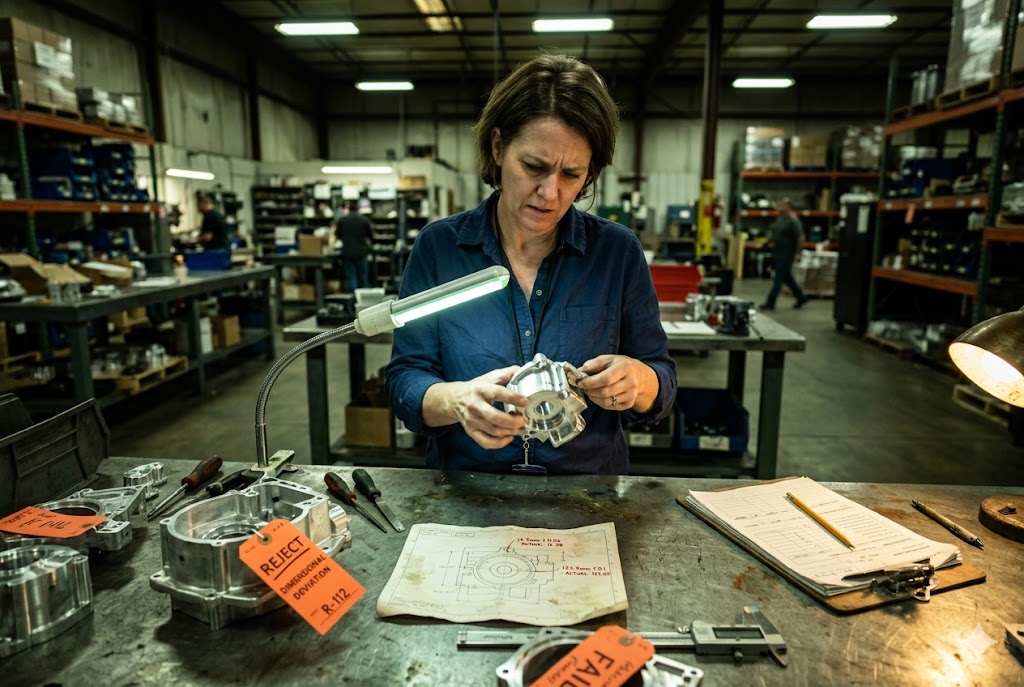
We have seen it happen more times than we can count: a shipment lands, the buyer unpacks it, and parts that looked fine on paper fail assembly the next morning. The supplier points to their internal inspection report. The buyer has no written AQL criteria 1 in the purchase order. Nobody wins.
For custom CNC machined parts imported from China, the industry-standard starting point is AQL 0 for critical defects, AQL 1.0 for major defects, and AQL 2.5 for minor defects, inspected under ISO 2859-1 General Inspection Level II. This is stricter than the generic consumer goods default because dimensional non-conformances in machined parts cause immediate functional failures, not just cosmetic complaints.
If you do not write your AQL requirements into the purchase order before production begins, you have no contractual standing to reject a batch after the fact. The sections below break down everything you need to know.
What AQL Level Is Appropriate for Precision CNC Parts?
Our team visits supplier factories every week, and the single most common gap we find is a purchase order with no AQL specification at all. The supplier ships, the buyer receives, and the argument starts only after failures appear.
For precision CNC parts, the appropriate AQL levels are: 0 for critical defects, 1.0 for major defects, and 2.5 for minor defects, applied under ISO 2859-1 General Inspection Level II. This combination gives you statistical protection against functional failures while keeping sample sizes manageable for mid-volume orders.
Why CNC Parts Need Stricter AQL Than Consumer Goods
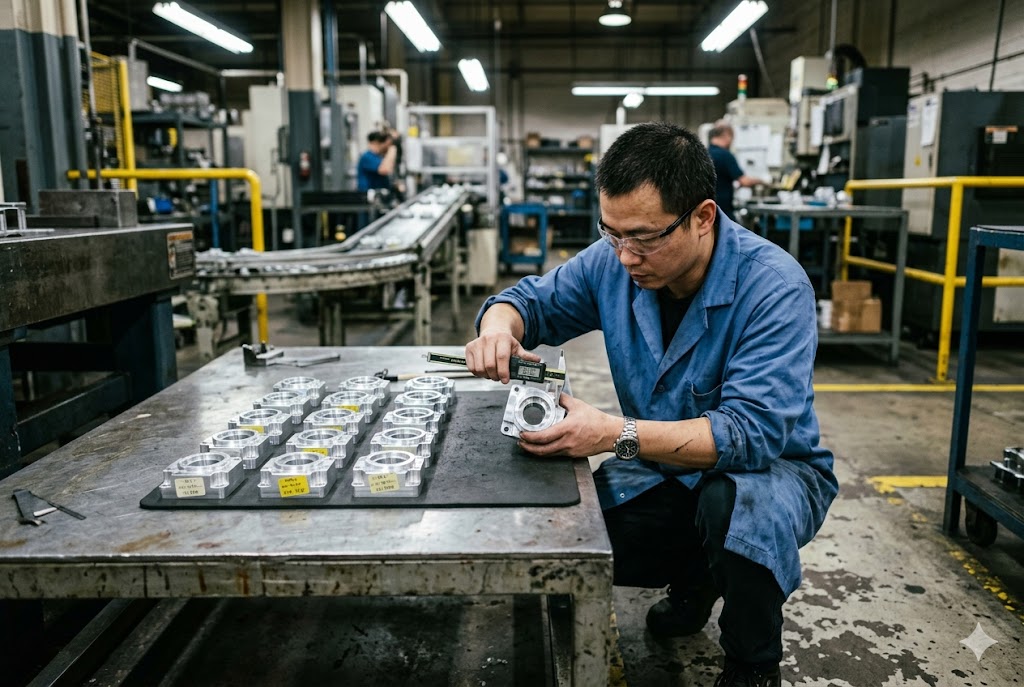
The generic consumer goods default is AQL 0 / 2.5 / 4.0. That is too loose for machined parts. A cosmetic scratch on a plastic toy does not stop the product from working. An out-of-tolerance bore diameter on a machined housing will prevent assembly entirely. The consequence of a single bad part is orders of magnitude higher.
Here is a practical reference for choosing AQL values by defect class:
| Defect Class | Definition for CNC Parts | Recommended AQL |
|---|---|---|
| Critical | Out-of-tolerance on safety or assembly-critical dimension | AQL 0 (zero acceptance) |
| Major | Dimensional deviation that prevents fit or impairs function | AQL 1.0 |
| Minor | Cosmetic mark in non-sealing, non-mating area | AQL 2.5 |
What ISO 2859-1 General Inspection Level II Means in Practice
ISO 2859-1 2 (equivalent to ANSI/ASQ Z1.4) gives you a lookup table. You take your lot size, find the sample size code for General Inspection Level II 3, and read off how many parts to inspect and how many defects are allowed before you reject the batch.
For example, a lot of 1,200 parts at Level II gives you sample size code K — you inspect 125 parts. Under AQL 1.0 for major defects, you accept the lot if you find 3 or fewer major defects in those 125 parts and reject if you find 4 or more.
This is a risk-management framework, not a guarantee. An AQL 1.0 acceptance does not mean the batch has exactly 1% defective parts. It means the sampling plan will accept a 1%-defective lot roughly 95% of the time. That residual risk is why you also need clear escalation procedures.
When to Use Tightened Inspection
ISO 2859-1 has built-in switching rules. Most importers ignore them. They should not.
| Trigger | Action |
|---|---|
| 2 out of 5 consecutive batches fail normal inspection | Switch to Tightened Inspection |
| 5 consecutive batches pass under Tightened Inspection | Switch back to Normal Inspection |
| 10 consecutive batches pass under Normal Inspection | Eligible for Reduced Inspection |
Applying these rules automatically creates quality pressure on your supplier. Good performance earns smaller samples. Repeated failures trigger higher scrutiny. Write these switching rules into your quality agreement, not just your first PO.
Variables Sampling vs. Attribute Sampling
Standard AQL inspections classify each part as pass or fail — attribute sampling. For tight-tolerance CNC parts, this misses information. A shaft that measures 0.001 mm under tolerance is classified the same as one that is 0.5 mm under.
If your inspector uses a CMM 4 and records actual measurements, request a variables-based acceptance decision on your two or three most critical dimensions under ISO 3951. Variables plans reach the same statistical confidence with a smaller sample size, and they tell you whether your process is drifting before parts cross the rejection line.
Should I Use Different AQL Levels for Cosmetic and Dimensional Defects?
When we prepare inspection checklists for our clients' parts, the first question we always ask is: what will actually stop this part from working? Cosmetic and dimensional problems have completely different consequences, and your AQL levels should reflect that.
Yes, you should always use different AQL levels for cosmetic and dimensional defects on CNC parts. Dimensional non-conformances on critical features should be held to AQL 0 or AQL 1.0. Cosmetic defects in non-functional areas can be held to AQL 2.5 or even AQL 4.0, depending on your end customer's requirements.
Define Your Defect Classes Before Production Starts
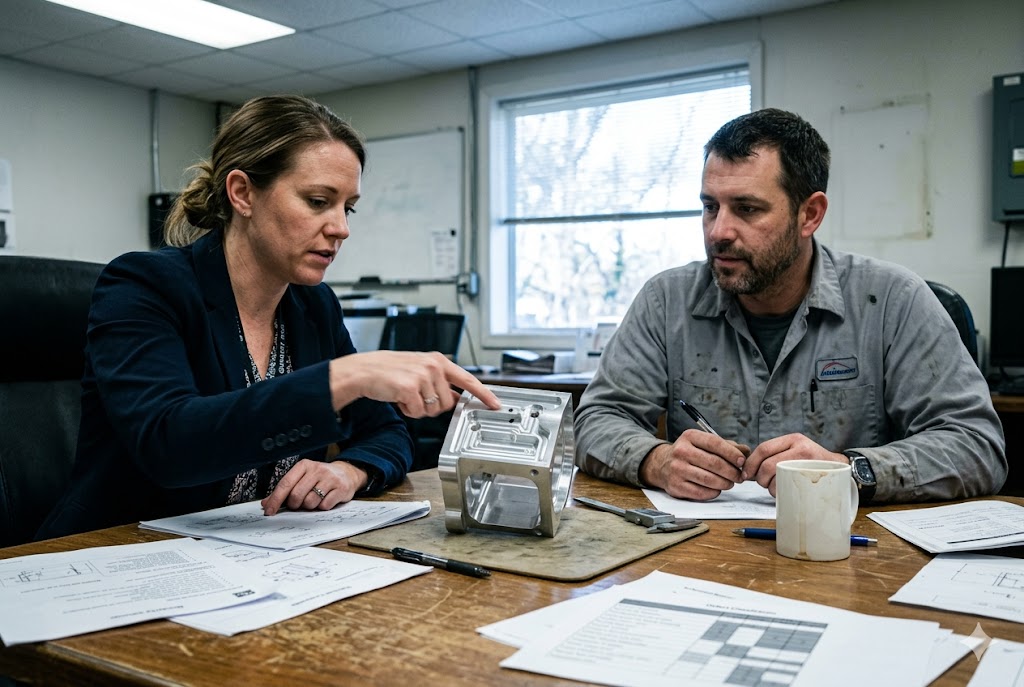
This step is not optional. You must define, in writing, what counts as a critical, major, and minor defect for your specific part — before the purchase order is placed. A generic definition is not enough.
Here is a practical example for a precision machined housing:
| Defect | Class | Reason |
|---|---|---|
| Bore diameter out of H7 tolerance | Critical | Prevents bearing fit; causes field failure |
| Thread form incomplete on tapped hole | Major | Assembly impossible; part cannot be used |
| Surface roughness exceeds Ra specification on sealing face | Major | Leak risk under pressure |
| Tooling mark on external non-contact face | Minor | Cosmetic only; no functional impact |
| Burr on interior non-mating surface | Minor | Easily removed; no functional impact |
Share this checklist with your supplier and your third-party inspector 5 before production begins. This alignment prevents the most common argument in quality disputes: "We never agreed that was a defect."
The Danger of Using One AQL for Everything
Some buyers specify a single AQL — say, AQL 2.5 — for the entire part. That approach is dangerous. Under AQL 2.5, a lot can be accepted with up to 2.5% of parts having a critical dimensional failure. For machined parts going into an assembly line, even a 0.5% critical defect rate can halt production and trigger compensation claims from your customer.
The 0 / 1.0 / 2.5 split exists precisely because not all defects have the same consequence. Use it.
Cosmetic Standards Require Visual Aids
Dimensional tolerances are objective. Cosmetic standards are not. "No visible scratches" means different things to different people. To make cosmetic AQL inspection reliable, prepare a visual limit sample — a physical part or a photo set showing the boundary between acceptable and rejectable appearance. Send it to the inspector before the inspection date. Without it, cosmetic inspection results are not reproducible.
How Can I Align AQL With My Customer's Quality Expectations?
Our service team regularly sits between the supplier and the end buyer, and the most uncomfortable position is discovering mid-shipment that our client's customer has a stricter AQL requirement than the one written into our client's PO with us. That gap always costs money.
To align AQL with your customer's expectations, start from your downstream obligation and work backwards. Review your customer's quality agreement or industry certification requirements first. Then set your supplier-facing AQL at least one class stricter than what your customer requires, so you have a buffer before a batch reaches your customer's incoming inspection.

Start From Your Downstream Contract
Before you set any AQL number with your supplier, answer these questions:
- Does your customer have a written quality agreement specifying AQL levels?
- Is your customer operating under a certification body — IATF 16949 6, AS9100, ISO 13485?
- Does your customer perform incoming inspection, and what are their acceptance criteria?
If your customer operates under IATF 16949 for automotive parts, they may mandate zero-defect acceptance criteria (c=0 plans) on all safety-critical dimensions. That means your supplier must deliver effectively zero critical defects, and a standard AQL sampling plan will not satisfy your customer's audit requirements. You need to match or exceed that standard upstream.
Build a Quality Buffer Into Your Supplier Agreement
If your customer accepts AQL 1.0 for major defects, set your supplier to AQL 0.65. If your customer accepts AQL 2.5 for minor defects, set your supplier to AQL 1.5. The buffer absorbs statistical variation in the sampling plan and gives you room to perform your own incoming check before forwarding goods.
Communicate in Writing
Every quality expectation must be in writing. Verbal agreements do not survive supplier turnover, production line changes, or dispute arbitration. Your quality requirements should appear in three places:
- The purchase order terms and conditions
- A separate quality agreement or inspection protocol signed by the supplier
- The inspection checklist used by your third-party inspector at the factory
If a requirement exists in only one of these three places, it is vulnerable. Put it in all three.
Industry-Specific AQL Obligations
| Industry | Common Certification | Typical AQL Obligation |
|---|---|---|
| Automotive | IATF 16949 | c=0 on safety-critical; AQL 0.65 major |
| Aerospace | AS9100 7 | c=0 on all critical dimensions; full traceability |
| Medical devices | ISO 13485 8 | Validated inspection plans; often 100% on critical |
| General industrial | ISO 9001 9 | AQL 0 / 1.0 / 2.5 typically sufficient |
Know which category your parts fall into before setting your AQL. If you are in doubt, ask your customer directly. They will tell you.
When Is 100% Inspection Better Than AQL Sampling?
Our engineers have dealt with situations where a client's parts passed every pre-shipment AQL check and still caused assembly failures at the customer's plant. In almost every case, the problem was not the AQL level — it was that 100% inspection should have been specified and was not.
100% inspection is better than AQL sampling when a single defective part reaching the field has severe safety or financial consequences, when lot sizes are small enough that sampling is statistically meaningless, when a supplier has a history of batch failures, or when your customer's contract or certification body explicitly requires it for specific dimensions.

When AQL Sampling Is Not Enough
AQL sampling is a risk management tool. It works well for large lots with acceptable defect rates. It is not appropriate in every situation.
Use 100% inspection when:
- The part is safety-critical and a single field failure causes injury or liability
- Lot size is below 50 units — statistical sampling at small quantities is unreliable
- The supplier has failed two or more consecutive AQL batches
- Your customer's quality agreement mandates 100% for specific dimensions
- First article inspection 10 of a new part or new tooling
What 100% Inspection Actually Looks Like
100% inspection does not mean one person visually checking every part. For CNC machined parts, it typically means:
- CMM measurement of every critical dimension on every part
- Go/no-go gauge check of every mating feature
- Visual inspection of every surface against a defined limit sample
This takes time and costs money. For a batch of 500 precision housings with 12 critical dimensions each, a full CMM inspection can take several days. Build that time and cost into your production schedule and PO terms.
The Three-Point Inspection Model
AQL applied only at final pre-shipment inspection catches defects too late. By then, all parts are already made, possibly already packed, and rework is expensive. For machined parts, the most effective model applies quality checks at three stages:
| Inspection Point | Timing | What to Check |
|---|---|---|
| Incoming material check | Before machining begins | Material certificate, hardness, raw stock dimensions |
| DUPRO (during production) | At 20–40% of order completion | Critical dimensions on sample; tooling condition |
| Final PSI (pre-shipment) | 100% packed, before container loading | Full AQL check; packaging; marking; quantity |
If a dimensional problem appears at the DUPRO stage, you still have time to correct tooling or reject the first run before the rest of the batch is produced. Waiting until PSI means the entire batch is at risk.
Checklist Failures Are Not AQL Failures
One more point that is often misunderstood. When a batch passes your pre-shipment AQL check but parts still fail during assembly, the root cause is almost always a checklist failure, not an AQL failure. The inspector measured what was on the checklist. The dimension that caused the failure was not on the checklist.
The corrective action is to audit your inspection checklist against your drawing's critical-to-quality dimensions and add every functionally important feature explicitly. AQL sampling only controls quality on the characteristics it is actually asked to measure.
Conclusion
Set your AQL in writing before production starts. Use 0 / 1.0 / 2.5 as your baseline. Define every defect class specifically for your part. Apply the three-point inspection model. And always work backwards from your customer's requirements — that is where your contractual exposure begins.
Footnotes
1. Plain-language explanation of AQL and how defect thresholds are set in product inspections. ↩︎
2. Overview of ISO 2859-1 sampling plans, AQL tables, and the accept/reject decision process. ↩︎
3. Step-by-step guide to reading AQL tables and applying General Inspection Level II in practice. ↩︎
4. Primer on coordinate measuring machines (CMM): types, accuracy, and use in quality inspection. ↩︎
5. What a pre-shipment inspection covers, how inspectors are deployed, and how AQL sampling is applied. ↩︎
6. IATF 16949 requirements for automotive quality management systems and zero-defect supplier obligations. ↩︎
7. AS9100D requirements for aerospace quality management, including critical-dimension traceability rules. ↩︎
8. ISO 13485 requirements for medical device QMS, including validated inspection and regulatory compliance. ↩︎
9. ISO 9001 quality management system requirements applicable to general industrial suppliers. ↩︎
10. What first article inspection (FAI) verifies and when it is required before full production begins. ↩︎