Skip to main content Skip to footer

Every week, our sourcing team handles drawings that mix GB and ASTM callouts. We see the same problem repeat: a U.S. buyer sends a drawing with "Q235B" written in the material block, and the downstream inspection fails because the mill cert doesn't match the ASTM requirement. It causes delays, rework, and frustration on both sides.
To convert Chinese GB steel grades to U.S. ASTM standards for your sheet metal drawing, match grades first by minimum yield strength, then verify tensile range and chemical composition. For structural mild steel, Q235B maps to ASTM A36. For high-strength low-alloy steel, Q345B maps to ASTM A572 Grade 50. Always use dual callout notation on your drawing and require an ASTM-conforming mill test report from your supplier.
This guide walks through each common conversion scenario, explains where grades diverge, and tells you exactly what to write on your drawing and purchase order.
Why Do GB and ASTM Grades Look Similar but Perform Differently in My Application?
Our engineers have found this to be one of the most misunderstood topics in cross-border procurement. Two grades can share the same yield strength number and still behave differently once they reach your production line.
GB and ASTM grades look similar because they often target the same minimum yield strength, but they differ in chemistry limits, Charpy impact requirements, and test methods. For example, Q235B and ASTM A36 are both general-purpose mild steels, but A36 specifies a higher minimum yield of 250 MPa versus Q235B's 235 MPa, and each standard sets its own carbon and sulfur maximums independently.
Standards Define More Than Strength
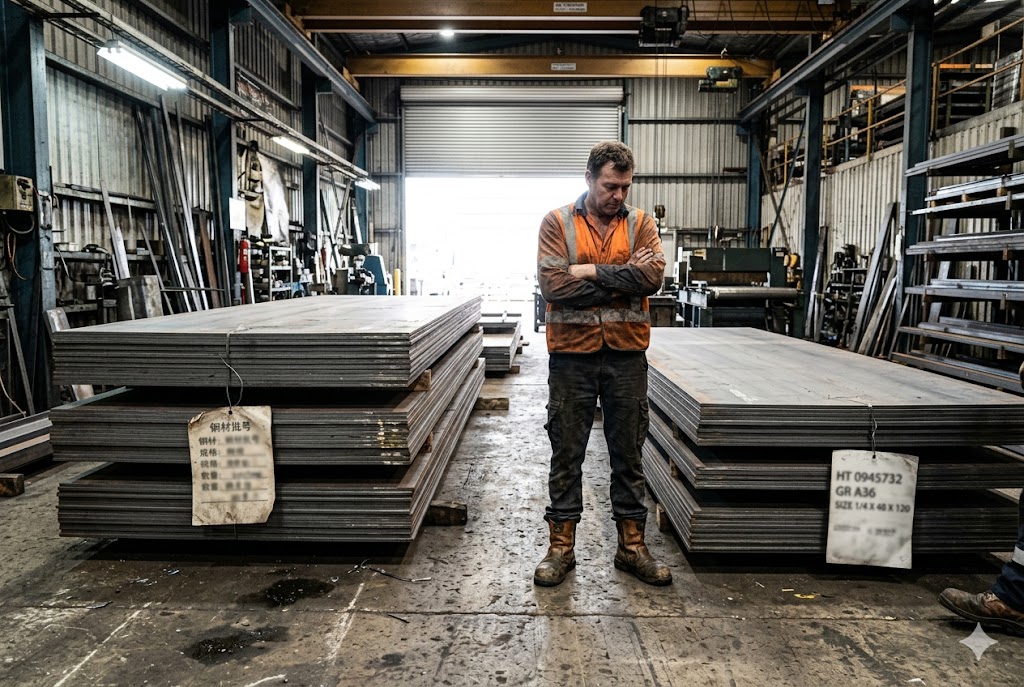
Yield strength is just the starting point. Each standard system — GB in China, ASTM in the United States — defines its own full package of requirements. That package includes chemical composition windows, tensile strength range, elongation minimums, impact toughness conditions, and accepted test methods.
When two grades share a yield number, that is only one data point. The rest of the envelope may differ.
The Carbon and Sulfur Gap
Take Q235B 1 and ASTM A36 2. Both are widely used for structural sheet, brackets, frames, and enclosures. On the surface, they look interchangeable.
But look closer at the chemistry:
| Property | Q235B (GB/T 700) | ASTM A36 |
|---|---|---|
| Min. Yield Strength | 235 MPa | 250 MPa |
| Tensile Strength | 370–500 MPa | 400–550 MPa |
| Max. Carbon (%) | 0.20 | 0.26 (plates > 19mm) |
| Max. Sulfur (%) | 0.045 | 0.050 |
| Max. Phosphorus (%) | 0.045 | 0.040 |
| Charpy Impact | Room temp (20°C) | No standard requirement |
The carbon and sulfur limits are set independently by each standard body. A mill producing to GB/T 700 is not required to meet ASTM A36 chemistry limits — even if the yield strength falls within range.
This matters in welding. Higher carbon content changes preheat requirements and heat-affected zone behavior. If your fabricator is qualifying a weld procedure to AWS D1.1 3, the material chemistry feeds directly into that qualification. A GB cert alone does not give your QA team the data they need.
Impact Toughness and the Sub-Grade System
Chinese structural steel uses a letter suffix — A, B, C, D, E — to control Charpy impact test 4 temperature. This is a separate dimension from strength.
| Sub-Grade | Charpy Test Condition |
|---|---|
| Q235A | No Charpy requirement |
| Q235B | Tested at room temperature (20°C) |
| Q235C | Tested at 0°C |
| Q235D | Tested at −20°C |
| Q235E | Tested at −40°C |
ASTM A36 has no standard Charpy requirement. If your application involves dynamic loading, low-temperature service, or fracture-critical classification under AWS D1.1, you need to specify the appropriate sub-grade on your drawing — and then map that sub-grade's notch-toughness requirement to a supplemental requirement in ASTM.
For example, if your part operates below 0°C, specifying "Q235D or approved equiv. ASTM A36 with Supplementary Requirement S91 CVN at −20°C" protects your design intent.
Why the Paperwork Trail Matters
U.S. fabricators and third-party inspectors certify to ASTM material test reports (MTRs). A GB mill certificate — even a complete one — does not satisfy most U.S. code-compliance or customer source inspection requirements. The cert format, traceability chain, and signatory requirements are different.
This is not a minor administrative issue. If your parts face PPAP, NADCAP audit, or customer-mandated source inspection, a GB cert may result in rejection at the receiving dock.
The safest approach: require your Chinese supplier to provide EN 10204 Type 3.1 mill test reports 5. These are third-party witnessed, internationally recognized, and give your QA team full chemical and mechanical traceability — even when the underlying material runs to a GB specification.
How Can I Avoid Material Confusion When I Work With a China Supplier Using Local Standards?
When our team works with new clients, material miscommunication is the most common source of first-order mistakes. It is not because suppliers are dishonest. It is because each side is reading the same part number through a different standard lens.
To avoid material confusion with a China supplier, always specify both the ASTM grade and its GB equivalent on your drawing using dual callout notation. Require the supplier to confirm in writing which standard governs the material certificate, and specify EN 10204 Type 3.1 mill test reports in your purchase order to ensure internationally recognized traceability.
Use Dual Callout Notation on Every Drawing
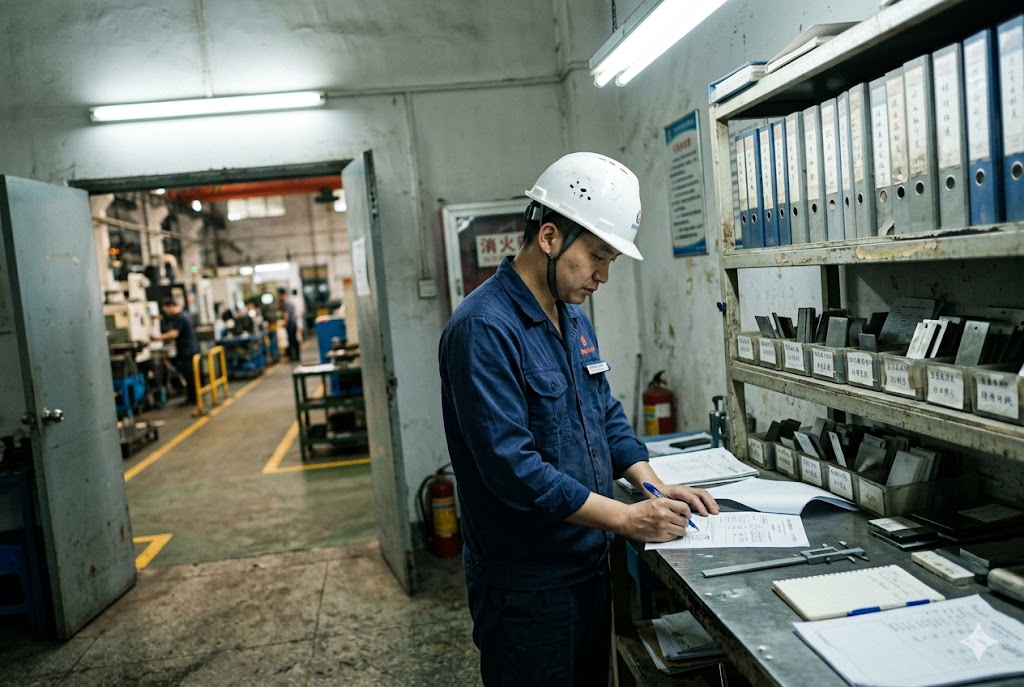
The single most effective thing you can do is write both standards on the material callout block. This removes ambiguity from both sides of the conversation.
A correct dual callout looks like this:
"ASTM A36 (or approved equiv. Q235B per GB/T 700)"
This tells your supplier: the governing standard is ASTM A36. If they cannot source ASTM A36 directly, they may propose Q235B — but the mill cert must demonstrate compliance with A36's property envelope, and the report must be in an acceptable format.
If you write only "Q235B" on a drawing governed by U.S. codes, you have created a documentation gap. Your supplier will deliver what you wrote. Your U.S. inspector will look for ASTM.
Define the Acceptable Cert Format in Your PO
A purchase order is a contract. Use it to specify:
- The material standard (ASTM, with GB equivalent noted)
- The mill test report format (EN 10204 Type 3.1 preferred)
- The required chemical and mechanical properties to be reported
- Whether heat number traceability is required on each piece
This is especially important if your parts will undergo further inspection or if your downstream customer has their own source approval process.
Set Up a Material Approval Step Before Production
For new part numbers or new suppliers, add a pre-production material approval step. Ask the supplier to submit a sample mill cert for your review before the production run begins. This takes one to two days and catches format mismatches before they become receiving inspection failures.
Our team routinely performs this step for clients sourcing parts in both China and Vietnam. A short review before production is far cheaper than a re-run after.
Common Substitution Scenarios and What to Watch For
| Specified Grade | Common GB Substitute | Key Risk to Check |
|---|---|---|
| ASTM A36 | Q235B (GB/T 700) | Carbon content, cert format |
| ASTM A572 Gr. 50 | Q345B or Q355 (GB/T 1591) | Chemistry equivalence, Q355 vs Q345 naming |
| AISI 304 / ASTM A240 Type 304 | GB 06Cr19Ni10 | Composition is nearly identical; verify thickness tolerance standard |
| AISI 316L / ASTM A240 Type 316L | GB 022Cr17Ni12Mo2 | Composition essentially identical; confirm governing tolerance spec |
| AISI 1045 / ASTM A108 | GB 45 steel | Bar spec vs plate spec confusion; specify hardness or heat-treat condition |
Thickness Tolerance Is a Separate Issue
Even when the alloy composition matches, the thickness tolerance may not. GB/T 3280 (cold-rolled stainless sheet) and ASTM A240 6/A480 use different tolerance tables. For material in the 1.0–2.0 mm range, the difference can be up to 0.05 mm.
Always specify decimal thickness on your drawing — never gauge number alone. State the governing tolerance standard explicitly. If your machined or formed dimensions are tight, 0.05 mm of incoming material variation can push your finished part out of tolerance before a single cut is made.
Should I Always Specify Both the GB and ASTM Equivalents in My Purchase Order?
This question comes up often in our conversations with purchasing managers. The short answer is yes — for most applications. But the reason matters more than the rule.
Yes, you should specify both the ASTM grade and its GB equivalent in your purchase order whenever you are sourcing from a China-based supplier. This dual callout establishes which standard governs compliance, allows your supplier to source material efficiently using local mill options, and protects you during inspection by setting clear documentation expectations from the start.

When Dual Callout Is Most Critical
Not every part carries the same risk. A mounting bracket for a non-structural enclosure and a load-bearing frame member are different conversations. But in both cases, dual callout is still good practice — it prevents miscommunication that costs time.
Dual callout is most critical when:
- Your parts are subject to U.S. code compliance (AISC, ASME, AWS D1.1)
- Your downstream customer requires material traceability
- Your parts undergo secondary operations (welding, heat treatment, plating) where chemistry matters
- Your parts operate in dynamic load, fatigue, or low-temperature environments
What to Include in the Purchase Order Material Clause
A well-written PO material clause removes guesswork. Here is a working template:
Material: ASTM A36 (approved equivalent: Q235B per GB/T 700). Supplier must provide EN 10204 Type 3.1 mill test report showing chemical composition and mechanical properties. Heat number must be traceable to each shipped piece. GB-only mill certificates are not accepted.
Adjust the grade names and standard references to fit your part. The structure stays the same.
The Q345 vs Q355 Naming Change
One practical note: GB/T 1591 was updated, and Q345 was replaced by Q355 in the current revision. If your supplier quotes Q355 material, this is not a downgrade or substitution error. Q355 is the current designation; Q345 is the legacy name. Both map to ASTM A572 Grade 50 7 for most applications.
When reviewing supplier quotes or incoming MTRs, accept either name — but confirm the cert shows the correct yield and tensile properties.
| Legacy Name | Current GB Name | ASTM Equivalent |
|---|---|---|
| Q345B | Q355B (GB/T 1591-2018) | ASTM A572 Grade 50 |
| Q345C | Q355C | ASTM A572 Grade 50 |
| Q345D | Q355D | ASTM A572 Grade 50 with CVN |
Medium Carbon and Alloy Bar Stock
For machined parts made from bar or round stock — shafts, pins, bushings, turned components — the correct reference is not a structural plate spec. GB 45 steel (approximately 0.45% carbon) maps to AISI/SAE 1045, and the correct ASTM reference for bar stock is ASTM A108 8 (cold-drawn) or ASTM A576 (hot-rolled).
Your drawing callout should read: "AISI 1045 per ASTM A108" — not a structural plate specification. And you should explicitly state the required hardness or heat-treat condition (for example, normalized, or Q&T to HRC 28–32). Without this, your supplier may deliver bar stock in whatever condition the mill provides, and your final part dimensions after machining may not meet hardness requirements.
Where Can I Find a Reliable Cross-Reference Table for GB and ASTM Material Grades?
When clients ask us this question, we usually say: the best cross-reference is one built from primary source documents — not a third-party chart copied from a forum. Here is a practical reference built from the standard documents themselves.
Reliable GB-to-ASTM cross-reference tables come from primary sources: the standard documents themselves (GB/T 700, GB/T 1591, ASTM A36, A572, A240, A108), or from established steel supplier databases such as those published by SSAB, ArcelorMittal, or the China Iron and Steel Association. Treat any online table as a starting point, not a final answer — always verify against the actual standard for your application.

A Working Cross-Reference Table
Use this table as a starting reference. Verify against the full standard before finalizing drawing callouts for critical applications.
| GB Grade | GB Standard | ASTM Equivalent | ASTM Standard | Notes |
|---|---|---|---|---|
| Q235B | GB/T 700 | A36 | ASTM A36/A36M | A36 min YS is 250 MPa vs Q235B's 235 MPa |
| Q355B (formerly Q345B) | GB/T 1591-2018 | A572 Grade 50 | ASTM A572/A572M | Essentially equivalent; confirm chemistry |
| 06Cr19Ni10 | GB/T 3280 | Type 304 | ASTM A240 | Composition nearly identical to 304 |
| 022Cr17Ni12Mo2 | GB/T 3280 | Type 316L | ASTM A240 | Composition essentially identical to 316L |
| 45 steel | GB/T 699 | AISI 1045 | ASTM A108 / A576 | Bar stock only; specify heat-treat condition |
| 20 steel | GB/T 699 | AISI 1020 | ASTM A108 | Low-carbon bar; verify carburizing requirements if applicable |
How to Read the "Q" in Chinese Structural Steel
The "Q" prefix stands for 屈服点 (qūfú diǎn), meaning yield point. The number that follows states the minimum yield strength in MPa for thickness at or below 16 mm. So Q235 means 235 MPa minimum yield; Q355 means 355 MPa minimum yield.
This makes the mapping logic straightforward: find the ASTM A572 9 grade with the nearest minimum yield strength, then verify tensile range and chemistry. Strength first, then chemistry.
Where No Exact Equivalent Exists
No GB-to-ASTM conversion is exact. Each standard system was developed independently, with its own chemistry windows, test methods, and acceptance criteria. When you cross-reference, you are primarily aligning the paperwork and property envelope — not asserting that two different heats of steel are physically identical.
For critical applications — pressure vessels, structural members in code-governed buildings, fracture-critical bridges, aerospace ground support equipment — an engineer familiar with the application must review the chemistry delta before treating grades as interchangeable. This is not optional. It is standard engineering practice.
Primary Sources to Bookmark
- GB/T 700 — Carbon structural steel (Q195, Q215, Q235, Q275)
- GB/T 1591 — High-strength low-alloy structural steel (Q355 and above)
- GB/T 3280 — Cold-rolled stainless steel plate and strip
- ASTM A36/A36M — Standard structural steel
- ASTM A572/A572M 10 — High-strength low-alloy columbium-vanadium steel
- ASTM A240/A480 — Flat-rolled stainless steel
- ASTM A108 — Cold-drawn carbon steel bar
- EN 10204 — Metallic products — types of inspection documents
For purchasing managers sourcing at volume, it is worth building an internal reference sheet that maps your most frequently used grades and includes the exact drawing callout language and PO clause language approved by your engineering team.
Conclusion
Getting GB-to-ASTM conversions right protects your parts, your schedule, and your supplier relationship. Use dual callout notation, require Type 3.1 mill certs, and verify chemistry — not just yield strength — before finalizing any drawing.
Footnotes
1. Q235B properties, sub-grades, and GB/T 700 chemical composition data explained in detail. ↩︎
2. ASTM A36 structural steel: history, chemical composition, and mechanical properties. ↩︎
3. AWS D1.1:2025 Structural Welding Code — Steel: key updates and weld qualification requirements. ↩︎
4. Nucor explains the Charpy V-notch impact test procedure and structural steel toughness requirements. ↩︎
5. Mill test report overview: EN 10204 certificate types, traceability, and international usage. ↩︎
6. ASTM A240 Type 304/304L stainless steel plate: mechanical properties and specification overview. ↩︎
7. SSAB product page for ASTM A572 Grade 50 high-strength low-alloy structural steel plate. ↩︎
8. AISI 1045 cold-drawn bar manufactured to ASTM A108: properties, machinability, and applications. ↩︎
9. ASTM A572 steel: five grades, chemical composition tables, and structural applications overview. ↩︎
10. Steel Warehouse guide to ASTM A572 HSLA steel plate grades 42 through 65, with weldability notes. ↩︎