Skip to main content Skip to footer

We have handled hundreds of sheet metal orders for U.S. importers, and one question comes up again and again at the worst possible time — after parts arrive and fail inspection. By then, tracing the material back to its source is nearly impossible.
A mill certificate — formally called a Material Test Report or Mill Test Certificate (MTC) — documents a material's chemical composition, mechanical properties, and grade conformance. Requiring it before production, not before shipment, is the single most effective document control step a buyer can take to protect against non-conforming sheet metal from China.
This article breaks down what an MTC contains, how to read it, how to verify it, and why it belongs in your purchase order as a hard hold point — not a courtesy request.
What Information Does a Mill Certificate Include, and How Do I Read It?
Every time we place a material order with a sheet metal supplier, we ask the same first question: where is the MTC, and which heat does it cover? Most buyers only think to ask this at shipment. That is too late.
A mill test certificate typically includes the material grade, heat number, chemical composition (carbon, manganese, silicon, sulfur, phosphorus, and alloying elements), mechanical test results (tensile strength, yield strength, elongation, hardness), the applicable standard (ASTM, EN, GB/T), and the authorized signature or stamp of the issuing inspection authority.

The Heat Number Is the Most Important Field
The heat number 1 links the certificate to a specific melt batch. Every coil or sheet cut from that batch carries the same heat number. When you receive material, the heat number on the physical label must match the heat number on the MTC. If they do not match, stop production. Do not treat this as a paperwork error.
Chemical Composition Section
This section lists elemental percentages. Compare each value against the minimum and maximum limits in the material specification you ordered. For example, if you ordered ASTM A36 2, check that the carbon content does not exceed 0.26% for plates over 3/4 inch. If the MTC reports a value outside the specified range, the material does not conform — regardless of what the supplier says verbally.
Mechanical Properties Section
This section reports:
| Property | What It Means | Example Minimum (ASTM A36) |
|---|---|---|
| Tensile Strength | Maximum load before fracture | 400–550 MPa |
| Yield Strength | Load at which permanent deformation begins | 250 MPa min |
| Elongation | Ductility, expressed as % over gauge length | 20% min (200 mm GL) |
| Hardness (if tested) | Surface resistance to indentation | Varies by grade |
Read these values against your drawing or specification. If you ordered a specific grade for a structural or load-bearing function, a value below the minimum is a reject condition.
Certificate Type Under EN 10204
Not all MTCs carry the same legal weight. The EN 10204 standard 3 defines certificate types:
| Certificate Type | Description | Acceptable For |
|---|---|---|
| 2.1 | Declaration of compliance — no test data | Cosmetic / non-functional parts only |
| 2.2 | Test report based on non-specific inspection | Low-risk internal components |
| 3.1 | Inspection by mill's authorized representative, tied to specific heat | Standard minimum for structural or functional parts |
| 3.2 | Witnessed by independent third party | Aerospace, pressure vessels, regulated markets |
Always specify EN 10204 Type 3.1 as the minimum in your purchase order. Type 2.1 is a declaration, not a test result. It provides no traceability and no data to verify.
How to Read the Issuing Authority Field
The bottom of the MTC should show who performed the inspection. A genuine mill-issued 3.1 certificate carries the name of the steel mill's own quality or inspection department, along with an authorized signature and, in many cases, a wet stamp. If the certificate names a trading company as the issuing body, that is a risk flag — not an automatic disqualification, but a prompt to investigate further.
Can a Mill Certificate Protect Me If I Receive Out-of-Spec Material in My Order?
Our sourcing team has seen buyers receive a clean-looking MTC along with sheet metal that failed hardness testing on arrival. The certificate said one thing. The material said another. The buyer had no pre-production hold in their purchase order, so they had limited contractual recourse.
A mill certificate can protect you — but only if you have embedded it as a contractual pre-production hold point in your purchase order. If you accept the MTC after shipment, or if your PO does not state that production authorization is withheld pending buyer approval of the MTC, the document becomes a courtesy paper rather than an enforceable quality gate.

The Timing Problem Most Buyers Get Wrong
Most buyers request the MTC before shipment. This is the wrong control point. Once a supplier has cut, bent, punched, or welded the material, substitution is nearly impossible to detect and the only remedy is scrapping finished parts. The MTC must be reviewed and accepted before the first operation touches the material.
How to Make the MTC Contractually Enforceable
Add explicit language to your purchase order. A simple, effective clause reads:
"Production authorization is withheld pending buyer's written acceptance of the Material Test Certificate (EN 10204 Type 3.1 minimum) for the specific heat lot to be used. Supplier shall not commence fabrication until written acceptance is issued by buyer."
This converts the MTC from a voluntary document into a named hold point. If the supplier ships without your written acceptance, you have a clear breach-of-contract position.
What the MTC Can and Cannot Do
| Scenario | MTC Protection | Action Required |
|---|---|---|
| Supplier ships wrong grade | Strong — MTC shows ordered grade, parts fail to match | Reject shipment, invoke PO breach clause |
| Supplier substitutes lower-grade material after MTC approval | Partial — MTC is correct, but material was swapped | Requires PMI testing to prove substitution |
| MTC is falsified | None — document itself is invalid | Requires third-party lab verification |
| MTC heat number doesn't match coil label | Strong — hold condition, reject incoming lot | Do not release to production |
Your Incoming Inspection Must Reference the MTC
The MTC only protects you if your incoming inspection checklist requires a heat-number match check. Assign one person to verify the heat number on the physical material label against the heat number on the accepted MTC. Log this in your incoming inspection record. If the numbers differ, that lot is on mandatory hold — no exceptions.
How Can I Verify That a Mill Certificate Is Genuine and Matches My Actual Material Batch?
Falsified MTCs are not rare. In our experience working with factories across China, we have seen certificates with swapped chemistry values, forged lab stamps, and heat numbers that do not correspond to any real melt record at the named mill. A PDF copy alone proves nothing.
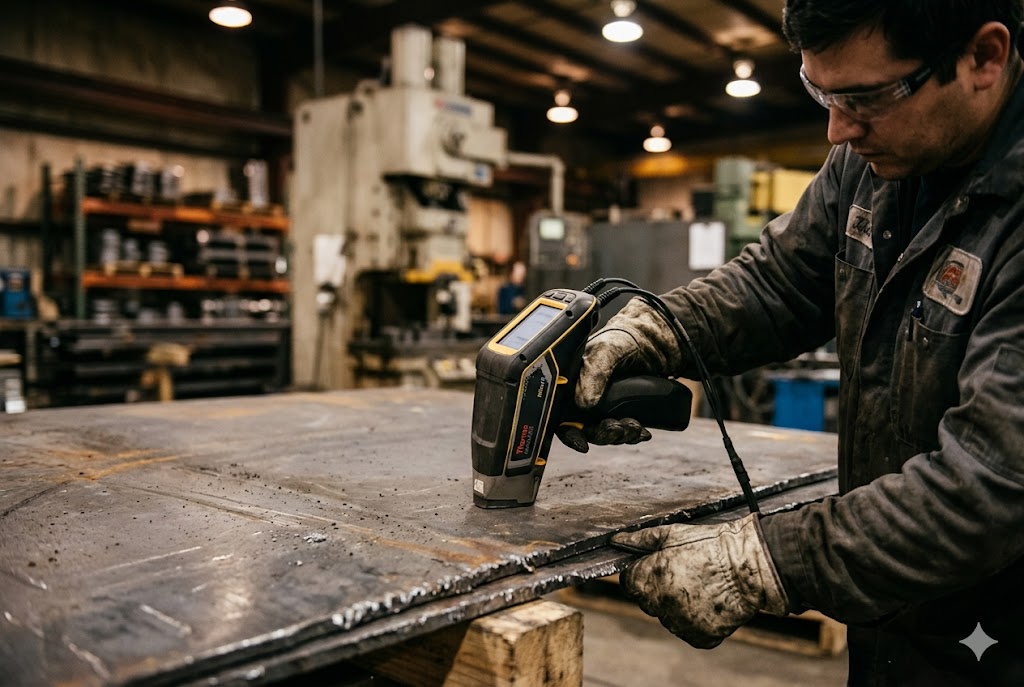
Verifying an MTC requires three steps: (1) confirm the issuing mill's identity through direct contact or a third-party database, (2) cross-check the heat number against the physical coil or sheet label at your warehouse, and (3) use Positive Material Identification (PMI) 4 — XRF or OES analysis — to compare the actual elemental chemistry of the material against the MTC's reported values.
Why Trading Companies Are the Highest-Risk MTC Source
Trading companies — middlemen who buy from mills and resell to fabricators — routinely replace the original mill's name on the MTC with their own company name. This is common practice in China's steel supply chain. The problem is that it severs your traceability. You cannot verify the chemistry against the source mill's records, and you cannot confirm which mill actually produced the material.
If your supplier is a trading company or a sheet metal fabricator that buys coil from a trader, request the original mill certificate — not the trader's re-issued version. If the supplier refuses, treat that refusal as a risk flag.
Step-by-Step MTC Verification Process
Step 1 — Mill Identity Check
Look up the mill name on the certificate. Search for that mill's official website and quality contact. Call or email to confirm the heat number exists in their records. Reputable mills in China, Japan, South Korea, and Europe maintain heat number logs that their quality departments can verify on request.
Step 2 — Physical Label Cross-Check
When material arrives at your warehouse or your supplier's factory (if you have an in-production inspector on-site), photograph the coil or sheet label. Record the heat number. Compare it character-by-character to the MTC. Any discrepancy is a mandatory hold.
Step 3 — PMI Testing
Positive Material Identification uses X-ray fluorescence (XRF) or optical emission spectroscopy (OES) 5 to measure the actual elemental composition of the physical material. A handheld XRF gun can test a sample in under a minute.
| PMI Method | Speed | Accuracy | Best For |
|---|---|---|---|
| XRF (handheld) | 30–60 seconds per point | ±0.01–0.05% for most elements | Field verification, supplier audits |
| OES (laboratory) | 5–15 minutes per sample | ±0.001–0.005% | High-precision or regulated applications |
PMI should be standard practice when establishing a new supplier relationship, when a new heat lot is introduced, or when visual or dimensional anomalies raise any doubt about material identity.
When to Deploy a Third-Party Inspector
If you do not have an on-site quality representative at your China supplier's factory, use a third-party inspection agency to perform incoming material verification before production begins. Ask them to:
- Photograph and record the coil or sheet labels
- Verify heat numbers against the submitted MTC
- Conduct PMI spot-checks on the material to be used
This adds a small cost per shipment. It is a fraction of the cost of scrapping a production run of non-conforming finished parts.
Is a Mill Certificate Standard Practice Among Reliable China Sheet Metal Exporters?
When we audit new sheet metal suppliers for our clients, MTC capability is one of the first questions on our checklist. The answer tells us a great deal about how a factory manages its supply chain, and whether it understands the expectations of professional importers in regulated markets.
Among reliable China sheet metal exporters supplying U.S. and European buyers, providing EN 10204 Type 3.1 mill certificates is standard practice — not an exceptional request. A supplier who cannot produce an original MTC tied to the specific heat lot being used, or who treats the request as unusual, is operating below the baseline quality management standard expected by professional importers.

What a Supplier's MTC Response Tells You About Their Operation
The way a supplier handles your MTC request reveals their quality culture quickly:
Immediate, clean response — The supplier provides an original MTC with a clear heat number, the correct EN 10204 type, and an authorized signature before production begins. This indicates a mature quality management system and a supply chain with documented material traceability.
Delayed or vague response — The supplier asks why you need it, says it will be provided with the shipment, or offers a certificate of conformance instead of an MTC. This indicates the supplier does not maintain incoming material records systematically and likely has no heat-number traceability in place.
Refusal or substitution — The supplier provides a generic material declaration, a trading company re-issue with their own logo replacing the mill name, or a scanned document with obvious formatting inconsistencies. These are disqualifying findings in a formal supplier audit.
Regulated End Markets Make MTC a Contractual Requirement
For parts entering aerospace, automotive, medical device, or food-grade production, MTC requirements are not preferences — they are audit findings under quality system frameworks:
| Quality Standard | MTC Requirement |
|---|---|
| AS9100 (Aerospace) 6 | Original MTC with authorized signature, heat traceability mandatory |
| IATF 16949 (Automotive) 7 | Material certification required for controlled characteristics |
| ISO 13485 (Medical Devices) | Material traceability documentation required throughout supply chain |
| ISO 9001 (General) 8 | Evidence of conformity to material specifications required |
A supplier's inability to provide an original MTC under these frameworks is a disqualifying audit finding — not a corrective action request.
The Customs Dimension: MTC and CBP Anti-Circumvention Reviews
Under current Section 301 tariff structures 9, U.S. Customs and Border Protection (CBP) scrutinizes the country of origin declared for raw material stock. If your commercial invoice states Vietnam as the country of fabrication, but the MTC shows the steel was melted and rolled in China, your shipment may trigger an anti-circumvention investigation — even when the fabrication work itself was legitimately performed in Vietnam.
Our Vietnam branch office deals with exactly this issue. We require suppliers in Vietnam to provide MTCs that clearly state the mill origin of the raw material coil. If the coil originated in China, that fact must be disclosed. Attempting to conceal it through a re-issued MTC creates a customs compliance exposure that is far more costly than any tariff savings.
Embed the MTC as a Named Hold Point in Your PO
The most effective way to establish MTC compliance as standard practice with any China or Vietnam supplier is to write it into your purchase order as a named pre-production hold point. Include:
- The required EN 10204 certificate type (minimum 3.1)
- The heat lot traceability requirement
- The explicit statement that production authorization is withheld until buyer issues written MTC acceptance
- A clause stating that shipment of material not covered by an accepted MTC constitutes a breach of contract
This approach removes ambiguity. The supplier knows the MTC is not a courtesy document. It is a contractual condition of production authorization. For a comprehensive reference on what EN 10204 Type 3.1 certification requires from the issuing mill, the projectmaterials.com MTC guide 10 provides a reliable technical overview used widely in international procurement.
Conclusion
Require the MTC before production — not before shipment. Specify EN 10204 Type 3.1 in your PO. Verify the heat number physically. Use PMI when starting a new supplier relationship. These four steps convert a paper document into a real quality gate.
Footnotes
1. Wikipedia entry explaining how heat numbers link steel products to their specific melt batch and test records. ↩︎
2. AZoM reference covering ASTM A36 chemical composition, mechanical properties, and weldability characteristics. ↩︎
3. MTR.AI guide explaining the four EN 10204 certificate types and when each is required in procurement. ↩︎
4. Wikipedia overview of Positive Material Identification methods including XRF and OES elemental analysis. ↩︎
5. AZoM technical article on using XRF for positive material identification in manufacturing and quality control. ↩︎
6. Tarvin Precision overview of AS9100 aerospace quality standard, covering traceability and material documentation requirements. ↩︎
7. AIAG resource hub for IATF 16949:2016 automotive quality management standard implementation and certification. ↩︎
8. ISO official page for ISO 9001:2015 quality management systems standard and its conformity requirements. ↩︎
9. CBP official FAQ on Section 301 China tariffs, country of origin rules, and anti-circumvention enforcement. ↩︎
10. Projectmaterials technical guide to mill test certificates covering EN 10204 types, heat traceability, and MTC verification. ↩︎