Skip to main content Skip to footer
We have worked with hundreds of factories across China and Vietnam, and the same mistake comes up again and again: buyers use the same checklist to evaluate a prototype shop and a mass production facility. The result is either a high-volume factory that treats your 20-piece custom order as a nuisance, or a job shop that cannot hold tolerances past piece 500.
The right way to choose a factory depends entirely on your volume. For low-volume custom sheet metal parts, prioritize engineering responsiveness and fast sample cycles. For mass production, prioritize process stability, automation depth, and Statistical Process Control. Using the same criteria for both stages will cost you time and money.
The difference is not subtle. It touches every part of the selection process — from the first email to the contract you sign. Here is how to think through each stage.
What Matters Most When I Source a Low-Volume Sheet Metal Prototype from China?
Every week our team receives inquiries from buyers who have already lost two or three weeks with the wrong factory. They sent drawings to a large facility, waited ten days for a quote, and received parts that did not match the tolerances. The factory was not bad — it was simply the wrong type.
For a low-volume sheet metal prototype, the most important factory attribute is engineering responsiveness. You need a factory whose engineers will review your drawings before quoting, flag DFM issues early, and communicate directly with your team. At low volumes, there is no buffer to absorb rework from a misread drawing.
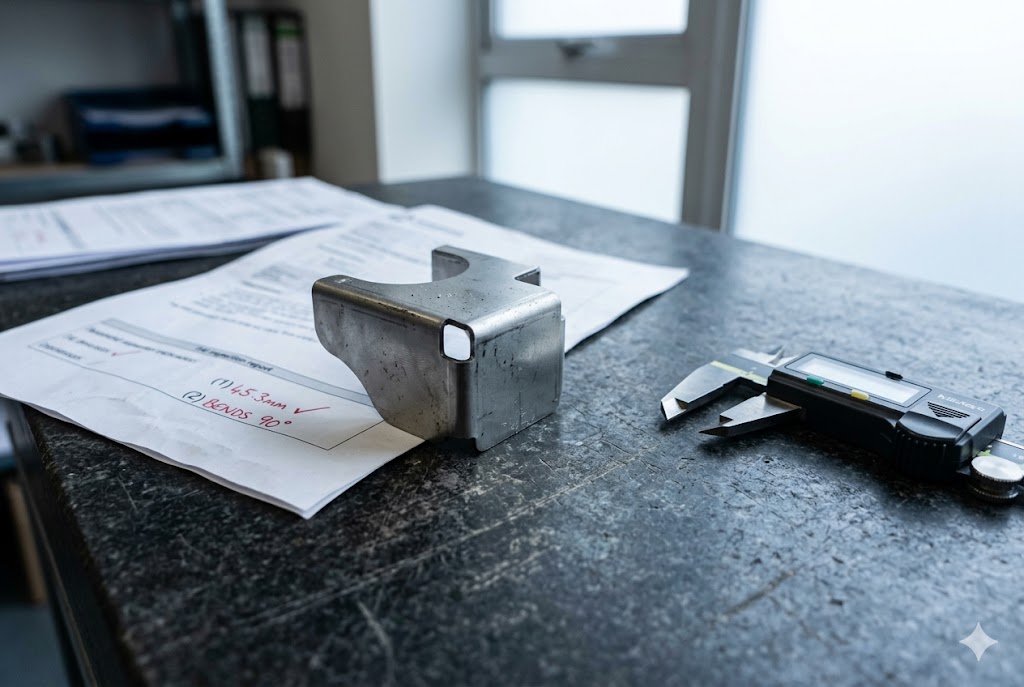
Engineering Responsiveness Is More Important Than Equipment
Most buyers look at machine lists first. That is understandable but misleading at low volumes. A factory with a newer laser cutter but a sales-only team will still miss your critical dimensions if no engineer reads your drawing before the job starts.
What you actually need is a factory where an engineer — not a salesperson — reviews your file, confirms tolerances, and flags anything that cannot be held with standard tooling. Catching DFM issues 1 before the purchase order, not after the first article fails, is what separates a good prototype partner from an expensive mistake.
Ask the factory directly: "Who will review my drawing before you quote?" If the answer is a sales representative, that is a warning sign.
Sample Cycle Time Beats Unit Price
At low volumes, your total project cost is dominated by iteration time, not material cost. A factory offering 15% lower unit pricing but a three-week sample cycle is almost always more expensive when you account for engineering delays and downstream schedule impact.
A competitive benchmark for low-volume custom sheet metal prototypes is five to seven working days for a first article, delivered with a balloon-referenced FAI report 2. If a factory cannot commit to that timeline at the quoting stage, it is likely running a job shop queue that deprioritizes small orders.
| Evaluation Criterion | Why It Matters at Low Volume | Red Flag |
|---|---|---|
| Drawing review by engineer | Catches DFM issues before production | Only sales team reviews drawings |
| Sample cycle time | Compresses development timeline | Quoted lead time exceeds 10 working days |
| FAI report format | Confirms dimensional compliance | No balloon-referenced report offered |
| Minimum order quantity | Signals business model fit | Unprompted MOQ of 500+ pieces |
| Design change response | Enables iteration | Change fees quoted per revision |
Tooling-Free Capability Matters More Than You Think
Low-volume custom work requires a factory that can run five to fifty parts of a new geometry without dedicated hard tooling. Factories that use universal die libraries and programmable CNC press brakes can do this. Factories whose economics depend on amortizing hard tooling across large runs cannot — and they will price your work punitively to compensate.
Ask whether the factory uses a standard die library or requires custom tooling for each new bend geometry. The answer tells you immediately whether your program fits their business model.
What to Check in the First Communication
Send a drawing with at least two tight tolerances and one non-standard bend, then measure the response. A good low-volume factory will reply with specific questions about those features within two working days. A factory that replies with a price and lead time only — with no technical questions — has not actually read your drawing.
| Communication Test | Good Response | Weak Response |
|---|---|---|
| Send a complex drawing | Engineer asks about tight tolerances within 48 hours | Sales rep sends a price with no technical questions |
| Ask about DFM | Factory flags specific issues and suggests alternatives | Factory says "no problem" without elaboration |
| Ask who handles your account | Named engineer or project manager assigned | "Our team will handle it" |
Why Do Supplier Selection Criteria Change When I Move from Sampling to Mass Production?
We have seen buyers try to scale up with their prototype supplier, and it sometimes works — but only if that supplier has already built the infrastructure for volume. Most have not. The factory that was responsive and flexible at 20 pieces becomes a bottleneck at 5,000.
When you move from sampling to mass production, the critical factory attribute shifts from engineering flexibility to process stability. You need automation depth, documented process controls, and Statistical Process Control infrastructure. A factory optimized for high-mix, low-volume work will struggle to hold tolerances consistently at scale.
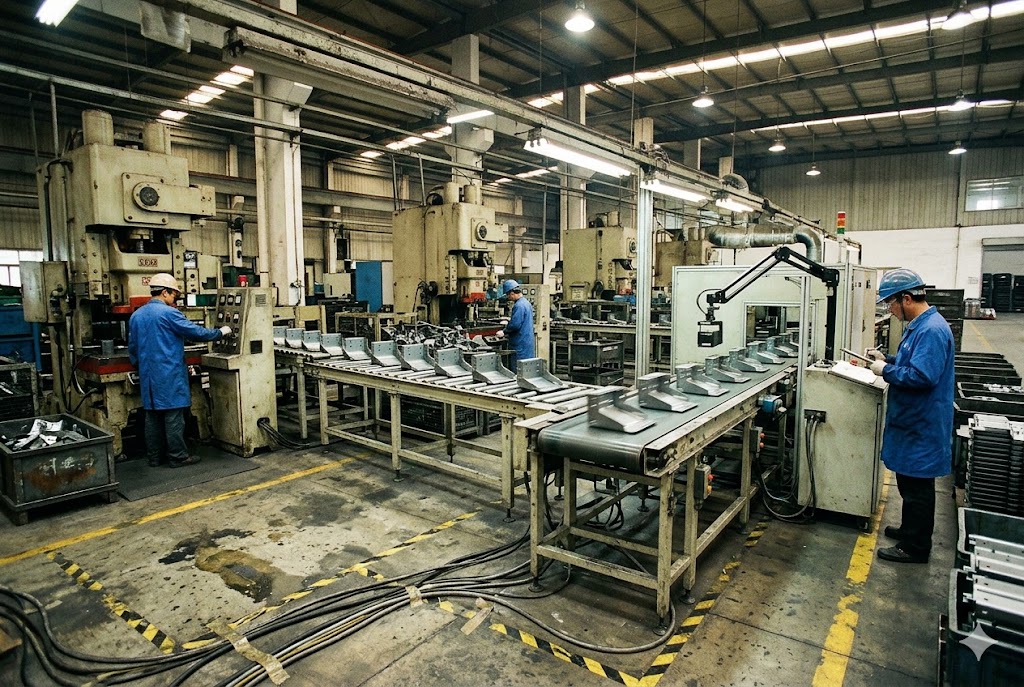
Process Stability Replaces Engineering Flexibility
At volume, quality variation comes from machine drift and setup repeatability — not from individual part judgment calls. A press brake operator who is excellent at reading a prototype drawing introduces the wrong kind of variability at 10,000 pieces. You need machines that compensate for variation automatically.
Specific features to look for in a mass production sheet metal factory:
- Press brakes with automatic angle-compensation sensors 3
- Laser cutting with software-optimized nesting 4 for material yield
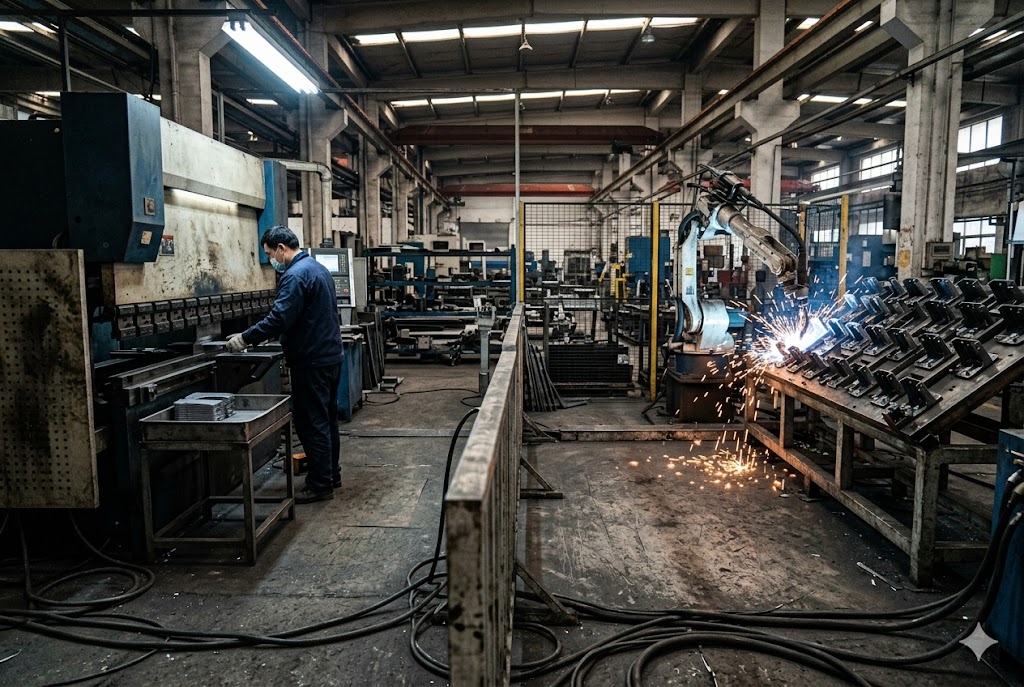
- Robotic or semi-automated welding cells 5 with saved programs
- End-of-line gauging stations built into the production flow
A factory running manual setups across dozens of active jobs simultaneously will struggle to maintain the consistency your volume program requires.
Statistical Process Control Is Non-Negotiable at Volume
First Article Inspection passes mean very little at mass production scale. A process that clears FAI but drifts outside tolerance by piece 5,000 will produce defective parts before any end-of-line inspection catches the problem.
Ask the factory: "Can you provide Cpk data 6 on our critical features across a production run?" If the factory cannot define what Cpk means, or has never measured it for a customer, it is not equipped to guarantee mass production quality consistency.
| Quality Tool | Low-Volume Relevance | Mass Production Relevance |
|---|---|---|
| First Article Inspection | Essential | Necessary but not sufficient |
| Cpk / SPC data | Rarely needed | Essential for critical dimensions |
| In-process gauging | Optional | Required for high-volume programs |
| End-of-line inspection | 100% check feasible | Sampling plan required |
| Robotic welding programs | Not necessary | Strongly preferred |
Dedicated Production Lines Reduce Variation
A factory running high-mix, low-volume scheduling across dozens of jobs cannot reliably maintain the operator familiarity and setup consistency that keeps per-unit quality stable across tens of thousands of pieces.
For a mass production program, ask whether the factory can reserve a dedicated cell or line for your part family. A dedicated line eliminates job changeover as a source of variation and allows the team to build deep familiarity with your specific geometry.
Financial Stability Becomes a Selection Factor
At low volume, you can redirect an order quickly if a supplier encounters problems. At mass production scale, a mid-program transfer is enormously costly — in engineering time, re-qualification, and supply disruption.
Before committing a mass production program, evaluate the factory's financial stability 7 and customer concentration. If your program would represent more than 30 to 40 percent of the factory's revenue, you are creating a dependency risk that the factory's cash flow problems, raw material disruptions, or labor turnover could make critical.
How Can I Find a Factory That Is Good at Both Small Runs and Repeat Orders?
This is the question we hear most often from buyers who are scaling a new product line. They want one supplier relationship that can grow with them — starting at 50 pieces and eventually handling 5,000. The honest answer is that these factories exist, but they are not common, and the way you identify them is specific.
A factory capable of both small runs and repeat orders will have a universal die library for tooling-free setups, documented process controls that can scale, and an engineering team that handles both DFM review and production SPC. These factories typically represent 10 to 20 percent of the market in any given region.
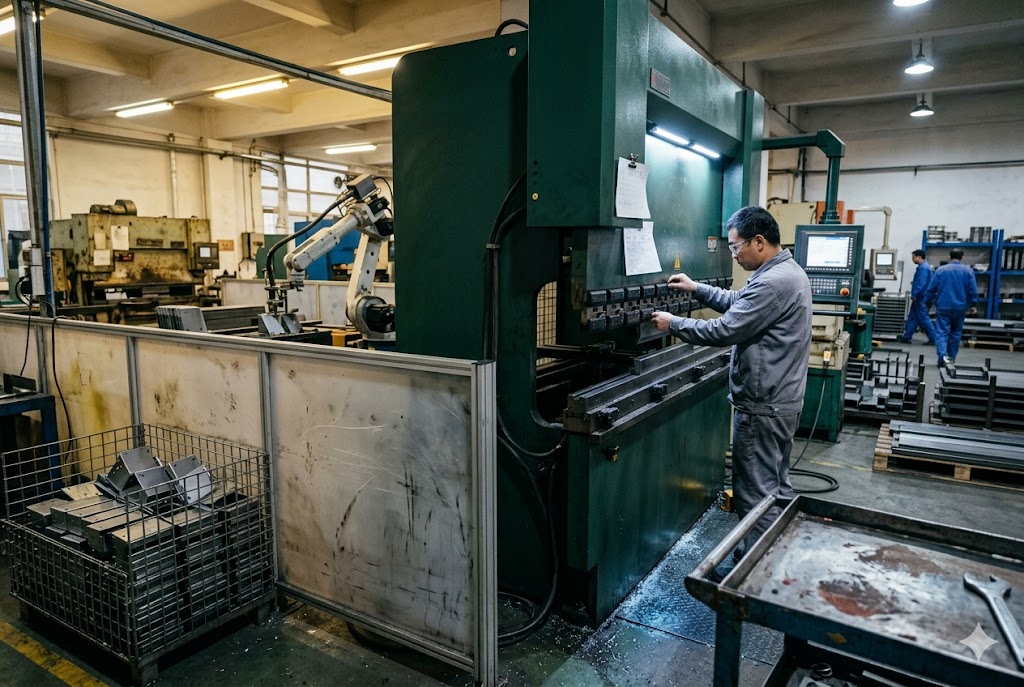
Look for Hybrid Scheduling Infrastructure
A factory built for both low-volume and mass production manages two types of job queues simultaneously. Ask how the factory schedules prototype jobs alongside repeat production runs. A factory with a clear answer — separate production cells, ring-fenced machine time for NPI, a named project manager for new programs — has built the organizational infrastructure to serve both. A factory that cannot explain its scheduling logic is probably optimizing for one model at the expense of the other.
The MOQ Question Is a Quick Filter
The minimum order quantity a factory quotes unprompted tells you its business model immediately. A factory that opens with "our MOQ is 500 pieces" is organized around batch production economics. A factory that quotes freely on quantities of 10 to 100 has built its scheduling and costing around high-mix work.
For buyers who need both capabilities, look for a factory with no stated MOQ or an MOQ below 50 pieces. Then ask what happens to lead time and unit cost when you scale to 1,000 pieces. A hybrid factory will have a clear answer for both scenarios.
Engineering Change Handling Reveals the Business Model
How a factory handles design changes is one of the clearest signals of its true operating model.
For low-volume custom work, you need fast change implementation — days, not weeks — without significant cost penalties.
For mass production, you need a formal engineering change management process 8: written approval, re-validation, and version control before any revision enters the production stream.
A factory that can do both — fast informal changes for NPI and controlled formal changes for volume — has the right process architecture for a scaling program.
Questions to Ask During Factory Evaluation
| Question | What a Hybrid Factory Says | What a Single-Mode Factory Says |
|---|---|---|
| What is your MOQ? | No minimum, or below 50 pieces | 500 pieces or higher |
| How do you handle prototype jobs alongside production runs? | Separate cells or ring-fenced scheduling | "We fit them in when we can" |
| Can you implement a drawing change in 3 days? | Yes, for NPI programs | Only with a change order and lead time |
| Do you have SPC data for repeat programs? | Yes, Cpk tracked per program | First article only |
| Who is my point of contact? | Named engineer + project manager | Sales representative only |
What Factory Strengths Matter Most for My Future Volume Growth Plan?
Buyers who are planning for volume growth need to think about supplier selection differently from buyers sourcing a one-time project. The factory you choose today becomes harder to leave as your program scales. Switching costs — re-qualification, tooling transfer, supply chain disruption — grow with every purchase order you place.
For a volume growth plan, the factory strengths that matter most are capacity headroom, process documentation quality, contractual provisions around tooling ownership and capacity reservation, and the factory's track record of growing programs with existing customers rather than replacing them with new accounts.
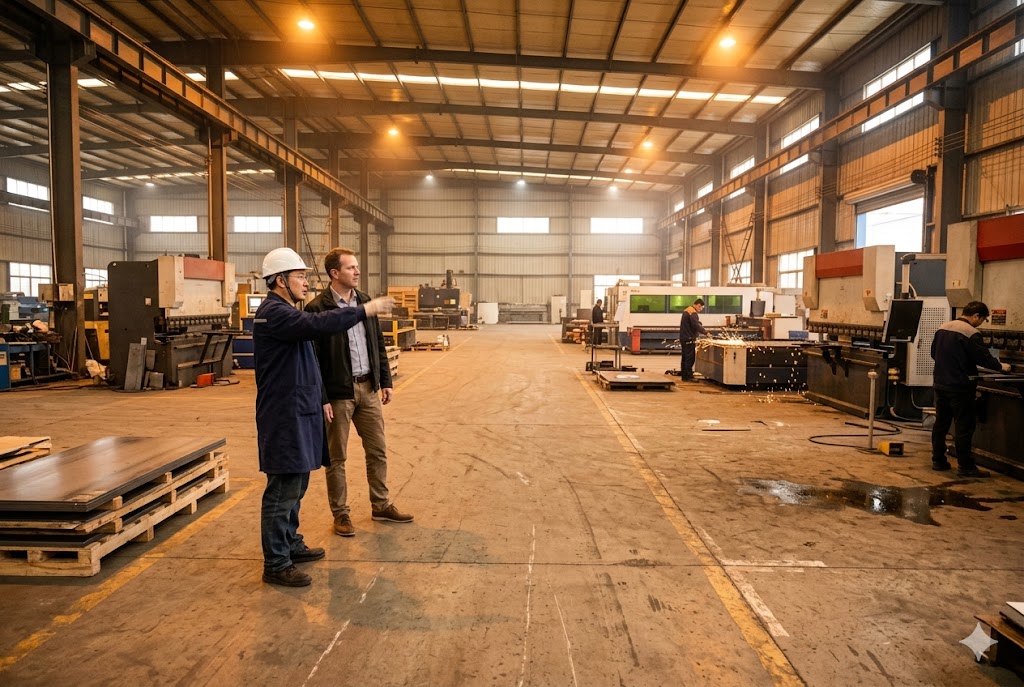
Capacity Headroom Determines How Far You Can Scale
A factory running at 85 to 90 percent utilization has no room to absorb your program growth without displacing another customer. Ask directly: what percentage of current capacity is committed to existing programs? A factory that cannot answer that question has not built the production planning infrastructure you need.
Look for a factory with 20 to 30 percent uncommitted capacity — enough to absorb a doubling of your program volume without a capital investment cycle.
Process Documentation Is Your Insurance Policy
If you ever need to transfer your program to a second source, the quality of the factory's process documentation determines how much you lose. A factory with documented work instructions, fixture drawings, program files, and SPC baselines can transfer a program in weeks. A factory that carries process knowledge in the operators' heads requires months of re-learning at a new facility.
During supplier evaluation, ask for a sample work instruction from a current program (redacted for confidentiality). The format and detail level tell you exactly how transferable your process will be.
Contractual Provisions That Protect Volume Programs
The contract you sign at program launch determines your options years later. For a mass production or volume growth program, the critical provisions are:
- Tooling ownership: All tooling paid for by you should be titled in your name, with a right to retrieve it — protecting your molds and tooling when manufacturing overseas 9 is a step many buyers overlook until it is too late
- Capacity reservation: Written commitment to reserve a defined machine capacity for your program
- Price-lock periods: Agreed pricing stability for a defined period, with a documented escalation mechanism
- Subcontracting restrictions: No outsourcing of your program without written approval
- IP protection: All drawings, programs, and fixtures treated as confidential and not used for other customers
For low-volume custom work, the priority is tooling and IP. For mass production, capacity and subcontracting restrictions become equally important.
Track Record With Growing Programs
Ask the factory to name two or three customers whose programs grew from prototype to volume over a period of years, and ask for permission to contact them. A factory that can provide those references — and whose customers will take your call — has demonstrated the organizational ability to grow with a buyer rather than treating volume as a new negotiation.
A factory that cannot name a single customer relationship spanning more than two years is a factory optimized for transactional business, not long-term program management. This is closely tied to the principles of ongoing supplier risk assessment 10, which smart buyers conduct before any long-term commitment, not just at the start.
| Factor | Why It Matters for Growth | How to Verify |
|---|---|---|
| Capacity headroom | Determines scaling ceiling without capital delay | Ask for current utilization rate |
| Process documentation | Determines transfer cost if you need a second source | Request a sample work instruction |
| Tooling ownership clauses | Protects your investment and mobility | Review draft contract before signing |
| Customer reference longevity | Signals program management capability | Ask for 2–3 references with 2+ year relationships |
| Subcontracting restrictions | Prevents undisclosed outsourcing at volume | Require written approval clause in contract |
Conclusion
Choosing the right factory is not about finding the best factory. It is about finding the right match for your current stage. Get that match right at prototype, plan the transition criteria before you move to volume, and build contractual protection before the program grows.
Footnotes
1. Comprehensive DFM guidelines for sheet metal bend radii, hole placement, and forming operations. ↩︎
2. Complete guide to AS9102 First Article Inspection Reports and their three accountability forms. ↩︎
3. How automatic crowning systems in CNC press brakes compensate for deflection to maintain angle accuracy. ↩︎
4. How smart nesting strategies in laser cutting reduce sheet usage and improve material yield. ↩︎
5. Overview of robotic welding cell benefits including repeatability, consistency, and productivity gains. ↩︎
6. Explanation of the Process Capability Index (Cpk) and how it measures manufacturing conformance to specifications. ↩︎
7. Framework for assessing supplier financial health to prevent supply chain disruption. ↩︎
8. Step-by-step guide to engineering change management including ECR, ECO, and ECN workflows. ↩︎
9. Legal strategies for protecting molds and tooling when manufacturing in overseas factories. ↩︎
10. TÜV SÜD guide to supplier risk assessment covering financial, operational, and ESG dimensions. ↩︎