Skip to main content Skip to footer

We have seen orders derail — not because parts were bad, but because the contract said nothing clear about what happens next. Without a defined NCR clause, suppliers stall, buyers absorb losses, and disputes drag on.
A nonconforming part contract clause must define the issuance trigger, disposition options, response timelines, and compensation structure before any order is placed. Covering these four elements in writing eliminates ambiguity, protects your production line, and gives you enforceable remedies when Swiss CNC parts fall short.
Every section below answers one of the core questions buyers ask us when building NCR language into a supply agreement.
What Response Time Should I Require from a Supplier After I Raise a Nonconformance Report?
Our QC team files NCRs the same day a deviation is found at incoming inspection. The worst outcome is silence — a supplier who takes two weeks to acknowledge a report while your line sits idle.
Suppliers must acknowledge each NCR in writing within 48–72 hours of receipt and submit a full root cause analysis and corrective action plan within 10–15 business days. Failure to meet either window should be treated as a material breach in your contract, not a minor administrative lapse.

Why the Acknowledgment Window Matters
Forty-eight to seventy-two hours is not arbitrary. It forces the supplier to triage the report immediately — identify which batch is affected, quarantine remaining stock, and confirm receipt before the problem compounds. A supplier who does not acknowledge within that window is almost certainly hoping the buyer will absorb the loss quietly.
Write the response window in hours, not business days. "Business days" language opens arguments about Chinese national holidays, weekend cutoffs, and time zone offsets. Hours are unambiguous.
Root Cause Analysis Format
Require 8D format 1 or an equivalent structured method. An 8D report forces the supplier through eight disciplines: problem description, containment, root cause identification 2, corrective action, preventive action, and long-term verification. Vague responses like "will improve process" are not acceptable and should be explicitly rejected in your contract language.
The 10–15 business day window for the corrective action plan 3 submission is tight enough to create urgency but realistic for a supplier running a proper investigation. If they need an extension, it must be requested in writing before the deadline — not granted automatically.
Escalation for Non-Response
Your contract must state what happens if a supplier misses either deadline. We recommend two tiers:
| Missed Deadline | Contractual Consequence |
|---|---|
| No acknowledgment within 72 hours | Buyer may engage third-party inspector at supplier cost |
| No CAPA submitted within 15 business days | NCR escalates to SCAR; holdback payment frozen |
| CAPA rejected twice by buyer | Supplier placed on ASL probation |
Silence is not neutral. Build penalties for it.
What Remedies (Replacement, Rework, Price Credit) Should My Contract Specify for Defective Swiss CNC Parts?
When a shipment of Swiss CNC parts fails incoming inspection, the conversation turns to remedies fast. We have watched buyers accept future-order credits — and later regret it.
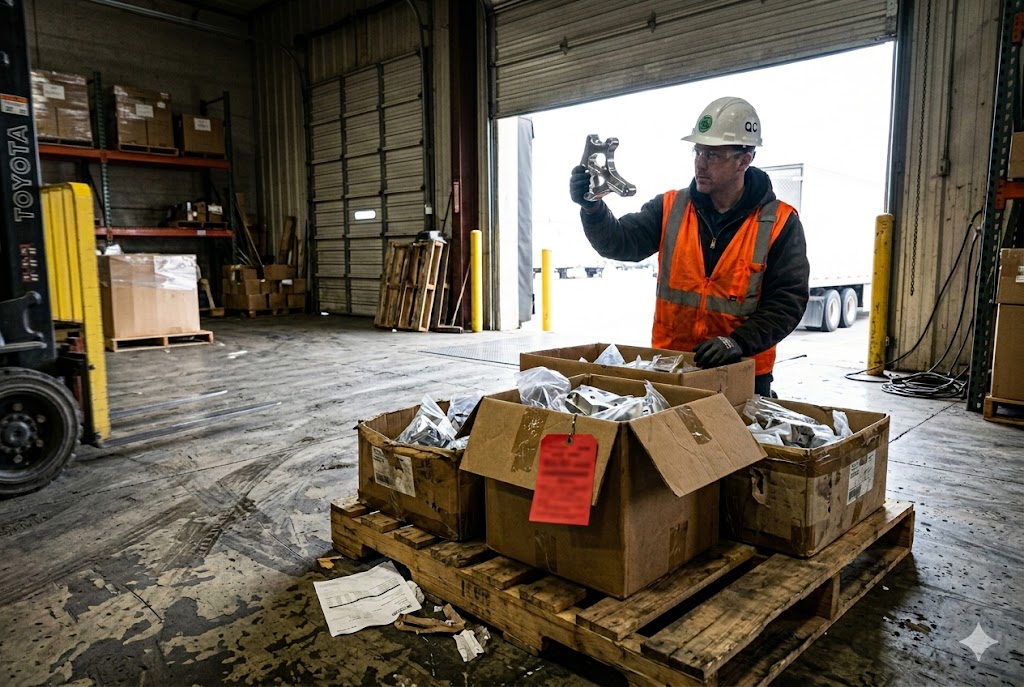
Your contract must enumerate all four disposition options — use-as-is, rework, return-to-supplier, and scrap — with explicit written consent requirements for each. No disposition may be executed unilaterally by the supplier. Replacement shipments must arrive within a defined window; price credits are the least protective remedy and should be treated as a last resort.
The Four Disposition Options
Every NCR ends in one of four ways. Define all four in your contract:
| Disposition | When It Applies | Who Authorizes |
|---|---|---|
| Use-as-is | Minor deviation, documented buyer approval | Buyer in writing only |
| Rework | Supplier can correct the defect | Buyer approval required before rework begins |
| Return-to-supplier (RTS) | Supplier must replace the batch | Buyer initiates; supplier bears return freight |
| Scrap | Part is unsalvageable | Joint written agreement; supplier reimburses full unit cost |
None of these dispositions should be the supplier's unilateral call. If a supplier scraps a batch without buyer approval, they have eliminated your evidence. Write that explicitly.
Why Price Credits Are Dangerous
Price credits feel like a clean resolution. They are not. A supplier who issues a 5% credit on a bad batch has simply reduced their revenue on that PO. On the next order, they recover that margin by tightening scrap tolerances, substituting a lower-grade bar stock, or skipping a secondary inspection step. We have seen this pattern repeatedly with Swiss CNC precision parts where material grade and process sequence are critical.
Your contract should state: All NCR compensation shall be paid as cash reimbursements within 30 days of invoice. Future-order credits are not acceptable as NCR remedies.
Right-to-Sort Provision
If a nonconforming shipment arrives and returning it would halt your production line, you need the legal right to sort or rework the parts yourself — and charge the supplier for it. Negotiate this clause before the order, not during a crisis:
- Pre-agree a labor rate for buyer-side sorting (e.g., $65/hour)
- No advance supplier approval required to begin sorting
- All costs invoiced directly to the supplier, not offset against future POs
This provision is the difference between keeping your line running and shutting it down while a supplier debates liability.
How Do I Calculate the Full Cost of a Supplier's Quality Failure, Including My Downstream Production Loss?
The unit cost of the bad parts is only the starting point. Our engineers have tracked NCR cost breakdowns for clients and the final number is almost always two to four times the face value of the defective batch.
The full cost of a supplier quality failure includes the defective unit value, return freight, re-inspection labor, third-party verification fees, expedited replacement shipping, production downtime, and any downstream customer chargebacks. All of these categories must be enumerated as supplier-borne liabilities in your contract, not absorbed as buyer overhead.

The True Cost Breakdown
When a batch of Swiss CNC parts fails, costs accumulate across several categories that buyers routinely fail to document:
| Cost Category | Example Amount | Supplier Liable? |
|---|---|---|
| Defective unit cost | $3,200 | Yes — with contract |
| Return freight (air, expedited) | $480 | Yes |
| Third-party re-inspection | $350 | Yes |
| Incoming sorting labor (8 hrs) | $520 | Yes — if pre-agreed rate |
| Expedited replacement shipping | $900 | Yes |
| Production downtime (4 hrs) | $2,800 | Yes — if documented |
| Customer chargeback (downstream) | $1,500 | Yes — latent defect clause |
| Total | $9,750 | vs. $3,200 face value |
Documenting Production Downtime
Production downtime is the category suppliers fight hardest. They argue it is speculative. It is not, if you document it correctly. Your contract should require that downtime claims be supported by:
- A signed internal production log showing the line stoppage time and cause
- A machine or supervisor report confirming the affected process
- A cost-per-hour rate for the affected line, pre-agreed in the contract
Pre-agreeing the downtime rate — even a conservative one — eliminates the arbitration argument. We recommend negotiating a figure that reflects your actual blended hourly line cost, even if it runs lower than true cost, because an agreed number is enforceable and an estimated number is not.
Liquidated Damages for Repeat Failures
If a supplier's defect rate exceeds your agreed AQL threshold 4 across a rolling shipment window, liquidated damages should kick in automatically. Under the PRC Civil Code 5, a liquidated damages clause is enforceable if the calculation method is fixed and specific. Write it as a formula, not as a range:
Liquidated damages = (defective unit value × 3) + all documented costs listed above
Vague language such as "substantial compensation" or "appropriate penalties" will not survive CIETAC arbitration 6.
What Evidence (Photos, CMM Reports) Should I Submit to Support a Quality Claim Against a Chinese Supplier?
Filing a quality claim without the right evidence is the fastest way to lose it. In our experience managing NCRs across dozens of Chinese CNC suppliers, the claims that get paid quickly are the ones that arrive complete on day one.
A strong quality claim against a Chinese CNC supplier must include photos of defective parts with dimension callouts, CMM or measurement reports showing actual versus nominal values, incoming inspection records, and any relevant material test certificates. Incomplete submissions allow suppliers to dispute findings and delay resolution indefinitely.
The Minimum Evidence Package
Every NCR submission should contain at least the following:
| Evidence Type | What to Include | Format |
|---|---|---|
| Photos | All defective surfaces; include a ruler or calibrated reference | JPEG, min 2MP, labeled |
| CMM / measurement report | Actual vs. nominal for all out-of-tolerance features | PDF with GD&T callouts |
| Incoming inspection record | Date, lot number, sample size, AQL level 7, result | Signed PDF |
| Material test certificate (MTC) | EN 10204 3.1 or 3.2 8, if material grade is in dispute | Original or certified copy |
| Purchase order reference | PO number, drawing revision, specification version | Included in NCR cover sheet |
Do not submit photos alone. Suppliers will respond that the photos are ambiguous, that the lighting is misleading, or that the defect is within tolerance on their own measurement. A CMM report leaves no room for that argument.
CMM Reports: What Makes Them Defensible
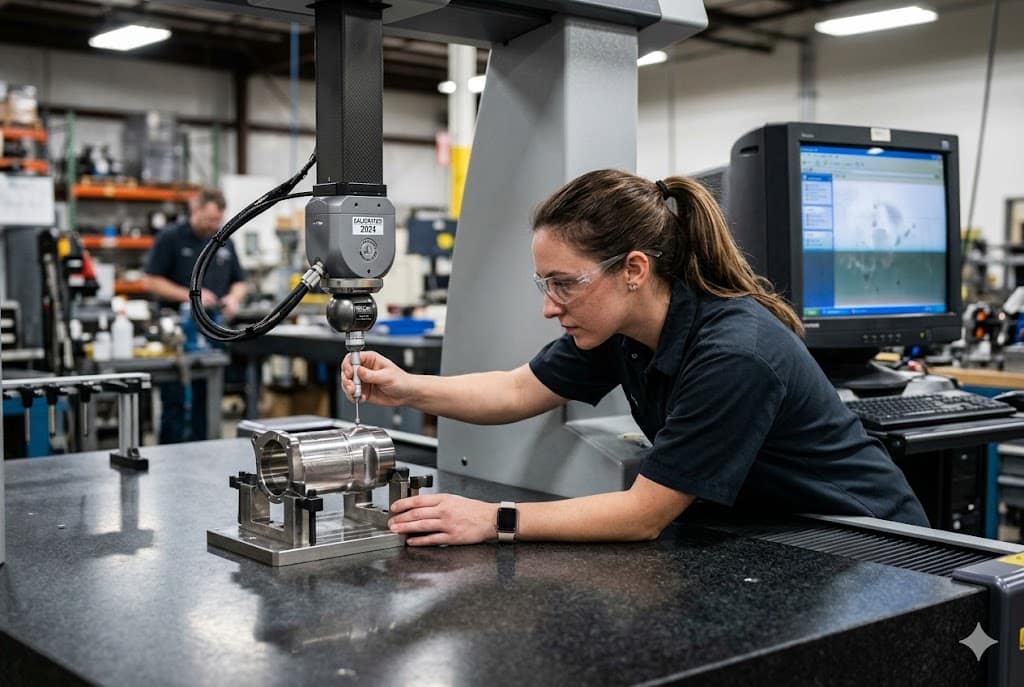
A Coordinate Measuring Machine 9 report is only as strong as the calibration record behind it. When submitting a CMM report as evidence:
- Include the calibration certificate for the CMM used
- Show the measurement datum setup, so the supplier cannot argue you measured from the wrong reference
- Report all features, not just the failing ones — cherry-picking raises credibility questions
- Use the drawing's own GD&T callouts 10 as column headers in the report
If your incoming inspection was performed by a third-party inspection company, their report carries additional weight because it removes the conflict-of-interest argument.
Latent Nonconformances: A Separate Evidence Track
Latent defects — those discovered during assembly or field use rather than at incoming inspection — require a different evidence chain. Your contract must include a separate latent defect clause with:
- A discovery window of 12–24 months post-delivery
- Assembly photos showing the defect in context
- A statement from your production engineer describing when and how the defect was found
- Any downstream customer chargeback documentation
Standard incoming inspection records will not cover latent defects. Build the evidence trail the moment a latent defect is discovered, not weeks later.
Conclusion
A well-drafted NCR clause changes how suppliers behave before shipment, not just after. Define response windows, enumerate dispositions, require cash compensation, and document every cost category in advance. That is the contract that keeps your production line running.
Footnotes
1. ASQ's overview of the 8D problem-solving model and its eight structured disciplines. ↩︎
2. Practical guide to completing an 8D report for serious manufacturing quality issues. ↩︎
3. Siemens explanation of the 8D report and CAPA system in manufacturing nonconformity management. ↩︎
4. QIMA's guide to Acceptable Quality Limit sampling methodology and defect thresholds. ↩︎
5. CMS expert overview of liquidated damages and payment terms under China's Civil Code. ↩︎
6. Official CIETAC arbitration rules for international commercial and trade disputes in China. ↩︎
7. ISO 2859-1 standard for acceptance sampling by attributes, the basis for AQL inspection levels. ↩︎
8. Holland APT's explanation of EN 10204 Type 3.1 vs. 3.2 material inspection certificates. ↩︎
9. Wikipedia entry on coordinate measuring machines covering probe types, accuracy, and calibration. ↩︎
10. Wikipedia entry on ASME Y14.5, the authoritative standard for geometric dimensioning and tolerancing. ↩︎