Skip to main content Skip to footer

Every time we manage a new sheet metal project, the same question comes up before the first part is even quoted: which finish do we actually need? Get it wrong and you face corrosion failures, dimensional mismatches, or a rejected shipment. Get it right and your parts arrive ready for the line.
Powder coating is the default choice for most sheet metal parts sourced from China. It offers 15–20+ year UV durability, a chip-resistant finish, zero VOCs, and wide availability across Chinese fabricators. E-coating suits complex geometry. Liquid painting works best when you need precise color matching or specialty chemistries.
These three processes look similar on a quotation sheet. They are not. The right choice depends on your part geometry, your corrosion environment, your tolerance stack, and your supplier's actual capability. Read on and we will walk through each decision point.
Which Finish Gives Me the Best Corrosion Resistance for Outdoor or Industrial Use?
When we export parts to customers running outdoor or industrial equipment, corrosion protection is always the first question they raise. It sounds simple. In practice, the answer depends on more than just the coating name.
For outdoor or industrial use, zinc phosphate pretreatment followed by powder coating delivers the best corrosion resistance in most cases, with salt spray performance exceeding 1,000 hours per ISO 9227. E-coat primer combined with a powder topcoat offers the highest protection for complex assemblies exposed to harsh environments.
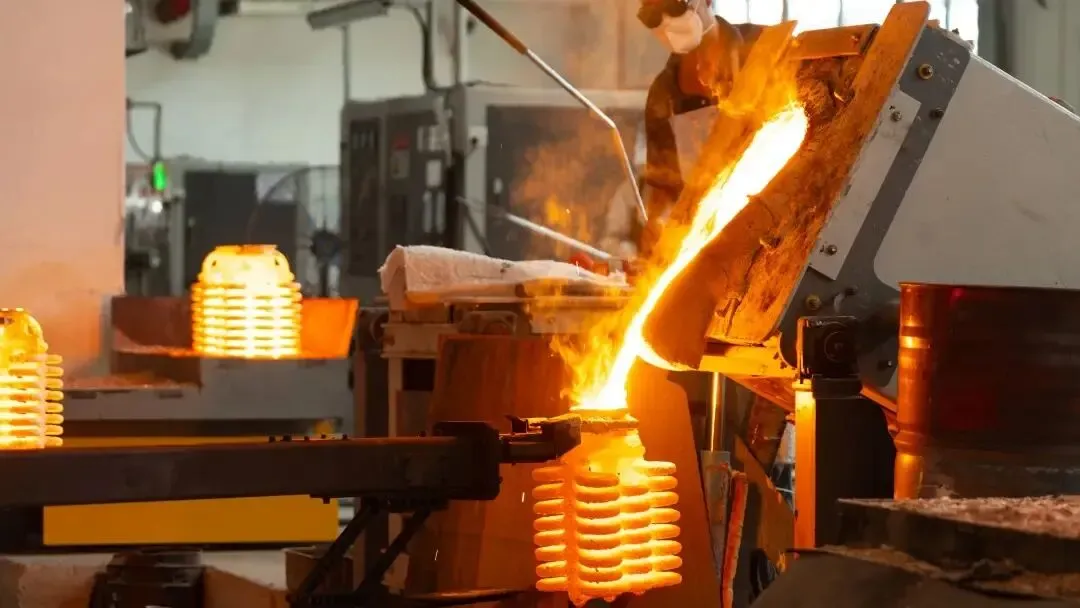
Why Pretreatment Decides the Outcome
Most buyers focus on the topcoat. The pretreatment stage is where corrosion protection is actually won or lost. Pretreatment converts the bare metal surface into a stable, adhesion-ready layer before any coating is applied. Skip it or underspec it, and even the best powder coat will fail within months.
There are three common pretreatment types used at Chinese fabricators:
| Pretreatment Type | Corrosion Protection Level | Typical Use Case |
|---|---|---|
| Iron phosphate | Basic | Indoor parts, low humidity |
| Zinc phosphate 1 | Good to Excellent | Outdoor, industrial, high humidity |
| Zirconium conversion coat | Good, RoHS-compliant 2 | EU-regulated markets, thin substrates |
Iron phosphate is cheap and fast. Many cost-competitive Chinese suppliers use it as a default. For indoor parts with no corrosion exposure, it is acceptable. For anything going outdoors or into an industrial environment, it is not enough.
Zinc phosphate adds a crystalline conversion layer that gives the coating a mechanical grip on the steel surface. In independent salt spray testing, zinc phosphate pretreatment before powder coating typically adds 300–500 hours of additional corrosion resistance compared to iron phosphate under the same topcoat. This is not a marginal difference.
Coating Process Comparison for Corrosion Resistance
| Coating Process | Typical Salt Spray Performance | Best Environment |
|---|---|---|
| Liquid paint (no primer) | 200–500 hours | Indoor, decorative |
| Powder coat over iron phosphate | 500–750 hours | Sheltered outdoor |
| Powder coat over zinc phosphate | 1,000–1,500 hours | Outdoor, industrial |
| E-coat primer 3 + powder topcoat | 1,500–3,000+ hours | Harsh outdoor, automotive |
What to Write Into Your Specification
Do not leave pretreatment to the supplier's default practice. Write the required pretreatment standard directly into your purchase order or technical specification. State the minimum: "zinc phosphate pretreatment required per ASTM D769 or equivalent." Request the supplier's pretreatment process sheet before production begins.
If the supplier cannot tell you what pretreatment chemistry they use, that is a disqualifying signal. Walk away or qualify a different facility.
For parts going into marine, chemical, or extreme outdoor environments, specify e-coat as a primer layer beneath the powder topcoat. Chinese suppliers capable of running both processes in sequence exist, but they are concentrated among larger facilities, primarily in Guangdong and Zhejiang. Verify the actual process line before committing production — not after.
How Do I Compare the Cost and Durability of Powder Coat Versus Liquid Paint for My Order?
Our sourcing team gets this question from purchasing managers almost every quarter. It seems like a simple cost comparison. But the numbers only make sense when you look at total cost over the part's service life, not just the unit price on the quote.
Powder coating costs 10–30% more per part than basic liquid painting at Chinese suppliers, but delivers 2–3 times the service life in most outdoor or industrial applications. Over a 10-year period, powder-coated parts typically require fewer refinish cycles, making them less expensive in total cost of ownership.

Unit Cost Comparison
Raw unit costs at Chinese fabricators vary by part size, geometry, and batch volume. The table below reflects typical ranges for flat or simple-geometry sheet metal parts in mid-volume production runs.
| Finish Type | Typical Added Cost Per Part (USD) | Expected Service Life (Outdoor) | Refinish Frequency |
|---|---|---|---|
| Liquid paint, single coat | Low baseline | 3–7 years | Every 3–5 years |
| Liquid paint, primer + topcoat | +15–25% over single coat | 5–10 years | Every 5–8 years |
| Powder coat 4 | +10–30% over liquid baseline | 15–20+ years | Rarely needed |
| E-coat primer + powder topcoat | +40–80% over liquid baseline | 20–30 years | Almost never |
Where Liquid Paint Still Wins
Liquid painting is not always the wrong answer. It is the right answer in three specific situations.
First, when you need highly precise color matching. Powder is supplied in pre-weighed, color-coded batches using standardized RAL codes 5. Color consistency across batches is structurally more reliable with powder. But if your product requires a brand-specific Pantone reference with a tight delta-E tolerance — something your customer will hold a colorimeter to — liquid paint gives your Chinese supplier more flexibility to mix and adjust.
Second, when you need specialty chemistry. Marine-grade epoxies, chemical-resistant polyurethanes, or two-component automotive finishes are liquid-only formulations. Powder coating chemistry is more limited. If your part operates in a chemical-splash environment or requires FDA-compliant coatings, liquid paint may be your only option.
Third, when your part geometry includes areas that need gradient effects or artistic finishes. Powder cannot do gradients. Liquid can.
Color Consistency Risk
Color repeatability across multiple orders is significantly harder to control with liquid painting at Chinese suppliers. Liquid tinting is operator-dependent. If a batch of paint is mixed slightly differently, you get color drift across a production run or between orders placed months apart.
Powder coating reduces this risk structurally. The powder batch arrives from the manufacturer pre-formulated to a specific RAL code. The operator does not mix it. If color repeatability across orders matters to your product — and for branded equipment it usually does — powder coating is the lower-risk choice.
What Surface Preparation Steps Should I Require Before Any Coating Is Applied?
Our engineers have found that more coating failures trace back to skipped or underspecified surface prep than to any problem with the coating material itself. Surface preparation is invisible in the finished part. That is exactly why it gets cut first when a supplier is under cost pressure.
Before any coating is applied, require the following in writing: degreasing, mechanical or chemical descaling to remove mill scale and rust, a chemical conversion coat (minimum iron phosphate, zinc phosphate preferred for corrosion-critical parts), and a final rinse and dry cycle. Specify each step by standard, not by name alone.
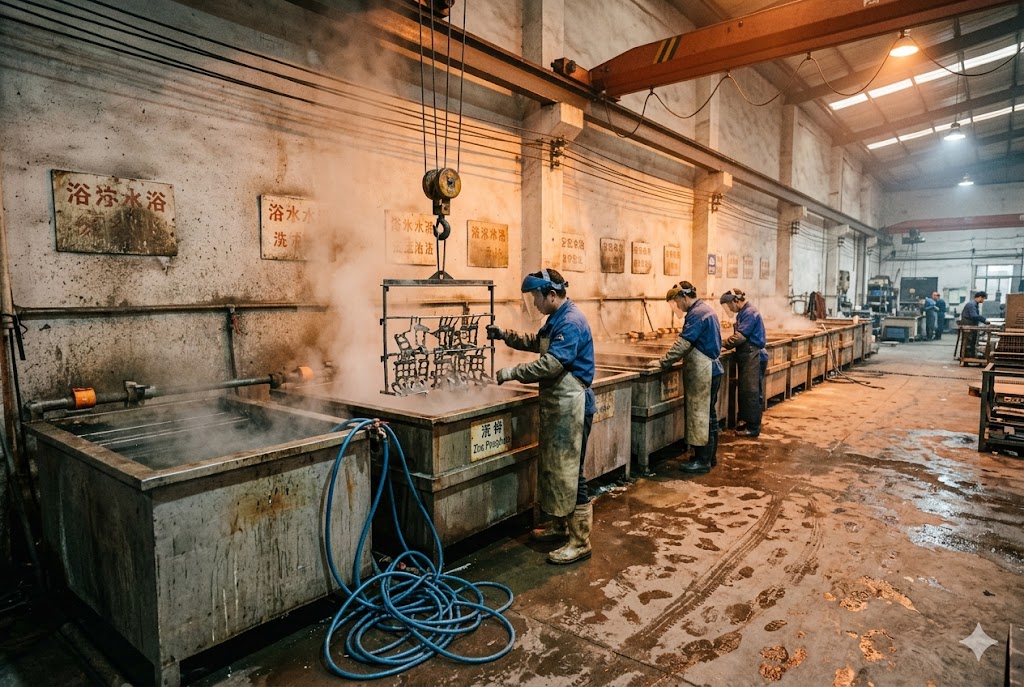
The Standard Pretreatment Sequence
A properly run pretreatment line follows a defined sequence. Each stage has a purpose. Skipping any stage weakens the result.
| Stage | Process | Purpose |
|---|---|---|
| 1 | Alkaline degreasing | Remove oils, machining fluids, fingerprints |
| 2 | Water rinse | Remove degreasing residue |
| 3 | Descaling / pickling | Remove mill scale, rust, weld scale |
| 4 | Water rinse | Remove acid residue |
| 5 | Conversion coating | Build adhesion layer (iron or zinc phosphate) |
| 6 | Water rinse | Remove conversion coat residue |
| 7 | DI water final rinse | Remove mineral contamination |
| 8 | Dry-off oven | Remove all moisture before coating |
What Chinese Suppliers Often Skip
Cost-competitive Chinese suppliers under margin pressure most commonly skip or shorten three stages: the descaling step, the conversion coating, and the DI water final rinse.
Skipping descaling leaves mill scale on the surface. Mill scale is electrochemically different from the base steel. It creates a corrosion cell at the interface. Coatings applied over mill scale will delaminate.
Skipping or diluting the conversion coating removes the adhesion layer. The coating bonds to a loose, unconverted surface. Impact or flexing causes it to pop off.
Skipping the DI water rinse leaves mineral salts on the surface. Those salts draw moisture under the coating over time, causing blistering.
How to Write the Requirement
Do not write "surface preparation required." Write the specific standard. For steel sheet metal parts, a reasonable minimum specification reads: degreasing per ASTM D4417 6, zinc phosphate conversion coat per ASTM D769, DI water final rinse, dry-off at minimum 120°C before coating application.
Send this specification to the supplier before the first order. Ask them to confirm in writing that their pretreatment line meets these requirements. Request a process audit report or allow a third-party facility audit if the order volume justifies it.
How Can I Verify Coating Thickness and Adhesion Quality Before My Parts Are Shipped?
We place pre-shipment inspectors at supplier facilities before every significant delivery. Coating verification is always on the checklist. But many buyers accept a certificate of conformance and call it done. A paper certificate does not tell you what is actually on your parts.
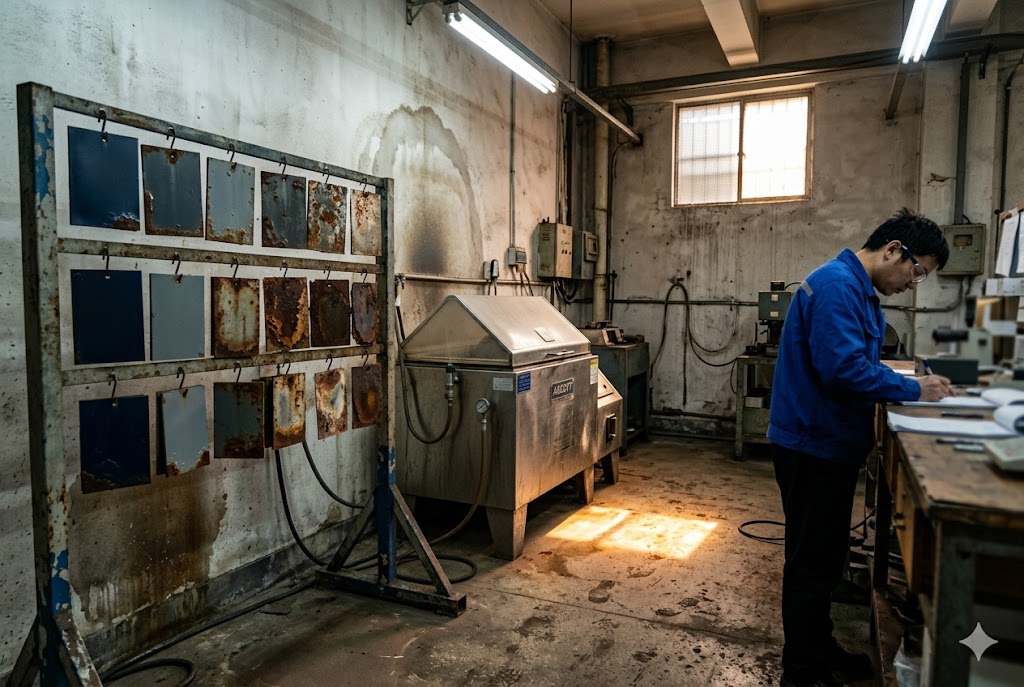
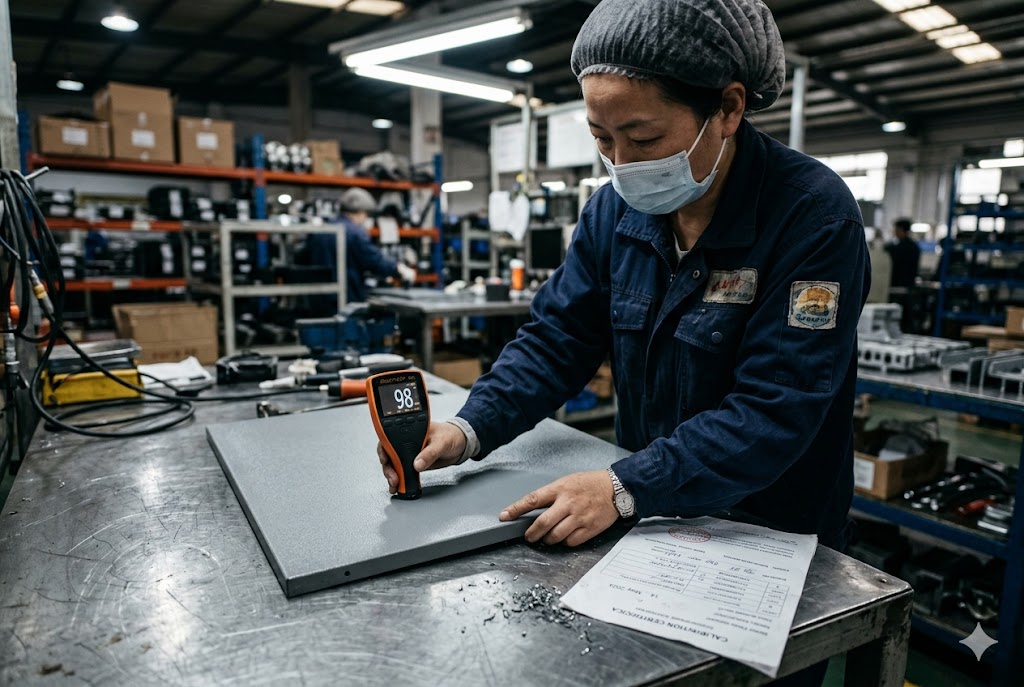
To verify coating quality before shipment, require dry film thickness (DFT) measurement per ISO 2808 7 using a calibrated magnetic gauge, adhesion cross-cut testing per ISO 2409 8, and salt spray test 9 certificates per ISO 9227 from the same production batch. Any supplier unwilling to provide batch-level test documentation is a disqualifying risk.
What to Measure and How
Each coating process requires different verification methods. The table below summarizes what to require for each.
| Coating Process | Thickness Test Method | Adhesion Test Method | Corrosion Test |
|---|---|---|---|
| Powder coating | DFT gauge per ISO 2808 (target: 60–120 µm) | Cross-cut per ISO 2409 | Salt spray per ISO 9227 |
| E-coating | DFT gauge, including internal surfaces | Cross-cut per ISO 2409 | Salt spray per ISO 9227 |
| Liquid paint | Wet film + DFT gauge | Cross-cut per ISO 2409 | Salt spray per ISO 9227 |
Thickness Tolerances Are a Functional Issue
Coating thickness is not just an aesthetic specification. For powder coating, typical deposition is 60–120 microns. That is 0.06–0.12 mm added to every coated surface. On a part with tight-tolerance mating features, threaded holes, or press-fit interfaces, that thickness directly affects assembly fit.
E-coating deposits 15–25 microns — a much thinner and more controllable layer. For parts where dimensional accuracy at coated surfaces is critical, e-coating is the technically correct choice. Specify it for that reason, not because it sounds more sophisticated.
How to Run the Cross-Cut Adhesion Test
The ISO 2409 cross-cut test is simple and requires only a scalpel or cross-cut tool, a pressure-sensitive tape, and a reference chart. A grid of cuts is made through the coating to the substrate. Tape is applied, pressed firmly, and pulled away at 60 degrees in under 2 seconds. The percentage of coating removed determines the rating from 0 (no removal) to 5 (severe removal). For structural or outdoor parts, require a rating of 0 or 1.
Ask your supplier to run this test on production parts — not on test panels. Test panels are prepped under controlled conditions. Production parts are not. Results on test panels are optimistic. Results on actual parts reflect reality.
Using Third-Party Inspection
If your order volume or risk level justifies it, send a third-party inspection team 10 to the supplier facility before shipment. A qualified inspector will bring calibrated DFT gauges, run cross-cut tests on samples from the production lot, and photograph the results. The cost of a pre-shipment inspection is small relative to the cost of a rejected container or a field failure.
Our service team coordinates pre-shipment inspections as part of standard order management. We do not rely on the supplier's own QC documentation alone. We verify.
Conclusion
Choosing the right coating is a technical decision, not a procurement preference. Match the process to your part geometry, corrosion environment, and dimensional requirements. Specify pretreatment and verification standards in writing. Qualify your supplier's actual process line before production starts.
Footnotes
1. Overview of phosphate conversion coating types, including zinc phosphate, and their role in corrosion protection and paint adhesion. ↩︎
2. EU RoHS Directive summary covering restricted hazardous substances relevant to surface treatment and conversion coating selection. ↩︎
3. PPG's detailed guide to the e-coat electrodeposition process, corrosion performance, and primer technology for industrial parts. ↩︎
4. Powder Coating Institute overview of environmental benefits: negligible VOC emissions, reusable overspray, and reduced waste. ↩︎
5. Official RAL COLOURS site explaining the standardized color system used worldwide for powder coating specification. ↩︎
6. Detailed explanation of the e-coating pretreatment and surface preparation sequence, including cleaning and descaling steps. ↩︎
7. ISO 2808:2019 standard specifying methods for measuring wet and dry film thickness on coated substrates. ↩︎
8. ISO 2409:2020 standard specifying the cross-cut adhesion test method for evaluating paint-to-substrate bonding. ↩︎
9. ISO 9227:2022 standard defining apparatus, reagents, and procedure for neutral salt spray corrosion resistance testing. ↩︎
10. Comprehensive guide to the e-coating process, quality control steps, and verification practices for metal parts production. ↩︎