Skip to main content Skip to footer
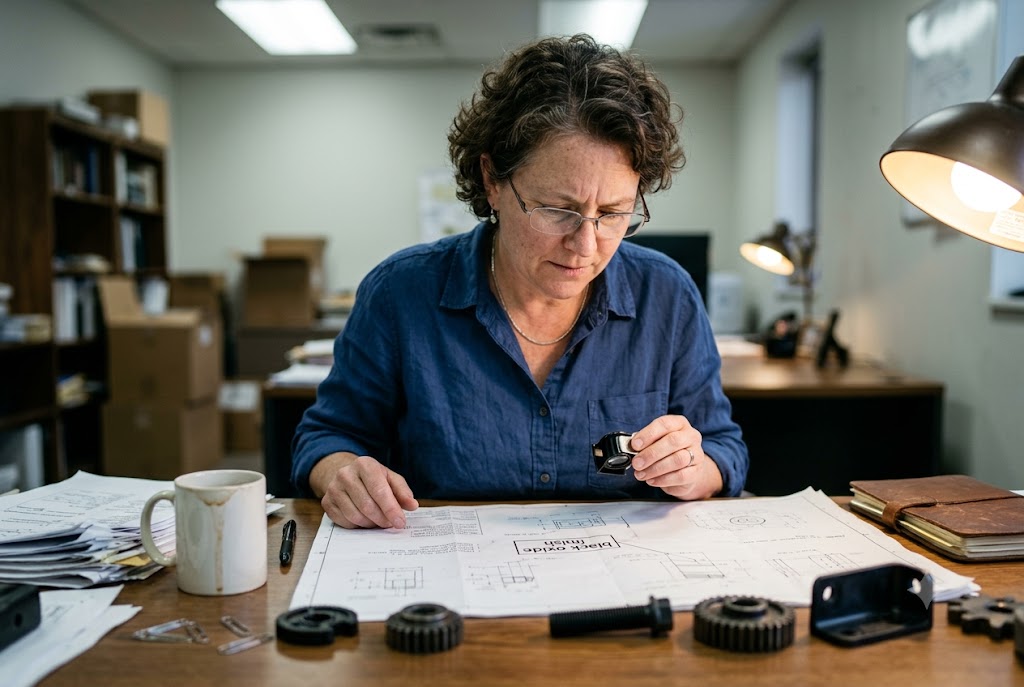
Every year, our team processes dozens of first-article submissions from factories across China and Vietnam. We have seen the same trap catch buyers repeatedly: they receive a thick inspection report, assume the supplier did their job, and sign off — only to find out three shipments later that the parts were never correctly measured in the first place.
To read a dimensional inspection report for custom die cast first samples from China, cross-reference every balloon number from your drawing against each row in the report, confirm that nominal value, upper tolerance, lower tolerance, and actual measured value are all present for each characteristic, and verify that the measurement instruments listed are calibrated and appropriate for the feature type. Any missing balloon, missing column, or uncalibrated tool is grounds to reject the report before you even look at the numbers.
Once you know what a complete report looks like, the rest becomes a checklist. Here is how to work through it efficiently.
Which Measured Results Matter Most When You Compare the Report With Your Drawing?
When we sit down with a supplier's first-article inspection 1 package, the first thing our engineers do is not read the numbers — it is confirm the document structure. A report with beautiful numbers but missing columns tells you nothing useful.
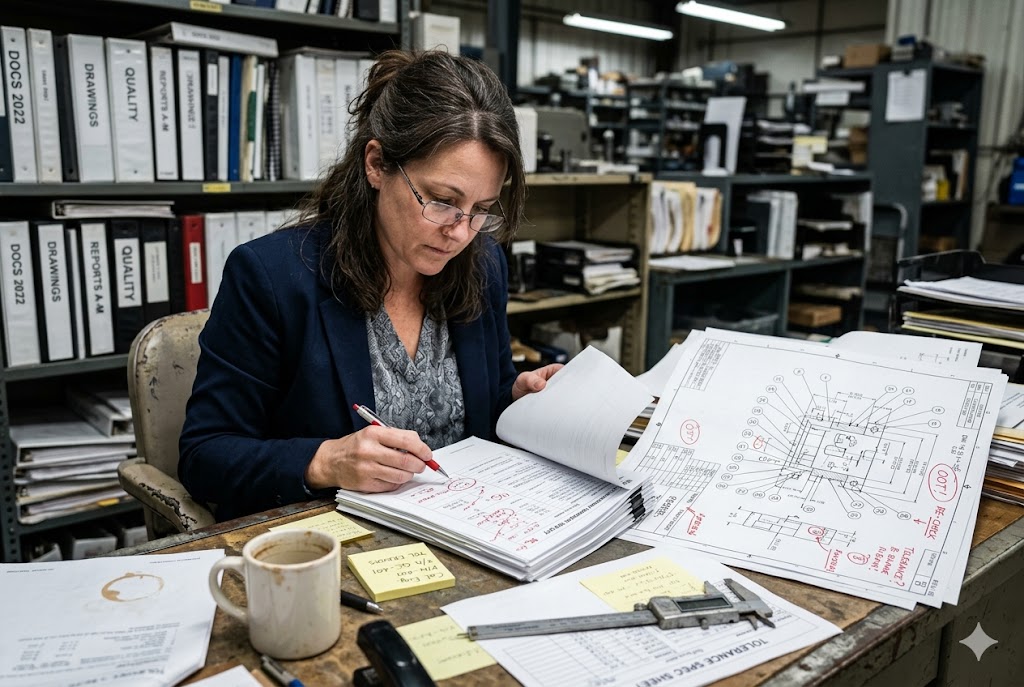
The results that matter most are those tied to balloon numbers on your released drawing. For each balloon, confirm four fields exist: nominal dimension, upper tolerance limit, lower tolerance limit, and actual measured value. Every balloon number must map to exactly one row. Any balloon without a row means the feature was never inspected, and that alone is reason to reject the submission.

Start With the Document Header
Before reading a single measurement, check two things in the header block. First, confirm the drawing revision number on the supplier's report matches your current released revision. Second, confirm the part number is identical, including any suffix or dash number.
This sounds obvious. But in our experience managing sourcing projects for US buyers, mismatched drawing revisions are the single most common reason first-article cycles get wasted. The supplier measures the wrong version. Everything passes. Then production parts fail because the revision you approved was outdated.
| Header Field | What to Check | Red Flag |
|---|---|---|
| Drawing Revision | Must match your current released rev | Any earlier revision letter or number |
| Part Number | Full number including suffix | Missing dash number or suffix |
| Submission Date | Recent, not months old | Older than your last drawing update |
| Sample Quantity | Must show individual results per piece | Single set of numbers with no piece ID |
Check That All Four Data Columns Are Present
A report with only nominal and actual values is incomplete. You cannot evaluate conformance without the tolerance limits. Some suppliers — especially smaller ones — omit the tolerance columns because they are entering numbers manually and skipping the column saves time. That is not acceptable.
For each row, you need:
- Nominal: the exact dimension shown on the drawing
- Upper Tolerance Limit (UTL): the highest acceptable value
- Lower Tolerance Limit (LTL): the lowest acceptable value
- Actual Measured Value: what the instrument read on the physical part
A dimension is conforming only when the actual value sits between LTL and UTL. A value that lands exactly on the limit is technically passing, but treat it as a warning. Production variation does not stand still. If a dimension measures exactly at the upper limit on the first article, volume production will push pieces over that limit regularly.
| Result Location | Conformance Status | Action Required |
|---|---|---|
| Well within tolerance band | Conforming | No action |
| At the tolerance limit exactly | Technically conforming | Flag as process risk, request Cpk data |
| Outside tolerance | Nonconforming | Written rejection, corrective action required |
| Missing actual value | Unknown | Cannot accept, request re-measurement |
How Many Pieces Should Be in the Report?
When a supplier submits three to five first-article pieces, the report must show individual measured values for each piece — not an average. Averaged data can hide one badly out-of-tolerance piece inside a group that looks statistically fine. Require a column per piece, not a single "average" column. This principle is a core expectation within inspection in manufacturing 2 quality standards.
Should You Focus First on Critical Dimensions Instead of Every Number on the Report?
When a report has eighty or a hundred rows, the instinct is to scan for anything marked red and move on. Our engineers have learned the hard way that this shortcut misses the dimensions that matter most for die cast parts specifically.
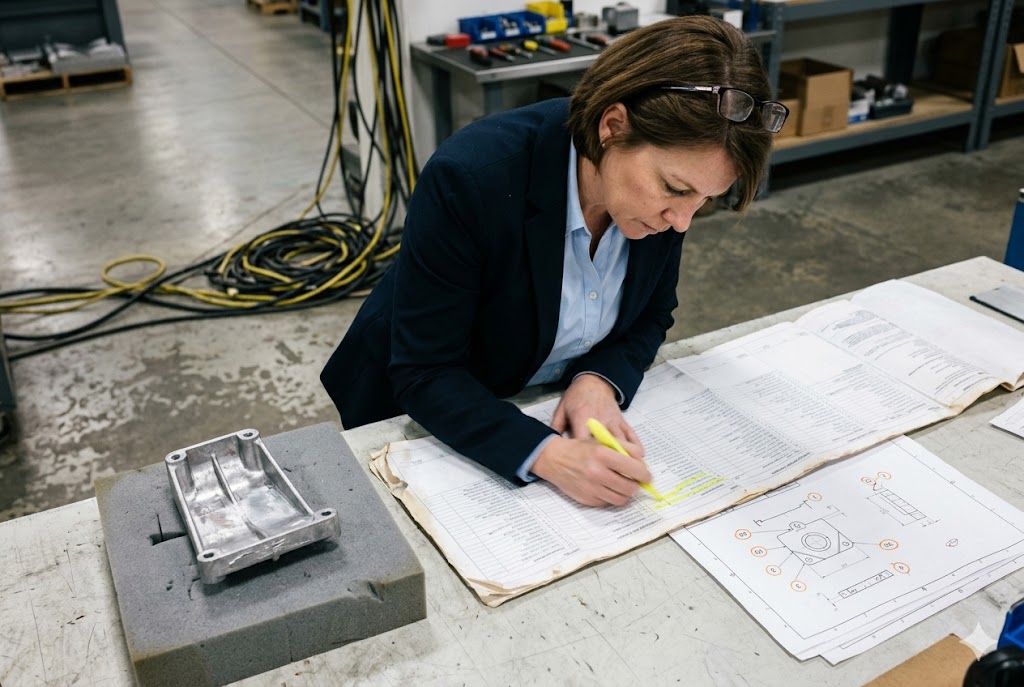
Yes, prioritize critical dimensions first, but define them before you receive the report. For die cast parts, the highest-risk features are wall thicknesses, parting line dimensions, hole true positions, draft angles, and any boss or rib geometry. These are the features most vulnerable to shrinkage and tooling mismatch. Review them before you read anything else on the report.
Why Die Cast Parts Have Specific Risk Zones
The die casting process 3 introduces dimensional variation that is different from machining. Shrinkage happens as molten metal cools. The parting line 4 — where the two halves of the die meet — is always a zone of potential mismatch. Bosses and ribs can shift during ejection. These are not random errors; they are predictable failure modes tied to the process.
This means you can build a priority list before the report even arrives. When we prepare sourcing projects for our clients, we mark these features on the drawing in advance and tell the supplier which ones will receive extra scrutiny.
Defining Critical vs. Non-Critical
Not every dimension on a drawing is equal. A critical dimension affects function, fit, or safety. A non-critical dimension is there for reference or for general geometry control. The drawing may use a tolerance block for non-critical features and explicit tolerances for critical ones. If your drawing includes a drawing note that designates "critical characteristics" or uses a special symbol, those rows must be reviewed first and must all be conforming before you continue.
| Dimension Category | Examples for Die Cast | Tolerance Source | Review Priority |
|---|---|---|---|
| Critical | Bore diameter, true position of mounting holes, mating surface flatness | Explicit drawing callout | First — must all pass |
| Process-sensitive | Wall thickness, parting line offset, draft angle | Drawing note or general tolerance | Second — flag any at-limit values |
| General geometry | Overall envelope dimensions, non-functional radii | Title block tolerance | Third — review after above |
What About GD&T Callouts?
If your drawing contains GD&T symbols 5 — true position, flatness, perpendicularity, profile of a surface — these require CMM (coordinate measuring machine) verification. Manual gauges cannot measure them correctly.
If the supplier has reported these characteristics using only calipers or height gauges, the data is not valid. You must request a CMM re-run. This is non-negotiable. A supplier who submits manual gauge readings for a true position callout either does not have a CMM or does not understand the requirement. Either situation needs to be resolved before approval.
How Can You Tell Whether a Measurement Issue Is Minor or a Real Production Risk?
Not every out-of-tolerance result means you scrap the first article. But every out-of-tolerance result requires a decision, and that decision needs to be yours — not the supplier's.
To assess whether a measurement issue is a real production risk, ask three questions: How far is the actual value from the tolerance limit? Is this a critical or non-critical dimension? Has the supplier self-approved the deviation without your concession? Any out-of-tolerance result on a critical dimension is a production risk by definition. A result on a non-critical dimension close to the limit needs a documented decision, not a verbal waiver.
The Distance From the Limit Matters
A part that measures 0.01 mm outside tolerance on a non-critical reference dimension is a different conversation from a part that measures 0.5 mm outside tolerance on a mating bore. The distance tells you how much process correction is needed and how likely the issue is to cause functional failure.
Ask the supplier: what is the process capability index (Cpk) 6 for this feature? A Cpk below 1.33 on a critical dimension means the process is not capable of holding tolerance in volume production, even if the first-article piece happens to pass. Understanding process capability 7 thresholds is essential before you interpret these numbers.
Supplier Self-Approved Deviations Are a Liability Gap
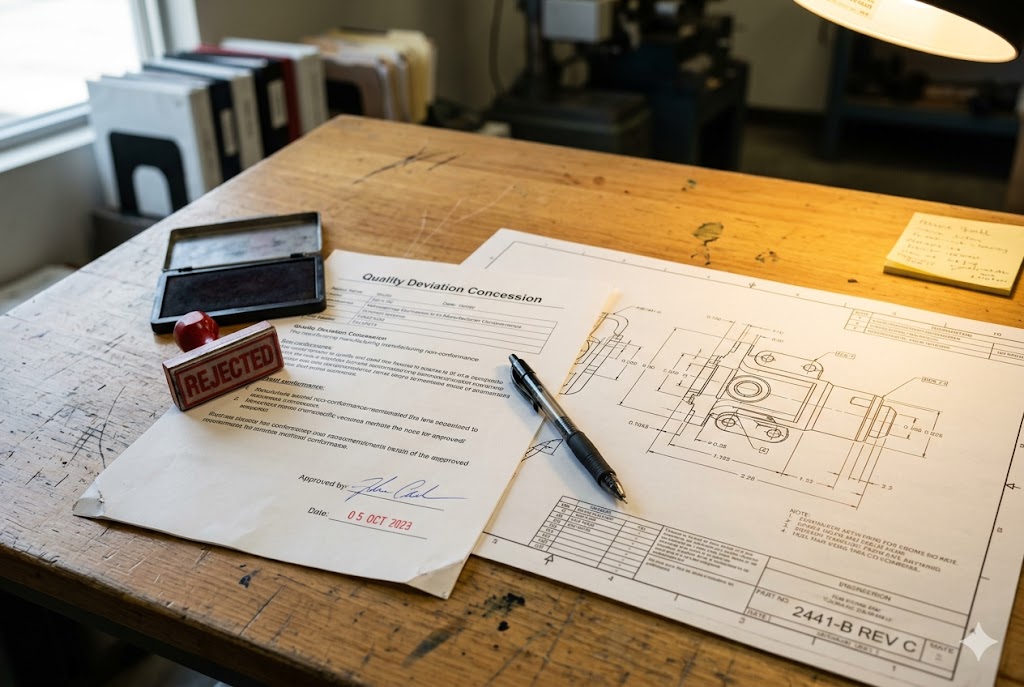
This is one of the most important points in any first-article review. If the supplier has marked a nonconforming result as "conditionally approved," "acceptable deviation," or added a note saying "within process capability," that is not your approval. That is their opinion.
Your signature on the first-article report does not automatically absorb their self-granted deviations. If those parts fail in the field, you will need to demonstrate that you did not explicitly accept the nonconformance. Without a written concession from you — or a documented rejection of their deviation request — your liability position is weak.
The rule is simple: any out-of-tolerance result requires one of three outcomes from you.
- Written rejection with corrective action required
- Written concession accepting the deviation for this submission only, with documented rationale
- Drawing change request if the tolerance was specified incorrectly
No verbal agreements. No email threads that say "looks fine, go ahead." Everything in writing.
What to Check on the Instrument Column
Every row in the report should identify the specific instrument used. Not just "caliper" — but the caliper's ID number and calibration status. Measurements taken with uncalibrated equipment are contractually worthless. This applies whether the measurement uses a simple hand tool or a sophisticated coordinate measuring machine 8. If the report lists instruments without calibration IDs, request the calibration certificates before you proceed. Proper instrument calibration 9 is what establishes traceability and makes measurement results legally defensible.
What Should You Ask If Your Supplier's Report Looks Incomplete or Unclear?
An incomplete report is not a small administrative problem. It is a sign that the supplier's quality system is not structured for the level of accountability you need. How you respond sets the tone for the entire production relationship.
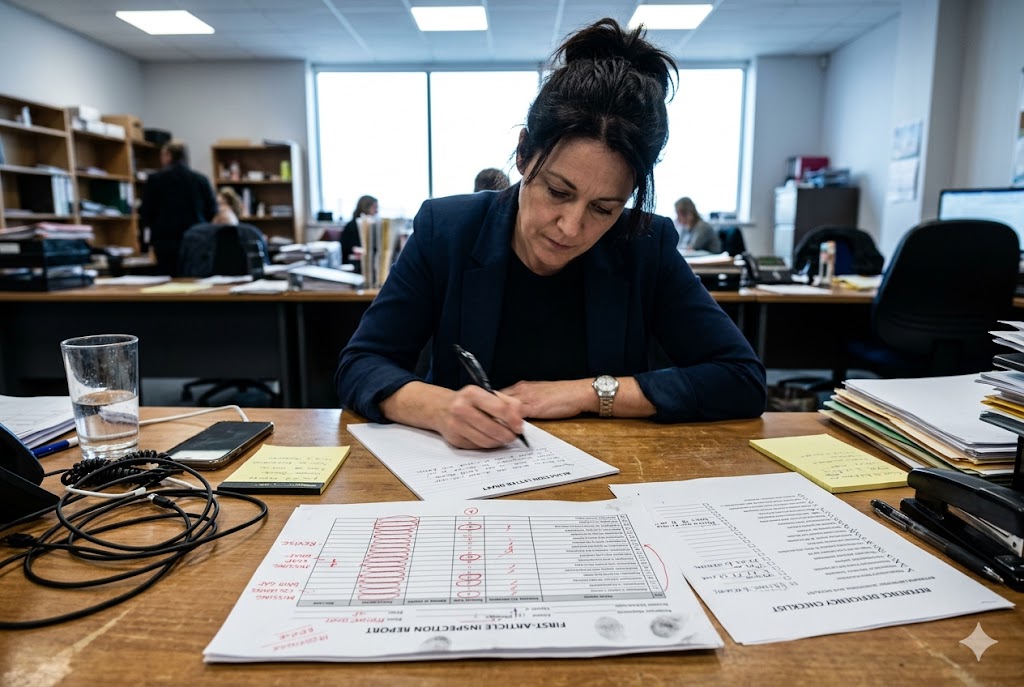
When a supplier's first-article report looks incomplete or unclear, do not guess or assume. Send a written rejection with a specific list of deficiencies, referencing the exact rows, columns, or header fields that are missing or incorrect. Request a corrected report with all deficiencies resolved before you proceed. Accepting an incomplete report once teaches the supplier that incomplete reports are acceptable.
Build a Standard Deficiency Checklist
When our team reviews a first-article package, we use a fixed checklist so that every rejection letter is specific and actionable. Vague feedback — "the report looks incomplete" — leads to vague corrections. Specific feedback leads to a corrected report.
Here is the checklist structure we recommend:
Report Deficiency Reference Table
| Deficiency Type | What to Write in Your Rejection | What to Request |
|---|---|---|
| Drawing revision mismatch | "Report header shows Rev B; current released drawing is Rev D." | Revised report measured against Rev D |
| Missing balloon numbers | "Balloon numbers 14, 22, and 31 are not present in the report." | Re-inspection of missing features with results added |
| Missing tolerance columns | "Upper and lower tolerance limits are absent for all rows." | Complete report with UTL and LTL columns populated |
| GD&T reported with manual gauge | "True position callout on Balloon 7 requires CMM; height gauge data is insufficient." | CMM re-run with report showing datum reference frame |
| No calibration IDs | "Instrument column lists 'micrometer' with no calibration ID or certificate." | Calibration certificates for all instruments listed |
| Individual piece data missing | "Report shows one set of values; 5 pieces were submitted." | Report revised to show individual values per piece |
| Supplier self-deviation | "Row 19 is marked 'acceptable deviation' without buyer concession." | Written deviation request for buyer review and decision |
How to Frame the Rejection Without Damaging the Relationship
Suppliers in China — especially those you want to keep working with — respond better to clear, factual rejection letters than to frustrated or emotional ones. State the deficiency. State what you need. Give a clear deadline for the corrected submission.
Our team typically writes something like: "The first-article report dated [date] cannot be accepted as submitted. The following deficiencies must be corrected before we can proceed with review." Then list each item.
This approach is professional, auditable, and leaves no ambiguity. It also documents that you identified the problem, which protects you if the supplier later disputes the timeline.
Archiving: The Step Most Buyers Skip
Once you approve a first-article report, archive three things together as a bound record: the approved first-article report, the ballooned drawing revision it was measured against, and the physical golden sample. All three must be linked. This is especially critical given the dimensional variability inherent in die cast parts 10, where production drift from the approved baseline is common.
In a China sourcing context, this triad is your legal baseline for rejecting future production shipments that drift out of specification. Without all three documents archived together, enforcing a dimensional nonconformance claim against the supplier is extremely difficult. We have seen buyers lose disputes simply because they could not produce the approved drawing revision alongside the approved report.
Conclusion
Reading a first-article report correctly is not about checking boxes. It is about building a documented baseline that protects every shipment that follows. Verify the structure before the numbers. Archive everything. Never absorb a supplier's self-granted deviation without a written decision of your own.
Footnotes
1. Overview of First Article Inspection (FAI) as a production validation standard. ↩︎
2. How in-process inspection controls quality and reduces defect rates in manufacturing. ↩︎
3. Detailed guide to die casting — process steps, machine types, and design considerations. ↩︎
4. Explanation of the parting line in mold casting and its effect on part dimensions. ↩︎
5. Wikipedia overview of GD&T symbols, rules, and the ASME Y14.5 standard. ↩︎
6. Wikipedia explanation of process capability indices Cp and Cpk with formulas. ↩︎
7. ASQ resource explaining process capability, Cp, and Cpk for quality practitioners. ↩︎
8. NIST publication on statistical issues in geometric feature inspection using CMMs. ↩︎
9. Wikipedia article on calibration traceability, ISO 9000, and measurement standards. ↩︎
10. Wikipedia entry on die casting covering shrinkage, parting lines, and draft angles. ↩︎