Skip to main content Skip to footer
Every week, our sourcing team fields the same question from purchasing managers in North America: which material actually holds up in high-volume Swiss-type production without killing tool life or blowing tolerances? We see a lot of projects come through with the wrong alloy spec — and it costs everyone time and money.
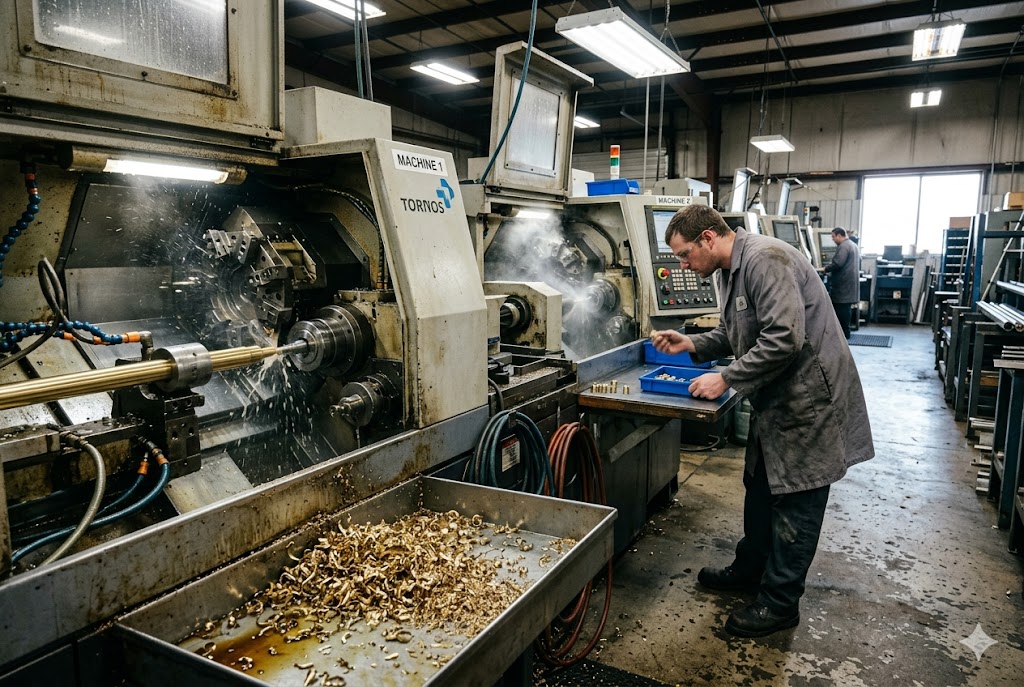
C36000 free-machining brass is well-suited for high-speed volume production on Swiss-type lathes. Its machinability rating of 100, short-chip behavior, and self-lubricating lead content allow consistent tight tolerances, long tool life, and fast cycle times — making it the go-to alloy for high-volume precision screw machined parts.
There is more to the story, though. Compliance limits, bar stock sourcing quality, and application suitability all affect whether C36000 is truly the right call for your project. Let's break it down section by section.
Why Is C36000 Brass One of the Most Popular Materials for Swiss Screw Machined Parts?
When we evaluate materials for a new client project, machinability is always the first filter. C36000 clears it by a wide margin — and the data backs that up consistently across our supplier network in China and Vietnam.
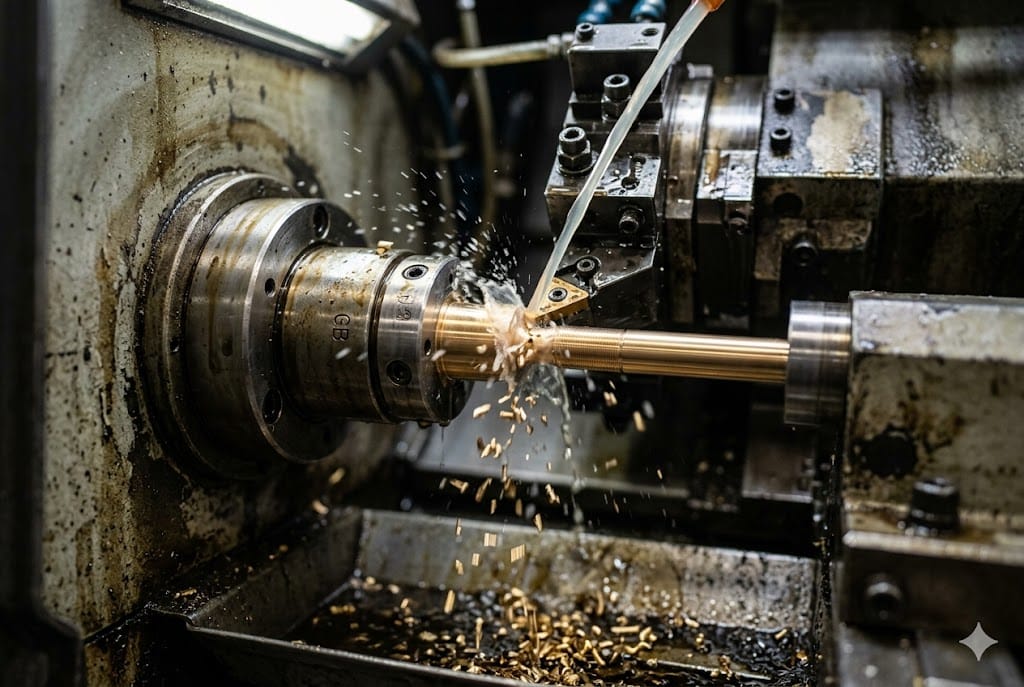
C36000 brass holds a machinability rating of 100 — the benchmark all other metals are measured against. Its 2.5–3.7% lead content acts as a built-in chip-breaker and lubricant, while its dual alpha-beta phase structure produces short, broken chips ideal for uninterrupted Swiss-type CNC operation at high spindle speeds.
The Machinability Rating of 100 — What It Actually Means
Most engineers have seen the number. Fewer know what it means in practice. The machinability rating of 100 for C36000 1 is not a marketing figure. It is the universal reference point. Every other metal — steel, aluminum, stainless, titanium — is rated relative to C36000. A rating of 50 means a material takes roughly twice as long to machine to the same specification.
For Swiss-type lathe production, this translates directly to cycle time and output per shift. Faster cuts, fewer tool changes, less heat in the cut zone, and less wear on the guide bushing interface. In high-volume runs of thousands or tens of thousands of pieces, the per-piece cost difference compounds quickly.
Lead Globules as an Internal Chip-Breaker
The 2.5–3.7% lead in C36000 does not alloy into the brass matrix. It stays dispersed as microscopic globules at grain boundaries. When the cutting edge moves through the material, those lead globules act as micro stress concentrators. The chip breaks short and falls away cleanly instead of forming long stringy swarf.
This matters on Swiss-type lathes 2 specifically. The guide bushing zone is tight. Long stringy chips in that area cause tool crashes and part-to-part dimensional scatter. Short chips evacuate easily and keep the cutting zone clean during unattended runs.
Lead also acts as a self-lubricant at the tool-chip interface. This reduces built-up edge formation on carbide inserts and lowers cutting temperatures — which is why tool life on C36000 runs 20–40% longer than on lead-free brass alternatives.
Alpha-Beta Phase Structure and Chip Control
C36000 has a dual-phase microstructure: alpha phase for ductility, beta phase for strength. The combination produces chips that are short and broken by nature, not just by the lead addition. This is a structural property of the alloy, not dependent solely on cutting parameters.
For operators running Swiss-type lathes on long overnight or weekend shifts, this means the chip conveyor is not clogged and the machine runs without intervention. That is a practical productivity advantage that directly reduces labor cost per piece.
C36000 vs. Common Alternatives
| Property | C36000 (Free-Machining Brass) | C26000 (Cartridge Brass) | 304 Stainless Steel |
|---|---|---|---|
| Machinability Rating | 100 | 30 | 45 |
| Lead Content | 2.5–3.7% | <0.07% | None |
| Chip Type | Short, broken | Stringy | Stringy |
| Typical Tool Life (relative) | Baseline | ~50% of C36000 | ~40% of C36000 |
| Guide Bushing Compatibility | Excellent | Moderate | Moderate |
What Surface Finish Ra Values Can Swiss-Type Lathes Achieve on C36000 Brass at High Spindle Speeds?
Our factory partners run C36000 at spindle speeds up to 10,000 RPM on Swiss-type lathes. The surface quality we see straight off the machine surprises many first-time buyers who assume they will need a secondary finishing step.
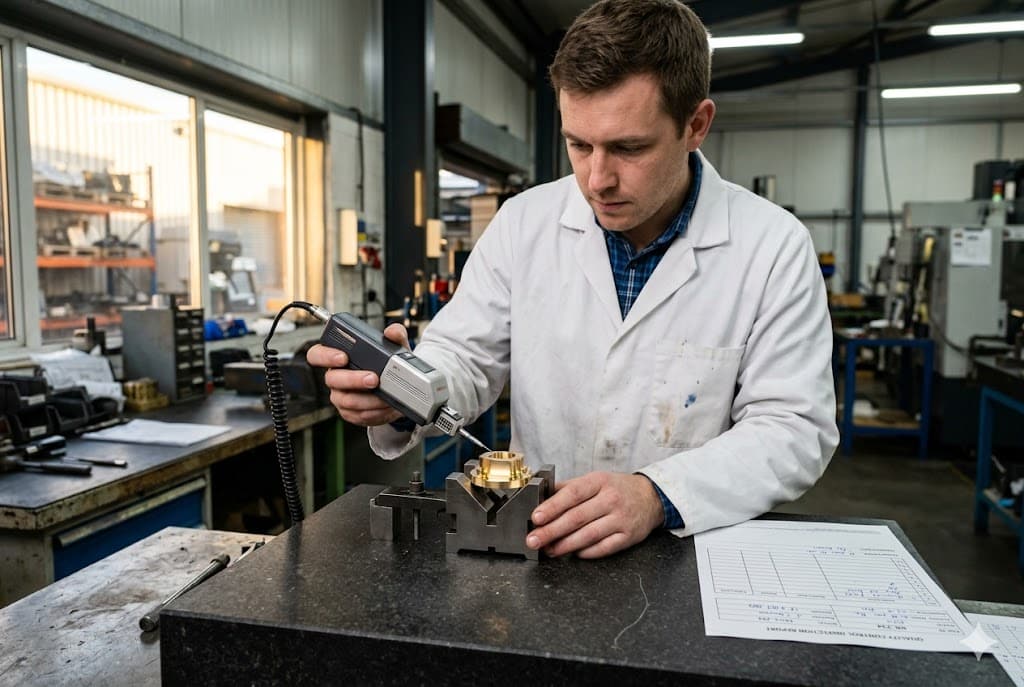
Swiss-type lathes machining C36000 brass at high spindle speeds routinely achieve surface finishes in the Ra 8–16 µin. (0.2–0.4 µm) range directly off the machine, and tolerances of ±0.01 mm (±0.0004 in.) are achievable without secondary operations, provided bar stock quality and coolant delivery are properly controlled.
Surface Finish Achievable Without Secondary Operations
Ra 8–16 µin. is the range most precision component buyers need for functional parts. It is smooth enough for press-fit assemblies, threaded connections, and fluid-path components. Achieving this straight off a Swiss-type machine eliminates a finishing operation — and each eliminated operation reduces handling, scheduling complexity, and cost.
C36000 enables this result because the alloy machines cleanly. The lead minimizes built-up edge, which is the primary cause of surface tearing. The short chip formation prevents re-cutting of chips against the finished surface. The result is a bright, clean surface with consistent finish across the part run.
Tolerance Capability: ±0.01 mm Is Realistic
For Swiss-type lathes with properly maintained guide bushings 3 and quality bar stock, ±0.01 mm (±0.0004 in.) is a practical production tolerance on C36000. It is not a best-case figure — it is a normal production result when the process is set up correctly.
The key variables are: bar stock diameter consistency (the guide bushing clearance depends on it), coolant delivery to the guide bushing zone, and spindle thermal stability during long runs. C36000's thermal conductivity of approximately 116 W/m·K helps here. Heat generated at the cut is carried away in the chip rather than building up in the workpiece, which keeps the part dimensionally stable across a long unattended run.
Bar Stock Quality Controls Finish Consistency
One issue our quality team sees regularly with Chinese-sourced C36000 bar stock: diameter variation that exceeds the guide bushing clearance spec. This creates part-to-part diameter scatter that looks like a machine problem but is actually a material problem.
The correct specification for Swiss-type production is cold-drawn, straightened, and polished (bright) rod with centerless-ground diameter tolerance per ASTM B16 4. Hot-extruded bar has coarser lead segregation and less consistent diameter — it is not the right form for Swiss-type volume production even if the chemistry is within spec.
Coolant Delivery Is Non-Negotiable
C36000's thermal advantage disappears if coolant delivery is inadequate. On lower-cost Swiss-type clones with restricted coolant passages, insufficient flow at the guide bushing interface is a documented cause of tolerance drift in long production runs. When qualifying a supplier for C36000 Swiss-type production, verify coolant system capability — not just machine brand.
Surface Finish vs. Spindle Speed Summary
| Spindle Speed (RPM) | Typical Ra (µin.) | Typical Ra (µm) | Notes |
|---|---|---|---|
| 3,000–5,000 | 16–32 | 0.4–0.8 | Acceptable for general parts |
| 5,000–8,000 | 8–16 | 0.2–0.4 | Standard Swiss-type production range |
| 8,000–10,000+ | 8–12 | 0.2–0.3 | Optimal; requires quality bar stock and coolant |
Are There RoHS or REACH Restrictions on C36000 Lead-Containing Brass for Parts Sold in the USA?
This is the question that catches buyers off guard most often. Our compliance team reviews regulatory requirements on every new project, and we have seen C36000 cause problems in applications where no one thought to check the rules upfront.
C36000 brass is non-compliant with RoHS due to its lead content exceeding the 0.1% threshold, and it is also restricted under NSF/ANSI 61 for potable water contact and under food-contact regulations. For applications in those market segments, lead-free alternatives such as C69300 ECO Brass are required, typically at a 15–25% cost premium.

RoHS: The 0.1% Lead Threshold
RoHS (Restriction of Hazardous Substances) 5 limits lead content to 0.1% by weight in electrical and electronic equipment sold in applicable markets. C36000 contains 2.5–3.7% lead — roughly 25–37 times over the RoHS threshold. It is categorically non-compliant for EEE applications.
Note that RoHS is primarily an EU directive. The USA does not have a federal equivalent, but many US OEMs require RoHS compliance for supply chain consistency and export flexibility. If your customer sells globally or into the EU, they likely require RoHS compliance from their component suppliers.
NSF/ANSI 61 and Potable Water Contact
NSF/ANSI 61 6 governs materials in contact with drinking water in the USA. C36000 does not meet this standard due to lead content. If your parts will be used in plumbing fixtures, water meters, valves, or any component in a potable water system, C36000 is not an acceptable material choice regardless of machining efficiency.
The replacement alloy for this segment is typically C69300 ECO Brass 7 (UNS C69300) or bismuth-selenium brass. Both machine significantly worse than C36000 — cycle times are longer, tool wear is higher — and bar stock costs more. Budget for a 15–25% total cost increase per piece when substituting.
REACH and US Market Relevance
REACH (Registration, Evaluation, Authorisation and Restriction of Chemicals) is an EU regulation. Lead is listed as a Substance of Very High Concern (SVHC) under REACH 8. Parts sold into the EU supply chain from US importers may require SVHC disclosure if lead content exceeds 0.1% by weight of the article.
For US domestic market parts with no EU exposure, REACH is not directly applicable. But buyers with global customers should verify their downstream compliance obligations before specifying C36000.
Application Segment Compliance Summary
| Application Segment | C36000 Compliant? | Reason | Recommended Alternative |
|---|---|---|---|
| Industrial mechanical parts (non-EEE) | Generally yes | No specific lead restriction | C36000 remains appropriate |
| Electronics / EEE (EU or global supply chain) | No | RoHS >0.1% Pb limit | C69300 ECO Brass or bismuth brass |
| Potable water contact (USA) | No | NSF/ANSI 61 | C69300 ECO Brass |
| Food contact applications | No | FDA/food-contact regulations | C69300 ECO Brass or alternative |
| Automotive (EU) | Check ELV directive | ELV exemptions may apply | Verify per application |
What to Do Before You Specify C36000
Check the end-use application first. Industrial components — connectors, fittings, instrument bodies, valve stems, mechanical assemblies — outside of water and food contact are typically fine. Parts going into electronics, water systems, or food handling are not. Establishing this upfront saves costly material changes after tooling has been made.
How Does C36000 Brass Compare in Cost to Stainless Steel for High-Volume Swiss CNC Orders?
Our project managers run cost comparisons on material choice regularly. The difference between C36000 and stainless steel is not just in raw material price — it runs through every element of the per-piece cost.
C36000 brass typically costs less per finished part than 303 or 304 stainless steel in high-volume Swiss CNC production. Lower bar stock price, faster cycle times, longer tool life, and fewer quality failures combine to make the total cost-per-piece advantage significant — often 30–50% lower for equivalent part complexity.
Raw Material Cost: Brass vs. Stainless
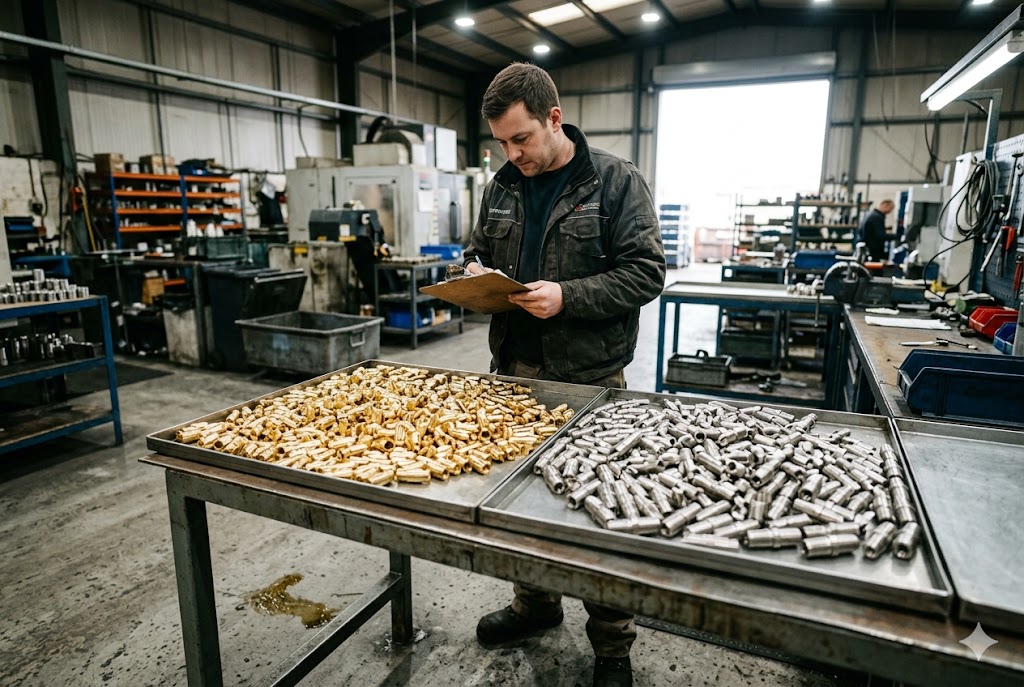
On a per-kilogram basis, C36000 brass bar stock typically prices below 303 or 304 stainless steel. The exact ratio varies with commodity markets, but brass has historically run 15–30% cheaper per kilogram than stainless at equivalent bar diameters. This alone is meaningful on high-volume orders where material cost is a significant portion of part cost.
Bar stock price is not the only input, though. The volume of material removed and the cycle time determine what you pay per finished piece — not the raw price per kilogram.
Cycle Time Difference Is the Bigger Factor
At equivalent spindle speeds, C36000 machines faster than stainless steel. The practical difference: a part that runs a 45-second cycle on stainless might run 25–30 seconds on C36000 at comparable quality. On a 50,000-piece order, that cycle time gap directly reduces machine hours — and machine hours drive a large portion of piece price.
Stainless steel also requires more conservative speeds and feeds on Swiss-type machines to maintain dimensional stability and avoid built-up edge. C36000 can run at higher surface speeds without those penalties. The guide bushing design 9 of the Swiss-type platform means these advantages compound: rigidity at the cut zone lets C36000 run faster without sacrificing dimensional control.
Tool Life Impact on Per-Piece Cost
C36000 delivers 20–40% longer tool life versus lead-free brass and significantly more versus stainless steel. On Swiss-type lathes running unattended, insert changes mean machine stops. Fewer stops per shift means more parts per shift. More parts per shift reduces labor and overhead allocated per piece.
Stainless steel's work-hardening behavior accelerates insert wear further. The combination of faster wear and more frequent changes makes stainless significantly more expensive to machine at the insert cost level.
Total Cost-Per-Piece Comparison
| Cost Element | C36000 Brass | 303 Stainless Steel | Advantage |
|---|---|---|---|
| Bar stock cost (relative) | 1.0x baseline | 1.2–1.4x | Brass |
| Cycle time (relative) | 1.0x baseline | 1.5–1.8x | Brass |
| Insert cost per 1,000 pcs (relative) | 1.0x baseline | 1.8–2.5x | Brass |
| Secondary finishing required | Rarely | Sometimes | Brass |
| Typical total cost advantage | — | +30–50% higher | Brass |
When Stainless Is Worth the Cost
C36000 is not always the right answer. Stainless steel is the correct choice when corrosion resistance, elevated temperature performance, or RoHS compliance is required. Parts exposed to salt water, chemical environments, or food contact need stainless or another non-lead alloy. In those cases, the added cost is not optional — it is a functional requirement.
For mechanical assembly parts, instrument components, connectors, and similar applications with no special environmental exposure, C36000 delivers better economics without functional compromise.
Bar Stock Verification as a Cost Control Measure
One risk our quality team monitors on Chinese-sourced C36000: lead content at the low end of the specification range or below. Bar sold as C36000 or CuZn39Pb3 can have variation in lead content or zinc ratio that degrades machinability without producing obvious dimensional failures immediately. This silently increases cycle times and tool wear over a production run.
Incoming OES or XRF verification 10 against ASTM B16 chemistry limits on first-article and periodic production lots is a practical control measure. It is not expensive relative to the cost of discovering a machinability problem mid-run.
Conclusion
C36000 is the right default for high-volume Swiss-type CNC production — but only when application, bar stock spec, and compliance requirements are verified upfront. Get those three things right, and the cost and quality results are hard to beat.
Footnotes
1. Copper Development Association alloy database entry for C36000, with full property data and fabrication details. ↩︎
2. Comprehensive overview of Swiss machining: how the sliding headstock and guide bushing enable tight tolerances on small precision parts. ↩︎
3. Detailed explanation of how guide bushings function in Swiss-type CNC lathes and their role in achieving tight tolerances. ↩︎
4. ASTM B16 standard specification for free-cutting C36000 brass rod and bar for screw machine applications. ↩︎
5. Official EU documentation on the RoHS Directive and its restrictions on hazardous substances in electrical and electronic equipment. ↩︎
6. NSF overview of ANSI/NSF 61, the US standard governing contaminant limits for materials in contact with drinking water. ↩︎
7. Wieland Chase product page for C69300 ECO Brass, the primary lead-free alternative for potable water and RoHS applications. ↩︎
8. Overview of REACH SVHC obligations, including notification requirements for lead-containing articles above 0.1% by weight. ↩︎
9. Metal Cutting Corporation technical article on how guide bushing rigidity in Swiss CNC machining reduces deflection and improves precision. ↩︎
10. Copper.org primer on Free-Cutting Brass C36000 for automatic screw machines, covering alloy structure, supply forms, and ASTM B16 compliance. ↩︎