Skip to main content Skip to footer
Every year, we see buyers commit to a supplier too early — before a single sample has been tested. They rely on a clean profile page, a nice equipment list, and an ISO 9001 certificate 1. Then the first production run arrives, and nothing meets the drawing.
Yes, you should ask multiple suppliers to make samples before choosing one. Sending the same drawing to 3–5 shortlisted suppliers for simultaneous sampling is standard due diligence for first-time China CNC sourcing. Quality and capability vary widely across factories that look identical on paper.
The good news is that multi-supplier sampling is manageable. You just need a clear process. The sections below walk you through the key decisions.
How Many Suppliers Should I Sample Before Choosing One?
When we help clients source CNC parts, one of the first questions they ask is: how many is enough? It feels wasteful to sample five factories. But one is almost always too few.
For most first-time China CNC sourcing projects, sampling 3 to 5 shortlisted suppliers gives you enough data to make a confident decision. Three is the practical minimum for a fair comparison. Five is appropriate when tolerances are tight, volumes are high, or you need a qualified backup supplier from day one.
Why Three Is the Minimum
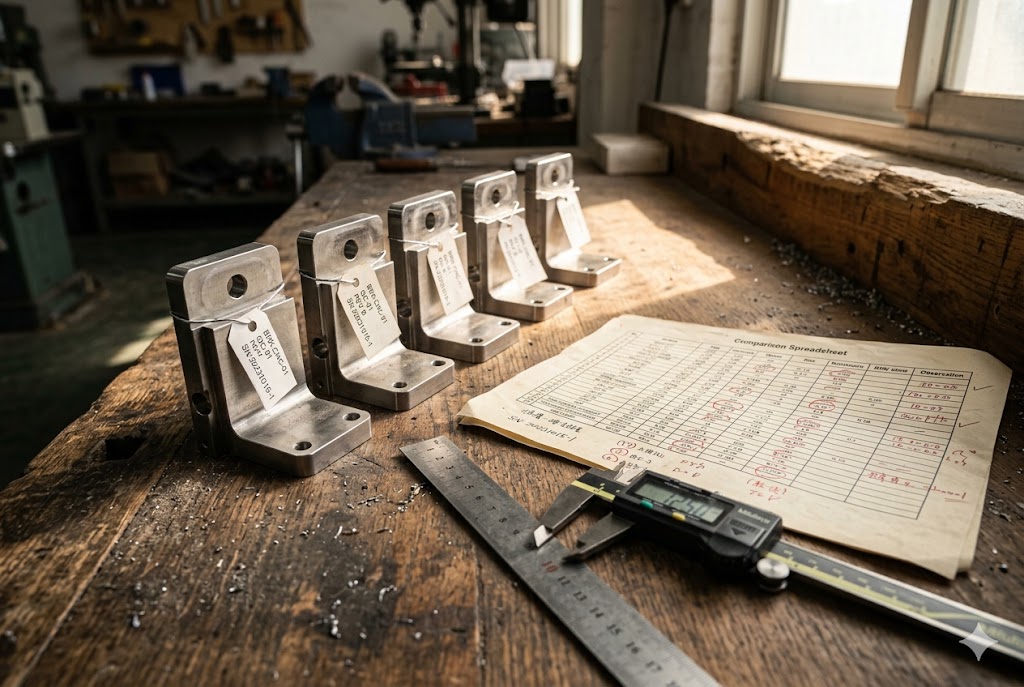
One sample tells you whether a part can be made. Two samples give you a comparison. Three samples give you a pattern.
With three suppliers, you can start to see which factory is genuinely capable and which one got lucky. You also protect yourself if one supplier drops out mid-process or delivers late.
Here is a simple way to think about sample quantity by project type:
| Project Type | Recommended Sample Suppliers | Reason |
|---|---|---|
| Standard geometry, common material | 3–4 | Lower risk, easier to benchmark |
| Tight tolerance, complex geometry | 4–5 | Capability gap between factories is larger |
| High-value, proprietary design | 2–3 | Limit IP exposure while still comparing |
| Repeat part, known supplier pool | 2 | You have prior data to anchor the decision |
| Emergency or time-critical sourcing | 1–2 | Speed takes priority; accept higher risk |
The Hidden Cost of Sampling Too Few
Buyers who sample only one or two suppliers often feel they are saving time and money. In practice, the opposite is true.
If your sole-sampled supplier passes inspection but fails during production — due to capacity issues, a machine breakdown, or quality inconsistency at scale — you have no approved backup. Re-sourcing from scratch under production pressure is expensive and slow.
Sampling three to five suppliers upfront spreads that risk. You end the process with one primary supplier and potentially one qualified backup. That is a supply chain asset, not a sunk cost.
What "Shortlisted" Really Means
Do not send drawings to every factory that contacts you. Shortlist first. A proper shortlist involves checking: verifiable factory address, real production equipment (not trading company), relevant industry certifications, and response quality on your initial inquiry.
This pre-screening is where a sourcing partner adds real value. Our team visits factories before recommending them, so clients receive a shortlist of verified manufacturers, not just a list of platforms profiles.
What Can I Learn by Comparing Samples from Different Suppliers?
Most buyers evaluate a sample by asking: does it look right? That is a start. But a structured comparison across multiple suppliers tells you much more.
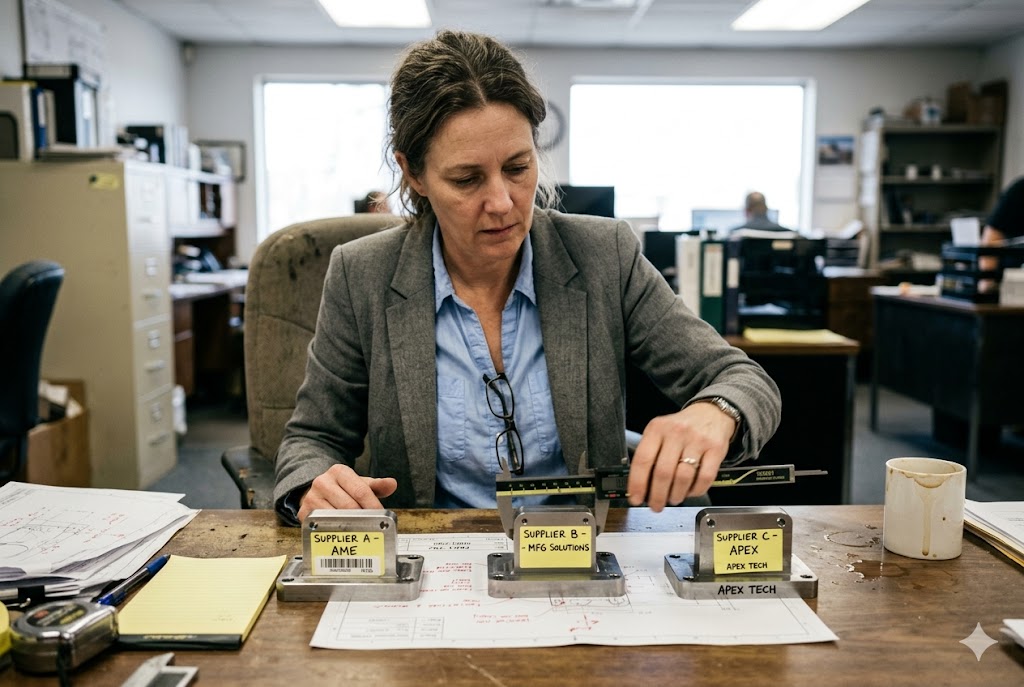
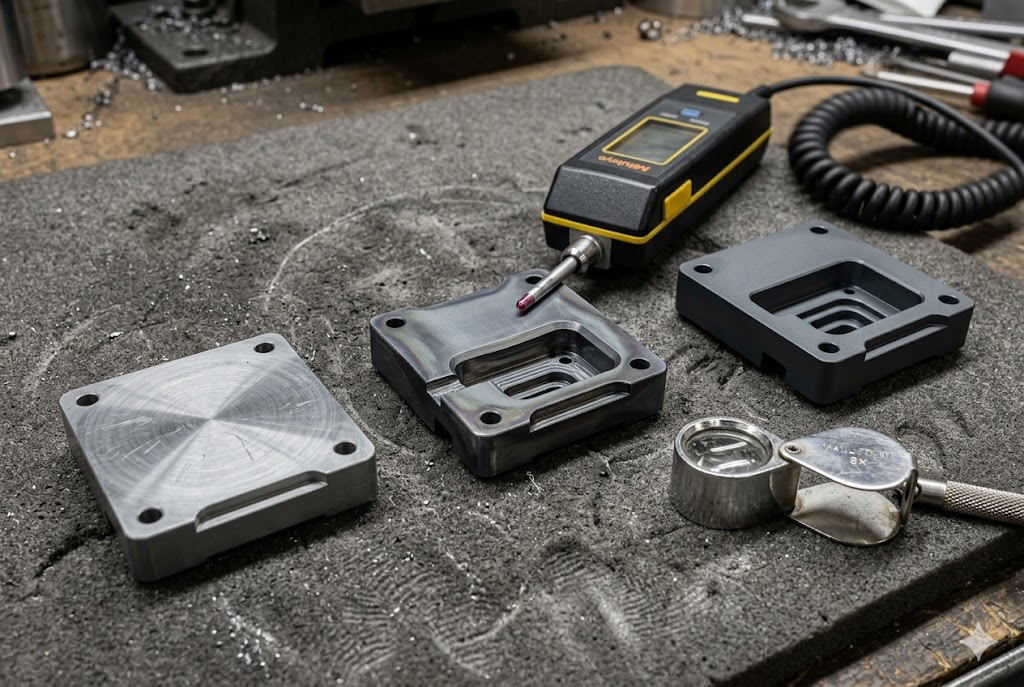
Comparing samples from multiple suppliers lets you benchmark dimensional accuracy, surface finish, material compliance, and documentation quality side by side. A supplier's stated tolerances and equipment list tell you what they claim; their sample against your drawing tells you what they actually deliver.
The Five Things a Sample Comparison Reveals
1. Dimensional Conformance
This is the most important test. Measure every critical dimension on each sample against your drawing. Use a consistent measurement method — CMM report 2 or caliper log — across all suppliers.
A supplier who hits all critical dimensions on a first sample has demonstrated process control. One who misses three dimensions and sends an explanation without a corrective action plan is showing you exactly how they will behave during production.
2. Surface Finish Quality
Surface finish is often where cheap production shows first. Check for machining marks, burrs, inconsistent anodizing, or coating adhesion problems. Visual inspection plus a profilometer reading (Ra value) 3 gives you a complete picture.
| Surface Finish Parameter | What to Check | Why It Matters |
|---|---|---|
| Ra value (roughness) | Measure and compare to drawing spec | Affects function, sealing, and wear |
| Burrs and sharp edges | Visual + tactile check | Safety and assembly fit |
| Coating uniformity | Color consistency, adhesion test | Appearance and corrosion protection |
| Anodizing thickness | Eddy current measurement 4 | Durability in service |
3. Material Compliance
Any supplier can claim they used 6061-T6 aluminum or 316 stainless. A material certification (mill cert) 5 and a third-party material test report verify the claim. Request both with every sample. Compare the actual test results, not just the document headers.
If a supplier cannot provide a material cert for a sample, they will not provide one for production either.
4. FAI Report Completeness
A First Article Inspection (FAI) report 6 documents how the supplier measured your part and what results they recorded. A complete FAI is a proxy for how seriously a factory takes quality documentation.
Compare FAI reports across your sample suppliers. A thorough report with measurement data for every dimension is a strong signal. A one-page document with "passed" written next to each feature is a red flag.
5. Packaging and Labeling
This sounds minor. It is not. How a factory packages a sample tells you how they will package your production shipment. Inadequate packaging leads to transit damage, customer complaints, and returns.
Check: part protection, inter-layer cushioning, labeling accuracy, and whether the packing matches what was agreed.
Communication Quality Is Also a Sample
Beyond the physical part, pay attention to what happened during the sampling process itself. How fast did the supplier acknowledge your RFQ? Did they flag any DFM concerns before starting? Did they send the FAI report proactively or only after you asked?
This communication behavior during sampling is a reliable predictor of their behavior at volume. A supplier who is slow, vague, or reactive during sampling will be the same during production — when the stakes are much higher.
How Do I Control Cost When I Sample with Multiple Factories?
Sample fees add up. If you send drawings to five factories and each charges $300–$800 per sample set, you are looking at $1,500–$4,000 before you have placed a single production order. For many buyers, that feels like a lot.
Control sampling costs by paying fees only to pre-screened, verified suppliers; negotiating to credit sample fees against your first production order; and treating total sampling spend as insurance against a single nonconforming production run — which almost always costs more.

Why Sample Fees Are an Investment, Not a Cost
The math is straightforward. Consider a production run of 500 parts at $40 each — $20,000 total. A nonconforming batch due to a supplier you did not sample properly may require:
- Rework or scrap costs: $3,000–$8,000
- Expedited re-sourcing and re-production: 4–8 weeks
- Air freight to recover schedule: $1,500–$4,000
- Customer penalty or revenue delay: variable
Total downside risk: easily $10,000–$20,000 or more.
Total sample investment for three suppliers: $1,000–$2,400.
The sample spend is a fraction of the risk it eliminates. Buyers who frame sample fees as a waste have usually not experienced a failed production run yet.
Practical Cost Control Tactics
Negotiate Sample Fee Credits
Most factories will credit the sample fee against your first production order above a certain MOQ. Ask for this upfront. A supplier who refuses entirely — when the alternative is losing a production order — is usually signaling limited confidence in their own sample outcome.
Stagger Your Samples if Budget Is Tight
If four or five simultaneous samples exceed your budget, start with your top two or three shortlisted suppliers. Run the first round, evaluate results, then add a fourth supplier only if the first round does not produce a clear winner or a qualified backup.
This approach stretches your budget while preserving the option to widen the comparison.
Standardize Your Drawing Package
Incomplete or ambiguous drawings cause supplier RFQ queries, delays, and rework — all of which cost time and sometimes additional sample fees. Before sending drawings to any supplier, ensure your package includes:
| Drawing Package Element | Why It Matters |
|---|---|
| Fully dimensioned 2D drawing with GD&T 7 | Supplier knows exactly what to make and inspect |
| 3D STEP or IGES file | Reduces machining setup errors |
| Material specification and grade | Prevents substitution |
| Surface finish call-outs | Eliminates ambiguity on Ra and coating |
| Critical dimension flags | Directs supplier inspection priority |
| Packaging requirement | Sets expectation from the start |
A clean, complete drawing package reduces back-and-forth, speeds up sampling, and makes supplier comparison more accurate — because everyone is working from the same information.
Use a Sourcing Partner to Pre-Screen
Sending drawings to unverified suppliers wastes sample budget. A sourcing partner who has already audited the factory removes this risk. You pay only for samples from factories that have been physically verified as capable of your part type.
Our team at Luckym does factory visits before any client drawing goes out. That pre-screening step alone typically reduces the number of samples needed — because the shortlist starts stronger.
When Is One Qualified Sample Supplier Enough for My Project?
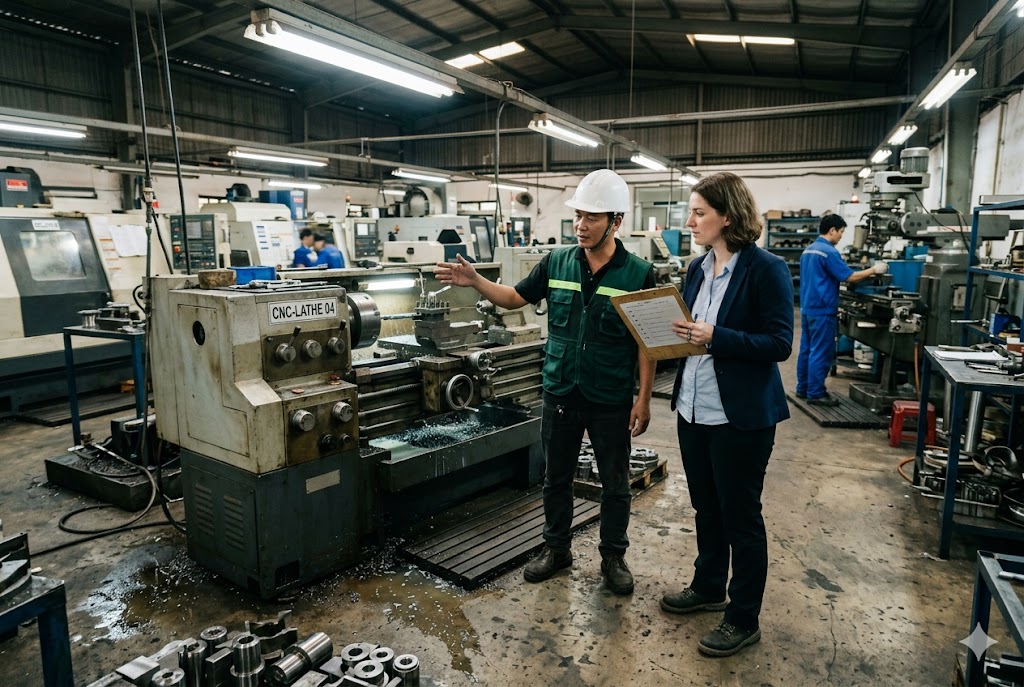
There are real situations where multi-supplier sampling is not the right call. Knowing when to sample broadly and when to focus on one supplier is part of running a cost-effective sourcing operation.
One qualified sample supplier is enough when you are reordering a previously validated part from an approved supplier, the part geometry is simple, IP sensitivity is high, or a time constraint makes parallel sampling impossible. In all other cases, multi-supplier sampling reduces risk more than it adds cost.
Situations Where One Supplier Is the Right Call
Reorders from an Approved Supplier
If a supplier passed your FAI, delivered conforming production runs, and maintained communication quality over two or more orders, they have already earned trust. Re-sampling them against new suppliers for the same part is redundant unless your drawing has changed or you have received a quality complaint.
Highly Proprietary or IP-Sensitive Designs
Every supplier who receives your CAD files and drawings has the technical information needed to reproduce your part. For designs with significant competitive value, the IP exposure from sharing with four or five factories outweighs the benchmarking benefit.
In this case, limit to two suppliers maximum — and require a signed NDA 8 before sharing any files. Do not send to unverified trading companies or platform storefronts without a confirmed factory address.
Simple, Commodity Geometries
A turned shaft with standard tolerances and no special finishing does not require five-supplier benchmarking. The capability spread between factories is smaller for simpler parts. Two suppliers give you enough comparison data.
Hard Time Constraints
Sometimes a project timeline does not allow four to six weeks for parallel sampling across multiple factories. In this situation, single-supplier sampling is a calculated risk — not best practice. Document it as such, and plan to qualify a second supplier as soon as time allows.
The Dual-Sourcing Endgame
The best outcome of a multi-supplier sampling process is not just selecting one supplier. It is qualifying two.
Dual sourcing 9 — maintaining two approved suppliers for the same part — eliminates single-supplier dependency. If your primary factory faces capacity constraints, a Chinese New Year shutdown, a tariff change, or a quality issue, your second approved supplier can step in without re-qualification.
Buyers who qualify a backup supplier during the initial sampling phase pay a fraction of what it costs to emergency-qualify one mid-production. The time to prepare for supply chain disruption is before you need it.
Our team regularly advises clients to award primary volume to their top-scoring sample supplier while keeping the runner-up active with small periodic orders. That keeps the backup supplier familiar with your part, your drawing, and your quality standard — so they are ready when you need them.
A Note on Tariff Strategy
Many US buyers are actively diversifying away from China-only supply chains due to Section 301 tariffs 10. Vietnam, the Philippines, and Malaysia have all grown as CNC sourcing destinations. If this applies to your situation, multi-supplier sampling that spans both China and a Southeast Asian country gives you both a benchmark comparison and a tariff-diversified supply base at the same time.
Our Vietnam office handles local supplier sourcing and factory visits for clients who want parts made outside of China. The sampling process works the same way — you get physical parts, FAI data, and direct communication records from each factory, regardless of country.
Conclusion
Multi-supplier sampling is not a luxury — it is the standard process for reducing risk in China CNC sourcing. Sample 3–5 shortlisted factories, compare results with a consistent scorecard, and aim to exit the process with one primary supplier and one qualified backup. The total cost is small. The protection is significant.
Footnotes
1. ISO 9001 is the internationally recognized standard for quality management systems in manufacturing. ↩︎
2. Coordinate Measuring Machines (CMMs) provide high-precision dimensional verification for machined parts. ↩︎
3. Ra value is the standard surface roughness parameter used in manufacturing drawings and quality inspection. ↩︎
4. Eddy current gauges measure anodizing thickness non-destructively on aluminum parts. ↩︎
5. Mill test reports certify a metal's chemical and physical properties throughout the supply chain. ↩︎
6. First Article Inspection (FAI) validates that a new production process yields parts conforming to drawing specs. ↩︎
7. GD&T (Geometric Dimensioning and Tolerancing) is the standard engineering language for defining part tolerances on drawings. ↩︎
8. Manufacturing NDAs protect proprietary CAD files and design specifications shared with contract suppliers. ↩︎
9. Dual sourcing reduces supply chain risk by maintaining two qualified, active suppliers for the same component. ↩︎
10. Section 301 tariffs imposed on Chinese imports have driven many US buyers to diversify sourcing to Southeast Asia. ↩︎