Skip to main content Skip to footer
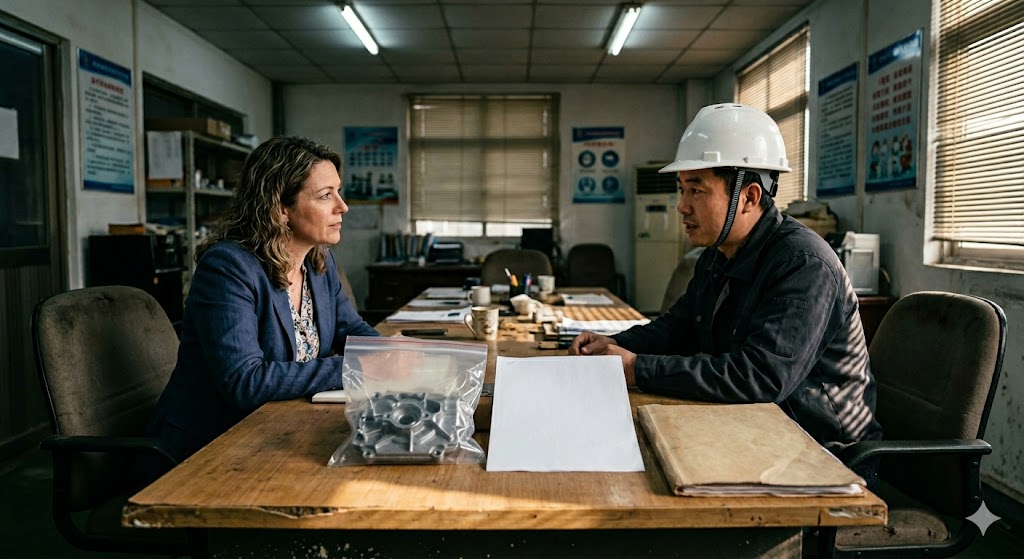
We see it happen more often than it should: a buyer signs off on a sample, production kicks off, and the finished shipment looks nothing like what was approved. By the time the container arrives, the damage is done — rejected parts, missed deadlines, and a supplier pointing at a "minor process change" as if that excuses everything.
To control quality between sample sign-off and production release for custom die cast parts, you need a documented approval gate that freezes drawings, materials, and tooling; requires dual sign-off on a physical golden sample; ties payment tranches to approval milestones; and defines exactly who has authority to approve, conditionally approve, or reject before any production signal is issued.
The good news is that the rules are not complicated. They just need to be written down, signed, and enforced. Here is how to build that system.
Should I Define Who Can Approve Changes After My Sample Is Signed Off?
Unclear authority is one of the most common causes of production problems. When no one knows who can say yes to a change, someone on the factory floor will say yes anyway.
Yes, you must define change approval authority in your purchase agreement before production begins. Specify which personnel on both sides can authorize an engineering change order, what documentation is required, and that any approved change triggers a formal re-validation before production resumes — no exceptions.

Why Undefined Authority Causes Real Problems
In our experience coordinating between US buyers and Chinese suppliers, the gap in authority definition is where most quality disputes begin. A purchasing manager approves a sample. Then a factory engineer makes a "small adjustment" to a gate location or material grade. Nobody flags it. Mass production runs. The parts fail dimensional inspection.
The factory says they made a reasonable call. The buyer says nobody approved it. Both sides are frustrated, and there is no written rule to settle it cleanly.
To prevent this, you need to define authority at three levels.
Three Levels of Change Authority
| Authority Level | Who Holds It | What They Can Do |
|---|---|---|
| Technical Hold | Factory QA / Process Engineer | Flag a potential issue; cannot approve changes |
| Conditional Approval | Buyer's sourcing contact + supplier account manager | Approve minor deviations with documented open items and a closure deadline |
| Full Approval | Buyer's designated sign-off authority | Authorize golden sample, release production, approve ECOs |
Only "Full Approval" authorizes a production release. Conditional approvals must have a written list of open items, a deadline for each, and a re-inspection requirement before production starts.
Engineering Change Orders Must Follow a Fixed Process
Any change after sample sign-off — including material substitutions, tooling repairs, process modifications, or supplier switches — must go through a formal engineering change order (ECO) 1. The ECO process should require:
- A written description of the change and the reason
- Updated drawings, BOMs, or control plans with a new revision number
- A first article inspection (FAI) re-run on the revised configuration
- A new golden sample sealed and signed by both parties
- Written production release issued only after the re-validation is complete
If your contract does not specify this, a factory can legally argue that their change was within normal production variation. You have no leverage.
Payment Is Your Strongest Enforcement Tool
Structure your tooling payment so the final 20–30% is withheld until golden sample approval is formally granted in writing. This gives the factory a direct financial incentive to resolve open items before claiming the next payment tranche. Without this link, approval becomes a formality that suppliers rush through.
What Documentation Should Be Frozen Before My Supplier Starts Mass Production?
Freezing documentation sounds bureaucratic. But if your drawings are not locked at the moment of sample sign-off, your supplier can interpret "close enough" in ways that surprise you.
Before mass production begins, you must freeze and version-control: the approved 2D drawing and GD&T specification, the bill of materials, the process control plan, the tooling configuration, and the approved material certification — all tied to the same revision number as the signed golden sample.
What "Frozen" Actually Means
Freezing a document means assigning it a revision number, getting both parties to sign off on that version, and prohibiting any change without going through the formal ECO process. It does not mean the document can never change. It means changes require authorization, re-validation, and a new revision — not a quiet edit on the factory floor.
For custom die cast parts 2, the minimum documentation freeze package should include the following:
| Document | What to Freeze | Who Signs |
|---|---|---|
| Engineering Drawing | Dimensions, tolerances, GD&T callouts, revision number | Buyer's engineer + supplier QA |
| Bill of Materials | Raw material spec, grade, supplier name | Buyer's sourcing lead + supplier PM |
| Process Control Plan | Casting parameters, shot weight, cycle time, cooling | Supplier process engineer (buyer retains copy) |
| Tooling Configuration | Die drawing, gate location, runner system, T-number | Supplier tooling lead (buyer retains copy) |
| Material Certification | Mill cert or test report matching BOM spec | Supplier QA (buyer retains copy) |
| Golden Sample Record | Photos, CMM report, sample serial number | Both parties |
The CMM Report Is Not Optional for Die Cast Parts
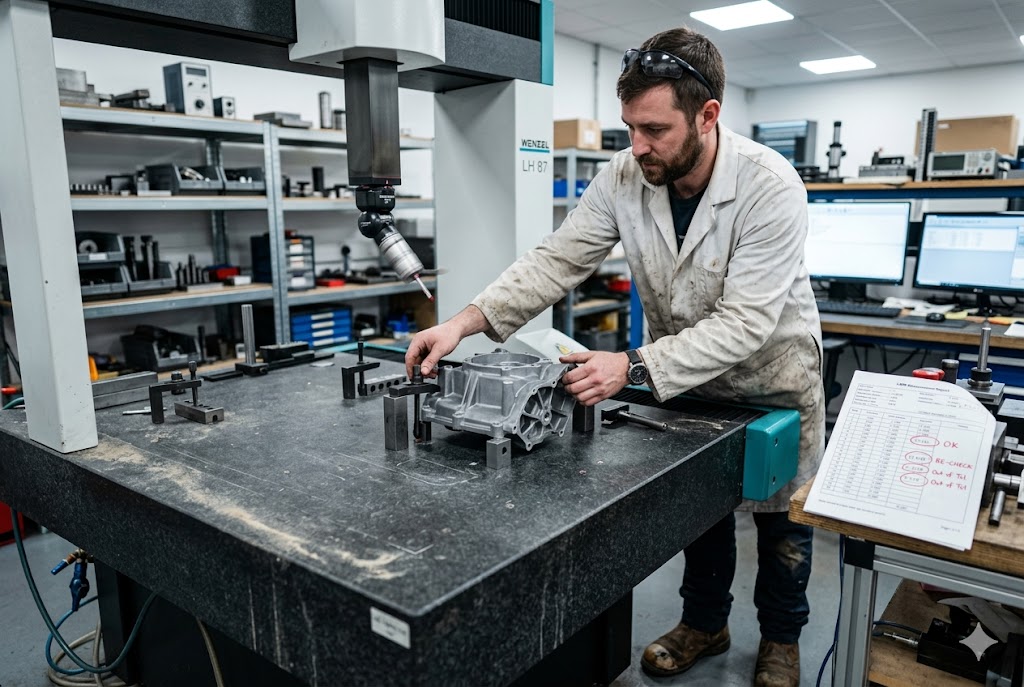
Our quality team requires suppliers to submit a full CMM (coordinate measuring machine) 3 report against the GD&T drawing before golden sample sign-off is valid. For any characteristic flagged as a Critical or Key Dimension, we require a minimum process capability index (Cpk) 4 of 1.33 at the T1 sample stage. This is a hard gate. No CMM report, no production release.
This matters because die casting dimensional variation is process-driven. If the first shot out of a production-ready die does not hit Cpk ≥ 1.33 on your critical dimensions, you are almost guaranteed to see out-of-tolerance parts in the production run.
Tooling Sign-Off Requires Multiple Trials
Do not approve a die after one trial shot. Structure your die sign-off across at least three tooling trials:
- Trial 1 — Initial validation. Check for obvious defects, flow issues, and gross dimensional errors.
- Trial 2 — Sample submission. Supplier submits parts for your dimensional review and surface inspection.
- Final Pre-Production Trial — Full tooling approval. All open items from Trial 2 must be closed before this trial is scheduled.
Only after the final pre-production trial passes all dimensional and cosmetic requirements do you issue the production release.
How Can I Prevent Last-Minute Changes From Hurting Quality or Lead Time?
Last-minute changes are almost always avoidable. They happen when open items are not resolved during the sample stage, when someone is under schedule pressure, or when the factory makes decisions without telling the buyer.
Prevent last-minute changes by establishing a formal re-validation trigger list in your contract, requiring that any ECO — material substitution, process change, tooling repair, or extended production gap — automatically triggers a FAI re-run and a new golden sample before production resumes, with no discretion allowed.

The Re-Validation Trigger List
Most buyers only think about re-validation when something goes wrong. By then it is too late. The better approach is to define, in writing and before you place the order, the exact circumstances that automatically require re-validation. This removes discretion from the factory and makes the process predictable.
A first article inspection (FAI) 5 re-run should be automatically triggered in your contract whenever any of the following events occur:
| Trigger Event | Re-Validation Requirement |
|---|---|
| Engineering change order (any scope) | Full FAI + new golden sample |
| Material substitution (grade, supplier, or cert) | Material re-certification + dimensional check |
| Tooling repair or modification | Dimensional re-check on affected features |
| Process parameter change (shot speed, temperature, cycle time) | Process sign-off + first-off inspection |
| Change of production line or shift | First-off inspection |
| Production gap longer than 90 days | First-off inspection + dimensional check |
| Supplier sub-contracting any operation | Buyer written approval before work begins |
Why the Production Gap Rule Matters
This one surprises buyers. If your supplier runs your job in January, stores the tooling for four months, and then runs again in May, the die has been sitting. Tooling can shift, corrode, or be repaired without notice. A 90-day gap rule forces a first-off inspection before full production restarts, which catches those problems before 10,000 parts are made.
Conditional Approval Is Not a Production Go-Ahead
One of the most dangerous habits we see is treating a "conditionally approved" sample as permission to start production. It is not. Conditional approval means there are open items. Those items must be closed, verified, and re-documented before production is authorized.
In your purchase agreement, define the three possible approval statuses clearly:
- Approved — All requirements met. Production release can be issued.
- Conditionally Approved — Open items exist, documented with a closure deadline. Production is not authorized until all items are closed and verified.
- Rejected — Parts do not meet requirements. A new sample trial is required.
Write into the contract that only "Approved" status authorizes a production release signal. Your factory's production floor must not interpret a conditional approval as a green light.
What Release Process Will Help Me Control Risk Between Sample Stage and Production?
A release process is not just paperwork. It is the checkpoint that separates your sample approval from the moment your supplier starts spending your money on production material and machine time.
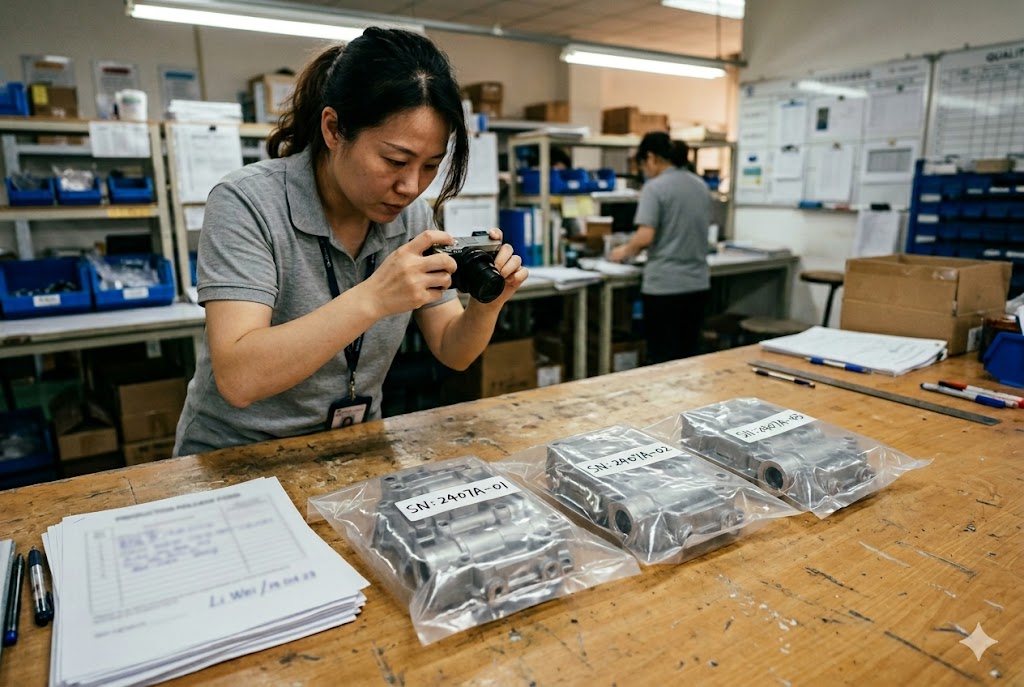
A structured production release process requires: a written release document signed by the buyer's designated authority, confirmation that the golden sample is sealed and distributed to all three parties, CMM data on file, all documentation frozen at the correct revision, and the final tooling trial passed — before any production material is ordered or production scheduling begins.
The Golden Sample Is a Contractual Tool
The approved golden sample is not just a reference part. It is a contractual standard. If mass-produced parts do not match it, you have clear and documented grounds to reject the shipment or demand rework. There is no argument about what "good enough" means — the sealed, signed, photographed golden sample answers that question.
To make the golden sample work as a contractual tool, you must produce and distribute multiple copies:
- Your copy — Retained at your facility or warehouse.
- Factory copy — Held at the supplier's production line or QA department.
- Third-party inspection copy — Issued to your inspection agency so their pre-shipment inspection references the identical standard.
Each copy must be sealed, signed, dated, and photographed. The serial number of the golden sample must match the revision number on all frozen documents.
The Pre-Production Sample Must Use Production Tooling
This is where many buyers make a costly mistake. They approve a sample made from a prototype die, a 3D-printed fixture, or a temporary mold — and then discover that the production die produces different results. The Pre-Production Sample (PPS) must be manufactured using the actual production tooling, production materials, and full production processes. No shortcuts. If the sample was made under any other conditions, it cannot be used as a golden sample for production release.
Many buyers in the automotive and industrial sectors apply the Production Part Approval Process (PPAP) 6 framework as a model for structuring their own pre-production sign-off requirements — even outside the automotive supply chain.
The Production Release Checklist
Before your designated authority issues the production release signal, every item on this list must be confirmed in writing:
- Final tooling trial passed all dimensional and cosmetic requirements
- CMM report on file showing Cpk ≥ 1.33 for all critical dimensions
- Golden sample sealed, signed, and distributed to all three parties
- All documents frozen at the correct revision number
- No open items remaining (or all conditional items formally closed and verified)
- Material certification 7 on file matching the frozen BOM
- Final tooling payment tranche status confirmed (withheld until this gate)
- Written production release document signed by buyer's designated authority
Only when all eight items are confirmed does the production release go out. The factory does not order production material, schedule machine time, or start any production activity before receiving that written release.
Buyers who want a fuller understanding of how geometric dimensioning and tolerancing (GD&T) 8 callouts should be specified and interpreted on engineering drawings will find the ASME Y14.5 standard to be the definitive reference. Similarly, your frozen bill of materials (BOM) 9 is not merely an inventory list — it is a contractual document that ties raw material specifications to your approved golden sample revision.
When evaluating a supplier's ability to run your part at scale, the NADCA die casting FAQ 10 provides a useful reference for understanding how die casting equipment, alloy selection, and process parameters interact — knowledge that helps you ask sharper questions during tooling trials.
Conclusion
Build your approval gate before the purchase order is placed. Freeze your documents, define your authority, seal your golden sample, and tie payment to sign-off. These rules are not bureaucracy — they are the fastest way to resolve disputes and protect your supply chain.
Footnotes
1. Explains what an engineering change order is and why formal authorization is required for any product or process modification. ↩︎
2. Overview of the die casting process, alloys used, and why dimensional consistency is a core characteristic of the method. ↩︎
3. Describes coordinate measuring machines, how they work, and their role in dimensional quality inspection. ↩︎
4. Defines the process capability index (Cpk) and explains why a minimum of 1.33 is the standard threshold for capable manufacturing. ↩︎
5. Defines first article inspection and explains how it is used to validate that a production process consistently meets design specifications. ↩︎
6. Overview of PPAP, the automotive industry's standardized framework for confirming supplier production readiness before mass production begins. ↩︎
7. Explains mill test reports, what information they contain, and why they are the foundation of material quality assurance in metal fabrication. ↩︎
8. Comprehensive reference on GD&T, including symbols, rules, and how tolerances are applied and interpreted on engineering drawings. ↩︎
9. Defines the bill of materials, its hierarchical structure, and its role in communicating component requirements across manufacturing partners. ↩︎
10. Industry resource from NADCA covering die casting alloys, equipment types, process variations, and quality considerations. ↩︎