Skip to main content Skip to footer

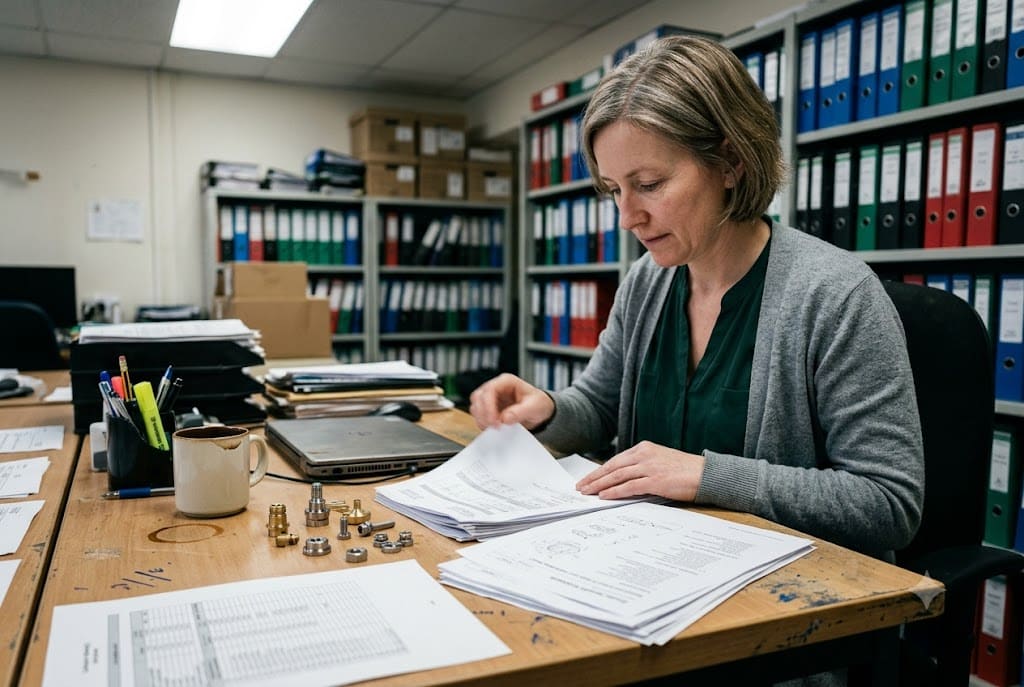
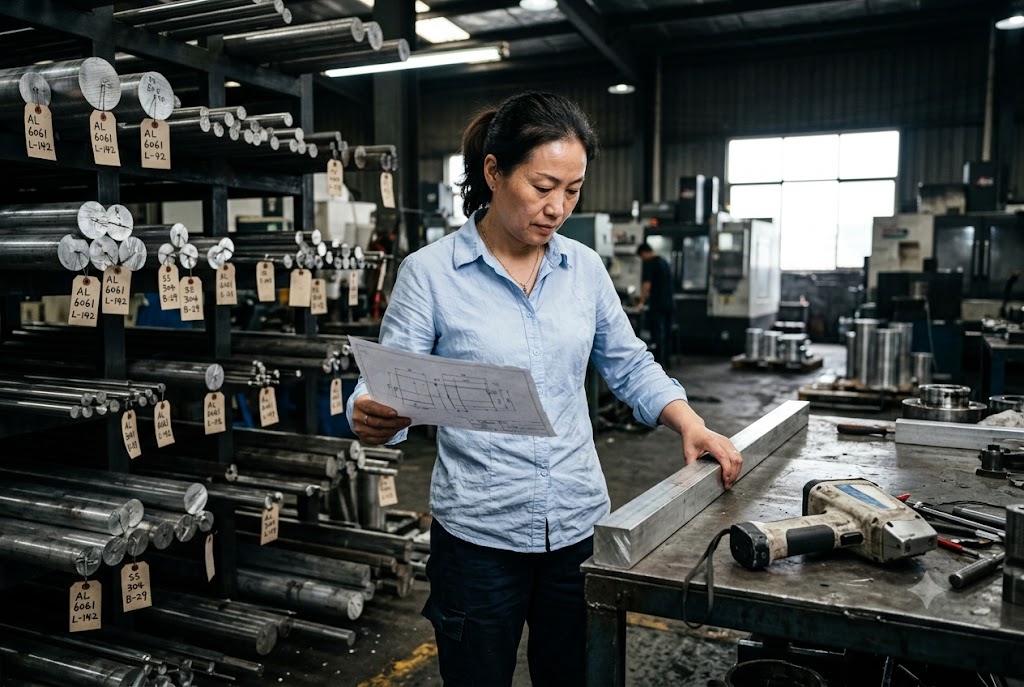
Every week, we process sample submissions from our network of die casting 1 factories in China and Vietnam. Time after time, we see the same problem: buyers receive parts but no paperwork, and the whole approval stalls.
When importing custom die cast parts from China, your supplier should send at minimum a dimensional inspection report, a material mill test report, a die casting process parameter sheet, a surface finish report with photos, a Certificate of Conformance, and RoHS or REACH compliance declarations. Together, these documents let you verify the sample is production-ready before you approve tooling.
Without this paperwork, you are guessing. And guessing costs money. Let us break down exactly what you need and why each document matters.
Should I Ask for Inspection Reports, Material Data, and Process Notes With My Samples?
When our team sends samples to clients in the US and Canada, we always include a full document package. Buyers who skip this step almost always run into problems later — during production, not before it.
Yes, you should always request inspection reports, material data, and process notes alongside your die cast samples. These three document types answer three different questions: does the part meet your drawing, is the alloy verified, and can the factory repeat the result at scale? Without all three, sample approval is incomplete.

Why Inspection Reports Are Non-Negotiable
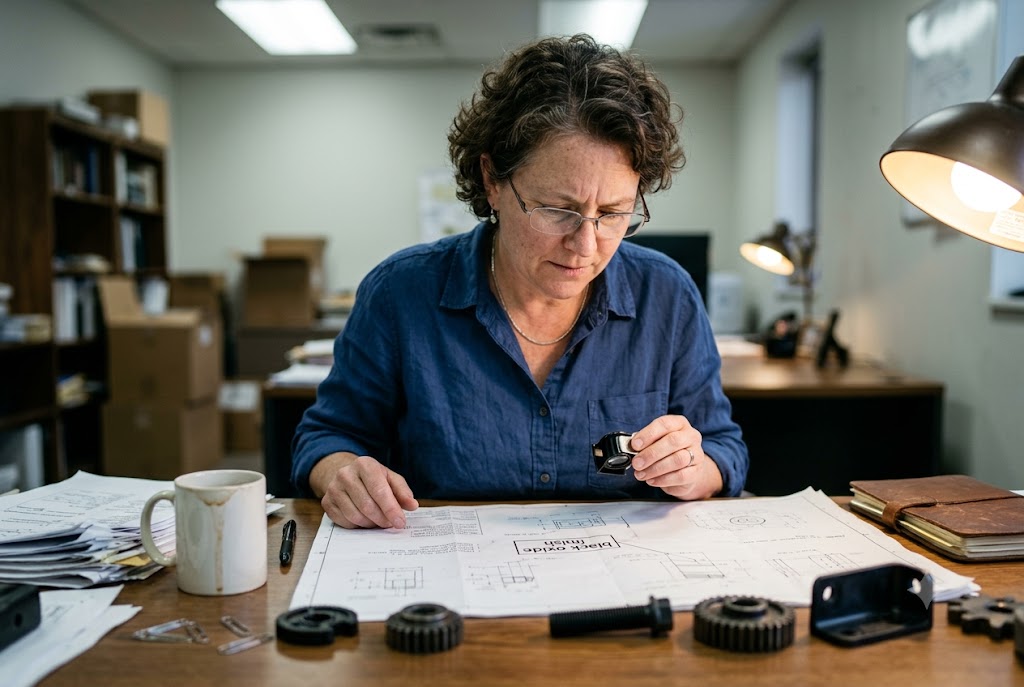
A dimensional inspection report is the most important document in any sample package. It should be formatted as a balloon drawing 2 paired with a measurement data table. Every feature on your engineering drawing — every diameter, every depth, every true position — should appear in that table with three columns: nominal value, tolerance, and actual measured result.
This is not a formality. It is the only objective proof that the part matches your drawing.
| Document | What It Confirms | Risk If Missing |
|---|---|---|
| Dimensional Inspection Report | All features meet drawing tolerances | You approve a part that fails in assembly |
| Material Mill Test Report (MTR) | Alloy composition and mechanical properties verified | Wrong alloy shipped at mass production |
| Die Casting Process Parameter Sheet | Shot conditions recorded for repeatability | Factory changes parameters without telling you |
Many factories will send a one-page "inspection record" that lists five or six dimensions and calls it done. That is not a full inspection report. Push for a complete balloon drawing with every feature numbered, and a matching table with actual measured values — not just pass/fail ticks.
Why Material Certificates Need Traceability
A material mill test report (MTR) 3 comes from the ingot or alloy supplier, not from the die casting factory. It records the exact chemical composition and mechanical properties of the specific heat or batch used to cast your sample.
Some factories send an internal "Certificate of Conformance" and claim it is equivalent. It is not. An internal CoC contains no traceability back to the original melt. If the alloy is wrong — if the silicon content is off, if the magnesium ratio is incorrect — you will not know until your parts fail in the field.
Ask specifically: "Can you provide the MTR from your alloy supplier for the material used to cast these samples?" If they cannot, that is a red flag.
Why Process Notes Protect You at Scale
The die casting process parameter sheet records the exact shot conditions used during sample production. This includes injection pressure, shot speed, first-stage and second-stage transitions, die temperature at each zone, cycle time, and cooling time.
Here is why this matters. A factory can produce a perfect sample using careful, manual adjustments. Then, when your order enters mass production, operators change the parameters to run faster and reduce cycle time. The parts look similar but internal porosity 4 increases. Tensile strength drops. Leaks appear in pressure-tested components.
If the process parameters are documented and signed off at sample approval, you have a reference point. You can ask the factory to demonstrate that mass production uses the same parameters. Without that document, you have no baseline to compare against.
What Sample Package Will Help Me Review the Parts More Efficiently?
Our project managers have handled hundreds of sample submissions. The ones that sail through client review share one thing: every question the buyer might ask is already answered in the document package.
A complete sample package should include a dimensional inspection report, material MTR, process parameter sheet, surface finish report with photographs, a signed Certificate of Conformance, tooling condition report, packing specification, and any applicable RoHS or REACH compliance declarations. This set lets you review part quality, material traceability, cosmetic baseline, and regulatory status in a single sitting.
The Surface Finish Report and Why Photos Matter
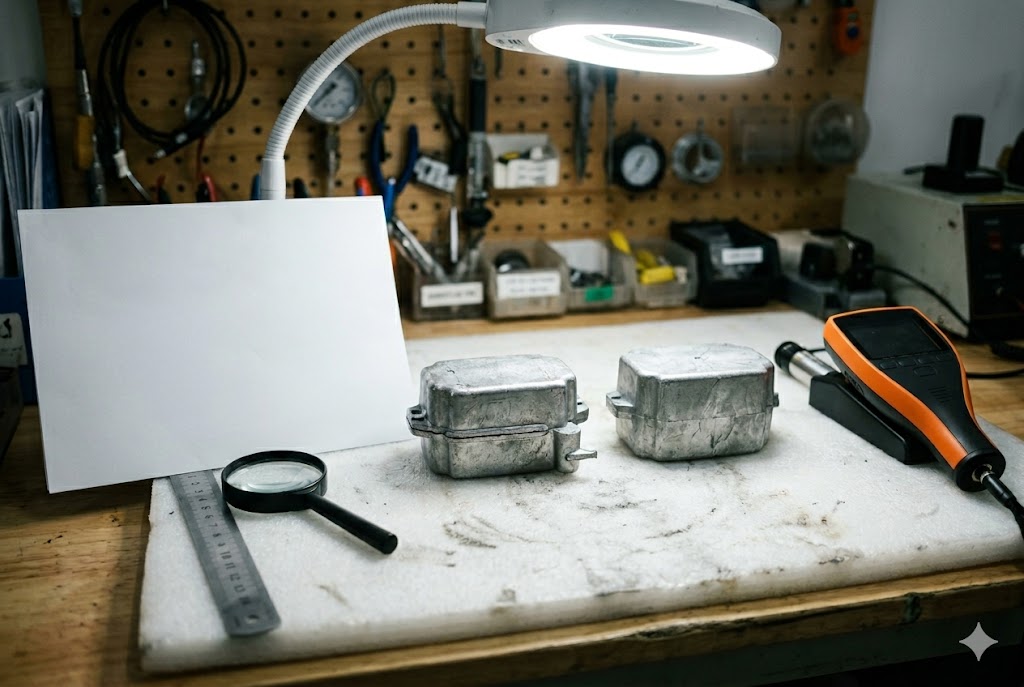
Die cast parts always have cosmetic features that cannot be captured by dimensional data alone. Flash lines, parting line locations, ejector pin marks, gate vestiges — these are permanent features of any die cast part. The surface finish report documents where they are and what they look like, using photographs taken under standardized lighting conditions.
This document serves a specific purpose: it becomes the agreed cosmetic baseline. During every pre-shipment inspection at mass production, the inspector compares the production parts against the approved sample photos. Without a documented baseline, cosmetic disputes become subjective. Every inspector, every quality manager, and every customer has a different standard. Put it in writing at the start.
| Surface Feature | Why It Must Be Documented | What to Record |
|---|---|---|
| Parting line location | Unavoidable; agreed location prevents disputes | Photo with annotation |
| Flash | Accepted flash height should be specified | Max flash height in mm |
| Ejector pin marks | Position and depth affect cosmetics and function | Photo + depth measurement |
| Gate vestige | Height and location affect mating surfaces | Photo + height in mm |
| Surface texture | Ra value or texture grade agreed in writing | Ra value or VDI/SPI grade |
The Certificate of Conformance Must Be Specific
A Certificate of Conformance 5 (CoC) signed by the supplier's quality manager is the formal declaration that these samples represent what mass production will deliver. A good CoC contains:
- Part number and revision level
- Drawing revision number
- Quantity of samples submitted
- Alloy designation (e.g., ADC12, A380, Zamak 3)
- Declaration that samples were produced using production tooling
- Declaration that material, process, and tooling are the same as those intended for mass production
That last point is critical. Some factories use soft prototype tooling for early samples to save cost. Soft tools have different geometry tolerances and different surface finishes than hardened production dies. If samples are made from prototype tooling and you approve them, the first production run from hard tooling may look and measure differently.
Tooling Condition Report: Often Overlooked
Most buyers never ask for a tooling condition report. This is a mistake. The tooling report confirms the die number, the steel grade used for the cavity and core, the mold life counter reading, and photographs of the cavity and core surfaces.
This document answers one important question: is this the production die or not? If the factory cannot provide a tooling report, you cannot verify that the sample was made from the die that will run your orders.
How Can Better Sample Documents Reduce Approval Delays in My Project?
In our experience coordinating sample reviews between Chinese factories and US buyers, most approval delays are not caused by bad parts. They are caused by missing information that forces the buyer to ask follow-up questions, wait for answers, and repeat the cycle.
Better sample documentation reduces approval delays by eliminating back-and-forth. When every dimension is measured and reported, every material is certified, every process parameter is recorded, and every cosmetic feature is photographed, a buyer can complete their review in one pass. Projects with complete sample packages typically reach approval two to four weeks faster than those with incomplete submissions.
The Cost of a Single Missing Document
Consider a practical example. A buyer receives samples but no MTR. They send a request to the factory. The factory contacts the alloy supplier. The alloy supplier is in a different time zone. The MTR arrives four days later. The buyer reviews it and discovers the alloy is correct, but the document was not formatted to their company's vendor qualification requirement. Another three days for a reformat.
That is one week added to your project timeline over one document. Multiply that by three or four missing documents and you are looking at a month of delay before a single part is approved for production.
| Missing Document | Typical Delay Added | Downstream Risk |
|---|---|---|
| Dimensional Inspection Report | 1–2 weeks (re-inspection required) | Approval based on incomplete data |
| Material MTR | 3–7 days | Wrong alloy used in production |
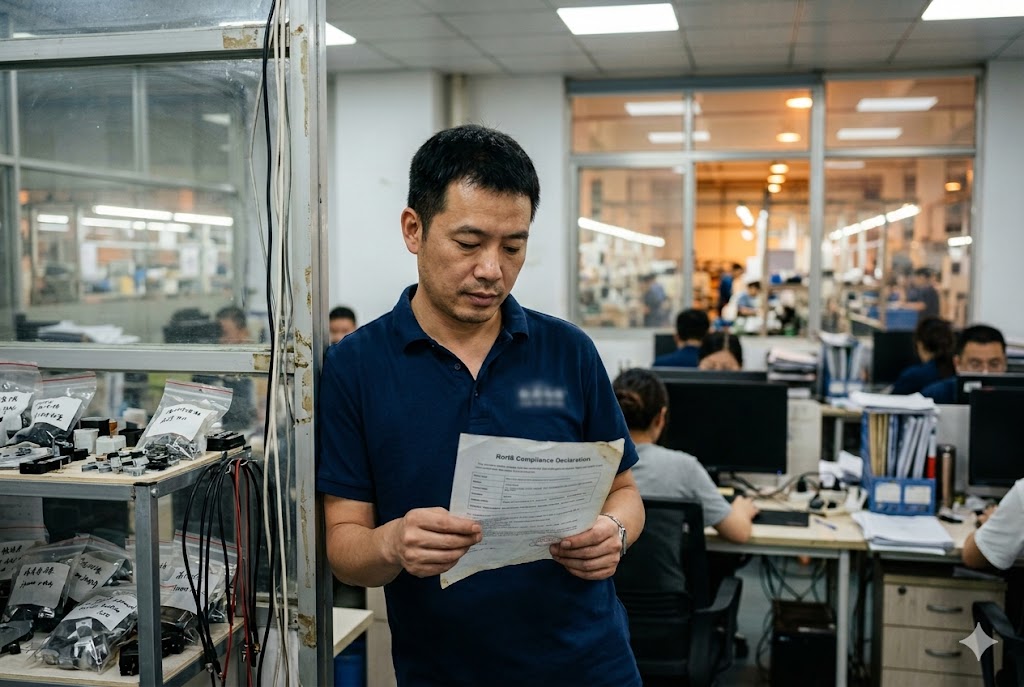
| RoHS / REACH Declaration | 1–3 weeks (compliance filing) | Customs hold or product recall |
| Process Parameter Sheet | 1 week | Parameter drift in mass production |
| Tooling Condition Report | 3–5 days | Unknown if production die was used |
Corrective Action Records Reveal the Full Story
One document that buyers rarely request but should is a corrective action record 6 or deviation log. This document lists every dimension or feature that was out of tolerance on the first sample shot, and explains what change was made — to the die, to the process, or to the design — before the submitted sample was produced.
This record is valuable for two reasons. First, it tells you how many revision cycles the tooling has already gone through. A die that required four rounds of welding and re-machining to achieve conformance may have compromised its long-term dimensional stability. Second, it tells you whether any compromises were made. If a tolerance was originally ±0.05mm and the supplier revised it to ±0.1mm during the tooling phase, you need to know that before you sign off.
Compliance Declarations Cannot Wait Until Shipment
RoHS 7 and REACH compliance 8 declarations are regulatory documents. If you are importing into the US, and your downstream customers serve the EU, UK, or California markets, these declarations must cover both the base alloy and any surface finish — plating, anodizing, powder coat, or paint.
Do not assume these are available. Ask for them at the sample stage. A factory that cannot produce compliance declarations at sample review will not have them ready at shipment. And a shipment without these documents can be quarantined at customs regardless of part quality.
What Missing Sample Paperwork Should Concern Me Before I Move Forward?
Some missing documents are inconvenient. Others are warning signs. After years of coordinating supplier audits and sample reviews, our team has learned to read the difference.
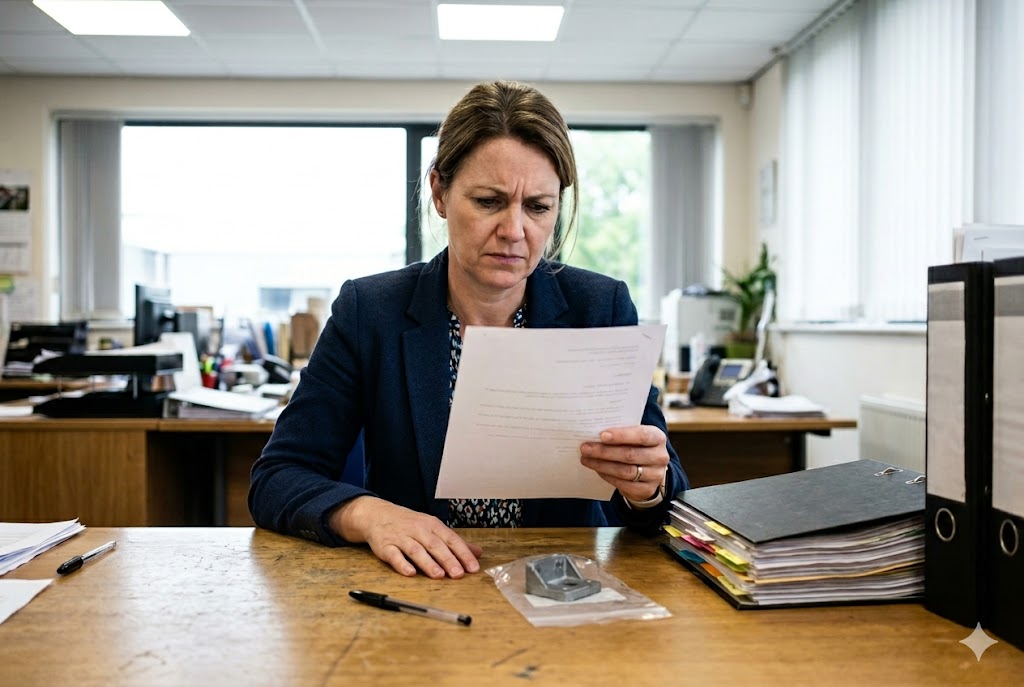
The most concerning gaps in a sample package are a missing material MTR, no process parameter record, absence of a tooling condition report, and no corrective action log. Together, these four omissions mean you cannot verify material traceability, production repeatability, die authenticity, or tooling history — the four pillars of a credible sample approval.
The Appearance Approval Report for Cosmetic Parts
For any part with cosmetic-critical surfaces, an Appearance Approval Report (AAR) signed by both parties is essential. This document goes beyond the surface finish report. It references specific Pantone or RAL color codes for painted or coated surfaces. It specifies gloss level by measurement (e.g., 60° gloss = 75–85 GU). It defines texture grade using VDI or comparable standards. And it includes an agreed defect classification table — what constitutes Class A, Class B, and reject.
The AAR is not memory. It is not a verbal agreement. It becomes the enforceable standard at every pre-shipment inspection from that point forward. Without it, cosmetic disputes will always be resolved by whoever argues louder.
Packing Specifications Are Frequently Ignored
Packing and labeling specifications are the most commonly skipped document in a sample package, and they cause real damage. Die cast parts with machined bores, threaded features, or plated surfaces are vulnerable during transit. If the factory does not follow an approved packing method, parts arrive scratched, dented, or contaminated.
A proper packing specification should define:
- Individual part protection (foam insert, poly bag, tray configuration)
- Carton construction (board grade, layer limits, part count per box)
- Master carton markings (part number, revision, quantity, country of origin, weight)
- Stacking and orientation limits
Get this approved at the sample stage. Do not wait until the first mass production shipment to find out the factory uses bubble wrap and gravity.
How to Read a Factory's Response to Your Document Request
The way a factory responds to your document request tells you more than the documents themselves. A factory that sends a complete, organized document package without being asked is operating a real quality management system 9. A factory that argues about what documents are necessary, or that sends scanned handwritten notes as a substitute for structured records, is showing you its capability.
When you request a full sample document package and the factory pushes back, that is the most important signal you will receive before placing an order. Understanding geometric dimensioning and tolerancing 10 will help you evaluate whether the inspection data your supplier provides is genuinely complete.
Conclusion
A complete sample document package is not extra paperwork. It is the foundation of a smooth production run. Request all ten document types before you approve tooling, and you will catch problems early — when fixing them is still cheap.
Footnotes
1. Overview of the die casting process, alloys used, and production characteristics. ↩︎
2. How GD&T balloon drawings define tolerances and communicate design intent to manufacturers. ↩︎
3. What a mill test report is and how it certifies alloy composition with heat-number traceability. ↩︎
4. Types of casting defects including gas porosity and shrinkage that affect structural integrity. ↩︎
5. US federal regulation defining when a Certificate of Conformance may substitute for source inspection. ↩︎
6. How corrective and preventive action (CAPA) systems document and resolve manufacturing non-conformances. ↩︎
7. The EU RoHS directive restricting hazardous substances in electrical and electronic equipment. ↩︎
8. The EU REACH regulation governing chemical substance registration and supply chain disclosure. ↩︎
9. What a quality management system is and how ISO 9001 structures continuous improvement. ↩︎
10. Practical guide to GD&T symbols and tolerance zones used in engineering drawings. ↩︎