Skip to main content Skip to footer
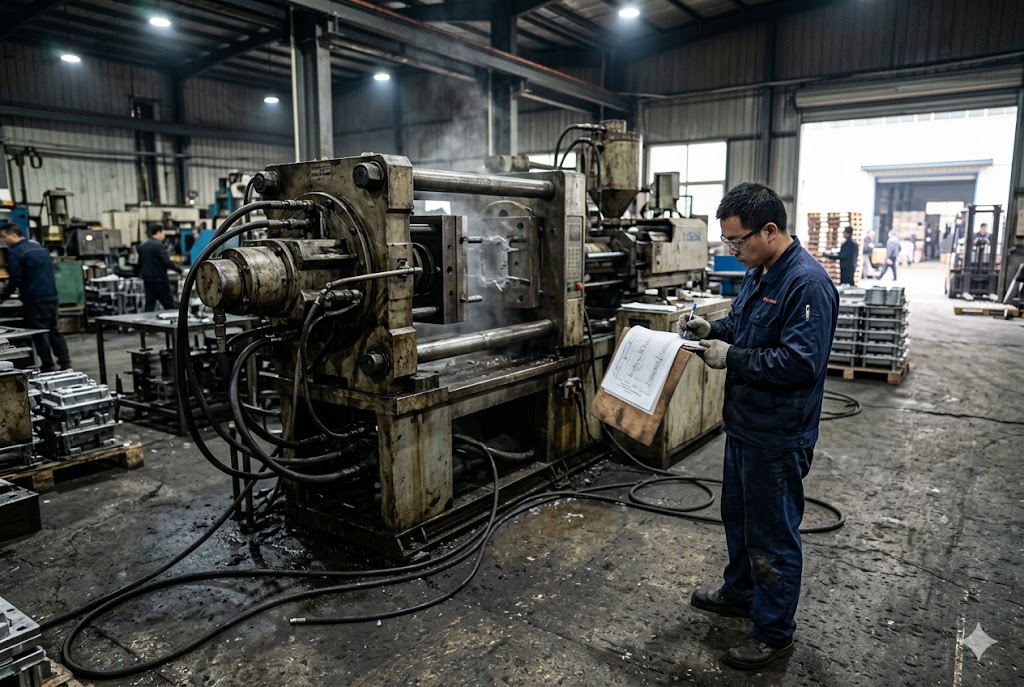
We have walked programs through T0, T1, and T2 more times than we can count — and every single time a buyer skips the basics, the same problems repeat. A tool ships late. Samples fail. Production gets delayed. The pain is predictable, and most of it is preventable.
T0, T1, and T2 are sequential die casting tool trial stages. T0 verifies mechanical assembly without metal. T1 runs the first metal shots to confirm fill, ejection, and basic geometry. T2 confirms dimensional compliance after tooling corrections. Each stage has specific deliverables. Missing one creates risk that compounds through your entire program.
If you are sourcing die cast parts from China and have never seen a clear explanation of what each stage means — or what you should receive from your supplier at each step — this article covers it all.
What Results Should I Expect from Each Trial Stage in My Project?
Every week we see purchase orders placed without a single line defining what the supplier must deliver at each trial stage. That gap costs buyers weeks of delay and thousands of dollars in rework.
T0 should produce a mechanical verification record showing all moving components cycle without binding, cooling lines hold pressure, and the ejector system resets correctly — with no metal involved. T1 should deliver 10–15 retained samples plus a dimensional report against your drawing. T2 should deliver a compliance report, a process parameter sheet, and a proposed golden sample set.
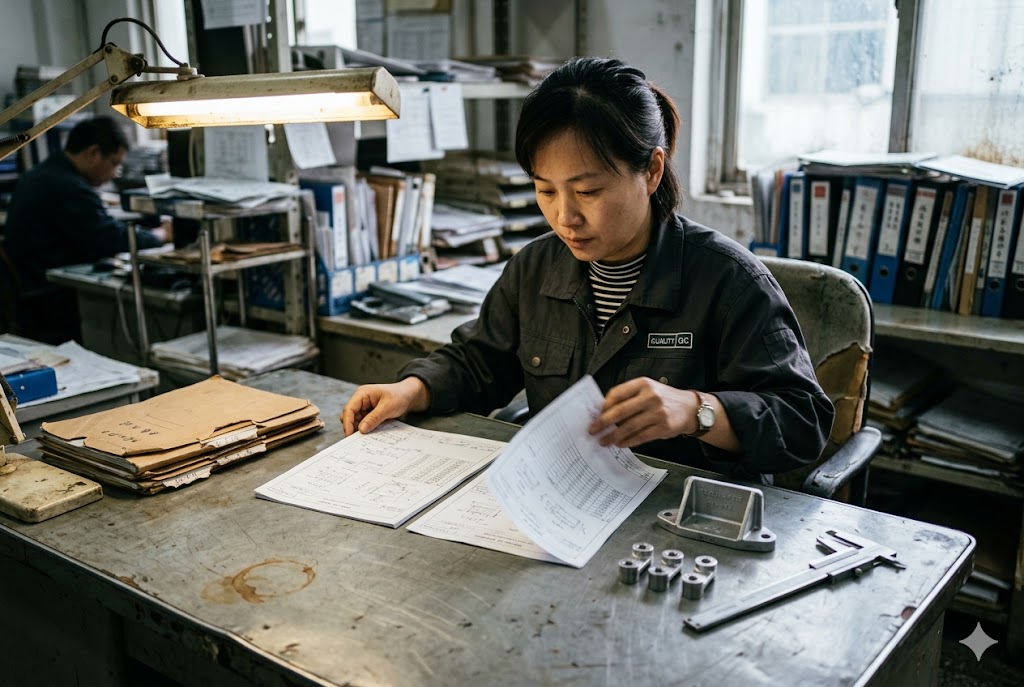
T0: The Mechanical Dry Run
T0 is the first time your completed die is mounted on the casting machine. No molten metal is used. The supplier cycles every mechanical element — die open and close, slide advance and retract, ejector plate forward and back — to confirm nothing binds, interferes, or misaligns.
Cooling lines are pressure-tested for leaks. Parting surface contact is checked under clamp tonnage. The ejector system is confirmed to reset correctly after each cycle.
T0 typically takes four to six hours of machine time. It sounds simple. It is. But many Chinese suppliers skip it entirely, treating the first metal shots as both a mechanical test and a casting trial at the same time. That is a false economy. A mechanical defect found at T0 costs a few hours. The same defect found mid-T1 costs the entire trial day plus steel repair time.
| Stage | Metal Used? | Primary Objective | Key Deliverable |
|---|---|---|---|
| T0 | No | Mechanical verification | Mechanical check record |
| T1 | Yes | First fill, eject, geometry | Dimensional report + 10–15 samples |
| T2 | Yes | Dimensional compliance, process window | Compliance report + golden sample set |
T1: The First Metal Trial
T1 is the first time molten metal enters your die under production-intent conditions — correct alloy, correct machine, first viable process window. The goal at T1 is not dimensional perfection. The goal is to confirm the cavity fills completely, the part ejects cleanly, and the geometry is recognisably close to your drawing.
The supplier runs a warm-up sequence of 20–50 shots to bring the die to thermal equilibrium 1. Then they retain 10–15 samples from a stable window for measurement and customer review. T1 is also when the supplier typically runs the first article inspection (FAI) 2, measuring every dimension on your drawing against actual samples.
You should receive from T1: the retained sample set, a dimensional report with actual measurements for every drawing callout, a process parameter record for each retained shot, and a written list of issues the supplier has identified.
T2: The Correction Confirmation Trial
T2 runs after every tooling modification and process adjustment agreed from T1 review has been implemented. The bar is higher now. Every dimension must be measured with the intent of confirming compliance or identifying residual deviations. T2 is also when the supplier begins to define the production process window 3 — the specific combination of injection pressure, fill speed, hold pressure, die temperature, and cycle time that consistently produces conformant parts.
| T2 Deliverable | Why It Matters |
|---|---|
| Compliance dimensional report | Confirms corrections worked |
| Process parameter sheet | Anchors the production window |
| Golden sample set | Physical inspection reference for all future batches |
| Deviation list (if any) | Documents residual issues needing concession or further work |
How Do These Trial Stages Affect My Tooling Timeline and Sample Approval?
When we help clients plan tooling programs, the number one source of schedule surprise is underestimating how many trial rounds will be needed — and how long each one actually takes.
Each trial round in China typically adds two to four weeks to your program timeline. One to two weeks for the supplier to implement tooling corrections, and one to two weeks to schedule press time and ship samples. A simple part may reach approval in two rounds. A complex part with multiple slides and tight tolerances should be budgeted for three rounds as a realistic baseline.
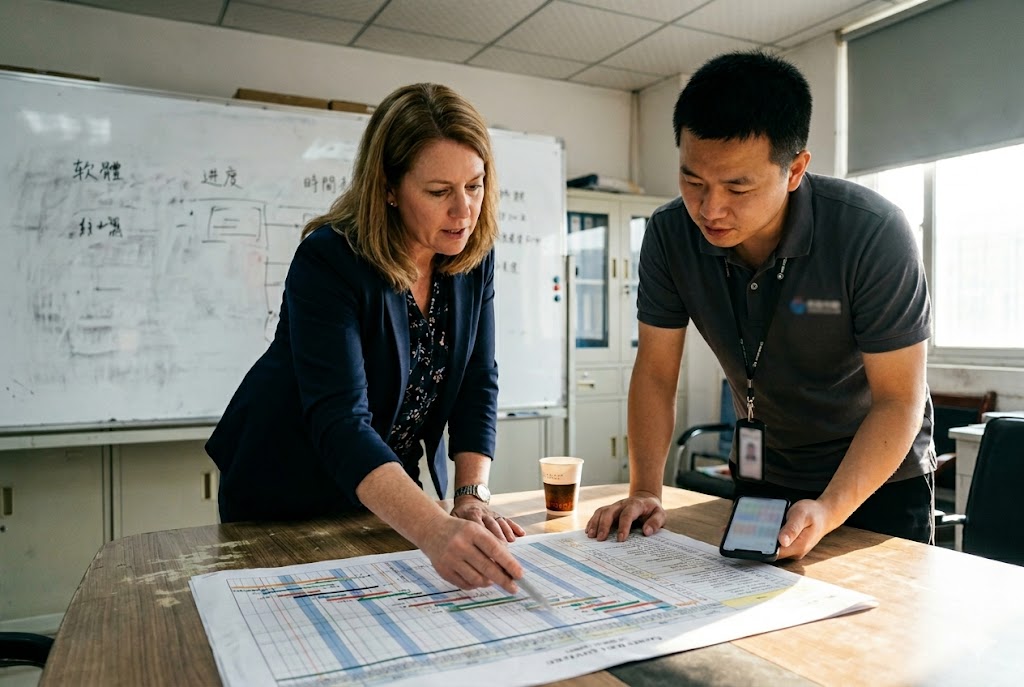
What Drives the Number of Trial Rounds?
Part complexity is the main driver. A simple housing with two slides and standard tolerances, backed by a thorough DFM review 4 and mold flow simulation 5, can reasonably reach production approval after T1 and T2. A complex part with thin walls, four or more slides, tight positional tolerances, and a rushed DFM review should be planned for three rounds — T1, T2, and T3 — as a realistic baseline, not a pessimistic one.
In the automotive sector, four or five trial rounds before production release is not unusual. The cost of each additional round is not just machine time and steel rework — it is the calendar time added to your launch date.
Timeline by Complexity
| Part Complexity | Realistic Trial Rounds | Estimated Additional Weeks |
|---|---|---|
| Simple (1–2 slides, standard tolerances) | 2 (T1 + T2) | 4–8 weeks |
| Medium (3–4 slides, moderate tolerances) | 2–3 (T1 + T2 + possible T3) | 8–12 weeks |
| Complex (5+ slides, tight tolerances, thin walls) | 3–4 | 12–16 weeks |
What Slows Approval Down?
Three patterns account for most delays we observe in Chinese die casting programs.
First, the supplier ships T1 samples before the die reaches thermal equilibrium. Dimensions measured on cold-die shots are not representative of production conditions. The dimensional report looks acceptable. Production starts. Parts fail. The root cause is traced back to an invalid T1.
Second, the DFM review was too brief. Features that were flagged as marginal during quoting are now producing dimensions that cannot be held as-cast. A design change on the buyer's side is required, which resets the trial clock.
Third, tooling corrections are incomplete between rounds. The supplier fixes four of six identified issues from T1, ships T2, and the remaining two issues are still present. Another round is needed. Requiring written sign-off confirming every agreed correction has been implemented before T2 is scheduled prevents this.
Should I Treat T1 Samples as Final Production Parts?
This is one of the most expensive mistakes buyers make, and we see it happen with experienced purchasing teams, not just first-time importers.
No. T1 samples should never be treated as final production parts. T1 confirms basic fill and ejection. Dimensions may be off in consistent or variable ways. The process window is not yet defined. Using T1 samples for downstream testing or customer approval before completing T2 transfers unquantified tooling risk directly into your supply chain.
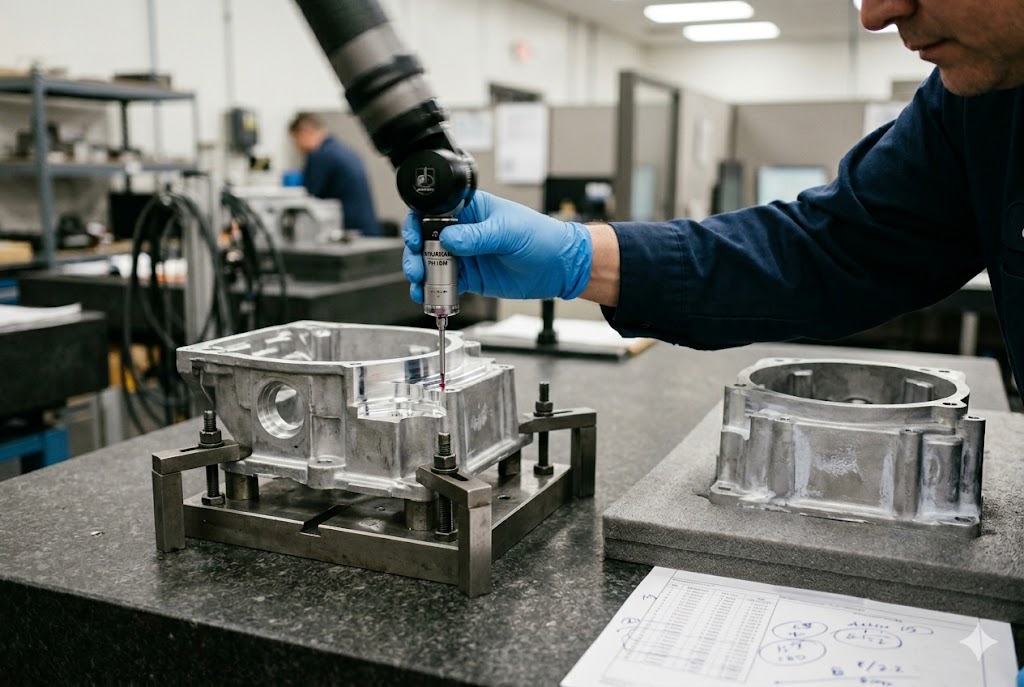
What T1 Actually Tells You
T1 tells you three things. First, whether the cavity fills without cold shuts or misruns — a fundamental gating and venting check. Second, whether the part ejects without sticking or damage — a draft angle, surface finish, and ejector pin placement check. Third, whether the overall geometry is close enough to your drawing to confirm the tool was built to the correct dimensions.
T1 does not tell you whether the part will consistently produce within your drawing tolerances across an entire production run. Process variation at T1 is high. The die has not reached thermal equilibrium. The process window is an initial estimate, not a validated range.
Classifying T1 Findings
When you receive T1 results, classify every finding into one of three categories before deciding how to respond.
Tooling-caused deviations are dimensions consistently off in the same direction across all measured samples. This means the cavity geometry is wrong. Steel modification is required before T2. The cost and timeline responsibility for this correction should already be defined in your contract.
Process-caused deviations are dimensions that vary across samples or are near nominal but show scatter. The process window needs optimisation, not steel work. These are typically addressable through parameter adjustment at T2.
Design-caused deviations are features that the DFM review flagged as difficult to hold as-cast. Their appearance at T1 confirms a design change on your side is needed. This distinction matters because it separates your cost and responsibility from the supplier's.
Keeping these categories distinct prevents the supplier from attributing tooling failures to process variation and deferring correction indefinitely — a pattern that benefits the supplier commercially but transfers risk to your program.
The Rule of Ten at T1
The economics of die casting tooling corrections follow a rough rule: a problem found at T1 costs one unit to fix. The same problem found at T2 costs ten units. Found in production, it costs one hundred units. The T1 review is your lowest-cost opportunity to identify and correct tooling errors. A rushed or incomplete T1 review is not a time saving — it is a cost deferral with a large multiplier.
What Should I Ask My Supplier After Each Tooling Trial?
Most buyers ask the wrong questions after a trial. They ask "did it pass?" The right question is "what does the data show?"
After T0, ask for the mechanical verification record. After T1, ask for the complete dimensional report against your drawing, the process parameter log for retained shots, and the supplier's written issue list. After T2, ask for the updated compliance report, the defined production process window, and the nominated golden sample set with sign-off documentation.

Questions to Ask After T0
T0 is mechanical. Your questions should be mechanical.
Ask the supplier to confirm every slide reaches its full designed stroke without binding under clamp pressure. Ask for the cooling line pressure test result — which circuits were tested, at what pressure, and for how long. Ask whether the ejector plate returned fully to the home position after every cycle in the test sequence. Ask whether the parting surface contact was visually inspected under tonnage and whether any witness marks indicate uneven contact.
If the supplier cannot answer these questions with documented results, T0 was not executed. Require the documentation before authorising T1.
Questions to Ask After T1
This is the most important question set in the program.
Ask for the full dimensional report 6 — every dimension on your drawing, with the actual measured value and a clear pass/fail against nominal and tolerance. Ask how many warm-up shots were run before retained samples were selected. The minimum acceptable is 20 shots; fewer than that means the die had not reached thermal equilibrium. Ask for the process parameter record for each retained shot — injection pressure, fill speed, die temperature, cycle time. Ask for the supplier's own written issue list from T1. A supplier who has no issues to report from T1 is either working with an exceptionally simple part or is not being thorough.
| Question | What a Good Answer Looks Like |
|---|---|
| Can you share the dimensional report? | A table with every drawing dimension, actual measured value, and pass/fail |
| How many warm-up shots before samples were retained? | At least 20, ideally 30–50 |
| What issues did you identify? | A written list of at least 2–4 observations even on a successful T1 |
| What tooling modifications do you propose? | Specific features, direction of correction, estimated timeline and cost |
Questions to Ask After T2
After T2, you are moving toward production release. Your questions should confirm readiness, not just correctness.
Ask whether every tooling modification agreed from T1 review has been implemented and documented. Ask for the updated dimensional report confirming compliance for each previously failed dimension. Ask for the proposed production process window — the specific parameter ranges, not just the settings used for T2 samples. Ask for the nominated golden sample set and confirm the sign-off process: who signs, how many samples are retained, and where they are stored.
Ask whether a run-at-rate validation 7 is planned before first production release. In our experience managing programs between Chinese suppliers and US buyers, this step is rarely offered voluntarily. Requiring it contractually — typically 300–500 consecutive shots under production conditions with full inspection of retained samples — is the difference between a T2 approval that holds through production and one that unravels in the first batch.
In the automotive sector 8, where four or five tooling trial rounds before production release are standard, run-at-rate validation is treated as non-negotiable, not optional. Applying the same discipline to commercial die casting programs protects both timeline and quality outcomes.
Beyond run-at-rate, it is worth confirming that the supplier has established a written die casting DFM checklist 9 for the part that will govern future tooling maintenance decisions. Dies wear. Process windows drift. A documented baseline established at T2 is what allows you to detect drift early — before it becomes a field quality issue.
Finally, confirm the subsurface porosity 10 risk has been assessed and documented for your part. Porosity is one of the most common internal defects in die cast parts and is not detectable by visual inspection. If your part requires pressure testing, machining, or surface finishing, ask whether the T2 sample set was evaluated for porosity risk and what mitigation steps are in the production process plan.
Conclusion
T0, T1, and T2 are not formalities. They are checkpoints. Each one has specific deliverables. Holding your supplier to those deliverables — not just stage labels — is the clearest way to protect your program, your timeline, and your production quality.
Footnotes
1. How thermal equilibrium affects die casting fill accuracy and dimensional stability. ↩︎
2. What the AS9102 First Article Inspection standard requires and why FAI matters before production. ↩︎
3. How PPAP defines and documents the production process window for supplier qualification. ↩︎
4. How DFM principles reduce die casting defects and tooling iterations before steel is cut. ↩︎
5. How mold flow simulation validates tooling design and prevents fill defects in die casting. ↩︎
6. How CMM inspection generates dimensional reports verifying part compliance against engineering drawings. ↩︎
7. How run-at-rate validation through PPAP confirms production stability before full launch. ↩︎
8. How Six Sigma and PPAP processes govern trial and approval standards in automotive manufacturing. ↩︎
9. How DFM analysis applied to die casting reduces defect risk and tooling rework cycles. ↩︎
10. How subsurface porosity forms in die castings and why it cannot be detected by visual inspection alone. ↩︎