Skip to main content Skip to footer

Every time we prepare a new tooling program for a client, we see the same pattern: buyers wait until T1 samples arrive to start asking hard questions. By then, the wrong alloy has already been run, the machine was undersized, and nobody recorded the process parameters. The delay is real. The cost is real.
Before your supplier runs a single trial shot on your custom die cast tooling, you need written confirmation on at least ten key items — covering design freeze, material certification, machine specs, process parameters, inspection scope, sample documentation, and shipment logistics. Skipping any one of these creates ambiguity that costs weeks and real money.
These are not bureaucratic boxes. Each one closes a gap that regularly derails import programs. Here is how to work through them systematically.
Should I Confirm My Trial Plan, Sample Quantity, and Inspection Method Before T1?
When we coordinate T1 trials for clients importing from China, the single most common cause of wasted runs is not a tooling defect — it is the absence of a plan. Nobody agreed on warm-up shots, nobody committed to a sample count, and nobody defined what "pass" means.
Yes, you must confirm your trial plan, sample quantity, and inspection method before T1. Agree in writing that the first 20–30 shots are warm-up and discard, that at least 10 consecutive stabilised shots are retained, and that a pre-agreed CMM or dimensional inspection method will be applied to every retained sample.
Why Warm-Up Shots Matter
A die casting 1 die must reach thermal equilibrium before dimensional samples mean anything. Die temperature affects metal flow, solidification rate, and shrinkage. Shots taken on a cold die will show wall thickness variation, surface shrinkage, and dimensional scatter that do not represent steady-state production.
In practice, thermal equilibrium takes 20 to 50 shots depending on die mass, alloy temperature, and cycle time. An aluminum alloy part in a 400 kg die typically needs 30 shots minimum. A small zinc die might stabilise in 15.
The rule is simple: warm-up shots are discarded. Dimensional samples are collected only after stabilisation.
How Many Samples Do You Need?
Ten consecutive stabilised shots is the accepted minimum for a first-article sample set. This gives you enough parts to:
- Measure every drawing dimension at least once
- Identify shot-to-shot dimensional variation
- Detect intermittent surface defects that appear on only some shots
- Have spare parts if samples are damaged in transit
Some buyers request 20 shots. That is reasonable for complex or high-volume programs. For a simple bracket or cover, 10 is sufficient at T1.
| Sample Quantity | Suitable For | Notes |
|---|---|---|
| 10 shots | Standard T1, simple geometry | Minimum acceptable |
| 20 shots | Complex geometry, tight GD&T | Provides statistical confidence |
| 30+ shots | High-volume production tooling | Full Cpk preliminary study possible |
Inspection Method Agreement
Without a pre-agreed inspection method, suppliers measure what they are confident about and skip the rest. This is not always deliberate — it is the path of least resistance.
You need to specify, in writing before the trial:
- Which dimensions will be measured at T1
- What instrument will be used for each (CMM, caliper, pin gauge, optical comparator)
- What the acceptance criterion is at T1 vs. T2
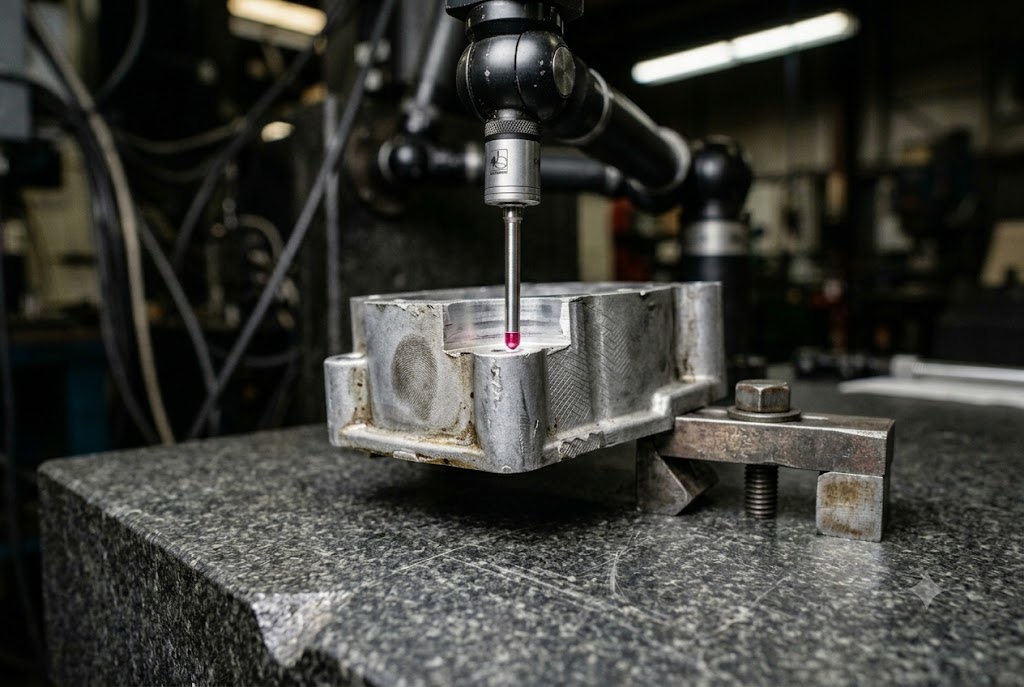
- Whether a CMM inspection program 2 will be run against your 3D CAD and drawing GD&T callouts 3
A CMM report tied to your drawing callouts is the gold standard. It removes selectivity and creates an objective baseline both parties agreed to before a shot was run.
Process Parameter Recording
Parameters must be recorded shot-by-shot for every retained sample. At minimum, record:
| Parameter | Why It Matters |
|---|---|
| Metal temperature | Affects fill, shrinkage, surface quality |
| Die temperature (fixed and moving) | Affects dimensional stability |
| First-phase speed | Controls initial fill behaviour |
| Fast-shot switchover point | Affects gate velocity and porosity |
| Second-phase velocity | Controls cavity fill pressure |
| Hold pressure and time | Affects solidification shrinkage |
| Cycle time | Must match target for thermal equilibrium |
| Shot sleeve fill ratio | Affects oxide entrainment |
If your supplier cannot provide this sheet, the trial data is not reproducible. That means T2 corrections are guesswork.
What Documents Should My Supplier Send Me Before the First Trial?
Our team follows a fixed rule on all China-sourced tooling programs: no trial date is confirmed until the pre-trial document package is received and reviewed. This is not a trust issue. It is a discipline issue. Suppliers who send complete documents before T1 run better trials.
Before the first die casting trial, your supplier must send you the signed tooling design approval referencing the current drawing revision, a material test report or spectrometer certificate for the specific alloy batch scheduled for the trial, the machine model number and shot sleeve diameter, and the agreed process parameter sheet template.
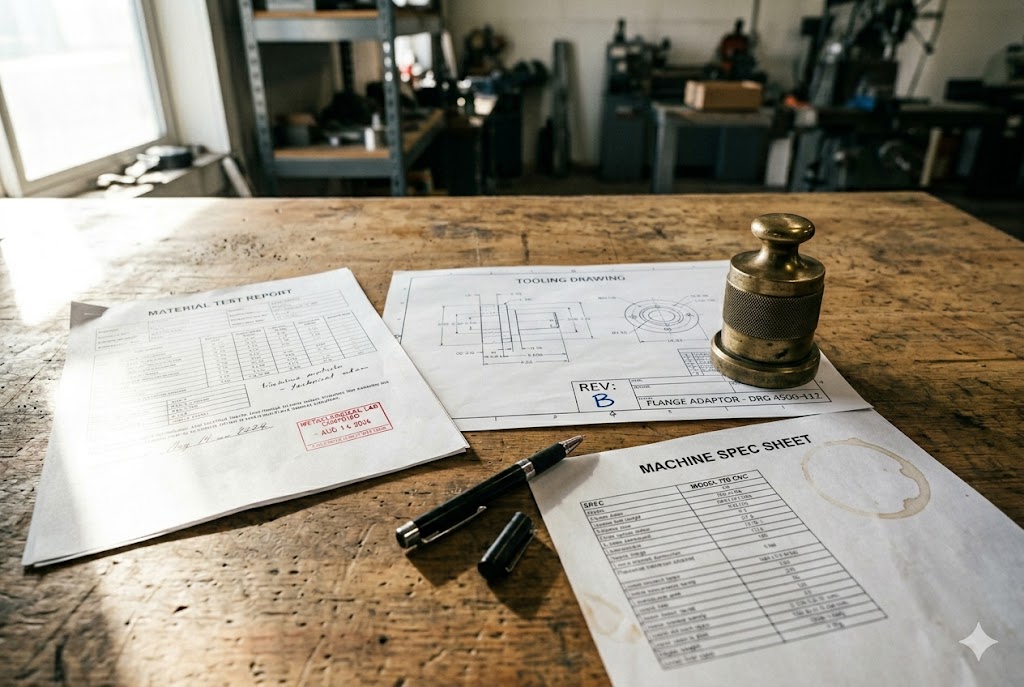
Tooling Design Approval — Design Must Be Frozen
Before any trial, you need written confirmation that the tooling design is frozen and that you have approved the final revision. This means:
- Parting line location and draft angles confirmed
- Gate location and runner geometry approved
- Ejector pin layout reviewed (no pins on datum faces or critical surfaces)
- Slide mechanisms confirmed
- Cooling circuit layout reviewed
- Steel specification confirmed (H13 or equivalent for aluminum alloy tooling)
In China, it is common for suppliers to begin machining cavity steel while design review emails are still open. Once steel is cut, raising a gate location objection costs four to eight weeks and a significant rework charge. Written design freeze — signed, referencing the drawing revision number — prevents this.
Material Test Report
The alloy chemistry used in your T1 trial directly affects:
- Fill behaviour and cavity pressure
- Surface finish and porosity tendency
- Mechanical properties of the finished part
- Dimensional stability during solidification
Suppliers occasionally substitute secondary alloy or blended remelt for first-article trials, reasoning that T1 is only for dimensional checking. This is incorrect. A T1 run on the wrong alloy gives you misleading process data that will not translate to production.
Request the material test report (MTR) or spectrometer certificate for the specific batch scheduled for the trial. Confirm the chemistry is within specification for the grade you ordered.
| Alloy Grade | Key Chemistry Check | Common Substitution Risk |
|---|---|---|
| A380 (aluminum) 4 | Si 7.5–9.5%, Fe ≤1.3%, Cu 3.0–4.0% | Secondary remelt with high Fe |
| ADC12 (aluminum) | Si 9.6–12.0%, Cu 1.5–3.5% | Mixed remelt, elevated Fe |
| Zamak 3 (zinc) 5 | Al 3.9–4.3%, Mg 0.03–0.06% | Zamak 5 or off-spec blend |
Machine Confirmation
The tooling was designed for a specific press tonnage and shot sleeve diameter. Running it on a different machine changes the cavity pressure profile, fill speed, and plunger dynamics. A tool designed for a 630-tonne press run on a 400-tonne press will produce underfill, cold shuts, and dimensional deviations that are not the tool's fault — they are the machine mismatch's fault.
Ask your supplier for the machine model number and shot sleeve diameter in writing before confirming the trial date. Cross-check the sleeve diameter against the fill ratio in the tooling design. For aluminum cold-chamber, the target fill ratio is typically 40–60%.
Dry-Cycle Verification Confirmation
Before the first shot, the assembled tool must be manually cycled without molten metal to verify:
- All slides open and close without interference
- Ejector pins travel full stroke without binding
- Cooling water connections are leak-tested at line pressure
- All moving components are correctly lubricated
Schedule pressure frequently drives Chinese suppliers to skip this step and discover mechanical interferences during the trial itself. A dry-cycle check takes two to three hours. Skipping it can cost a full day of machine time and four to eight weeks of program delay.
Request written confirmation that the dry-cycle check has been completed before the trial date is confirmed.
How Can I Avoid Confusion About Sample Approval After the Trial Run?
One of the most common disputes on tooling programs is what happens after T1 samples arrive. The buyer thinks they are reviewing for approval. The supplier thinks they already passed. Nobody agreed on what "pass" means. This is avoidable.
To avoid confusion after the trial, define T1 pass/fail criteria before the trial begins. Classify each finding type — gross fill defects, dimensional deviations, cosmetic issues — by severity and required action. Agree on the FAI document package format and confirm it in writing before the trial date.
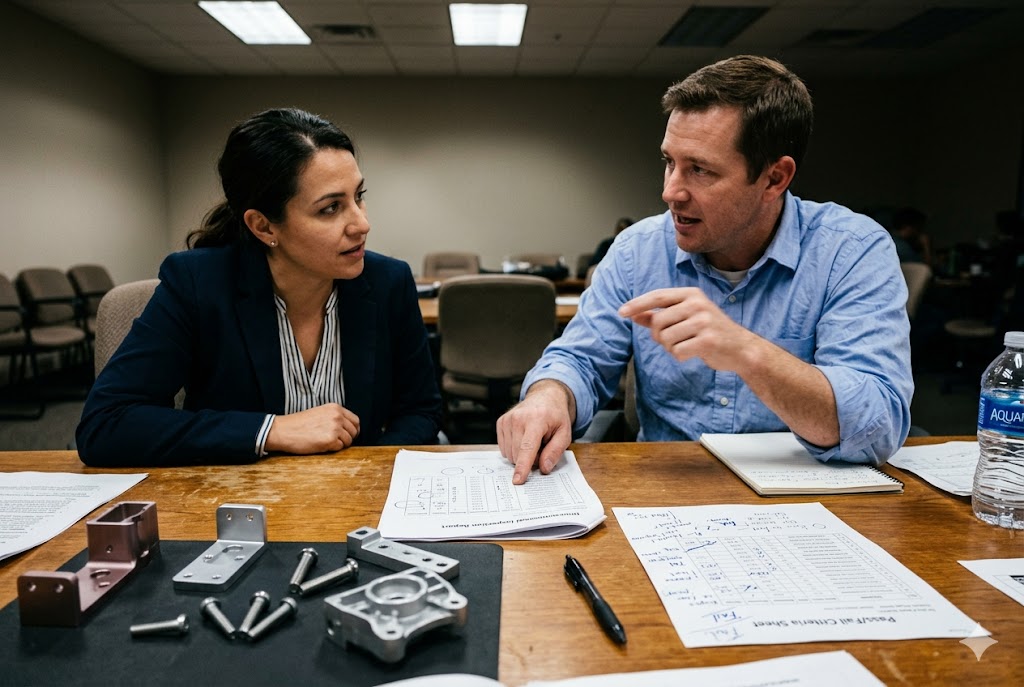
Define Pass/Fail Before the Trial
Every T1 finding needs a pre-agreed classification. Without one, every defect becomes a negotiation. After the tooling deposit has been paid, your leverage to require rework is reduced if there is no written standard to point to.
A workable three-tier classification:
| Finding Type | Example | Required Action |
|---|---|---|
| Critical — stop, rework required | Short shot, cold shut, large porosity on critical surface, gross dimensional miss (>0.5mm on critical feature) | Tool modification required before T2 |
| Major — document, correction plan required | Dimensional deviation within 0.3mm on non-critical feature, minor sink mark on non-appearance surface | Correction plan and timeline required; T2 confirmation needed |
| Minor — acceptable at T1, monitor | Parting line witness mark on unspecified surface, ejector pin witness within agreed limit | Noted in FAI report, no action required before T2 |
Agree on the FAI Package Format
Specify in advance exactly what documentation you expect with T1 samples. Chinese suppliers who understand a complete first article inspection 6 package is required before payment of the tooling milestone run more disciplined trials.
A complete T1 FAI package should include:
- Dimensional report covering all drawing dimensions, with actual measurements and pass/fail status
- Photographs of each sample showing all four sides and any cosmetic concerns
- Process parameter sheet for each retained shot
- X-ray or CT scan report if internal integrity is a requirement
- Written list of open issues identified by the supplier
Real-Time Trial Visibility
For most buyers importing from China, attending every mold trial in person is not practical. Establish — before the trial — that:
- The trial will be video-documented
- A qualified tooling engineer (not a sales contact) will be present throughout
- Live photos or video will be shared during the trial via WeChat or an agreed channel
This gives you early warning of fill problems, surface issues, or mechanical trouble in real time, not a polished presentation of selected results three days later.
Sample Shipment Specification
T1 samples from China need commercial invoice, packing list, and in some cases an MSDS to clear customs without delay. Agree before the trial:
- Shipment method (air express is standard for T1 samples)
- Who bears freight cost
- Packaging specification — foam-lined rigid case with individual part nesting is the standard
Die cast aluminum samples are robust, but thin walls, long unsupported bosses, and machined datum faces can be damaged in a cardboard box during transit. A false dimensional failure on arrival wastes inspection time and delays your approval decision.
What Expectations Should I Align Before My Supplier Starts Mold Testing?
Before mold testing begins, alignment is not about trust — it is about removing the conditions that produce bad outcomes. In our experience coordinating tooling programs between Chinese suppliers and North American buyers, most T1 failures trace back to an expectation that was never stated, not a capability that was missing.
Before mold testing starts, align on design freeze confirmation, alloy certification, machine assignment, dry-cycle verification, warm-up procedure, process parameter recording, T1 pass/fail classification, FAI package scope, sample shipment logistics, and real-time communication protocol. Every one of these must be confirmed in writing.
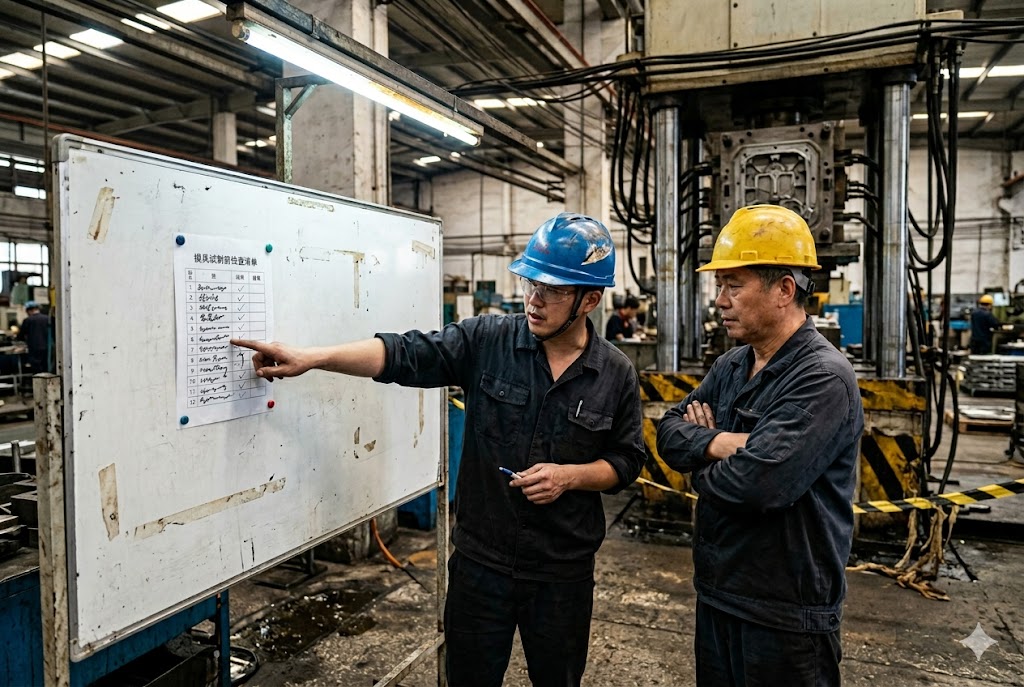
The Full Pre-Trial Alignment Checklist
Use this as your working document. Each item should have a written response from your supplier before you confirm the trial date.
| Item | What to Confirm | Format |
|---|---|---|
| Design freeze | Final tooling design approved, revision number referenced | Signed design approval email |
| Alloy certification | MTR or spectrometer certificate for the specific trial batch | Certificate document |
| Machine assignment | Model number, tonnage, shot sleeve diameter | Written confirmation |
| Fill ratio check | Shot sleeve fill ratio within 40–60% for aluminum cold-chamber | Calculation from supplier |
| Dry-cycle verification | Completed before trial date, all mechanisms checked | Written confirmation |
| Warm-up procedure | First 20–30 shots discarded, samples from stabilised process only | Agreed trial protocol |
| Process parameter recording | Shot-by-shot record for all retained samples | Agreed parameter sheet template |
| T1 pass/fail criteria | Three-tier classification agreed for each defect type | Written before trial |
| FAI package scope | Full dimensional report, photos, parameter sheets, open issues list | Agreed format document |
| Sample quantity | Minimum 10 consecutive stabilised shots retained | Written trial plan |
| Shipment method | Air express, foam-lined rigid case, agreed freight terms | Written logistics plan |
| Real-time communication | Video documentation, engineer present, live updates via agreed channel | Written protocol |
Why Written Confirmation Is Non-Negotiable
Verbal agreements with Chinese suppliers — even with suppliers you have worked with for years — are routinely forgotten under schedule pressure. A trial is rescheduled, a different engineer is assigned, or the sales contact who confirmed the expectation is not on the floor during the run.
Written confirmation does two things. First, it creates a record both parties can reference on the day of the trial. Second, it signals to the supplier that you run a disciplined program and that gaps will be noticed. This changes behaviour before the trial, not after.
The Cost of Not Aligning
A misaligned T1 trial has direct costs:
- Machine time wasted on a trial that cannot produce valid data
- Tool rework triggered by machine mismatch rather than tooling problems
- Program delay of four to eight weeks while rework and T2 are scheduled
- Dimensional data from the wrong alloy, requiring the trial to be repeated
It also has indirect costs: eroded confidence in the supplier relationship, re-negotiation of tooling payment milestones, and delay to your customer's production schedule.
A pre-trial alignment checklist, completed in writing, costs one hour of correspondence. The problems it prevents cost weeks and thousands of dollars. The H13 tool steel 7 specification for cavity inserts, the process capability study 8 framework for production approval, and the coordinate measuring machine 9 methodology for dimensional verification all rely on a foundation of properly documented and disciplined trial data — which only exists when you have aligned expectations before the mold opens. Suppliers who understand that buyers follow a structured first article inspection 10 process consistently produce better trial documentation and more disciplined results.
Conclusion
Confirming ten specific items in writing before your first mold trial eliminates the conditions that cause most T1 failures on China-sourced die casting programs. Design freeze, alloy certification, machine assignment, and a pre-agreed inspection plan are not optional — they are the foundation of a valid trial.
Footnotes
1. Overview of the die casting process: how molten metal is forced under high pressure into a mold cavity. ↩︎
2. How CMM inspection works and why it provides objective, repeatable dimensional verification. ↩︎
3. Introduction to GD&T symbols and how they communicate design intent on engineering drawings. ↩︎
4. Composition, mechanical properties, and casting characteristics of A380.0 aluminum alloy. ↩︎
5. Properties, chemistry, and casting performance data for Zamak 3 zinc die casting alloy. ↩︎
6. What first article inspection (FAI) is and how the AS9102 standard structures documentation requirements. ↩︎
7. Chemical composition, thermal properties, and die casting applications of H13 chromium hot-work steel. ↩︎
8. Explanation of the Cpk process capability index and how it measures production conformance to specifications. ↩︎
9. Detailed guide to CMM inspection in die casting and metal molding quality control workflows. ↩︎
10. How AI tools and structured workflows are used to streamline AS9102 first article inspection. ↩︎